Amazon loses your stuff. Then it makes YOU file the paperwork to get paid back.
Read that again. The warehouse loses your inventory, and the money only comes back if you chase it. Last month I reconciled a shipment from April: 300 units sent, 291 received, 9 missing. Amazon auto-reimbursed 5. The other 4? Gone forever if I hadn't filed an Amazon FBA reimbursement claim myself.
Here's the part that should bother you: the full claim process has five steps — spot it, reconcile, open a case, follow up, confirm payment. Sellers drop off at every single step. Fewer than one in ten actually finish. Everything below is stuff I did myself, with real numbers.
The Uncomfortable Truth: Auto-Reimbursement Only Covers What Amazon Finds
Since January 2025, Amazon proactively reimburses units its fulfillment centers report as lost. Sounds generous. Here's the catch: it only covers what Amazon itself flags.
Inbound shipment receiving gaps, customer returns that never make it back to stock, removal orders lost in transit — those are almost all on you to claim manually. And the window got brutal: in late 2024, Amazon slashed the claim window from 18 months to 60 days. The clock starts when Amazon marks the item lost or damaged, not when you notice it. Miss the deadline and the money simply evaporates. No extensions, no appeals.
That's my first counter-intuitive take: if you don't file an Amazon FBA reimbursement claim within 60 days, Amazon treats your silence as consent. You assume "they'll reimburse automatically." They reimburse the part they feel like reimbursing. The rest never happened, as far as they're concerned.
What You Can Actually Claim: Four Buckets
| Loss type | Claim window | Auto or manual? |
|---|---|---|
| Lost/damaged in the fulfillment center | 60 days from Amazon's reported date | Partly automatic; open a case for the rest |
| Customer return never restocked | 45–105 days after the refund/replacement date | Mostly manual |
| Removal order lost in transit | 15–75 days from the removal order creation date | Manual |
| Inbound shipment receiving discrepancy | Reconcile as soon as the shipment closes | Manual |
(Windows change — always confirm the latest policy in Seller Central before you act. Amazon rewrites these rules regularly.)
One more 2025 change that stings: since March 2025, pre-order losses are reimbursed at manufacturing cost, not sale price. Your $29.99 item might get reimbursed at your sourcing cost instead. There's a "Manage Your Manufacturing Cost" portal buried in Seller Central — the more accurate your cost data, the closer the payout lands to your real loss. Most sellers I know never filled it in. That's a voluntary discount.
My 5-Step Amazon FBA Reimbursement Claim Process
Case one. April 2025: I sent 300 units of a kitchen organizer to a US fulfillment center. Once the shipment flipped to "Closed," I counted: 291 received, 9 short. Two weeks later, 5 units appeared as auto-reimbursed in my reports. The other 4? Radio silence.
Here's exactly what I did.
Step 1: Check the Reimbursements report every two weeks. Seller Central → Reports → Fulfillment → Reimbursements. This single habit matters more than any trick. Lost units don't announce themselves.
Step 2: Reconcile line by line. Export the report and match it against your inbound records, SKU by SKU. I do it the dumb way: spreadsheet, one row per SKU. My catalog is around 300 SKUs; it takes 30 minutes.
Step 3: Open a case. Help → Contact Us → FBA issue. Paste the shipment ID, SKU, missing quantity, and your proof of delivery. The evidence chain is everything: carrier proof of delivery, packing list photos. My first case ever got bounced because I forgot the signed delivery receipt — cost me three days for nothing.
Step 4: Follow up. Opening the case isn't the finish line. The first reply is almost always a template. Don't flinch — keep pushing, add evidence, and most of my cases resolve within one to two weeks.
Step 5: Confirm the money actually lands. Only when the reimbursement line shows in the report and the amount hits your account balance is it done. Those 4 units landed on day 12. Paid at manufacturing cost — less per unit than I'd hoped, but infinitely more than zero.
Case two still annoys me. Peak season 2025: one SKU had an unusually high return rate, and in October I found 6 returned units marked "refund issued" that never came back into inventory. Returns like these are almost never auto-reimbursed — all manual. I opened two cases and recovered 5 units. The sixth? Expired. I was still thinking in 18-month terms; under the new 60-day rule, it was already dead on arrival.
Lesson burned in: reconciliation went from "whenever I remember" to "every two weeks, no exceptions." With a 60-day window, dragging your feet for a month burns half your runway.
The Math: Is This Worth Your Time?
My store does roughly $80K a month. My FBA loss rate hovers between 0.5% and 1% — that's $5,000 to $8,000 a year in vanished inventory value.
Auto-reimbursement catches roughly half. The manual half? I recovered $3,200+ in 2025. Each reconciliation takes 30 minutes, twice a month — 12 hours a year. $3,200 divided by 12 hours is about $267 an hour.
Another way to look at it: my store averages around $2,600 in daily sales, so $3,200 is more than a full day of revenue — recovered for free. And in inventory terms, at my average sourcing cost, that's two extra rounds of small-batch test orders funded. Before peak season, those two extra rounds are the difference between staying in stock and going dark for a week.
You tell me if that's worth 30 minutes every two weeks.

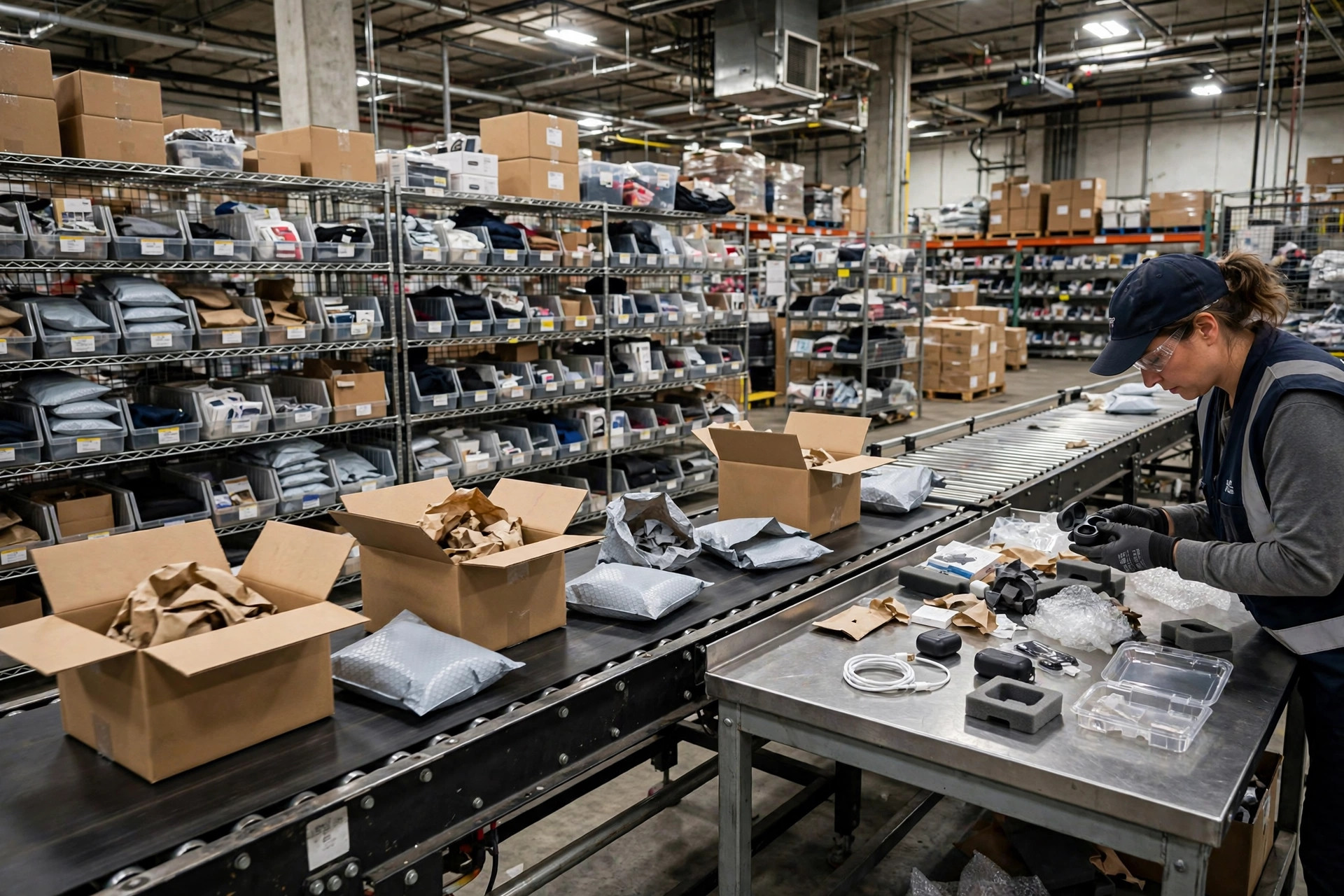
Keep this image in mind: your products sit on racks like these, and when a few units vanish, no alarm goes off in any system. The only person counting is you.
Four Traps That Kill Your Amazon FBA Reimbursement Claim
Trap 1: No evidence. No pack-out photos, no signed delivery receipts — your case is your word against theirs, and you'll lose. I now keep a folder per shipment: packing list plus carrier proof of delivery, pasted straight into every case.
Trap 2: Missing the window. The 60 days start when Amazon flags the loss, not when you discover it. By the time you notice, 40 days might already be gone, leaving you 20 days to act. Fixed cadence beats motivation.
Trap 3: Blank manufacturing cost. Since March 2025, payouts use your manufacturing cost. Leave that portal empty and Amazon estimates it — and its estimate won't be generous. The portal is buried, but filling it in is real money.
Trap 4: Assuming auto-reimbursement covers everything. It handles exactly one scenario: fulfillment-center-reported losses. Return losses, inbound gaps, and removal losses are all manual. Trusting full automation means donating half your money to Amazon.
Bottom line: an Amazon FBA reimbursement claim is a habit problem, not a knowledge problem. Thirty minutes every two weeks — reconcile, file the cases you owe yourself. Amazon won't volunteer every dollar, but it won't stiff you on a properly filed claim either. This one I've tested myself, and it's been paying for extra inventory rounds all year.
By Ah K, E-commerce Seller (5 yrs)