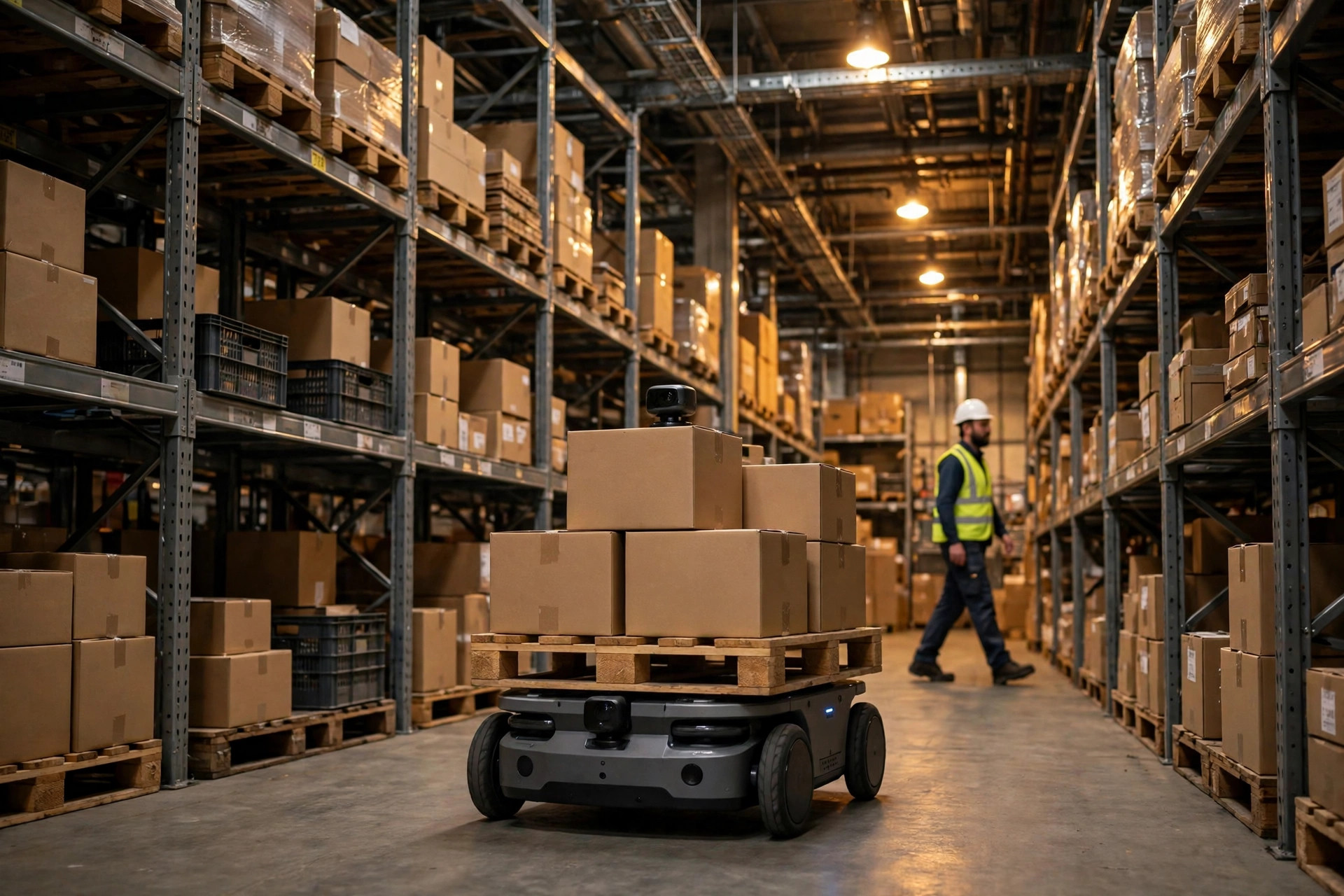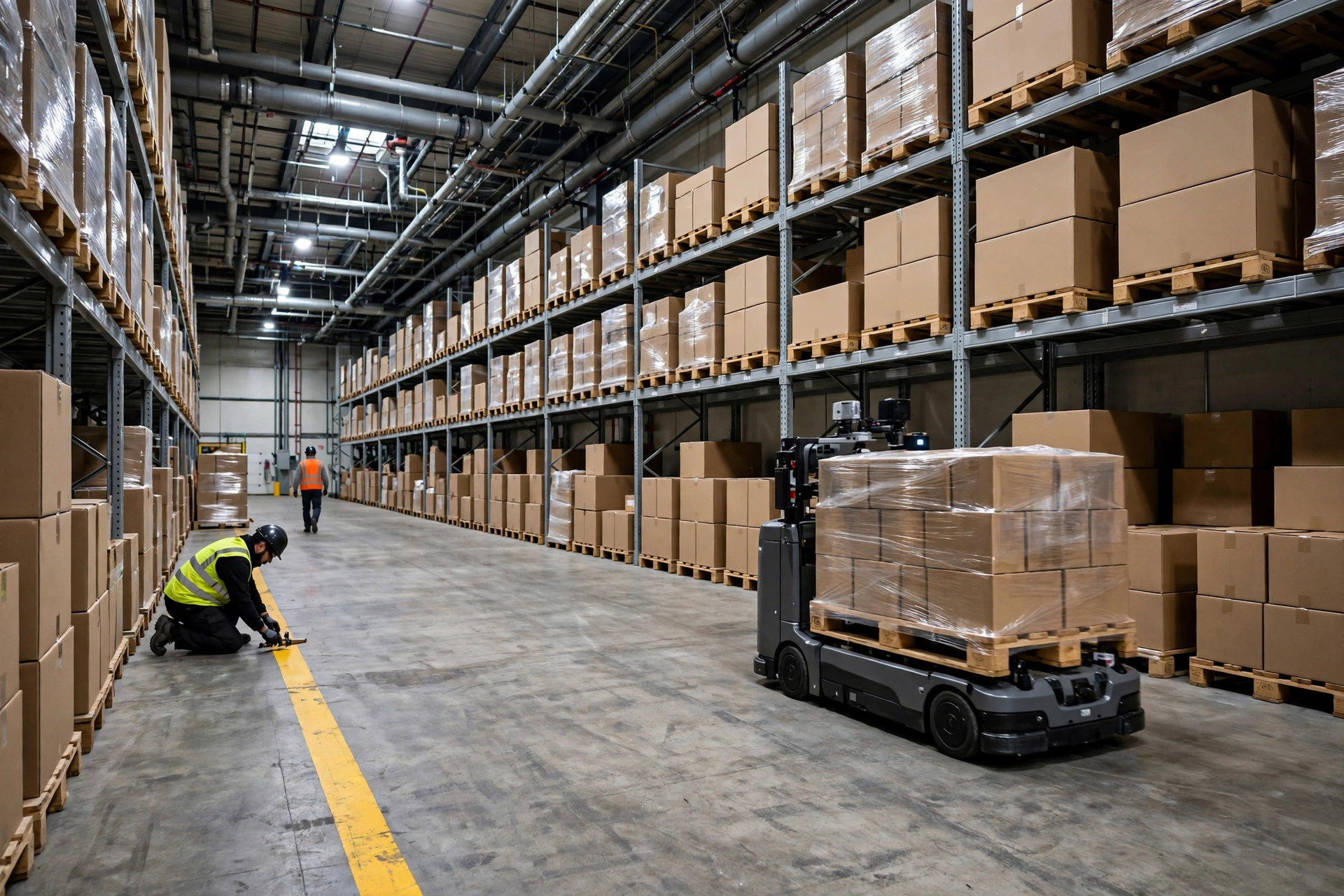
We had a client, a contract manufacturer of small home appliances in Dongguan, who learned about the AGV safety zone the expensive way. His warehouse was not large, a little over two thousand square meters, with picking and shipping squeezed onto one main aisle. In the autumn of 2024 he put in three AGVs to haul finished-goods pallets from the production line to the shipping area, and his comment to me was blunt: getting the vehicles to run was the easy part; the hard part was people and vehicles sharing the same aisle all day without anyone getting hurt. The vendor's drawings showed neat yellow lines and signs. In the first week of go-live, the AGVs stopped seventeen times. Nobody was hit; the vehicles simply braked every time a shadow moved, and the whole line waited. Workers soon learned to hug the walls and take detours, and throughput ended up lower than before the AGVs arrived. The client was ready to send the vehicles back, and the vendor shrugged: the zones were drawn to the layout the client had approved, and no one had been hit, so the job was done. How that standoff got resolved is the part vendors rarely volunteer.
The AGV Safety Zone Is Two Zones, Not One Line
Most buyers think a safety zone is the yellow line on the floor: the vehicle stops inside the line, people stay outside it. That is not how it works. What actually protects people is a pair of invisible scan fields. The first is a warning field. When an AGV detects a person or an obstacle inside it, the vehicle slows down, lights up, and sounds a warning, which is its way of saying, I am coming through, watch out. The second is a protective field, smaller and much less forgiving: the moment someone steps into it, the vehicle must stop dead, no discussion. That is what an AGV safety zone really is, two fields doing two different jobs. Our Dongguan client got into trouble because his vendor, to save a round of tuning, had set both fields to the same boundary. A person entering the warning field triggered a full stop, seventeen times in a week, all of them false.
The fix was unglamorous. Widen the warning field so the AGV has time to slow down gracefully, and tighten the protective field to just the space the vehicle genuinely needs to stop. In the first week after the retune, false stops fell from seventeen to three, and workers stopped hugging the walls. Why had the vendor not set it that way to begin with? Because separating the two fields takes several rounds of testing: stopping distance changes with load, with floor friction, with a full pallet versus an empty one, and each round costs half a day of engineering time. If the contract does not spell out tuning against a fully loaded test run, the vendor has every incentive to hand over a one-shot setup. The lesson here is plain: a safety zone is not drawn, it is measured, and it has to be measured under the heaviest pallet the vehicle will ever carry.
| Field | What it does | If it is set too large | If it is set too small |
|---|---|---|---|
| Warning field | Slows the AGV and warns people early | The vehicle creeps along and the takt time slips | People get too little warning before the vehicle is on them |
| Protective field | Stops the vehicle the moment someone enters | Every stray shadow halts the whole line | There is not enough margin left to stop safely |
Faster Vehicles Need Bigger Safety Zones, and That Bill Lands in Your Quote
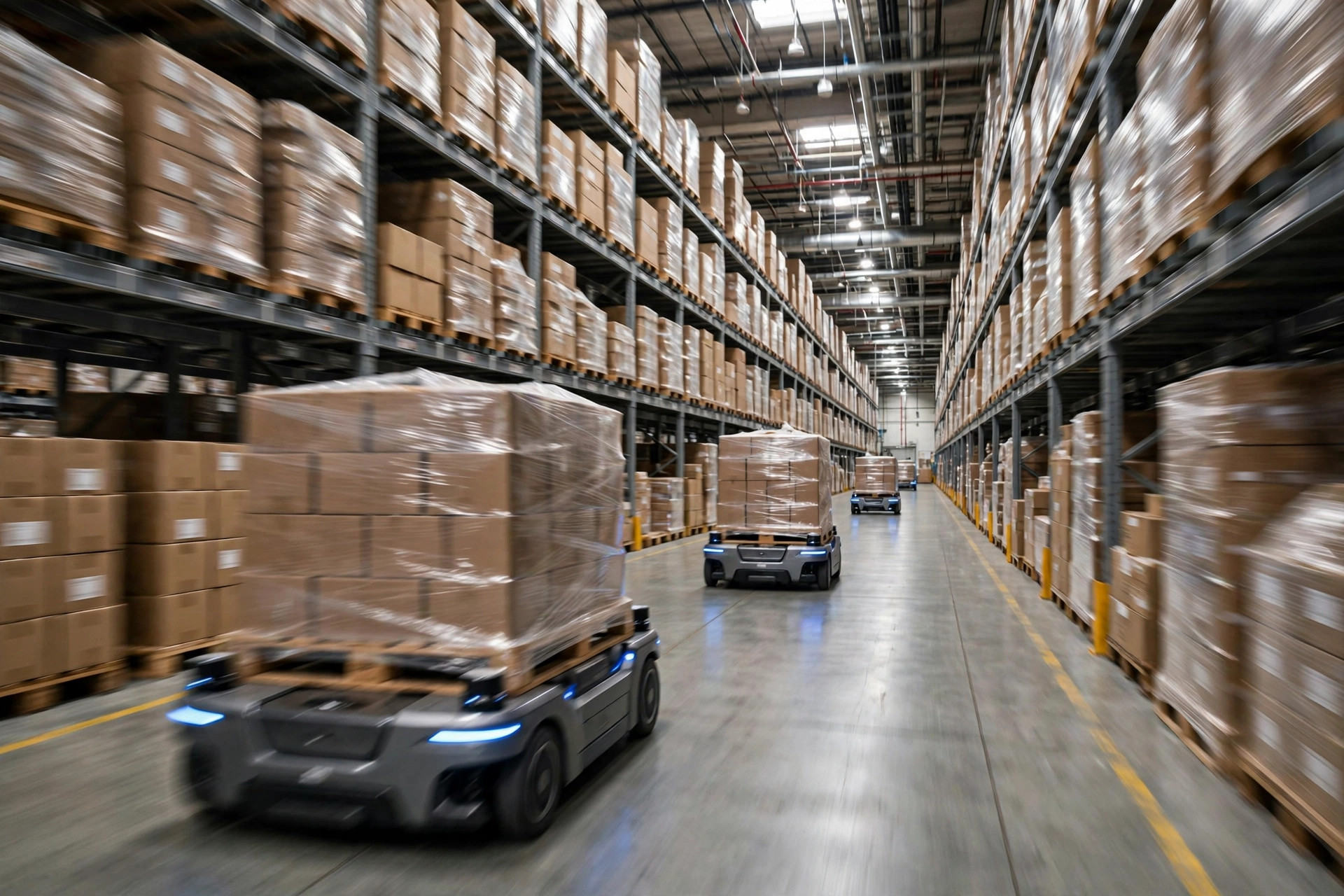
Here is the counterintuitive part: a faster AGV does not always save money. Push the speed up and the scan fields have to grow with it, or the vehicle cannot stop in time. Grow the fields and fewer people and vehicles can share the aisle at once, so the takt time goes the wrong way. We saw this with a client in Zhongshan who, in early 2025, insisted on top speed because fast felt like efficient. His main aisle ended up with a warning field so wide that pickers had to wait for each AGV to pass before stepping into a bay, and a shift came out forty minutes longer. Dropping the speed one notch, and shrinking the fields to match, brought output back up.
So when you talk speed, do not just ask how fast it can go. Ask what the warning and protective fields measure at that speed, what the stopping distance is under full load, and how many people can still use the aisle at the same time. Ask those three things and a vendor can no longer sell you top speed as a pure win. Too many false stops carry a hidden cost no quote shows: workers stop trusting the system, detour around it, and treat the AGV as an obstacle. Slowing down a notch buys back their willingness to cooperate.
Crossings, Charging Bays, and Handover Points Are Where It Actually Goes Wrong
Straight aisles are rarely the problem; the real danger sits at the points where their paths cross. The first is the aisle intersection. An AGV turning out from between racking cannot see around the corner, and a worker coming from the other side cannot see it either. The fix is old-fashioned: mirrors on the corner and a floor bump forcing the AGV to slow before the turn. The second is the charging bay. AGVs return to charge on fixed routes, and workers love cutting through the charging area as a shortcut. The vehicle is looking down at its dock, the worker is looking down at a pick ticket, and neither sees the other. Charging bays need a physical barrier, even at the cost of a dozen extra steps for workers. The third is the handover point, where the AGV drops a pallet at a conveyor and a worker steps in to scan, label, and pull product. People and vehicles trade the same square meter over and over, so the rule has to be absolute: the vehicle has not stopped and the light has not turned green, hands stay off; the worker has not stepped clear, the vehicle does not move. A rule in the work instruction beats a painted line, which goes invisible after a thousand walk-pasts.
Don't Just Test That It Runs, Test That It Stops Right
On acceptance day, most buyers watch the AGV run smoothly and the pallet arrive on time, and call that a pass. That only tests half the system. What you really need to test is whether it stops right. We tell clients to run at least four scenarios before signing. One, a worker walks normally along the edge of the warning field, and the vehicle should slow, not slam to a halt. Two, a worker steps suddenly out from behind racking into the protective field, and the vehicle must stop and must not creep forward again on its own. Three, a fully loaded AGV stops on a slope, and you watch whether it rolls before it settles. Four, three people cross one after another, and you see whether the vehicle waits steadily or stutters and drags the takt time down. Run each scenario twice, once empty and once fully loaded, and write the numbers into the acceptance sheet. If false stops are still high, do not blame workers first. Ask whether the field boundaries were measured in your warehouse or copied from another project's drawings; copied drawings are the ones that come back for rework.
Sharing a floor with AGVs is not really a contest of vehicle technology. It is a contest of how carefully the rules are written. Set the fields sensibly and workers treat the vehicle as a colleague; set them with a single crude boundary and it becomes a nuisance, and the most expensive automation in the building quietly stops earning its keep.
Next time you negotiate a contract, ask these three questions: were the warning and protective fields set from fully loaded measurements in our warehouse, or copied from a generic drawing? Are speed, field size, and false-stop counts written into the acceptance criteria? Do the crossings, the charging bay, and the handover points each have their own protection plan and their own test scenarios? Ask those three out loud and the vague parts of the proposal will suddenly get a lot more specific.
By Susan, 3PL Sales Director