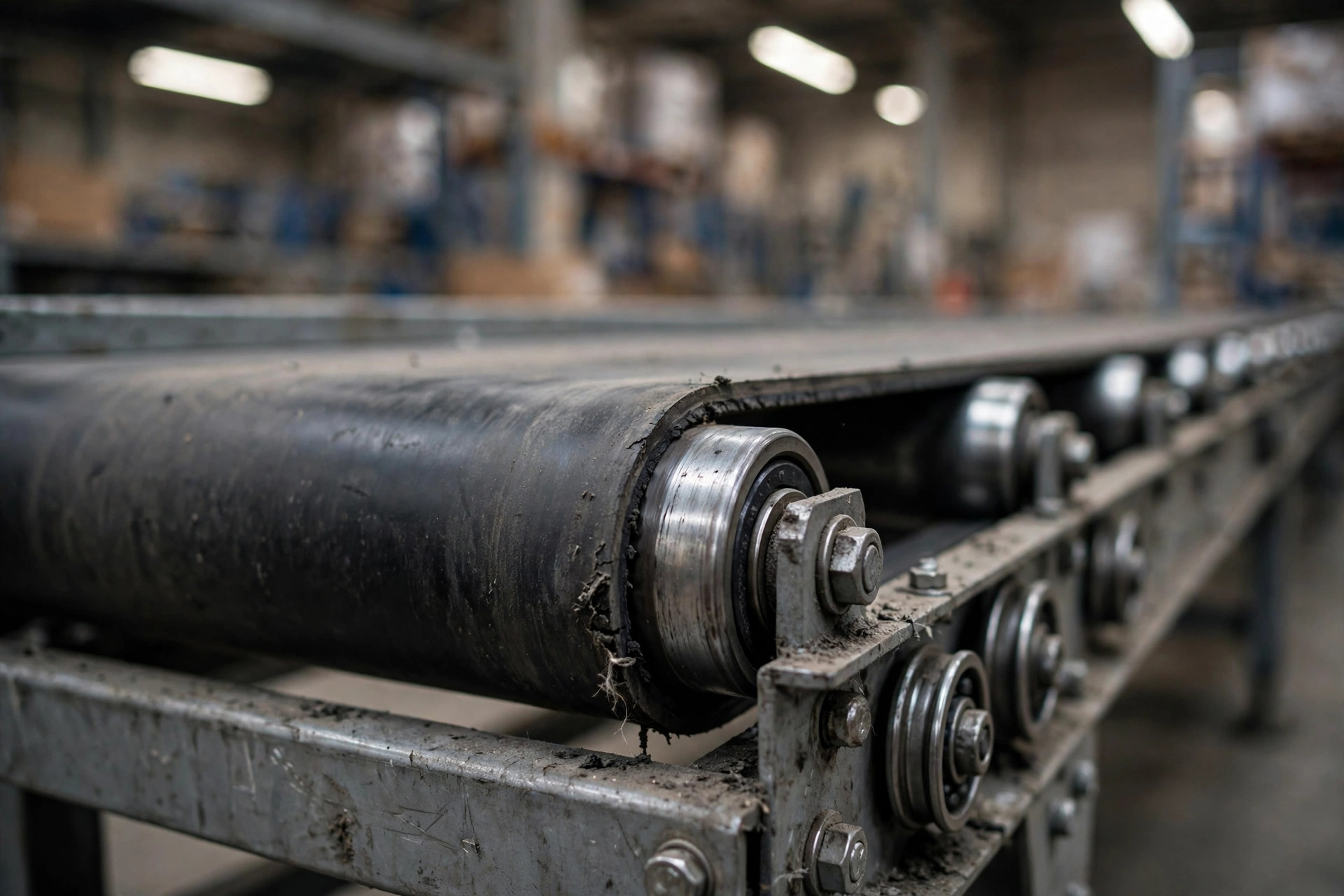
A belt that drifts a finger's width to one side does not look like an emergency. That is exactly why conveyor belt tracking alignment warehouse work gets postponed until the edge frays, a roller seizes, and a line stops in the middle of a shift. I have watched this movie too many times: the drift is treated as a five-minute adjustment, the root cause is never fixed, and the belt pays for it. The expensive failure is rarely the dramatic one. It is the slow grind that nobody logs.
In November 2023, just before peak season, I walked a 3C accessories warehouse in Dongguan where a sortation line had been drifting right for weeks. The offset was small enough that the team kept running. Within two weeks the belt edge started fraying and a roller under the scan zone had a groove worn into it. Operators blew debris off the belt at the end of every shift and called it maintenance. Less than a month later the edge tore, the line stopped for over two hours, and orders were sorted by hand to catch up. The bill was not just a new belt. It was the belt, the rollers and bearings that failed with it, and the overtime to clear the backlog. Two weeks earlier, half a day of proper alignment work would have cost a fraction of that.
Why a Belt Refuses to Run Straight
Think of a belt as a long sheet running over rollers: if the forces on it are uneven anywhere, it slides toward the side with less resistance. In my experience three causes cover most cases. First, off-center loading: product drops onto one side of the belt shift after shift, and the belt is pushed sideways thousands of times a day. Second, rollers or pulleys that are not square: an installation error too small to see with the eye still steers the belt steadily to one side. Third, uneven tension: one side pulls harder than the other, so the belt walks toward the slack side.
A fourth cause gets missed because nobody wants to check it: a crooked belt splice. If the joint itself is not square, the belt is born crooked, and no amount of roller adjustment will fix it. My first check on site is always the same: run the line empty and watch. If it drifts empty, the problem is usually in the equipment or the installation. If it only drifts under load, the problem is usually in loading or load distribution. That one distinction saves about half the pointless adjusting I see in the field.
Tracking Alignment Fixes: Adjust in This Order
I adjust in a fixed order, easiest first, and I do not touch the big components until the small ones are ruled out. Start with the loading point. Check whether the chute and guide are centered and whether product actually lands in the middle of the belt. A surprising number of drift problems end here, because a guide knocked out of position by a forklift or a tote keeps feeding the belt off-center all day.
Next, check the idler sets. Pull a straightedge and a level over a sample of idlers and look for any that are skewed or seized. A seized idler is effectively a brake pad under the belt, and the belt will run away from it. Only then touch tension, and adjust both sides together, a little at a time, running the belt between adjustments. Adjusting one side only is the classic way to make things worse: the tight side gets tighter, the slack side gets relatively slacker, and the drift flips direction. Then the team chases it back and forth all afternoon. Confirm under load, not just empty, because a belt that tracks empty and drifts loaded still has an unresolved loading problem. Good conveyor belt tracking alignment warehouse practice is never one adjustment and done; it is adjust, run, observe, and fine-tune.
Idlers and Tension: The Two Bills People Get Wrong
Idlers are where buyers fool themselves on unit price. A cheap idler with higher rolling resistance and a shorter bearing life gets replaced more often, and every replacement costs a stoppage plus labor. I have run the numbers for a line with dozens of idler sets: the per-unit saving looks small, but two extra replacement rounds in a year, plus the stops to do them, quickly exceed the price difference of buying better idlers. Do not take lifespan claims on trust; check the warranty terms and the actual service history in comparable warehouses, and treat anything without a manufacturer specification as unverified. That discipline is part of conveyor belt tracking alignment warehouse work, not paperwork for its own sake: the idler you buy today decides how many stops you pay for next year.
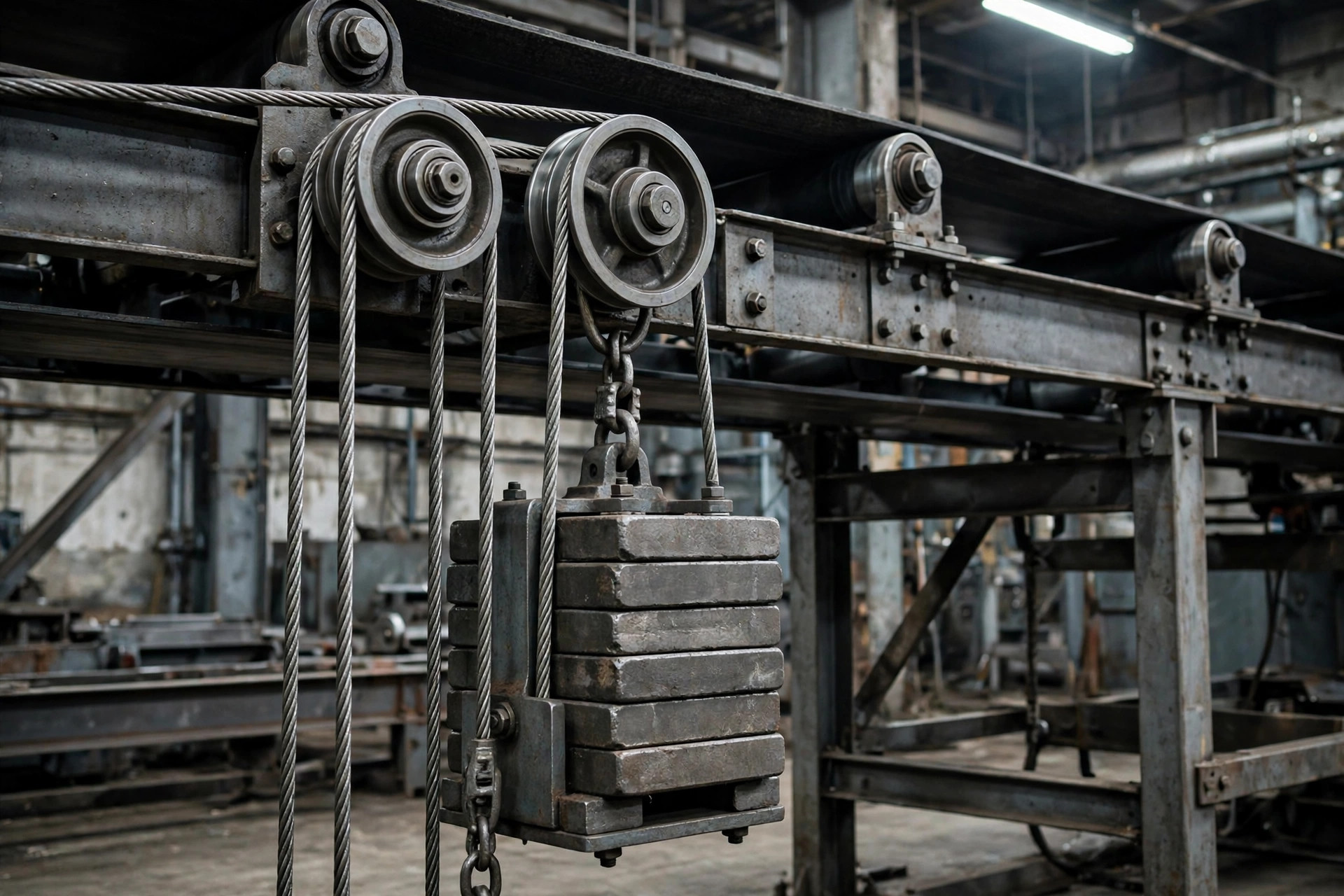
Tension is the sneakier bill. Too tight, and the belt, bearings, and motor all work harder, so energy use and wear climb together. Too loose, and the belt slips, drifts, and wrinkles, which also eats the edge. The line is not a matter of feel; it is the tension range in the manufacturer's specification, checked against what you see on site: slippage at the drive pulley, and how much the drift changes between empty and loaded running. Any tension outside the manufacturer's specification is borrowing against belt life, no matter how long the site has "always run it that way."
| Option | Cost level | When it fits | Biggest trap |
|---|---|---|---|
| Adjust idlers and guides | Half a day of labor | Drift just appeared, edge not yet damaged | Adjusting tension on one side only |
| Replace a batch of idlers | Idler purchase price, per manufacturer quotation | Seized idlers or clearly rising rolling resistance | Replacing only the failed few, mixing old and new loads unevenly |
| Add automatic belt tracking | Equipment purchase plus installation and commissioning | Long lines, multiple curves, inspection cannot keep up | Using it to hide uneven tension while the root cause worsens |
| Replace the whole belt | Full belt plus stoppage cost | Edge torn or splice already crooked | Skipping the root-cause check, so the new belt wears the same way |
Is Automatic Tracking Worth Buying? Check This One Number
In the summer of 2024, a cold-storage warehouse changed my mind about automatic correction. One line in the cold section drifted constantly, the team adjusted it twice a week, and the belt edge still wore thin within months. They added tracking units at the critical sections, the drift stayed within a small range, and belt life improved noticeably. Here is the counterintuitive part: an automatic tracker is not a cure for misalignment. It is a backstop for drift you cannot otherwise control. If tension is uneven and loading is off-center, the tracker just keeps pushing the belt back while rollers and edges keep wearing. You have bought an automated way to hide the problem.
So the dividing line is simple. On a short line, with a known cause and inspections that actually happen, do not buy it; fix the root cause instead. On a long line, with many curves, or where the root cause cannot be fixed quickly because the loading point is constrained by upstream equipment, a tracker earns its place. Before buying, run one comparison, the standard conveyor belt tracking alignment warehouse test: the total cost of drift over the past year, meaning stoppages, belt replacements, and idler and bearing replacements, against the purchase plus maintenance cost of the tracker. If the first number is bigger, buy it. If not, get the basics right first. That one number tells you whether the money is worth spending.
By Da Liu, Automation Engineer