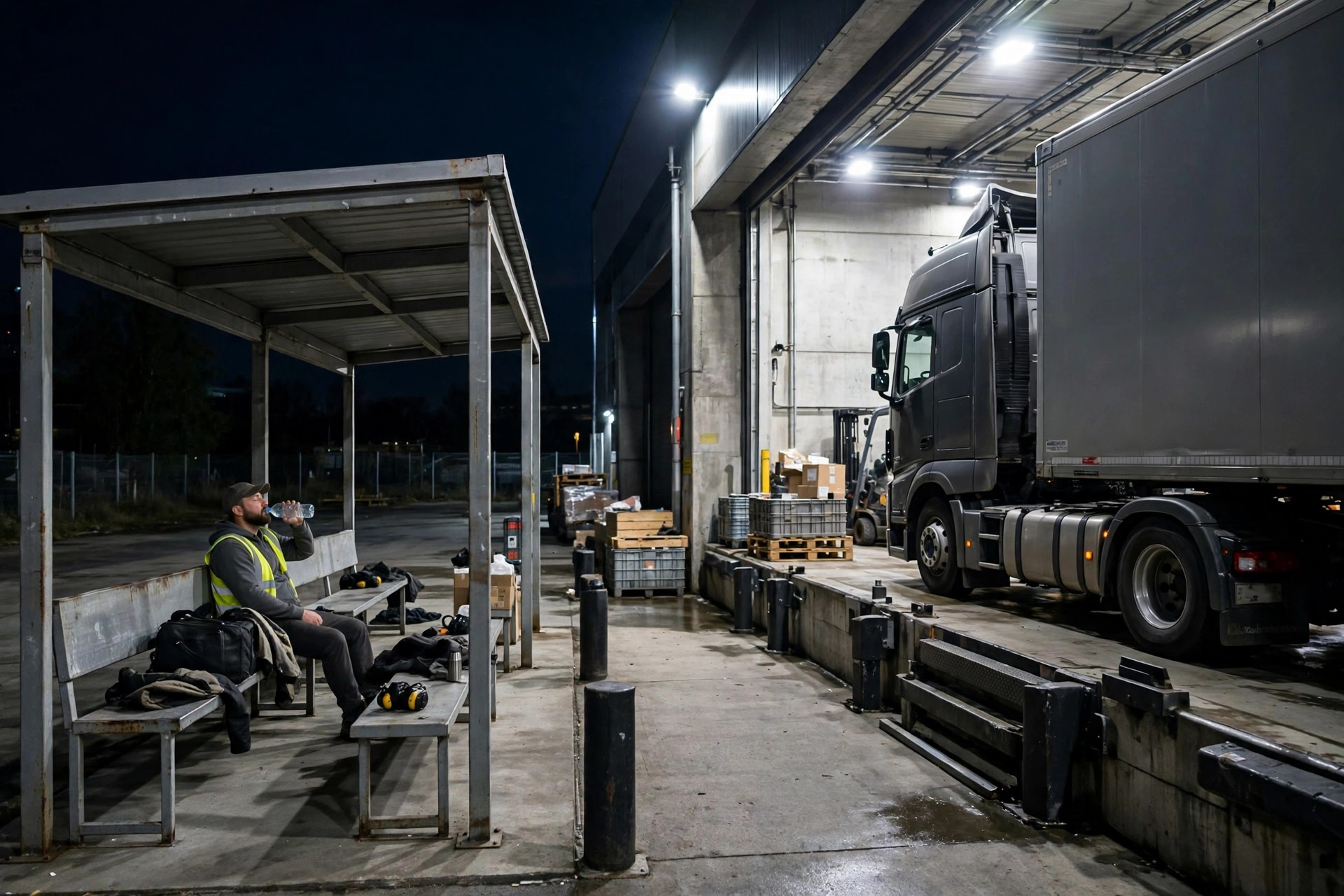
Driver fatigue management used to sound like someone else's problem to me. The driver works for the carrier, so tired or not is their boss's problem, right? I was dead wrong. Last peak season, a night-shift truck scraped our dock door while backing in, and the driver climbed out with bloodshot eyes, barely able to string a sentence together. That was the moment it clicked: the truck drove to my warehouse, and the risk lands on my load and my yard in the end.
Let's Be Blunt: Driver Fatigue Management Is a Warehouse Problem, Not Just a Driver's Problem
Here is how a lot of warehouses work: the appointment window is rigid, and if a driver shows up fifteen minutes late, they go to the back of the line. So drivers push through the night to avoid losing their slot. When the truck arrives, the warehouse rushes them, as if the driver should jump on a forklift and help unload. In the yard, the speed limit sign exists, but nobody enforces it, and people and forklifts share the same lanes. There is nowhere for a driver to sit down and drink some water, so they just wait it out in the cab.
That is how fatigue stacks up, layer by layer. A driver runs all night, then has to stay sharp waiting, stay sharp backing in, and stay sharp moving around a yard where people and machines mix. The most dangerous moment is often not the highway stretch. It is the last half hour at the destination, right when the driver starts to relax. When something goes wrong, the cargo damage, the lost hours, and the finger-pointing all land on the receiver too. Blaming the carrier after the fact is too late.
One Tuesday last November, at around one in the morning, a truck from an inland warehouse pulled up to our gate. The driver told me he had only napped twenty minutes at a highway rest stop because he was afraid of missing our two o'clock window. Our dock was already full, and by the old rules he would have waited two more hours. I sent him to the rest area to sleep for an hour first, and the load went out forty minutes late. Truck and driver came out fine. Since then, I have never again treated being on time as more important than a human being.
How I Do It: Driver Fatigue Management Starts at the Appointment Window
The first thing I changed was the appointment window. Arrive within an hour late and we still take you, no penalty, no back-of-the-line, no attitude. I also stretched the windows themselves and set aside two flexible night slots just for long-haul night arrivals. Do not underestimate that one hour. When drivers know a late arrival will not be punished, they dare to actually sleep at a rest stop instead of gambling on the road with the gas pedal down.
The second change was simple: no rushing arrivals. I put it in writing in our coordination group chat: trucks check in when they arrive, unloading runs in check-in order, and no phone calls to jump the queue. During peak season, salespeople tried to push their loads ahead, and I blocked every one of them. The half hour you gain by rushing a driver is nothing compared with a driver backing up angry and exhausted. That trade never pays.
The third change was drop-and-hook. Wherever we can do it, we do it. The driver arrives, swaps trailers, and leaves in about fifteen minutes instead of burning two or three hours waiting for unloading. Drivers leave early, rest early, and drive their next run safer. In the yard, I separated people from machines with marked lanes, swapped the ignored speed sign for speed bumps and bold floor markings, and set up a real driver rest area: chairs, hot water, phone chargers, and a clean restroom. It cost very little, and drivers remember it.
One more move people overlook: do not surprise drivers with night handoffs. For every night arrival, I send the carrier dispatcher the window, the contact person, and the gate route a day ahead, so the driver knows before departure when to arrive, who to find, and where to park. When a driver already knows the plan, they do not spend the drive calling around for directions, and that takes a real mental load off.
Earlier this year, a driver from a regular carrier arrived in the evening after two runs in one day, looking wiped out. His handwriting on the check-in sheet was crooked. I did not send him straight to the dock. I let him eat something hot in the rest area and sleep for forty minutes, then unloaded. The load went out less than an hour late, and later the driver told his dispatcher that ours was the only warehouse on his route that ever let him sleep. Come peak season, that carrier prioritized our loads first. Tell me that math does not work.
Do the Math: Rushing One Truck 30 Minutes Can Cost You the Whole Load
| Approach | Time saved | What it really costs |
|---|---|---|
| Rush unloading, penalize late arrivals | About 30 minutes | Fatigued driving, dock scrapes, damaged cargo, disputes |
| Flexible windows, no rushing | None, maybe 30 minutes slower | Rested drivers, fewer accidents, less cargo damage |
| Drop-and-hook | About 2 hours of driver waiting | A few extra trailer spots and a handoff routine |
I have run these numbers myself. One scrape means repair bills, lost hours, and back-and-forth arguments, and that bill alone covers months of hot water and electricity for the rest area. If someone actually gets hurt, the profit on the whole load does not cover it. On the other side, flexible windows and drop-and-hook cost visible small money: a few parking spots, one process change. I have taken the other side of that trade before, lost money on it, and never will again.
There is also a hidden cost. Drivers talk. If your warehouse is famous for endless waits, constant rushing, and nowhere to rest, dispatchers will put you last when trucks are tight. During peak season, you will feel that. Flip it around: a warehouse drivers like going to gets its loads covered first. That goodwill, counted over a year, is pure profit.
Red Flags: When You See These Signs, Stop
Fatigue shows, if you look. A driver who suddenly talks slowly, repeats the same question, keeps rubbing their eyes and yawning, hesitates while backing up, or asks about a route you already explained twice is waving a flag. If I see two or more of these, I treat it as fatigue: stop, do not unload, send the driver to rest, and call the carrier dispatcher to reschedule or swap drivers.
I put this process in the contract. Carriers may not send drivers who have exceeded driving limits or are visibly fatigued, with the specific hours rules following the latest FMCSA regulations. If the warehouse spots fatigue signs, we may delay or reschedule, and that delay does not count as a breach by the receiver. Night loads must confirm the driver's rest status in advance. Harsh words up front mean fewer arguments later, because both sides know where the line is.
The easiest trap is politeness. A tired driver will insist they are fine, and the warehouse feels awkward stopping them. Do not fall for it. The most fatigued people are the ones most likely to say they are fine. The other trap is only watching arrivals and ignoring departures. A driver who just unloaded and has red eyes and slurred speech should not be pushed back onto a night road to clear your yard. Let them rest before they leave.
At the end of the day, the warehouse cannot steer the driver's wheel, but it controls its own windows, its own rushing habit, and its own yard rules. Get those three right and most fatigue accidents never get the chance to happen. This one I have personally tested and it works. Try it on your next night arrival, and start with the flexible window.
By Ah K, E-commerce Seller (5 yrs)