September last year, right before peak season, Lao Wang — our most senior picker — went down. His back. The doctor found nothing structurally wrong; the diagnosis was basically "exhausted." I asked him, half joking: how far did you walk yesterday? He pulled out his phone. The step counter said: 21.3 kilometers.
My brain short-circuited. Picker walking distance optimization is the kind of thing big companies solve with software and AMRs. My small warehouse can't burn that kind of money. But 21.3 km staring me in the face — if we didn't fix it, peak season would break people before it broke records.
Here's our situation: a 3,000-square-meter warehouse (about 32,000 sq ft), seven pickers, around four thousand SKUs. I've priced the big-company playbook — voice picking, routing optimization software, AMRs. Every quote ended the same way: me walking out and going back to pushing carts. Not because I look down on the tech. Because we genuinely can't afford it.
But being broke doesn't mean standing still. Walking is exactly where a small warehouse can squeeze out margin. Bartholdi and Hackman worked out the classic math in Warehouse & Distribution Science: order picking eats roughly 55% of warehouse operating costs, and 55% of picking time goes to traveling. In plain English: more than half the money in a warehouse is spent on walking. Industry reports have clocked pickers at upwards of 12 miles (about 19 km) per shift — so our 21.3 km isn't even an outlier.
Before Optimizing Picker Walking Distance, Measure It
Most warehouses jump straight to optimizing. Ask them how far their pickers walk today and the answer is "feels like a lot." Feelings are expensive — they can't drive a single decision. Our methods were crude. The numbers were real.
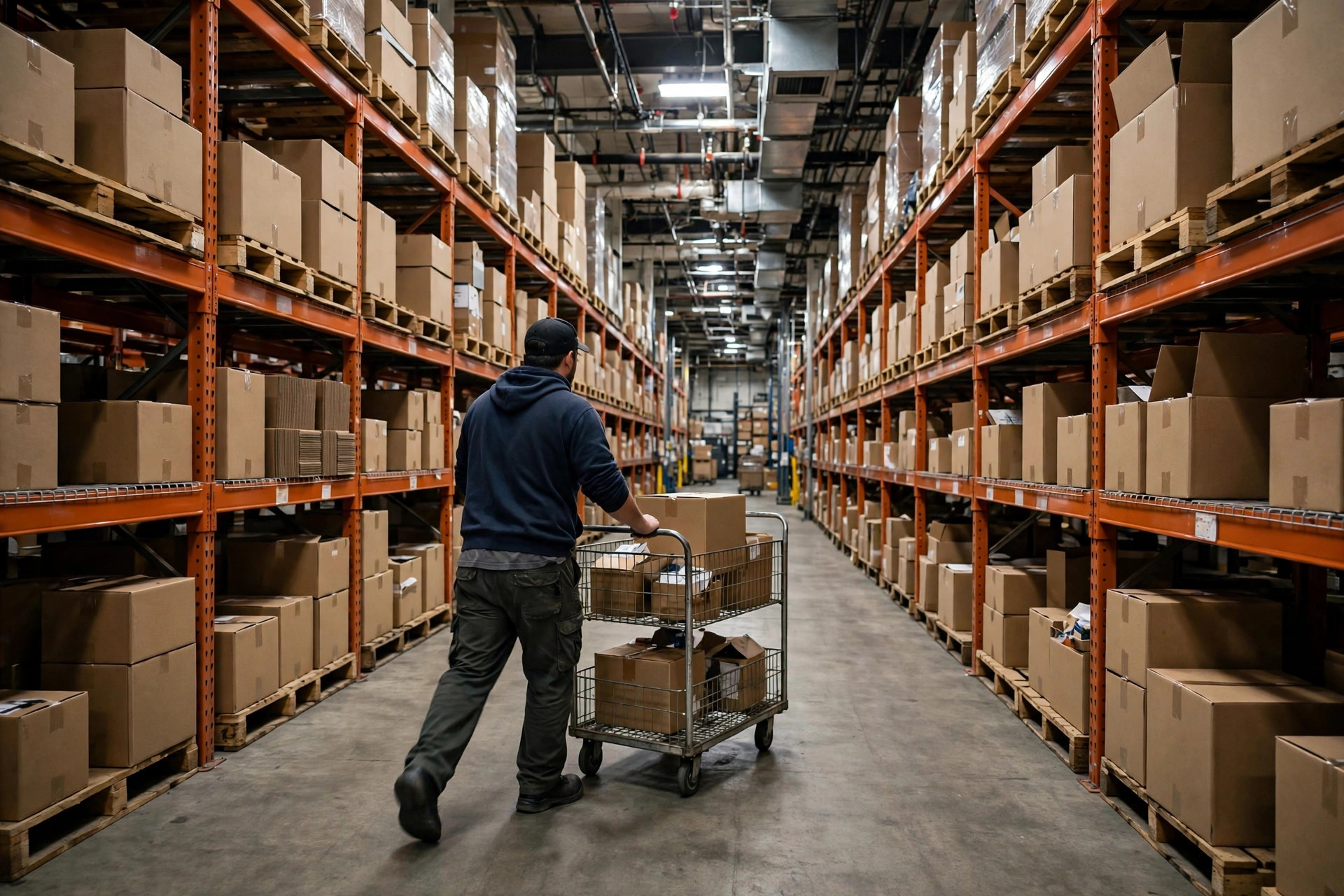
First, phone step counters. I had three pickers keep their phones in their pockets for a week. The data: 17.8 km per day on average, 21.3 at the top — Lao Wang again. Don't laugh at this trick. It costs nothing, and the numbers were walked by the employees themselves. Nobody argues with their own legs.
Second, old fitness bands. I dug a few out of a drawer and strapped them on the other four. The bonus: time-of-day breakdowns. We found our walking peak was 10:00–11:30 a.m. — a wave of small scattered orders.
Third, WMS pick logs. Our WMS is the cheap kind, but it records pick lines and bin coordinates. Dump it into a spreadsheet, compute theoretical travel distance from the coordinates — accurate to maybe 70–80%. Compare theory against the step counters, and the gap is "stupid walking": searching for product, wrong turns, going back for missed lines.
Fourth, a paper floor plan. Print the layout, hand the supervisor a highlighter, trace one picker's full day. Tape it to the wall. The whole warehouse went quiet: the route looked like an EKG, zigzagging everywhere.
Here's the counterintuitive take: measuring costs nothing, yet it's the highest-ROI step in the entire project. Big companies spend six figures on digital twins to answer the same question — how far, and where. We answered it with phones and highlighters. Three tiers down in tooling, zero tiers down in understanding.
Three Cheap Fixes That Cut Our Travel Distance
Measured, then moved. Three moves, zero dollars spent, all done over weekends.
Fix one: ABC slotting plus a golden zone. Three months of order data showed A-class SKUs — under 15% of SKUs — driving 72% of order lines. And those A items were scattered across the entire building; our hottest seller lived in the farthest aisle from the pack stations. One weekend, we moved every A SKU into two aisles within 15 meters of packing. We call it the golden zone. Lao Wang's back was still out, so he supervised from a chair, shouting himself hoarse.
Fix two: batch picking. We used to pick one order at a time — three lines, one full trip across the building. Now we pick six orders per wave, sweeping one direction, then sort at the wall. The "sort wall"? Cardboard boxes divided into cubbies. Embarrassingly low-tech. Works great. Six was our tested number: more than that and sorting errors creep in; fewer and you don't save the miles.
Fix three: forward-staging high-frequency items. Daily consumables, freebies, hot accessories now ride on the top shelf of the pick cart or sit next to the pack station. It used to take an 80-meter round trip for one freebie; now it's arm's reach. Don't sneeze at these crumbs — dozens of trips a day add up fast.
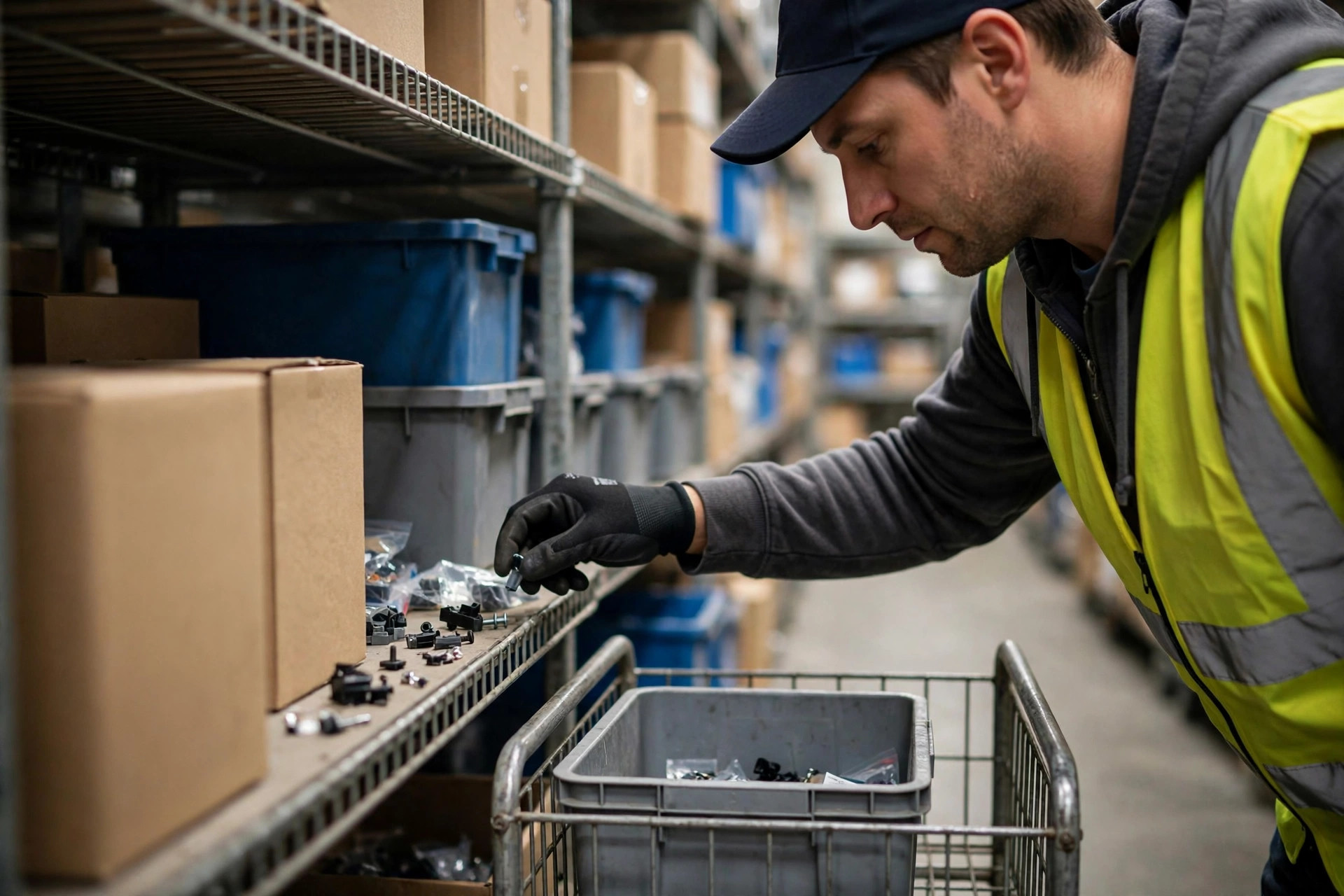
Results, measured two weeks later: average daily walking dropped from 17.8 km to 12.4 km; lines picked per person per day rose from 320 to 395. Lao Wang's back? He says it doesn't hurt anymore. I suspect it's mostly psychological, but now he tells everyone our warehouse is "humane." Fine by me.
The Friend's Warehouse: Software Can't Fix Rotten Slotting
Late 2024, I visited my friend Lao Chen's warehouse outside Phoenix — 40,000-plus square feet, a size up from ours. The year before, he'd spent tens of thousands of dollars on picking-route optimization software. The sales rep promised a 30% cut in travel distance. The reality? He'd never done ABC slotting. A-class product still sat in the back collecting dust, and the software's "optimal routes" sent people on daily detours. Three months later, the software was shelfware and the crew was back on paper lists.
Lao Chen taught me the big lesson: routing software is a multiplier, and slotting is the multiplicand. Multiply by zero, get zero. Do ABC slotting first, talk software second — reverse the order and the money goes down the drain. It's also why I tell small warehouses not to rush into "buying a system": a system can't fix management you never did. It just automates the chaos.
The Math: What 1 km Less Walking Is Worth
Here's the money table, using our warehouse's measured figures:
| Walking saved (per person per day) | Time saved (at 4–5 km/h pace) | Lines gained (about 45 lines/hour) | Labor value (median picker wage $17.34/hr) |
|---|---|---|---|
| 1 km | 12–15 min | about 9–11 lines | about $3.5–$4.3 |
| 2 km | 24–30 min | about 18–22 lines | about $7–$8.7 |
| 5 km | about 1–1.25 hr | about 45–56 lines | about $17.3–$21.7 |
The $17.34 figure is the U.S. Bureau of Labor Statistics' 2025 median hourly wage for stockers and order fillers; California reality runs higher, so I'm being conservative.
Now our warehouse's total: seven people, 5.4 km less per person per day. Per the table, that's roughly 1–1.25 hours freed per person daily — 7 to 8.75 hours across the crew, every day. Over 260 working days: $31,000–$39,000 a year. That excludes the hidden ledger — injuries, turnover. If Lao Wang had truly blown out his back, hiring and training his replacement would've cost more than all of this.
So 1 km less isn't some feel-good "easier day for the crew" story. It's cash. Picker walking distance optimization beats most equipment investments on ROI, because it costs nothing.
The Trade-off Nobody Warns Small Warehouses About
I have to talk trade-offs, or this article is just hype.
Trap one: the miles your pickers stop walking, your replenishers start walking. Golden-zone A SKUs burn through stock fast; our replenishment frequency doubled in week one. Our replenisher Xiao Li walked an extra 6 km a day and came to complain. Optimize "picking + replenishment" as one number, or you're robbing Peter to pay Paul. Our fix: replenish the golden zone twice a day in bulk — before shift start and at lunch — instead of topping up continuously. Total replenishment volume didn't change, but the route got sane, and Xiao Li's daily distance went back to normal.
Trap two: an overcrowded golden zone is a traffic jam. Everyone cramming into the two aisles nearest packing turned morning peak into gridlock — slower, not faster. Our fix: split the golden zone into two tiers (A+ in the front aisle, A in the second) and made cart traffic one-way. Density and speed are forever in tension. Don't get greedy.
Advice for Warehouses Like Ours
One: don't buy software first. Run phone step counters for a week; the numbers will tell you where the problem is. Two: ABC slotting is the foundation, batch picking is the lever — both free, do those first. Three: count replenishment in the total, or you're just moving the problem around.
Big companies solve walking with money. We solve it with scrappy methods. Same result, orders of magnitude apart in cost. A small warehouse has its own way of surviving — count every kilometer as money, and the road keeps getting shorter.
By Xiao Ma, Small Warehouse Owner