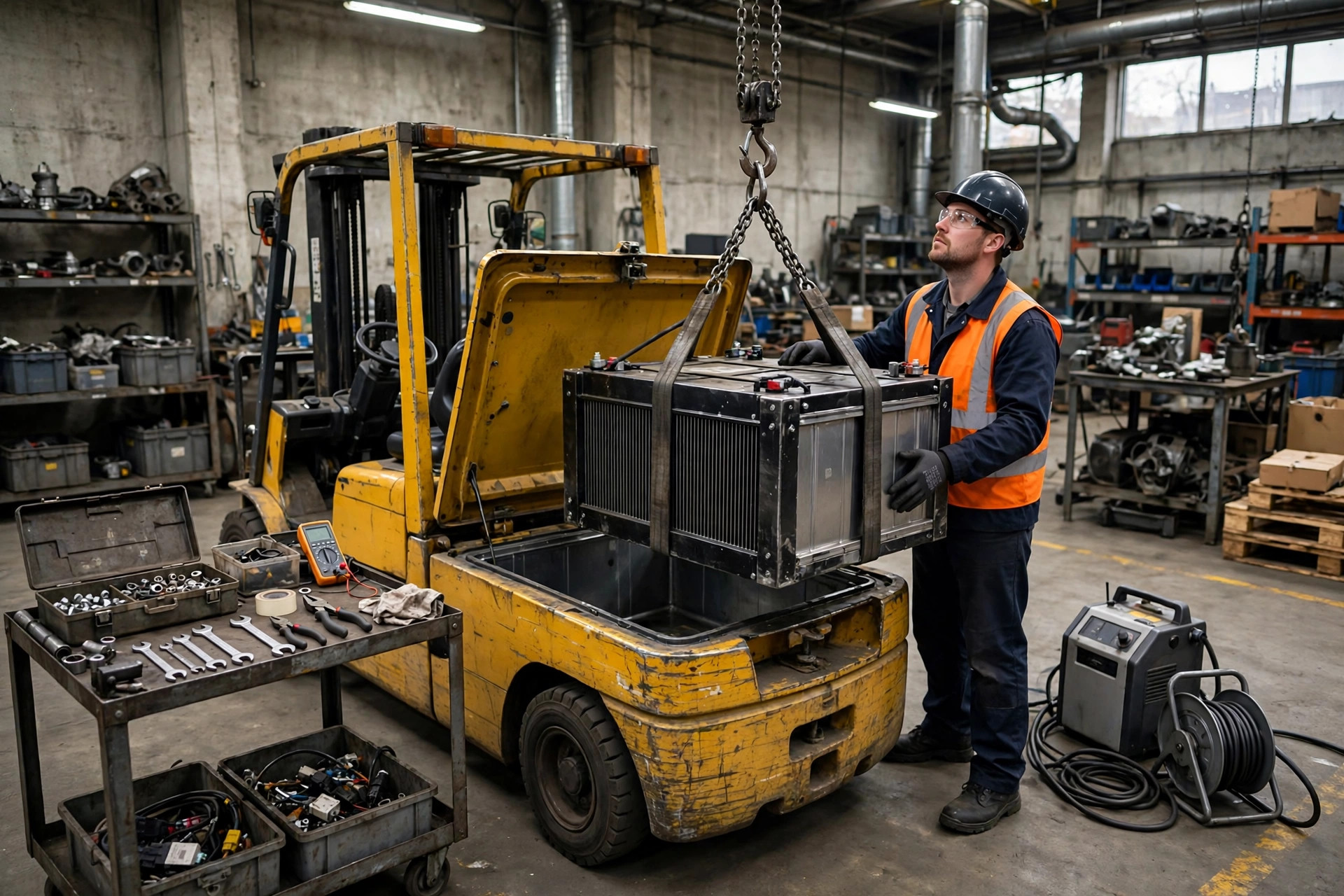
A sodium-ion forklift gets asked about more and more, always the same question: lithium is fine, except it loses charge fast in winter and cold storage, so is sodium-ion the fix? My answer is the same too: it fixes the cold part, and only the cold part. On energy density it is actually shorter. Keep those ledgers separate: buyers who mix them buy the wrong truck.
Why a Sodium-ion Forklift Shrugs Off the Cold
Think of it this way: inside a battery, carriers do the hauling, lithium ions one kind and sodium ions another. When the temperature drops, every carrier slows down. The difference is how much each slows down. Sodium ions suffer less from the cold, so internal resistance rises more gently and the discharge curve stays flatter. It is like two runners on a winter morning, one in a thin jacket and one in a proper coat: both can run, but halfway through you can see which one is gasping.
There is a measurement trap to state up front. Vendor figures for sodium-ion batteries contradict each other: energy density, cycle count, and cold retention vary widely by datasheet. So any vendor figure here is framed as what one vendor claims, and the real test is the datasheet plus a trial in your own building. One vendor claims its sodium-ion pack keeps most of its usable capacity at minus twenty degrees Celsius. Check that against two other vendors on the same basis, then verify it over a full shift in your own cold store. A laboratory temperature and the draughty temperature by a cold store door are never the same.
Take a real-world shape of a case. A Shenyang cold chain warehouse runs its halls near minus eighteen degrees year-round, with forklifts shuttling to the dock doors. With its previous trucks, the gauge seemed to leak the moment a truck entered the hall, so the shift leader brought the battery swap forward half an hour every shift. After a sodium-ion pilot truck went in, the curve flattened, the swap stayed on schedule, and the roster finally ran as written. Sodium-ion is not magic. In a cold setting, stability of range matters more than headline range: headline range is measured in a laboratory, stability in a roster.
Where Low Energy Density Actually Bites
Low energy density means a battery of the same weight holds less electricity. You can understand it as a smaller fuel tank on the same truck: the truck is unchanged, but it refuels sooner. Sodium-ion energy density is generally below lithium-ion, a property of the material itself, not a tuning problem any vendor can smooth away. Whether that shortcoming blocks you depends entirely on how long your shifts are.
Suppose one truck must work eight continuous hours with no charging window. A small tank is then a hard limit, and the truck heads for a charger while work waits. Suppose instead a shift lasts four or five hours, with breaks and handovers for a top-up. Then the small tank never matters. The selection boundary therefore sits not on a datasheet but on your roster: short shifts with many charging windows hide the weakness, long shifts with few magnify it until it cannot be ignored.
| Factor | Sodium-ion | Lithium-ion | Lead-acid |
|---|---|---|---|
| Cold performance | Best, flattest curve | Noticeable loss in cold | Worst in cold |
| Energy density | Below lithium-ion | Highest | Lowest, heaviest |
| Charging pattern | Suits fragmented top-ups | Fast charging | Slow, plus swaps |
| Cycle life | Vendor-claimed long life | Proven, stable | Shortest |
| Cost trend | Abundant, low lithium exposure | Exposed to lithium prices | Cheap, costly upkeep |
| Best-fit shifts | Short shifts, many top-ups | All shifts | Fixed shifts |
That table carries no precise numbers. When vendors measure the same parameter differently, a precise-looking figure reads like truth, not fact: just one supplier's pitch. Checking each row with a supplier like-for-like is worth far more than memorising numbers.
Which Warehouse Should Pilot a Sodium-ion Forklift, and Which Should Not
The warehouses worth piloting first all look alike. Cold stores come first: sub-zero working is everyday there, and the cold advantage pays off daily. Second are northern warehouses with outdoor winter work, where three months of fast discharge is a real pain. Third are multi-shift centres with short shifts, so the small tank never gets exposed. Fourth are operations sensitive to lithium prices: sodium is abundant, a genuine cost hedge, not a concept slide.
The warehouses that should stay away look alike too. Long-range heavy-duty work comes first: a truck running ten continuous hours under heavy load will never make the sodium-ion range arithmetic work. Second are sites with few chargers and one charging window, where trucks queue for chargers longer than they work. Third are warm, single-shift warehouses whose range demands were never demanding: the cold advantage would sit unused most of the year, a textbook pseudo-requirement. I have no patience for paying for an advantage you never use.
Here is a second case, from a regional warehouse in northern China. It runs three shifts a day, each about four and a half continuous hours, with roughly forty minutes of handover and meals between shifts. Two sodium-ion pilot trucks ran two months; the shift leader's verdict was practical: no low-charge alarms on cold days, a handover top-up started the next shift, and the roster was never disrupted. That warehouse succeeded not because sodium-ion is strong, but because its roster sat in sodium-ion's comfort zone. Put the same truck and battery in a ten-hour-shift warehouse, and the conclusion flips completely. Selection conclusions follow the warehouse, never the battery.
The Maintenance Traps: Charging, Old Batteries and Disposal
Maintenance holds three traps: ignore them before buying, and you pay in overtime. The first trap is mixing chargers. A sodium-ion charging curve differs from a lithium-ion one, and charging sodium-ion with a lithium-ion charger can leave the pack undercharged, cut usable range, or damage the battery. The contract should name the charger model and curve owner. The word generic is the most expensive word in the battery business.
The second trap is the battery management system. A sodium-ion system watches different signals, and its low-temperature voltage curve and charge estimation behave in their own way. At acceptance, do not only check full-charge duration; check whether the charge estimate is accurate in the cold. A truck whose gauge lies in the cold is the worst trap: the display says thirty percent, a heavy load pulls it to the alarm line, and the shift leader's trust is gone after one incident. Put a cold trial on the acceptance sheet, a full shift at your real temperature, and only sign when the data passes.
The third trap is old battery disposal, the easiest to leave until too late. The sodium-ion recycling chain is less mature than lithium-ion's, so recovery route, transport cost, and residual value need settling before a bulk order. Ask before you buy: who takes the old battery back, who pays the freight, who keeps the residual value, and is it in the contract? Buying in bulk without those answers is budgeting yourself a disposal bill a few years from now. Spare parts and service coverage deserve the same question: the network is thinner than lithium-ion or lead-acid, so a remote warehouse should confirm response times first, not discover after a breakdown that the nearest service point is hundreds of kilometres away.
So before buying, ask three questions: is cold trial data measured at my working temperature, is the charger and curve dedicated to this chemistry, and is old battery disposal in the contract? A supplier that cannot answer all three should not get a signature, however cheap the quote looks.
Whether the money is worth it comes down to one number: your longest continuous shift length divided by this truck's measured range in your own cold conditions. If that ratio sits below zero point eight, the margin absorbs peaks and surprises, the cold advantage pays off in real work, and the money is well spent. If it approaches or passes one, your roster sits outside this truck's comfort zone, and no cold performance closes the range gap. Do not spend the money. By Da Liu, Automation Engineer