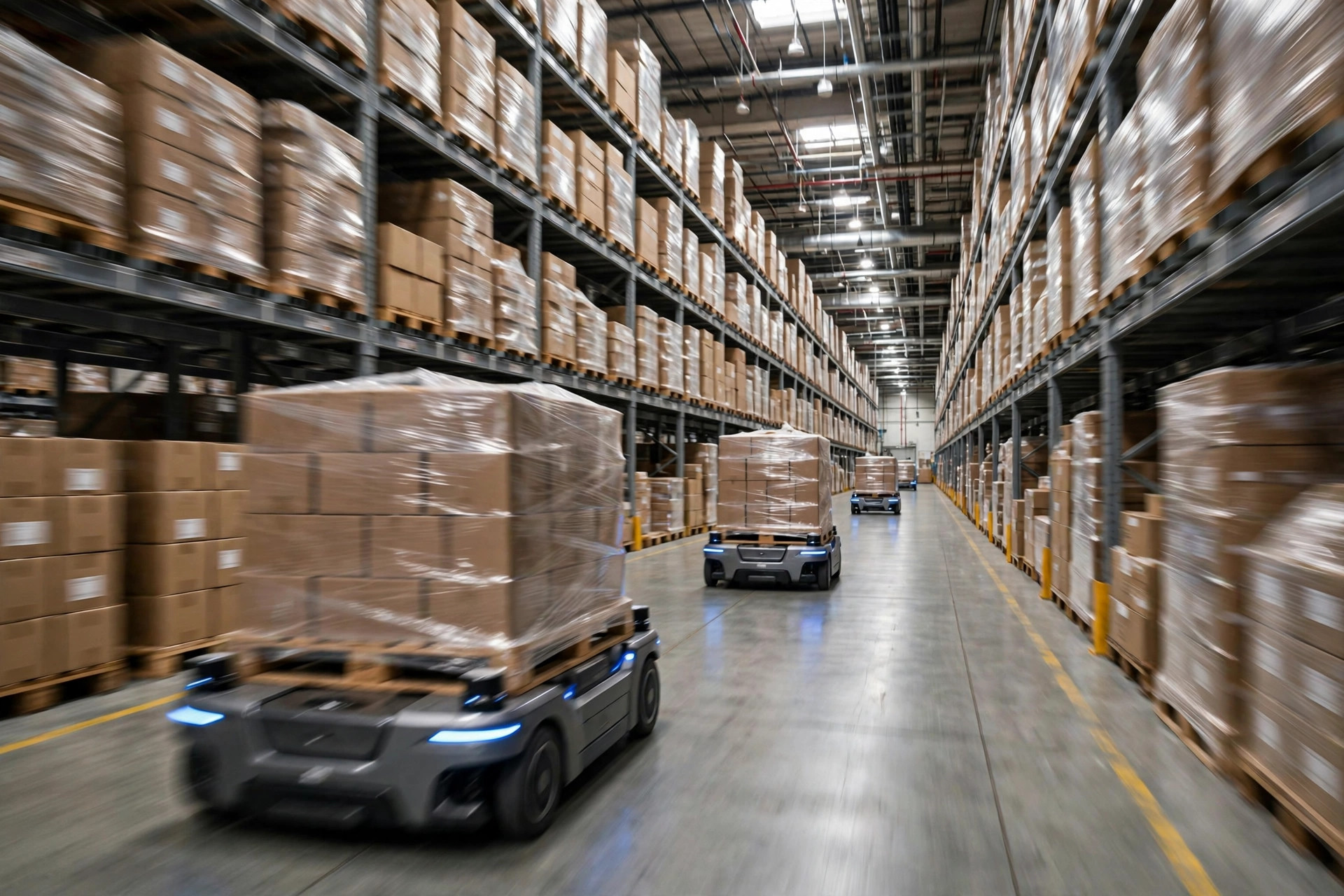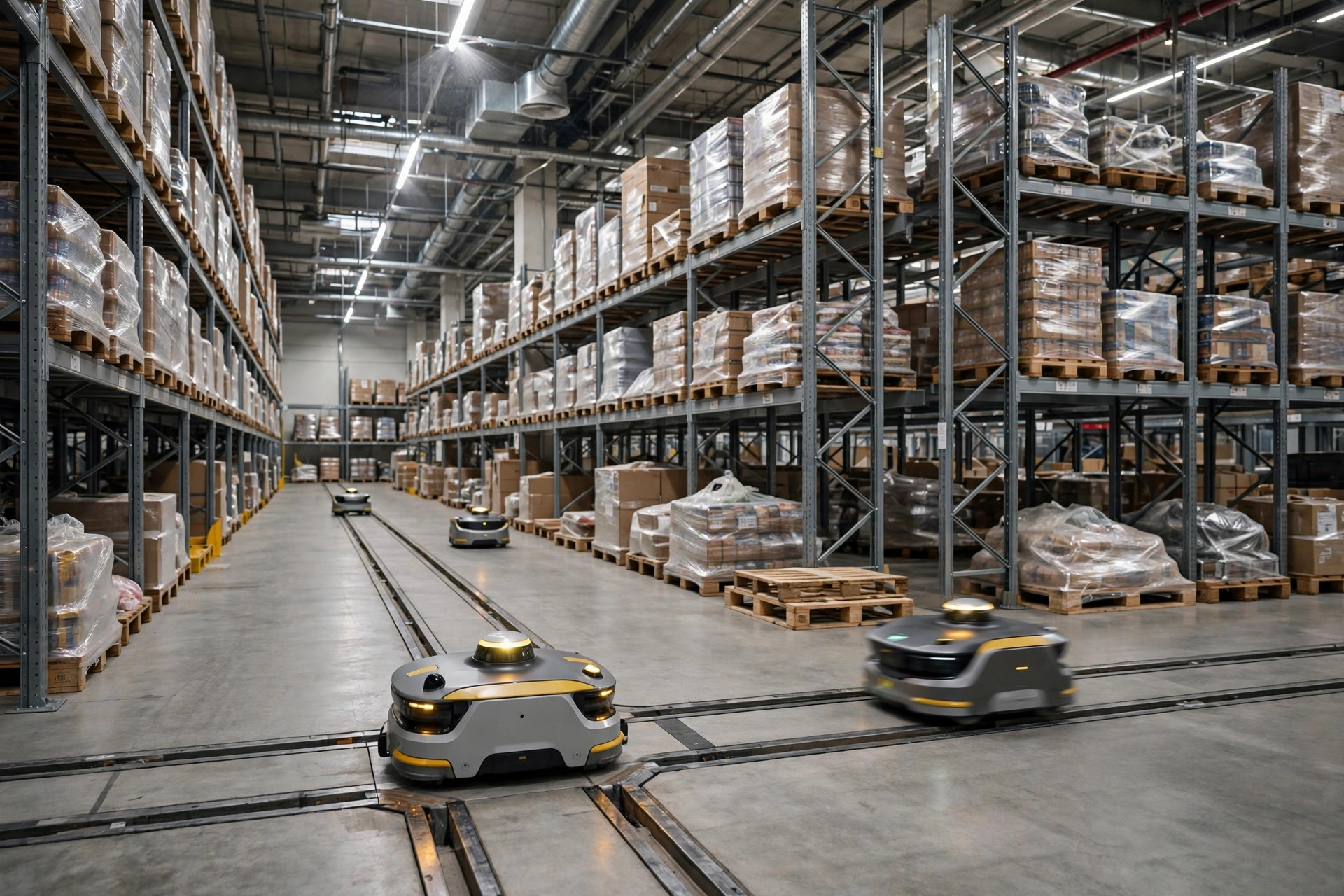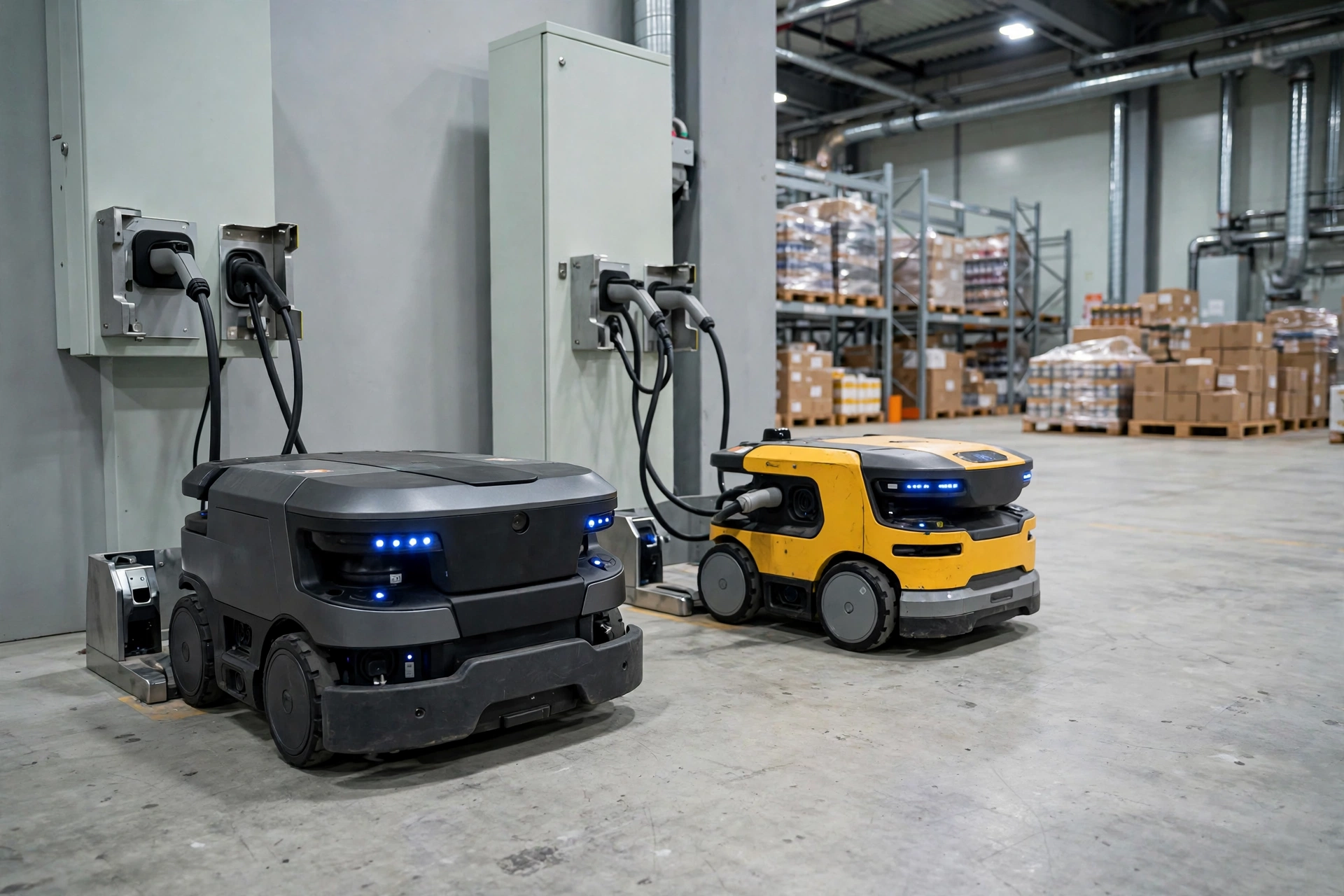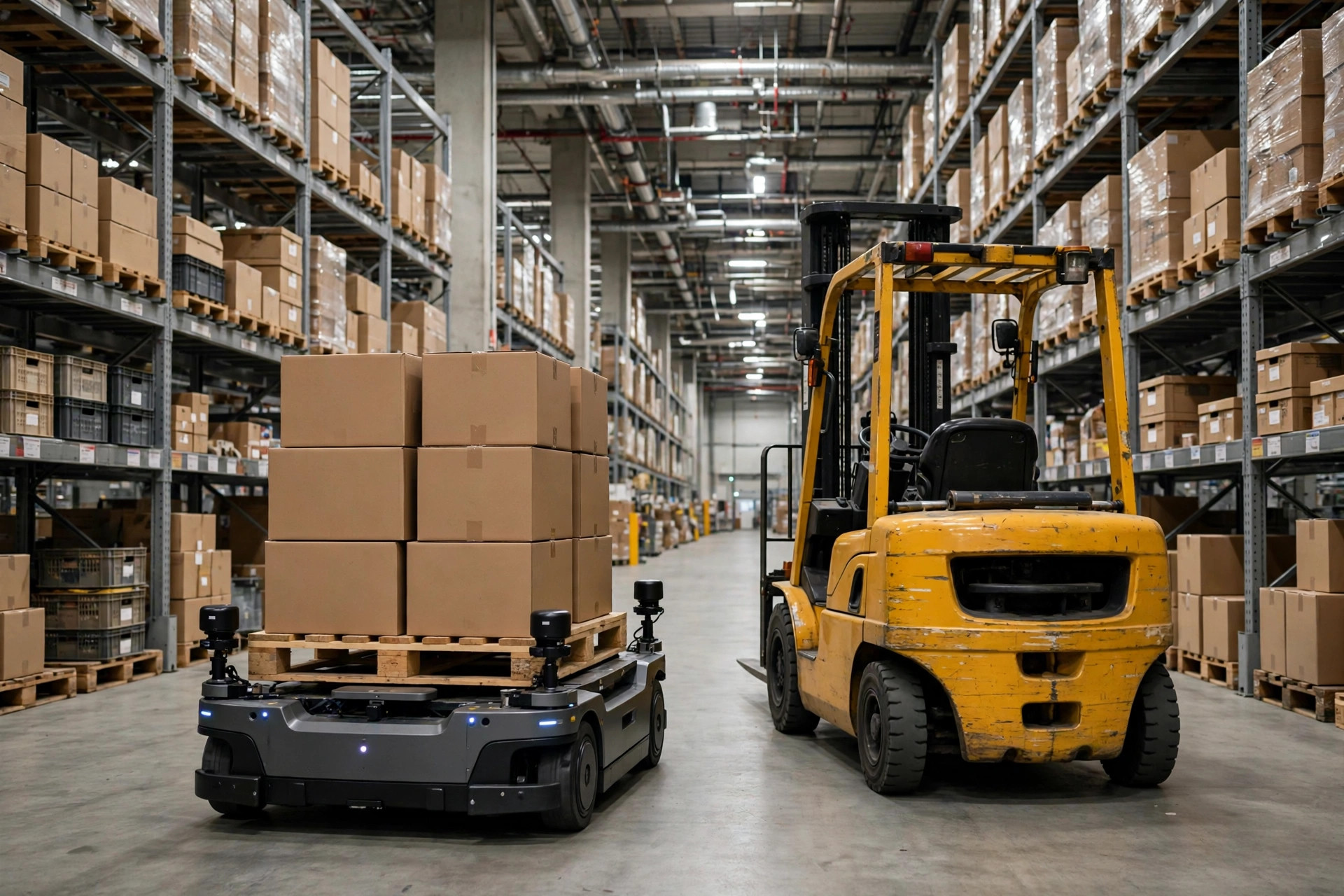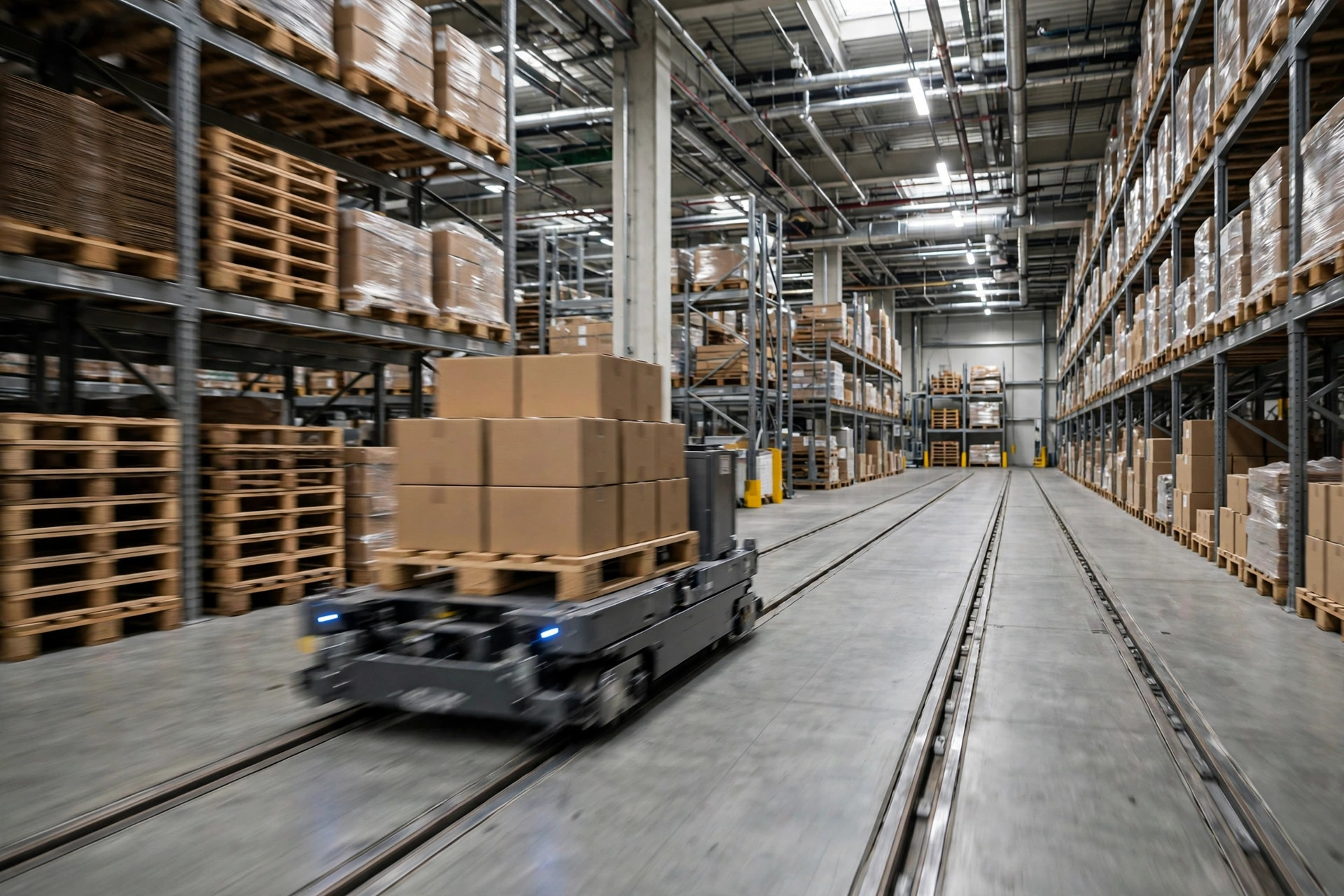
Think of it like choosing transport. An RGV is a train on rails: fast, punctual, hauls heavy loads, but it can only run the one line you built. An AGV is a rideshare car: goes anywhere, but rush hour means traffic jams and dispatching is a real engineering problem. A conveyor is the belt in your house: runs 24/7, but once installed it never moves again. Picking the wrong one costs real money.
RGVs (Rail Guided Vehicles) keep showing up in automated warehouses, and the principle is simple: the vehicle runs on fixed steel rails, powered through conductor rails and current collectors — you can think of it as the pantograph on an electrified railway, so it never stops to charge. Positioning comes from the rails plus encoders, which puts straight-line accuracy an order of magnitude above free-navigating vehicles. Manufacturers publish honest numbers. Take DAMBACH's RAIL CART: rated load up to 1,500 kg, travel speed up to 150 m/min (2.5 m/s), acceleration 0.7 m/s². Across the market, typical RGV payloads run 500 kg to 5 t and speeds 0.5–2.5 m/s — check the vendor's datasheet, not the sales rep's mouth.
RGV vs AGV vs Conveyor: the three-way comparison, cards on the table
| Dimension | RGV | AGV | Conveyor |
|---|---|---|---|
| Route flexibility | Zero — rails are fixed | High — remap the floor | Zero — steel is fixed |
| Speed | Fast (up to 2.5 m/s) | Medium (typically 1–2 m/s) | Continuous flow, takt-driven |
| Payload | Strong (multi-ton capable) | Medium (heavy-duty models cost) | Strong |
| Footprint | One rail line | Needs drive aisles | The whole line body |
| Upfront investment | Medium (cheap vehicle, pricey rail + civil work) | Medium-high (fleet + dispatch) | High |
| Single-point failure | Whole line stops | One unit down, others reroute | One section down, segment stops |
| Sweet-spot volume | Medium-high, fixed takt | Medium-low, multi-point delivery | High, continuous |
Read that table and the selection boundary draws itself.
The RGV selection boundary: four dimensions, one veto
First, volume. An RGV is a fixed-cost amortization business. Once the rails are down, whether the vehicle runs 200 trips a year or 200,000, the cost per trip is a different universe. Above roughly 30 pallets an hour, both directions, on a steady takt — the RGV math works. Spiky volume, many small drops: take the AGV.
Second, distance. Long hauls (over 100 meters) are RGV home turf: accelerate in a straight line to 2.5 m/s while the AGV on the same run burns its advantage on traffic management, charging, and obstacle avoidance. Under 50 meters, the AGV is simply more agile.
Third, payload. Above a ton, RGVs and rail transfer carts are the natural pick. AGVs can do heavy loads — heavy-duty AGV pricing will just make you redo the spreadsheet.
Fourth, flexibility — this one is a veto. If the route might change in the next three years, don't touch RGVs. Don't touch conveyors either. Ripping up and relaying rails, plus the downtime, costs far more than whatever you saved on day one. This is the most common fake requirement in RGV selection: it looks beautifully "automated" until the layout changes in year two.
Two sites: one that paid off, one that didn't
In 2023, an auto-parts distribution center in Ohio ran RGVs moving pallets between buildings: 180 meters each way, 40 pallets an hour, replacing 2 forklifts and 2 drivers on three shifts (labor-cost basis). Rails plus two vehicles came to roughly $450,000 installed (vendor quote range, illustrative). Payback in 18 months. Why did it work? Stable volume, long distance, a route frozen for five years — all four dimensions inside the RGV comfort zone.
The other one: in 2024, an e-commerce warehouse debated RGV versus a loop conveyor and picked RGV because "it's cheaper than conveyor." After peak season the layout changed. The rails had to come up and go back down. Two weeks of stopped line. Had they picked AGVs, they would have changed a map, not a railroad. The expensive lesson: an RGV saves you upfront capital and bets your next three years of layout stability.
The maintenance traps: rails are cheap, the ground under them isn't
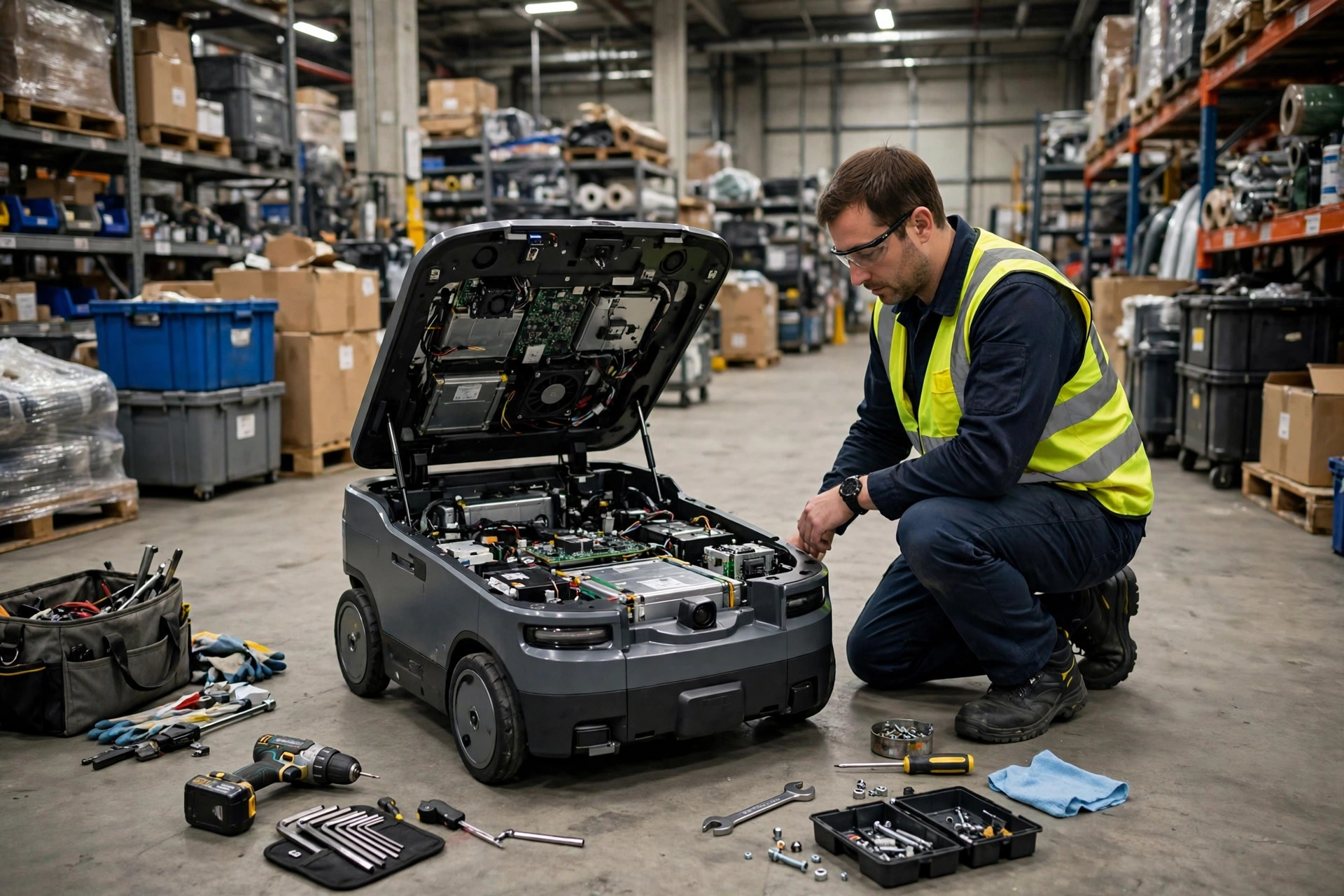
The RGV maintenance list is short, and every line costs money:
- Rail cleaning. Metal chips, dust, and packaging debris on the rail — best case you lose positioning accuracy, worst case you chew up the wheels. Vacuum daily, and write it into the SOP.
- Collector carbon brushes. The consumable in conductor-rail power. Run them past the wear limit and you get intermittent contact and a dead vehicle. Stock spares; don't order them after the line stops.
- Foundation settlement — the most expensive trap. Five millimeters of floor settlement and your docking drifts; the vehicle arrives at the station and misses the roller conveyor. Realigning rails routinely costs more in money and time than the vehicle itself. Skimp on the civil groundwork and you pay interest forever.
- Joints and turnouts. Rail joint height differences and switch mechanisms are the highest-failure mechanical parts on the system. Give them their own line on the inspection sheet.
And the counterintuitive call: in an RGV project, the vehicle is only about a third of total investment; rails plus civil work are the bulk. Any selection that compares vehicle prices instead of installed prices starts with the wrong math.
Worth it or not? Watch this one number
My rule: no feelings, one number — cost per pallet per kilometer moved.
The math: (amortized rail and civil cost + vehicle depreciation + annual maintenance) ÷ annual pallets ÷ average haul distance. Compare it against the forklift-plus-driver labor line at the same unit. Below the labor line: worth it. Above it: you bought an expensive toy.
Run the Ohio case through it: about 200,000 pallets a year, 0.18 km average haul, roughly $120,000 a year in total cost (depreciation plus maintenance, illustrative) — about $3.30 per pallet-kilometer. Local forklift labor at the same unit ran about $5.00. Worth it, and not close.
An RGV is not a universal answer. It is the optimal answer inside a narrow gate: fixed route, medium-high volume, heavy loads, stable layout. Inside the gate it outruns the AGV and undercuts the conveyor; outside the gate it is a railroad you can't tear up. Walk the four dimensions, compute the one number, then sign.
By Da Liu, Automation Engineer