A grape is a product with a built-in countdown. From the moment it is cut from the vine, field heat starts eating its shelf life. Peru table grape export cold chain work comes down to one job: pull the fruit temperature down as fast as possible, then never let it climb back up. Pre-cooling, SO2 pads, and cold treatment are not exotic technology. They are a question of rhythm and execution.
Peru Table Grape Cold Chain: The Principle of Pre-Cooling
Think of it this way. After harvest, a grape keeps breathing. The warmer the fruit, the faster it breathes, the faster it loses water, and the faster grey mould gets going. Pre-cooling is a race against that clock: get freshly picked grapes down to around 0°C so they effectively go to sleep. You can understand it like bringing down a fever. Until the temperature drops, nothing else you do works very well.
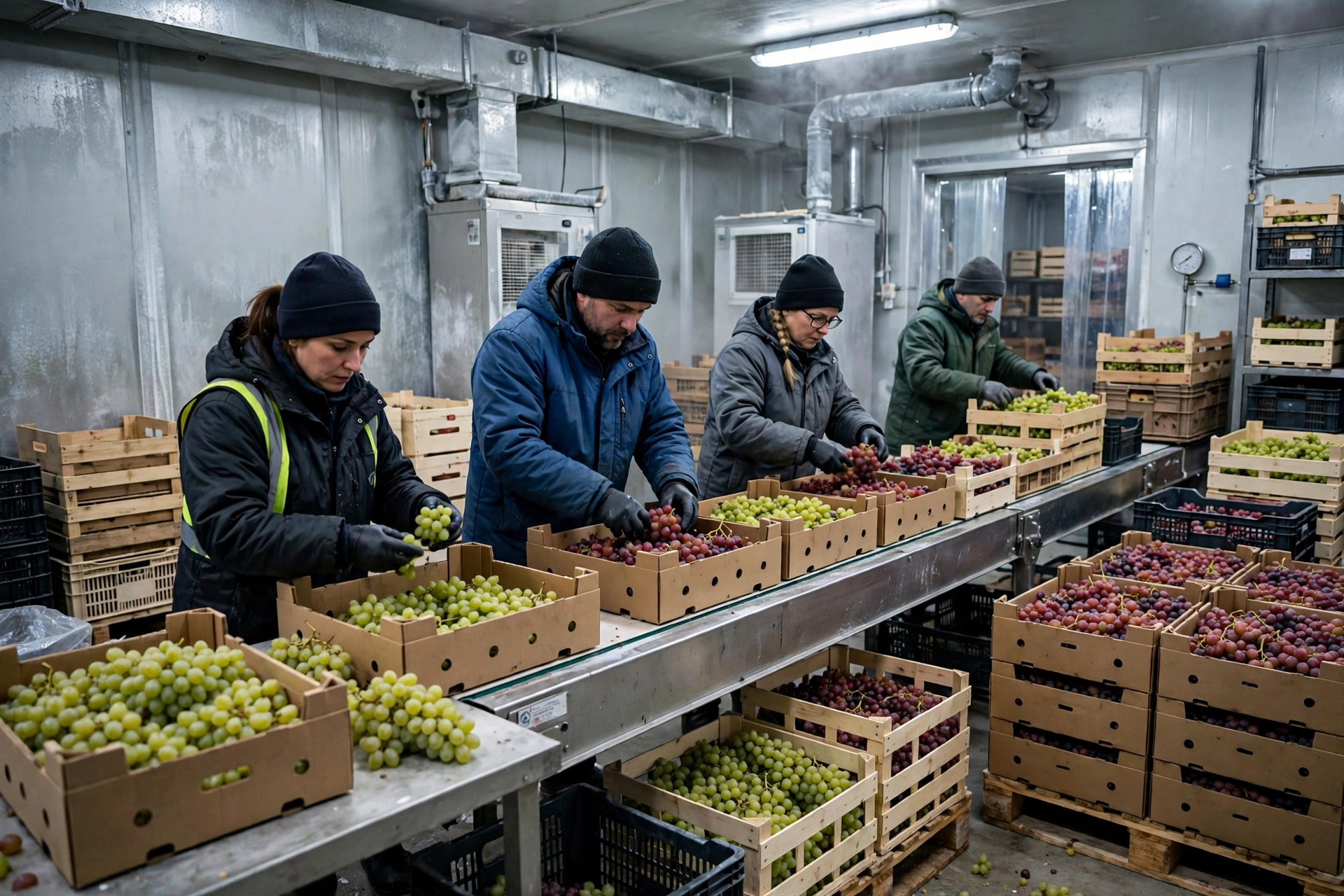
During the 2025 season I spent an afternoon at a packing house in Ica. The rhythm went like this: grapes picked in the morning reached the packing house before noon and went into pre-cooling the same afternoon. The veteran on the floor told me his biggest fear was not equipment failure. It was grapes picked but not delivered, or delivered but not cooled. Two extra hours sitting in a field crate under the sun, and the cold room needs twice as long to catch up. That day I watched a sorting line move several thousand cartons in a shift. Sorting was not the bottleneck. Pre-cooling turnaround was. Every time the cold room door opened and closed, cold air escaped, the room temperature wobbled, and pre-cooling took longer.
That gives a clear line for equipment selection: size pre-cooling capacity for peak harvest days, not average output. A cold room sized for the average day is overwhelmed on the first day of peak season. My rule is to take the highest single-day harvest of the season and add a 20 percent margin for weather and labour swings. That margin is not waste. It is the buffer that stops grapes from queuing for cooling, because every minute a grape waits, it loses value.
Peru Table Grape Cold Chain: SO2 Pads in the Ica Packing House
An SO2 pad is an old, proven tool for table grapes. The pad slowly releases sulphur dioxide inside the carton and holds back grey mould. It works well, and it is easy to misuse. I have seen two failure modes in person. In one, the pad was placed under the grapes, so the gas spread unevenly: fruit near the pad was irritated, fruit far from it was unprotected. The pad belongs on top of the fruit or wherever the manufacturer's instructions say, so the gas settles evenly. Dosage and placement must follow the manufacturer's specifications.
The second failure is sneakier. A carton sealed too tightly traps SO2 and can bleach the fruit surface. A carton with the wrong ventilation lets the gas escape too fast and weakens mould protection. An SO2 pad is therefore not a fit-and-forget item. It has to be matched to the carton type, the vent holes, and the pre-cooling rhythm. My standard practice is to run a small trial shipment under the manufacturer's instructions, open it on arrival, and check the fruit surface and stem colour before scaling up. Never use a full container to test a new pad. That lesson is too expensive.
Here is a counterintuitive point that surprises people: for grapes, stronger is not better. Too much SO2 damages the fruit surface, too little fails to control mould, and the useful window sits in between. That window depends on variety, fruit temperature, carton type, and transit time. There is no universal table to copy. Each packing house has to find its own window from trial data.
In-Transit Cold Treatment and the Reefer-versus-Bulk Choice
Cold treatment is a quarantine requirement, not a freshness technique, and the distinction matters. Some destination markets require grapes to be held at a prescribed low temperature for a prescribed period during transit, to kill specific quarantine pests. The temperature and duration must be confirmed against the destination country's quarantine rules before booking, and written into the transport plan. Do not discover the requirement after the cargo is loaded. Exact temperatures, durations, and operating rules vary by market and variety, so always confirm against the destination country's quarantine requirements rather than last year's experience.
That leads to a practical choice: reefer container or bulk reefer vessel? A reefer container gives precise temperature control, independent units, and immediate availability on arrival, which suits high-value cargo that cannot tolerate temperature breaks. A bulk reefer vessel can offer a lower cost per unit for large volumes heading to one port. My dividing line runs through three numbers: volume, destination concentration, and temperature tolerance. Large volume, one destination port, and relatively forgiving temperature needs point toward bulk. Scattered destinations and zero tolerance for breaks point toward reefer containers. Neither option wins everywhere. The question is whether your cargo can live with the weaker option's downside.
I also keep a break-point checklist that I run through at every packing house: transfer time from pre-cooling to the packing area, waiting time from packing to container loading, container temperature while waiting at the port, and pick-up speed after arrival. If any of those four points fails, everything spent earlier in the chain can be wasted. My method is to set a maximum waiting time for each point and escalate when it is breached, instead of reviewing temperature curves afterwards and regretting it. Place temperature loggers inside the cargo, not just at the container door. The door reads the prettiest temperature and tells the least truth. The carton in the middle of a pallet tells you what the fruit actually experienced. And pre-cool the empty container before loading. A warm container eats a large share of the cold from chilled fruit, and the packing house ends up blamed for the rebound.
The Piura Container That Taught Me the Lesson
One more case. A packing house in Piura once had a container of grapes draw complaints in Europe for dry stems. The cold room temperature was fine. The SO2 pads were fine. The problem was the packing area: that batch waited nearly an hour and a half at ambient temperature before loading. Fruit temperature recovered during packing, then cooled again in the container, but the lost moisture never came back, and dry stems stayed dry. The lesson is blunt: a cold chain is not a cold room temperature. It is a time ledger across the whole chain. A temperature logger can tell you what the temperature once was. It cannot tell you how long the fruit sat at ambient temperature. Only process checkpoints can manage that.
Is the money worth it? Look at one number: the good-fruit rate on arrival. Pre-cooling equipment, SO2 pads, cold treatment bookings, and temperature loggers all have to land on that number. When the good-fruit rate rises, the spending is a cost. When it does not move, even cheap spending is waste. Do not judge a packing house cold chain by equipment prices. Judge it by the good-fruit rate at destination.
By Da Liu, Automation Engineer