Over the past two years, talking with warehouse managers and integrators, I keep hearing the same opening line: "We want to start with a small pilot." A small, contained AI pilot has become the standard opening move for small warehouses embracing AI. But when I follow up with three questions — which use case will you pilot, what baseline did you record beforehand, and what counts as success afterward — most answers turn vague. That gap is worth studying: everyone agrees on "starting small," yet few can explain how to start an AI pilot in a small warehouse in a way that holds up. A pilot done well becomes a benchmark; a pilot done badly becomes the reason the whole company votes against AI. The difference is rarely the technology. It is the pilot methodology.
The data: how leaky is the pilot-to-production funnel
Start with the public numbers. According to an analysis Gartner published in 2024, at least 30% of generative AI projects will be abandoned after the proof-of-concept stage by the end of 2026, citing excessive cost, unclear value, and risk control. The figure covers all industries, but the logic applies to warehousing: pilots are easy to launch, pilots that reach production are rare, and the funnel leaks on two questions — "is it worth it" and "can this warehouse absorb it."
The other side is adoption speed. According to MHI's 2024 Annual Industry Report (with Deloitte), AI adoption in the supply chain industry is on a steep upward curve, expected to reach mainstream levels within five years. We are in the window where large numbers of small warehouses are being pitched AI, getting interested, and running their first pilots.
A small round of field visits supports this reading. In Q4 2024, I visited 14 warehouses under 10,000 square meters; four had run AI pilots (vision inspection, voice picking, intelligent scheduling). Of those four, three were in the state of "the pilot ended, and nothing followed" — no rollout, no post-mortem. The sample is small, but it points to a real, common outcome for small-warehouse AI pilots: not success, not failure, but a quiet death.
Attribution: three ways AI pilots die
The stalled and failed cases cluster into three familiar patterns.
First, the wrong use case: solving the vendor's sales problem, not the warehouse's pain. I have seen more than one small warehouse pilot the vendor's flashiest demo — for example, a large-language-model "smart assistant" for looking up SOPs. Impressive, but the warehouse was bleeding daily on receiving damage, count variances, and mis-picks. Three months in, the assistant had fewer logins than the time clock, and the pilot "concluded." Get the use case wrong and nothing downstream can save it.
Second, no baseline: without pre-pilot data, acceptance is storytelling. In late 2023, a roughly 3,000-square-meter home-goods warehouse in Yiwu, Zhejiang, piloted AI voice picking. The problem: picker turnover exceeded 60% per quarter, so the pre-pilot baseline — 95 seconds per pick — no longer described the team at acceptance time, when half the crew had been replaced. The baseline drifted, every comparison lost meaning, and the final report could only say "employee feedback was positive." A pilot without a control is methodologically void.
Third, the greenhouse effect: pilot conditions that cannot be replicated. The vendor stations an engineer on site for two weeks, data is specially labeled and cleaned, pilot SKUs are cherry-picked tidy categories. The pilot ends, the conditions vanish, and so do the results. A healthy pilot should run under normal production conditions.
Picking the use case: four criteria for the first pilot
With the attribution clear, the selection criteria write themselves. I score a small warehouse's first AI pilot on four dimensions, 1–5 points each, and recommend only use cases scoring 14 or above out of 20:
| Criterion | Meaning | What a high score looks like |
|---|---|---|
| Pain frequency | Scenario happens often enough | Hundreds of occurrences per day, ample samples |
| Baseline measurability | Existing data can serve as baseline | 30–60 days of data directly pullable from WMS, attendance, or claims records |
| Feedback-loop length | How fast results come back | Visible results within 24 hours — shorter is easier to validate |
| Failure cost | Can you roll back quickly if it flops | Rollback within a week, losses within an acceptable range |
Ranked this way, common use cases sort themselves: vision-based anomaly detection (receiving damage, quantity verification) usually scores highest — high frequency, claims records as a ready baseline, same-day feedback, and failure just means returning to manual spot checks. Predictive replenishment alerts come next. Voice picking and intelligent scheduling, which depend on workforce stability and process standardization, should wait — not because they are bad, but because they carry too many variables for a first pilot.
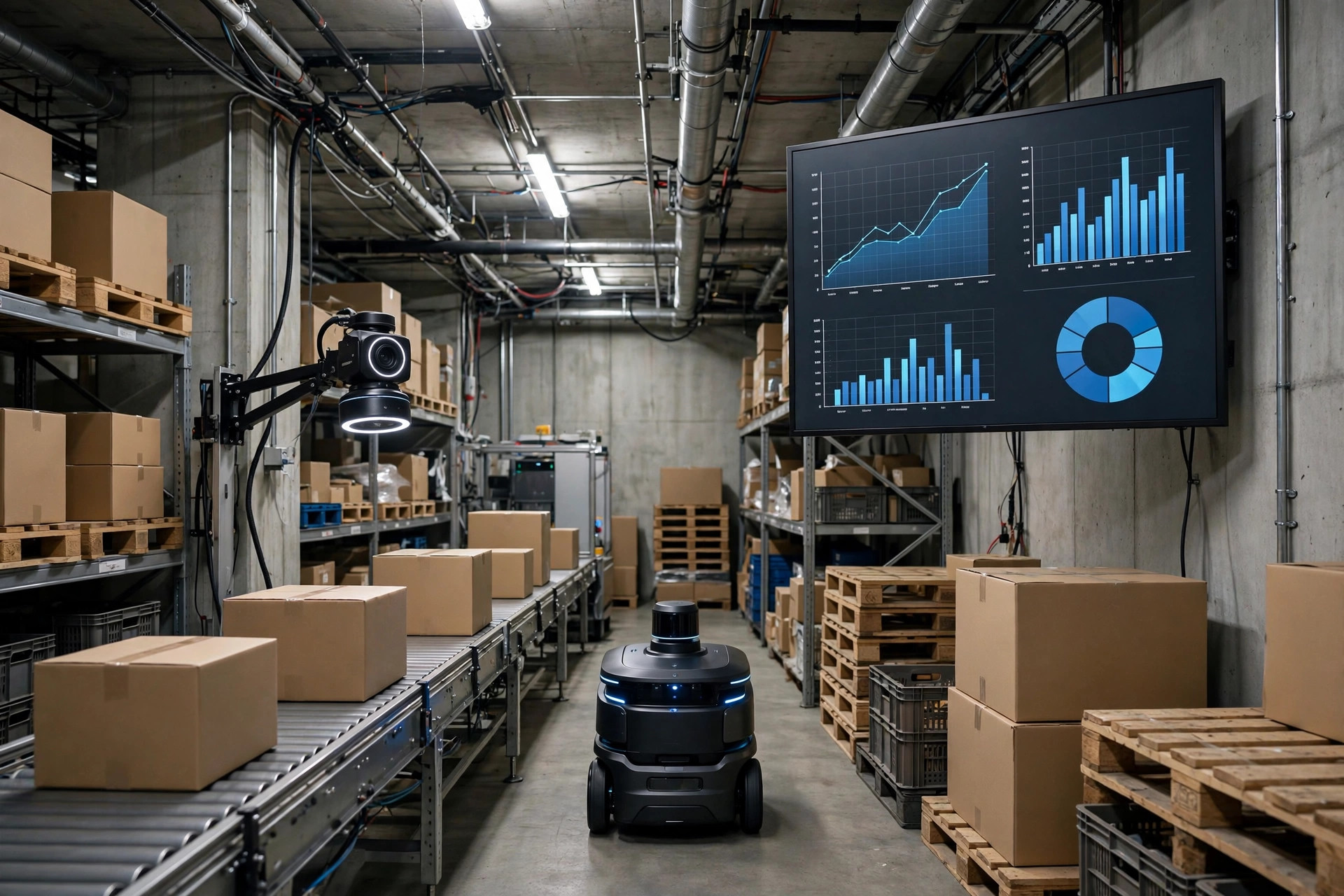
One case followed this logic well. From March to June 2024, an auto-parts e-commerce warehouse of about 5,000 square meters in Dongguan processed roughly 800 units a day at receiving, with damage claims fluctuating between 12,000 and 15,000 yuan per month. The pilot added two vision cameras above the receiving conveyor to flag suspected damage. Beforehand, the team spent two weeks compiling 60 days of claim and miss rates as the baseline. Over three months, missed defects in the flagged scope dropped by roughly 40–50%, but false positives cost receivers about 20 extra minutes a day in re-checks. The decision was pragmatic: the effect was real, but the ROI hinged on re-check cost, so alerts stayed only on high-claim SKUs and the rest went back to manual. The pilot answered three questions — does it work (yes), what does it cost (re-check time), and where is the boundary (high-claim categories). That is what a qualified pilot looks like.
The baseline: without baseline data, acceptance is theater
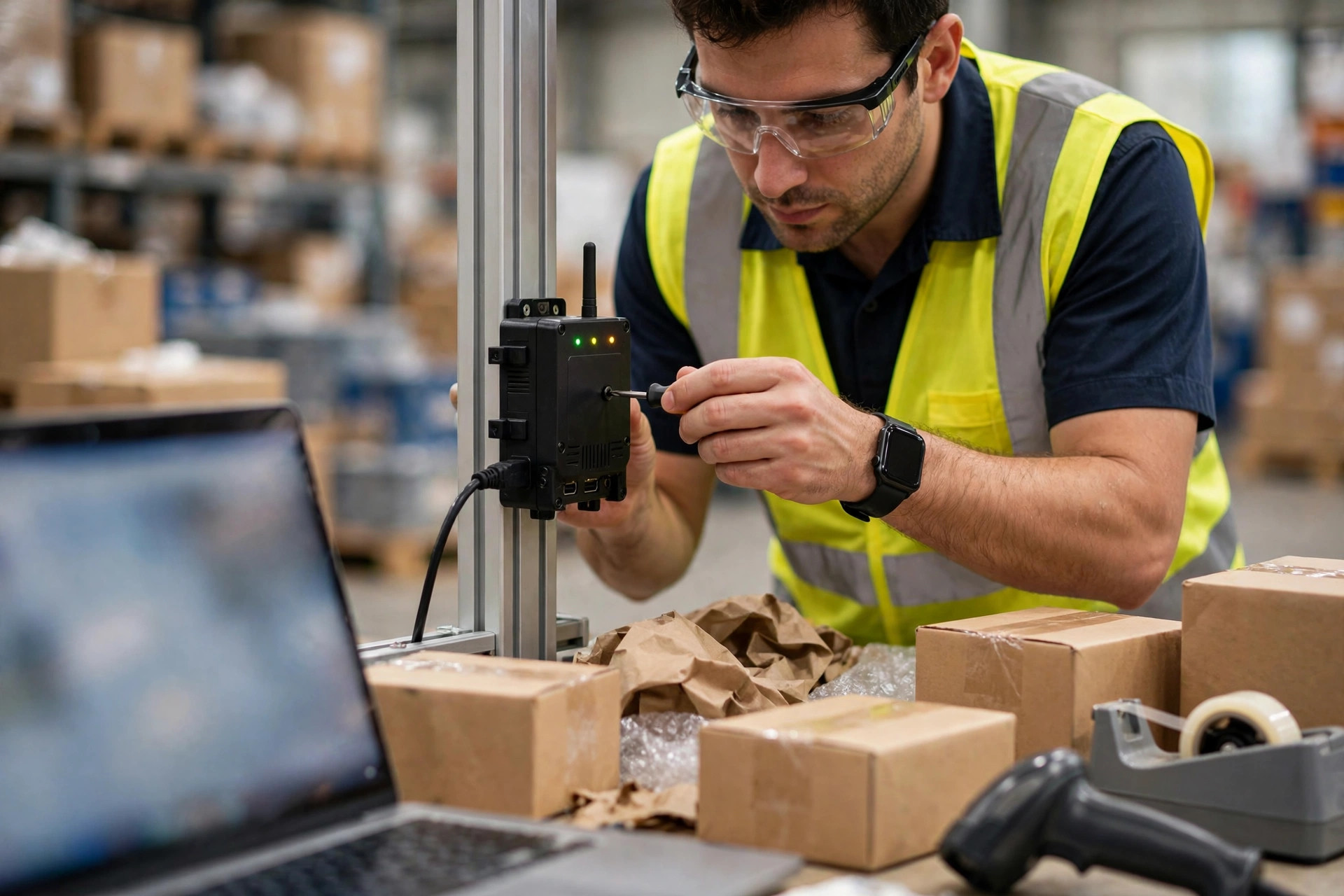
The baseline is the easiest step to skip, precisely because it looks the least "AI." But I hold to this judgment: a pilot without a baseline produces literature, not an acceptance report. Baseline collection has three required parts:
First, current metric values — at least 30 to 60 days of continuous data. Pick cycle time, damage claim rate, count variance rate, or re-check labor hours: the metric must map directly to the problem the pilot targets, and it must be data the team can produce today, not a number the vendor estimates.
Second, how the data was collected. Automatic system logging or manual Excel entry? For manual data, keep the same recording discipline during the pilot; otherwise the "improvement" may just be more careful recording.
Third, confounding variables. Seasonality, promotions, staff turnover, SKU-mix changes — write them down. If the pilot coincides with peak season, the numbers will flatter themselves; exclude the effect or stretch the comparison window to cover a full cycle.
Fill out a baseline record sheet before the pilot starts, signed by both sides. Its very existence is immunity against "it feels better" acceptance.
The acceptance checklist: five questions before the pilot closes
After the pilot runs — I suggest 8–12 weeks, covering at least one full business micro-cycle — answer these five questions one by one. The pilot counts as successful only if all five pass:
| Acceptance item | Pass standard |
|---|---|
| Effect improvement | Core metric beats the baseline by the preset target, sustained at least 4 weeks (not a two-week spike) |
| False-positive and re-check cost | False-positive rate and added re-check time stay acceptable; the total cost still pencils out |
| Real usage | In the final two weeks, staff use the system normally without the vendor on site — not performing for acceptance |
| Replicability | The same process and parameters can move to the next zone or warehouse without special conditions |
| ROI math | Hardware, software, implementation, re-check labor, and training all counted; payback period acceptable to management |
Items two and five deserve emphasis. The most common accounting error is counting only the software subscription and ignoring hidden costs: re-check time from false positives, learning costs, process rework, dual-track operations during the pilot. When AI talks ROI, selective optimism is the cardinal sin — keep effect numbers conservative, never inflated.
Three counterintuitive judgments
First, the primary goal of a first AI pilot is not to prove AI works, but to prove the warehouse can absorb AI. A vendor demo runs anywhere; the real risk was never the algorithm. It is the data foundation and process discipline. A warehouse that cannot produce baseline data is in the most dangerous position when its pilot "succeeds" — it tempts management to build on an unprepared foundation.
Second, pick the "boring" use case, not the "cool" one. Damage detection, quantity verification, anomaly alerts — they make poor stories, but they are high-frequency, measurable, and short-loop. The first pilot's goal is to build organizational capability in the select–baseline–accept cycle, not to produce a headline.
Third, if a pilot can be judged successful without a baseline, it probably proves nothing. Real improvement always shows up in measurable indicators. Any pilot accepted on "positive employee feedback" alone is substituting ritual for verification.
A trend judgment, and an open question
Zooming out, my judgment is this: from 2025 to 2027, small-warehouse AI pilots will shift from the debate of "whether to do it" to the infrastructure question of "what counts as doing it right." As vision, voice, and prediction products keep getting cheaper, the technology bar drops — while the organizational bar, the ability to select, keep data discipline, and set acceptance standards, rises and becomes the main variable separating success from failure. Warehouses that build pilot methodology first will capture the dividend of every price drop; warehouses without it may pay tuition in every technology wave.
So here is the open question: if your warehouse launched its first AI pilot tomorrow, could you produce 60 days of baseline data today? If not, perhaps the real first step is not choosing an AI product, but starting to record data. Pilot methodology begins with recording.
By Dr. Chen, Supply Chain Researcher