When I think about Czech glassware export warehouse packaging, the image that comes to mind is not a port or a container yard but the concrete floor outside a Bohemian workshop, where freshly fired wine glasses stand in rows on a wooden pallet and a worker in gloves lifts each one against the light, setting aside any glass with a hairline mark on its rim. That slow inspection looks like a bottleneck, yet it is the cheapest link in the whole export chain, because a glass that leaves the workshop with a hidden flaw will almost certainly crack somewhere on the road, and by the time it reaches the buyer, nobody will be arguing about when the crack appeared, only about how many pieces will be deducted from the payment.
The inspection at the workshop door decides the fate of the crate
According to what I have observed across European craft exports over the years, most glassware breakage disputes do not really begin on a truck or a ship. They begin at goods-in inspection, at the point where a defect either gets caught and documented or slips silently into a carton. In October 2024 I watched a workshop in northern Bohemia prepare 240 handmade crystal wine glasses for a German distributor. The inspector checked every glass in natural light, rim, stem, and the joint where stem meets bowl, and pulled out nine pieces with bubbles or fine lines, marking them with colored stickers and moving them to a rework area. I would not read an industry rate into that one batch. What it illustrates is a simpler point: a written inspection standard and an inspection actually performed by hand are two different things, and a sampling check lets flawed pieces through at a far higher rate than a piece-by-piece check.
My own rule is to turn inspection into something that can be re-checked later. Glasses are grouped by style, and the inspector records three items for each group in the packing list or the system: appearance, stem symmetry, and rim evenness. Any abnormal piece is photographed and numbered separately, and the photos are filed by carton number. The photos do not need to look like advertising shots. They need three elements — the piece identifier, the location of the defect, and the date — because months later, when a claim arrives, the buyer, the forwarder, and the insurer will not be debating whether glass is fragile. They will be debating what that particular glass looked like when it left the workshop.
Dividers and upright packing: the cheapest insurance in Czech glassware export packaging
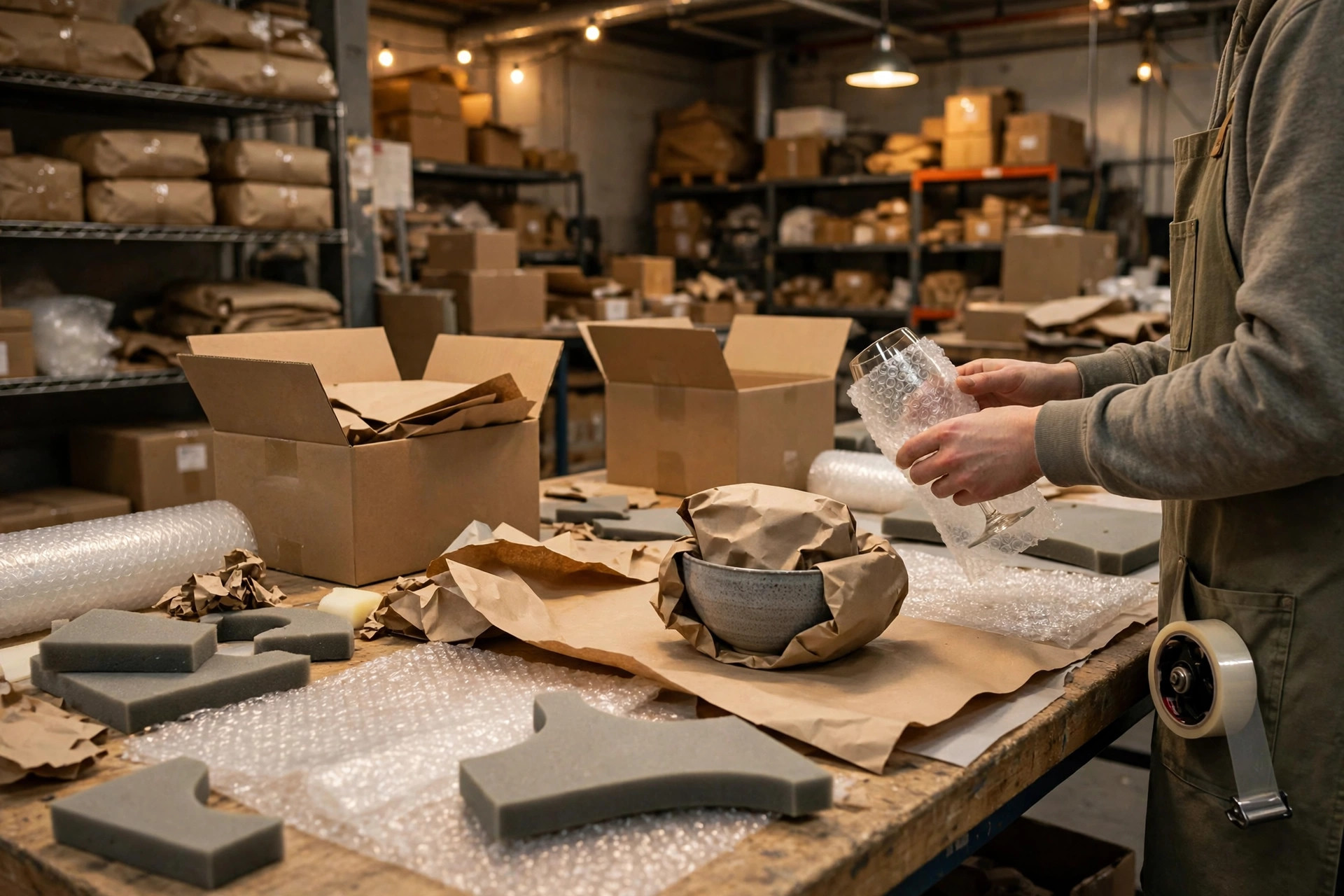
What glassware fears most is not one heavy blow but repeated contact between two hard surfaces during transit, and dividers exist to cut that contact off at the source. Corrugated dividers are the default choice for a reason: they are light, cheap, and recyclable, and they suit ordinary wine glasses with even wall thickness. For tall-stemmed glasses I prefer adding a thin layer of bubble wrap or paper lining inside each divider cell, so the stem does not press directly against the bottom of the cell. Divider cells must be sized from the actual glass, not from habit. A cell that is too large lets the glass rattle, and a cell that is too small puts pressure on the rim at the very moment of packing, planting a crack before the journey even starts.
The upright versus flat question is the one I get asked most often, and it is also the one where intuition most often misleads. Instinct says flat is safer because the center of gravity is lower, but for a stemmed glass, lying flat loads the stem and the bowl at the same time, and one sharp braking event turns the stem into the fulcrum of a lever, which is exactly how stems snap. Standing upright distributes the load along the body of the glass, and a top pad can be added above the rim inside the cell. The cost is height: fewer pieces fit in the same carton. My working rule is practical rather than theoretical. When the stem is longer than half the height of the bowl, the glass travels upright. Short, thick-walled tumblers and mugs travel flat with dividers without any problem, and insisting on upright packing for them only wastes carton space.
Crates, marks, and the arithmetic of one shipment
A thicker crate is not automatically a better crate. Heavy boards and steel strapping resist compression, but the added weight raises air freight charges where volumetric weight applies and complicates pallet loading for sea freight, and an overweight crate is more likely to be dragged or tilted by handlers trying to save effort, which creates exactly the kind of handling damage the crate was meant to prevent. The layered approach I have seen work best uses divided cartons inside, a wooden crate as an outer frame, corner protectors on the crate, and void fill packed tight enough that shaking the sealed crate produces no sound at all. That shake test is crude, and that is its virtue: if anything still moves inside the crate, it will certainly move on the road.
The trade-off becomes clearer when the common options are set side by side, with cost shown as a tier rather than a false precise figure:
| Option | Main protection | Cost tier | Best for |
|---|---|---|---|
| Corrugated dividers | Against impact and friction | Low | Standard wine glasses, thick-walled tumblers |
| Dividers plus bubble lining | Against impact, cushioning for stems | Medium | Stemmed glasses, thin-walled crystal |
| Wooden crate frame with full void fill | Against compression and shifting | High | Long sea voyages, high-value handmade pieces |
Run a hypothetical calculation on that table. A carton holds 48 wine glasses, and skipping the inner lining saves a small amount per carton. If that saving costs three extra broken glasses, the replacement, re-inspection, and second shipment will exceed the lining cost for the whole batch several times over, before counting the damage to the buyer's confidence in the next order. Packaging cost should never be judged on its own line. It belongs in the same calculation as replacement cost, claim cost, and lost repeat business, and judged alone, it produces the most common false saving in export warehousing.
A claim is decided by evidence, not luck, in Czech glassware export packaging
In March 2025 a shipment of Czech glassware routed through the port of Hamburg arrived with 12 pieces reported broken, and the exporter initially expected to absorb the loss, because the crates looked intact from the outside and the carrier insisted nothing unusual had happened in transit. The case turned on the packing file. Every crate had a top-down photograph taken before sealing, showing the divider layout, the orientation of each glass, and the top padding, and the buyer had filmed the unboxing as agreed. The broken pieces were concentrated in one corner of a single crate, where the corner protector showed a slight dent. That evidence narrowed the dispute from a general complaint about fragile glass to a specific impact on a specific corner at some point in handling, and both the claim negotiation and the insurance process moved much faster as a result.
The method behind that outcome is not complicated, which is precisely why it is so often skipped. Photograph the crate before sealing, mark the outside with style, quantity, crate number, and this-way-up symbols, and ask the buyer to photograph the unboxing in return. Marks deserve the same care as the packing itself, because a crate whose number does not match the packing list, or whose handwriting cannot be read, gets handled and re-sorted more often at the destination port, and every extra handling is another chance of damage. As for the exact customs and insurance terms, these change by country and by carrier, so before signing, the current official policy should be checked rather than relying on the terms of the previous shipment.
Looking at this trade as a whole, the real barrier for Czech glassware has never been how well the glass is blown. It has been whether each step from the workshop door to the destination warehouse translates the word fragile into an action that can be checked: inspection with photos, dividers sized to the piece, orientation chosen by glass shape, crates chosen by journey length, and claims argued from evidence. Orders are becoming smaller and more customized, which means crates will hold more mixed combinations and packing teams will face more variation, and the open question I keep returning to is whether dividers and linings can become modular enough to fit each new combination as precisely as a made-to-measure case, instead of relying on workers improvising with loose paper at the packing bench.
By Dr. Chen, Supply Chain Researcher