Start with conveyor belt tracking causes warehouse crews misread every week: the side the belt drifts toward is rarely where the fault lives. A belt steers like the front wheel of a bicycle. Tilt that wheel a couple of degrees and the bike slowly rides into the curb, no matter how straight you think you are holding it. Most mistracking I get called in for has already been made worse by someone cranking on the head pulley or bolting on a tracker before anyone stopped to ask three simple questions. Does it drift empty or only loaded? Does it drift everywhere or only on one stretch? Does it drift steadily, or once per belt revolution? Those three answers narrow the cause before you spend a dollar.
Belt tracking causes you can check first: idlers and frame
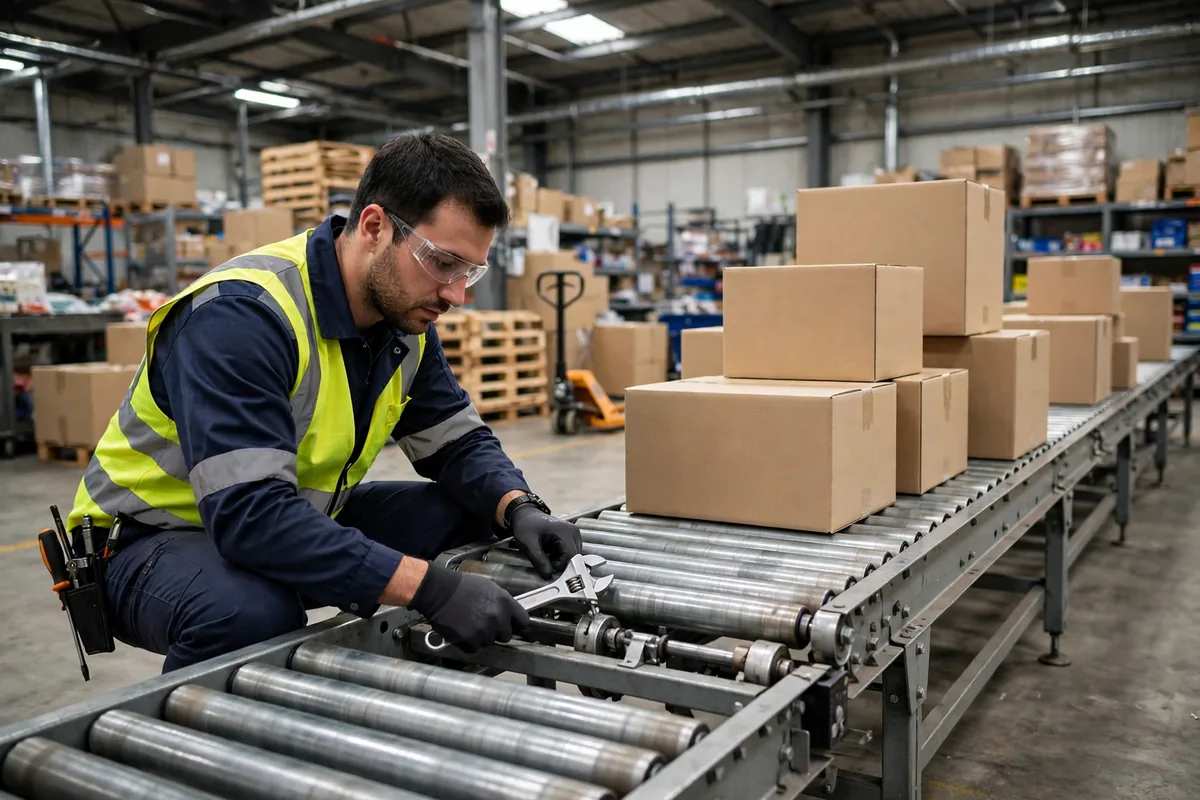
The most common cause is a skewed idler set or a frame that is not square to the belt centerline. The rule is simple: a belt steers toward the side of the idler it contacts first. A few millimeters of skew per set compounds over the length of a line, the same way a small steering error compounds over a long road.
In August 2023 I was called to a 42-meter outbound line at an apparel warehouse in Zhengzhou. Running empty for 10 minutes, the belt edge walked about 35 millimeters to the left and had polished a bright stripe into the skirt rubber. The local crew had adjusted the head pulley three times and made it worse each time. We stopped the line, snapped a centerline, and measured every idler set. Set number 17 sat 8 millimeters forward on one side — a replacement idler had been bolted through the wrong hole in its bracket. We squared that one set, ran the line for 40 minutes, and the drift settled inside 5 millimeters. Nobody touched the head pulley again.
The check costs nothing. Run the belt empty at low speed, mark the edge, and watch whether the drift builds gradually with distance. Then lock out, pull a line, and measure each idler set for squareness and level. If the drift starts at one point, look one or two idler sets upstream of where you first see it. That is where the steering input is coming from.
Belt tracking causes tied to loading: off-center feed
The second cause is load placement. If the belt runs true empty and drifts only under load, stop adjusting hardware and stand behind the feed point. Product landing off center loads one side of the belt more than the other, and the belt yields toward the heavier, later-contacting side. Think of passengers all sitting on one side of a small boat: the boat does not have a rudder problem, it has a loading problem.
In November 2024, a 3PL warehouse in Suzhou was pushing roughly 18,000 parcels a day in peak season. Their pre-sort line drifted right whenever cartons got large, yet small parcels ran fine, and the team was already pricing a replacement belt for alleged aging. I stood at the infeed and watched for two minutes. Cartons coming off the lift were landing about 60 millimeters right of belt center, and bigger cartons put their weight even further out. We shifted the feed chute, added an adjustable guide plate, and held the landing point within about 20 millimeters of center. The drift was gone the same day, and that supposedly worn-out belt ran for more than another year.
Test it the cheap way: run 10 minutes empty, 10 minutes with uniform small items, and 10 minutes with your normal mixed load, logging the belt edge position each time. Empty true and loaded drifting means loading. Chasing idlers in that situation just adds a second fault on top of the first.
A cheapest-first diagnostic table for belt tracking
| Order | Check | How to do it | What the result tells you |
|---|---|---|---|
| 1 | Empty vs. loaded run | 10 minutes each, log edge position | Empty drift points to mechanics; loaded-only drift points to loading |
| 2 | Centerline and idlers | Lock out, pull a line, measure squareness and level | Drift starting at one spot points 1-2 idler sets upstream |
| 3 | Feed point | Stand behind the infeed, measure landing offset from center | Large offset means fix the chute before touching the belt |
| 4 | Splice and belt camber | Check the splice is square; look for a crescent-shaped belt edge | Drift once per revolution usually means splice or camber |
| 5 | Buildup on rollers | Scrape pulleys and idlers clean, then retest | Drift gone after cleaning means buildup had enlarged one side |
The third cause is the one most often misdiagnosed as an adjustment problem: a splice that is not cut square, or camber in the belt itself — a belt manufactured or stored so one edge is effectively longer than the other. A bad splice produces a rhythmic drift, one lateral kick each time the splice passes. Camber produces drift that no idler adjustment cures for long, because you can steer one stretch back only by steering the next stretch out. If the drift repeats on the belt's revolution cycle, count the timing before you turn another bolt. Re-making the splice or replacing the belt section is the fix; more adjustment is just noise.
Here is the counter-intuitive part, and I will say it plainly: adding more automatic tracking devices can make a line less reliable, not more. Trainers, self-aligning idlers, and edge-guide systems are a safety net, not a cure. If an idler set is skewed, a tracker fights it all shift and eats the belt edge doing it. If a splice is crooked, a tracker hides the kick until the device wears, and then the problem comes back all at once. I once audited a warehouse running three tracking devices on one line that had gone through two belts in a year; both belts came off with edges chewed into fringe. Fix the root cause first. Only when the remaining wander is small and random does a tracking device earn its money.
One more trap: tighter is not better. Over-tensioning does not change the direction a belt wants to steer. It only raises the lateral force, loads the bearings harder, and shortens splice life. Run enough tension to prevent slip and excessive sag, and no more.
Do this on your next walk-through: grab a marker and a tape measure, run 10 minutes empty and 10 minutes loaded, write down the edge position, then work the table from step 1 to step 5. Most mistracking can be located in half a shift without approving a belt purchase. Whether any fix was worth the money comes down to one number: after 30 minutes running empty, does the belt edge hold within about 10 millimeters? If it will not hold, the root cause is still in the line — keep looking before you buy a tracker.
By Da Liu, Automation Engineer