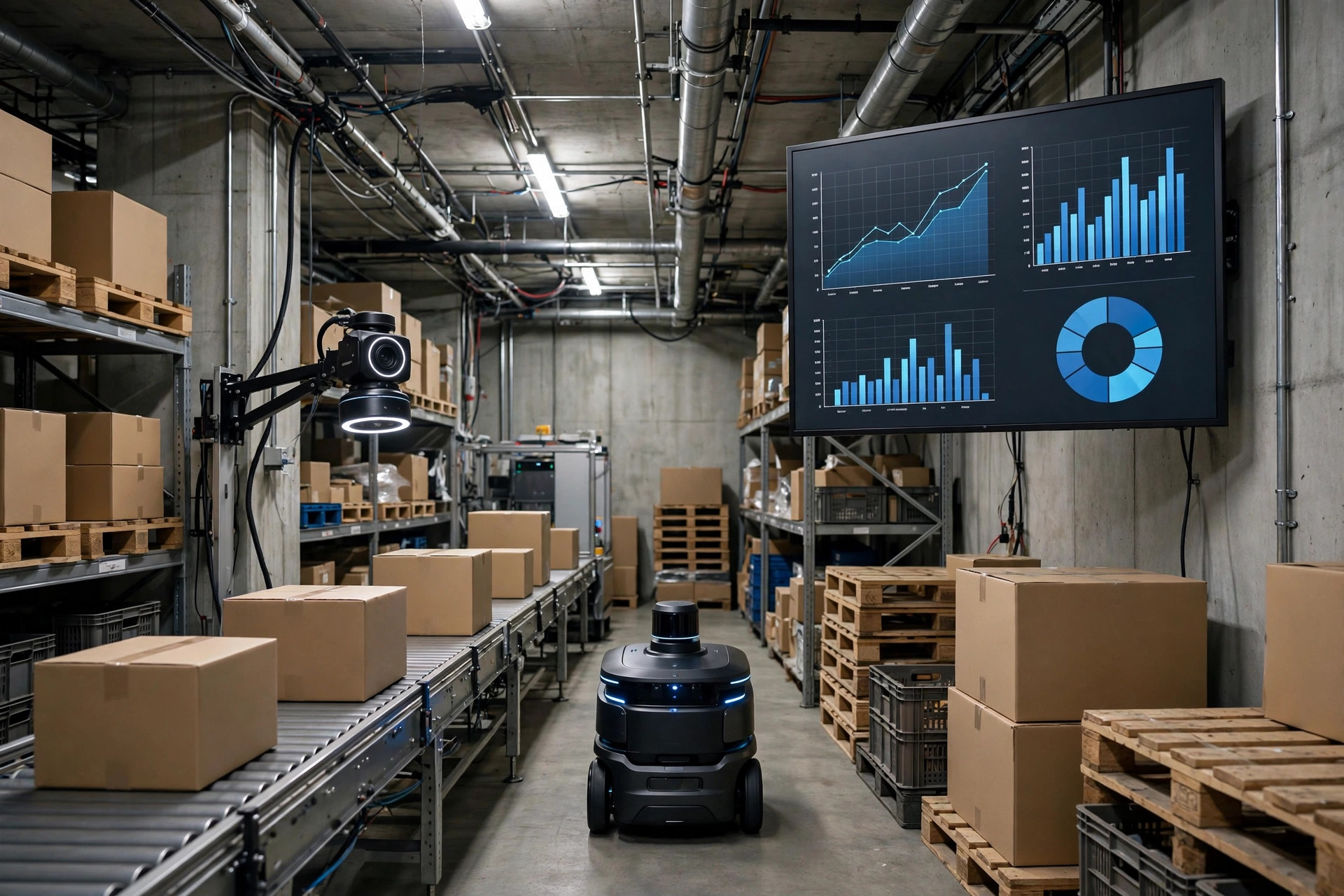
Last week, two AI vendors came to demo their systems at my 3,000-square-meter warehouse. The dashboards looked stunning — cameras recognizing products in a flash, picking routes drawn prettier than a subway map. Then the sales guy leaned in and whispered, "Annual license under 80,000 yuan — that's barely over 200 a day."
I nearly spat out my tea. Under 80,000? My entire warehouse's annual electricity bill is barely over 60,000.
I didn't haggle. I asked three questions instead: What's the minimum inventory accuracy you'd need from my system before going live? Does your AI know who my shift lead is? What happens when Lao Li, who's done cycle counts for eight years, refuses to use your system? The salesman's smile froze.
That's when it clicked for me: the most expensive part of AI adoption isn't the software — it's the fact that our organization isn't ready. It's like blind dating — if the fundamentals don't match, every meeting is a waste of time.
So here's my honest take as a small-warehouse owner: before any AI vendor walks through your door, run three readiness checks on yourself — data, process, and people. Each comes with a scrappy, low-cost fix. The big-company playbook of consultants and change-management programs? We can't afford it, and we don't need it.
If Your Data Isn't Clean, AI Is Just an Expensive Spreadsheet
Here's the counterintuitive truth: the biggest risk in AI adoption isn't bad algorithms — it's garbage data fed into good ones. The enterprise world calls it "data-driven." In a small warehouse, it translates to one question: how many of the inventory numbers in your system are actually right?
Last year I had a fellow warehouse owner help me measure our inventory accuracy. The first full count came back at 73%. Our master data was worse — the same SKU had three different names, with over 400 of these "triplets" in the system. A camera recognizing "a red mug" means nothing when my system can't tell which red mug it is.
Here's the scrappy fix. I didn't buy any "data governance service." I did three rough-and-ready things:
First, for eight straight weeks, we closed two hours early every Friday and did a full-team count. I bought dinner — less than 800 yuan extra a month. Second, ABC classification: A-items counted daily, B-items weekly, C-items whenever. Third, a "triplet kill list" on the whiteboard: 20 yuan in bubble-tea money for every duplicate SKU merged. Two months, 300+ duplicates gone.
Two months later, our accuracy went from 73% to 96.5%. My attitude toward AI demos completely flipped — from "wow, amazing" to "is my data even worthy of you?" The leverage had switched sides.

If the Process Lives in Someone's Head, AI Can't Learn It
Data is static; process is alive. And in small warehouses, the process mostly lives inside veteran employees' heads.
My shift lead has been with me six years. Short on stock — which orders to cut, which to ship first. A mispick — call the carrier or the customer first. A dropship client's order — can it share a carton with another client's goods. One phone call, always right. During a vendor's "intelligent exception handling" demo, he muttered from the corner: "It doesn't even know that Zhang is a dropship client whose goods can't ride with Li's. Some intelligence."
Dead silence.
That's the small-warehouse reality: our SOPs aren't on paper; they're in people. When someone leaves, the process walks out with them. AI learns rules — and if you haven't written the rules down, there's nothing for it to learn. No 300-page manuals, though: we can't write those, and we can't enforce them. The scrappy version: write your ten most common exceptions on one sheet of paper and stick it on the wall.
"Ten receiving questions" by the dock door. "Three steps for exceptions" at the packing bench — dictated by the shift lead, typed by me, one page each. Fifteen-minute standup every week: walk through the week's exceptions, check whether they followed the sheet, review the ones that didn't. Two months in, exception handling visibly converged — three shift leads used to mean three different calls; now it's basically one voice.
Remember this: before AI adoption, move the process from brains to paper. If it's not on paper, it won't be in the algorithm.
If the Veterans Don't Buy In, AI Is Decoration
The first two are technical problems. This one is a people problem — and it's the deadliest.
Early this year, a friend running a 5,000-square-meter warehouse in Chengdu rolled out a scan-based picking system — over 40,000 yuan in hardware, software, and implementation. The result? His veteran staff, five years on the job, decided scanning "slowed them down." For three months the scanners hung around their necks as ornaments. Forty thousand yuan bought a very expensive necklace. "Good system," he told me. "Nobody uses it. What's the point?"
Small warehouses can't afford that kind of experiment. So my scrappy rule: find your seed users first; skip the all-hands campaign.
How it works: pick the most curious young worker in each shift and let them try it first. Then the critical step — convert the time they save into piece-rate bonuses, paid in real money. Everyone else sees it: "Wait, that kid took home 600 extra this month?" No pep talks needed; they'll line up to ask how. Human nature works like this: a hundred speeches about "AI is the future" can't beat watching the guy next to you earn 600 more.
AI adoption works the same way. Don't start with "full warehouse intelligence." Start with one process, one person, one visible win. Veterans don't resist AI — they resist "a bunch of hassle that ends up worse than before." Prove it makes life easier, and they'll be more enthusiastic than you.
The Readiness Scorecard: Score Yourself Before Spending
Enough talk — here's the checklist I use. Score each item 0 to 2, thirty points total.
Data (0 = no, 1 = exists but shaky, 2 = solid)
- Inventory accuracy has held above 95% for three straight months
- Clean master data: one SKU, one name, with barcode, dimensions, and weight on file
- Every day's inbound and outbound transactions hit the system same-day — no backlogs, no backdating
- Data exceptions get followed up: variances, losses, and damages are logged with conclusions
- You can pull three months of order history in a consistent format
Process
- Receiving, putaway, picking, packing, and shipping each have a written SOP (one page counts)
- High-frequency exceptions — stockouts, mispicks, damages, rejections — have a defined call
- A new hire can work independently in a week following the SOP, no veteran hand-holding
- Process changes have a decision-maker and a record — not whoever shouts loudest
- A fixed weekly review turns exceptions into rules
People
- There's one named owner of the AI rollout — not "everyone's responsible"
- Veterans have heard from your own mouth that AI is here to save them effort, not take their jobs (you said it yourself; don't assume they know)
- At least one willing seed user exists
- Someone on the team can read a data report without calling the vendor
- You, the owner, can carve out two hours a week to personally follow this — no absentee management
Scoring: 24 or above — invite vendors to talk pilots. 18–23 — do homework first, fix what's missing. Below 18 — keep the budget in your pocket. Spend it now and most of it becomes sunk cost.
The Math: What Premature AI Adoption Really Costs
Let's do the math. Say you're at 15 points and go ahead anyway:
The software license, 80,000 yuan a year — the visible bill. Implementation consultants, 30,000 for two weeks on-site — the hidden bill. The nastiest one is the third: you go live right before peak season, the team learns the system while rushing orders, error rates double, you lose a customer or two — 50,000 yuan minimum. That line never appears in any vendor's slide deck.
That's 160,000 yuan at minimum, and it buys less than spending 10,000 (dinners, bubble tea, overtime pay) to get your data and process straight first. AI investment without readiness has negative ROI — and it's a certain negative.
At 24 points, your negotiating posture completely changes: "My accuracy is 96.5%, my SOPs are on the wall, my seed user is ready. Tell me how much labor your AI saves me in three months." They used to sell you a dream; now they do homework for you.
Big companies do AI adoption with consulting firms and change-management programs — millions a pop. We can't use that playbook. But small warehouses have their own way: count your own inventory, write processes on paper, win over one person first. Scrappy, but it works.
So next time an AI vendor knocks, don't ask about price first. Ask yourself: data, process, people — what's my score? If it's high enough, invite them in for tea. If not, go count your inventory first. Small warehouses have their own way of surviving — and the ones who prepare before stepping onto the field are the ones who don't pay tuition.
By Xiao Ma, Small Warehouse Owner