Let me tell you something. Fifteen years driving long haul, I've rolled into close to a thousand warehouses. How they stack the freight inside — that's the warehouse manager's business, not mine. But which wall the docks are on, which way the trucks come and go — I deal with that every single day. I know it better than most people who work inside.
A while back I delivered to a warehouse out in Ontario. Got there at seven in the morning, and there were already four or five trucks lined up at the gate. Every dock door was crammed onto the one south-facing wall — receiving doors shoulder to shoulder with shipping doors. I finished unloading and tried to leave, but a pickup truck was backing in at the same time. Inbound, outbound, all jammed in the same yard, nobody moving. I sat in my cab for nearly an hour watching forklifts race around inside, busy as anything, while the gate stayed gridlocked.
Two days later, a big facility in Fontana. Completely different picture: receiving on the east end, shipping on the west end. I unloaded on one side, they loaded on the other, trucks looping around the building like a conveyor belt. But my buddy Lao Wang, who runs that lane regular, grumbled that the place is so big it takes seven or eight minutes just to drive the empty truck from the receiving doors around to the shipping doors. Over a full day, that's a good ten-plus miles of extra driving.
Two trips, and it clicked for me: warehouse flow comes down to U-flow versus through-flow — "receive and ship off the same wall" or "in one end, out the other." Dock positions are fixed, especially in a leased building. The landlord decided which wall gets the doors years ago, and you're not moving them. But flow? Flow isn't all about the docks. There's plenty you can still work with.
U-Flow: Same Wall for Everything — Saves Space, Invites Pileups
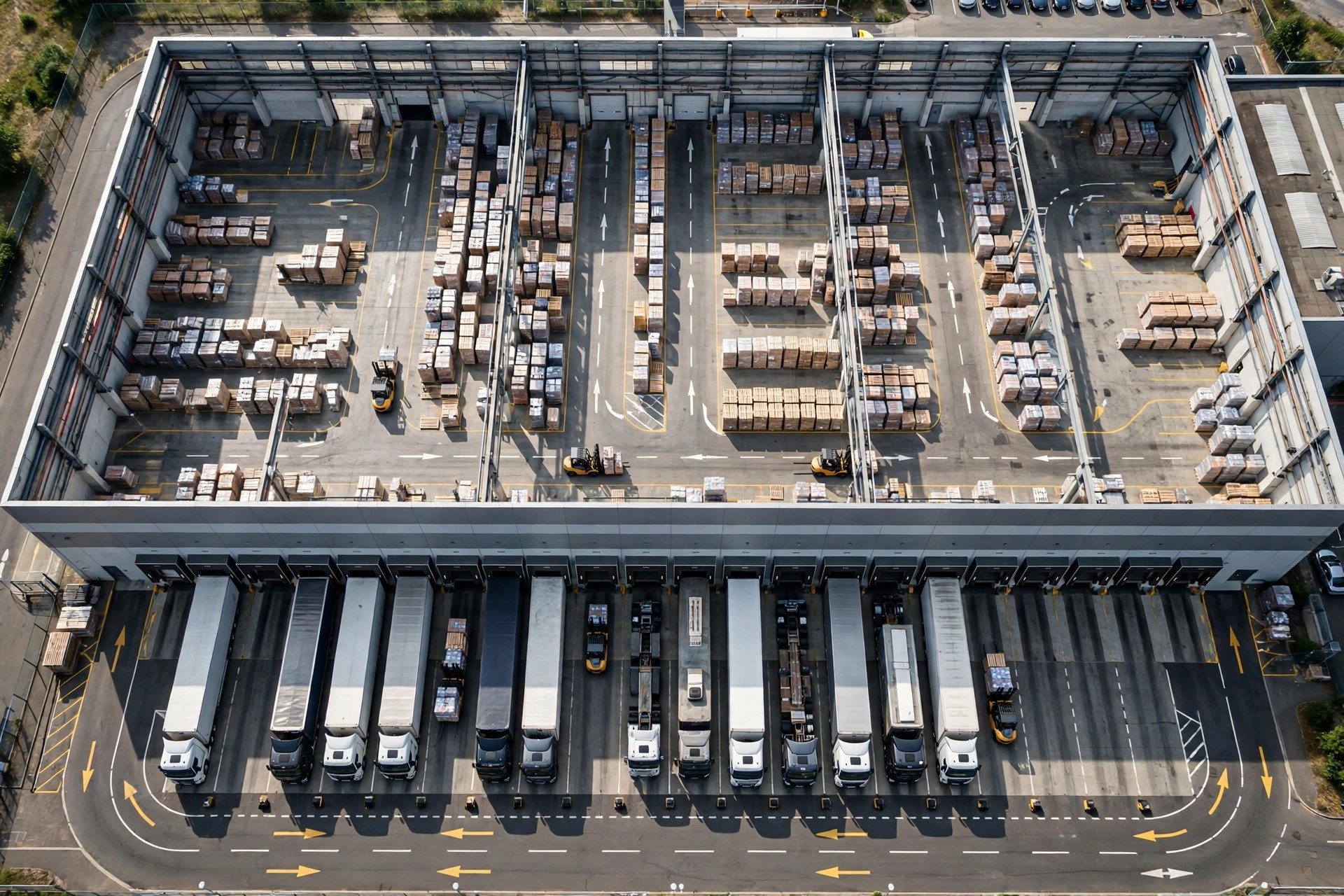
U-flow means receiving and shipping sit back to back along the same dock wall. Freight comes in off that wall, loops through the building, and goes back out the same wall. Draw it on paper and it looks like a U.
I know this layout best. Small warehouses, 3PL cross-dock operations — seven out of ten run U-flow. The upside is real: docks concentrated on one wall means you only maintain one yard. Security, dispatch, the gate guard — one crew covers it. Forklifts never cross the whole building, receiving staging sits close to shipping staging, and the same crew can receive in the morning and ship in the afternoon. Easy to staff.
The downside, I've lived through: when the receiving peak and the shipping peak collide, the gate turns into a mess. Delivery trucks trying to get in, pickup trucks trying to get out, all queuing in the same yard. Inside it's the same story — receiving forklifts and shipping forklifts fighting over the same staging area. The worst I ever saw was the week before Thanksgiving at one facility: a dozen-plus trucks parked in the yard, the dispatcher shouting into his radio until he went hoarse.
So whether a U-flow warehouse runs smooth comes down to one thing: can you separate receiving hours from shipping hours? Separate them, and U-flow is cheap and effective. Let them collide, and the gate plays bumper cars every day. Plenty of folks assume U-flow is the "budget" layout. Truth is, a U-flow with separated peaks beats a through-flow with colliding peaks any day.
Through-Flow: In One End, Out the Other — Smoothest, Pickiest
Through-flow is what we drivers call "in one end, out the other": receiving docks on the east, shipping docks on the west. Freight comes in the east side, travels straight west, gets loaded, gone. No backtracking.
It's the smoothest flow there is. Receiving and shipping each get their own doors, trucks never fight, forklifts never cross paths. Big facilities, consumer goods DCs, e-commerce peak-season warehouses — they mostly run this way. I used to run a lane to an apparel DC that pushed hundreds of trucks a day in peak season. If receiving and shipping shared one wall, that yard would have exploded.
But through-flow is picky about real estate. First, the building has to be big and long — a short, square box can't pull it off. Second, you need a maneuverable, queue-friendly yard on two walls, which means maintaining two yards. And the travel distances inside are longer; a forklift's one-way trip runs noticeably farther than in U-flow. Lao Wang's seven-to-eight-minute loop is the price of through-flow — the freight glides, the trucks drive extra.
Quick comparison:
| U-Flow (same wall) | Through-Flow (end to end) | |
|---|---|---|
| Fits | Small-to-mid warehouses, square footprints | Big warehouses, long footprints |
| Fits the volume | When receive/ship peaks can be separated | All-day high throughput, both ends busy |
| Biggest fear | Peaks colliding, gate gridlock | Not enough room, long internal hauls |
| Driver's view | Might queue at the gate | Extra minutes looping the yard |
Bottom line: U-flow is "saves space, easy to staff, hates collisions." Through-flow is "smooth flow, big throughput, hungry for space." Neither is inherently better — only better matched to your volume.
Can't Move the Docks? Plenty You Can Still Move
Here's the part that matters. In a leased warehouse, the landlord fixed the dock wall. You can't change it. But after all these years on the road, I've seen plenty of warehouses with mediocre dock positions and fantastic flow. The tricks are all here:
One: dedicate the doors. Even with every door on one wall, stop mixing receiving and shipping. Left few doors for receiving only, right few doors for shipping only, draw a line down the middle. Trucks roll into the yard already knowing which side they're headed for — no more asking around at the gate. Costs nothing. Works immediately.
Two: park staging next to the doors. Receiving staging hugs the receiving doors; shipping staging hugs the shipping doors. Sounds obvious, but I've seen too many warehouses unloading at the east end while staging sits at the west end, forklifts running a daily marathon across the building. The closer staging sits to the doors, the fewer wasted miles.
Three: give fast movers the golden spots. Every warehouse has those SKUs that arrive today and ship tomorrow. Put them in the slots nearest the shipping doors; leave the far slots for the slow stuff. No system needed — any veteran knows the fast movers by heart, and it's a five-minute change in the WMS slot priorities.
Four: make the aisles one-way. Paint the main travel lanes with direction arrows — in one lane, out another — so forklifts stop meeting head-on in the aisles. U-flow warehouses need this most, since receiving and shipping forklifts share the same zone to begin with.
Five: negotiate appointment windows with carriers. Receiving trucks in the morning, shipping trucks in the afternoon — force the peaks apart by schedule. The warehouse has to drive this conversation with shippers and carriers, but once it's agreed, a U-flow gate gets twice as quiet.
Six: borrow yard space when you have to. If the queue won't clear, rent half a lot next door as a buffer, or talk the landlord into marking a temporary waiting area. Pride doesn't matter; moving trucks matter.
None of these six touch a dock door. All software, no construction. I know a 50,000-square-foot warehouse that ran just three of these — dedicated doors, staging by the doors, appointment windows — and cut peak-season gate queues from two hours to under twenty minutes.
Leasing a Warehouse? Drive It Three Times First
One last piece of advice for anyone about to sign a lease: before you sign, don't just look at rent and square footage. Drive the site three times. First loop: the docks — enough doors, and where do trucks queue at peak? Second loop: the yard — easy to turn around, anywhere to park overnight? Third loop: the neighborhood — decent roads, any truck restrictions? Three loops, and you'll know in your gut whether this building's flow runs smooth or clogs.
There's an old saying back home: good roads are made by the trucks that drive them. Warehouse flow works the same way. Dock positions are fixed, but the road is alive — how you split the doors, where you stage the freight, when the trucks show up. Get those right, and U-flow or through-flow, either one runs smooth.
By Shifu Zhao, Trucking Veteran (15 yrs)