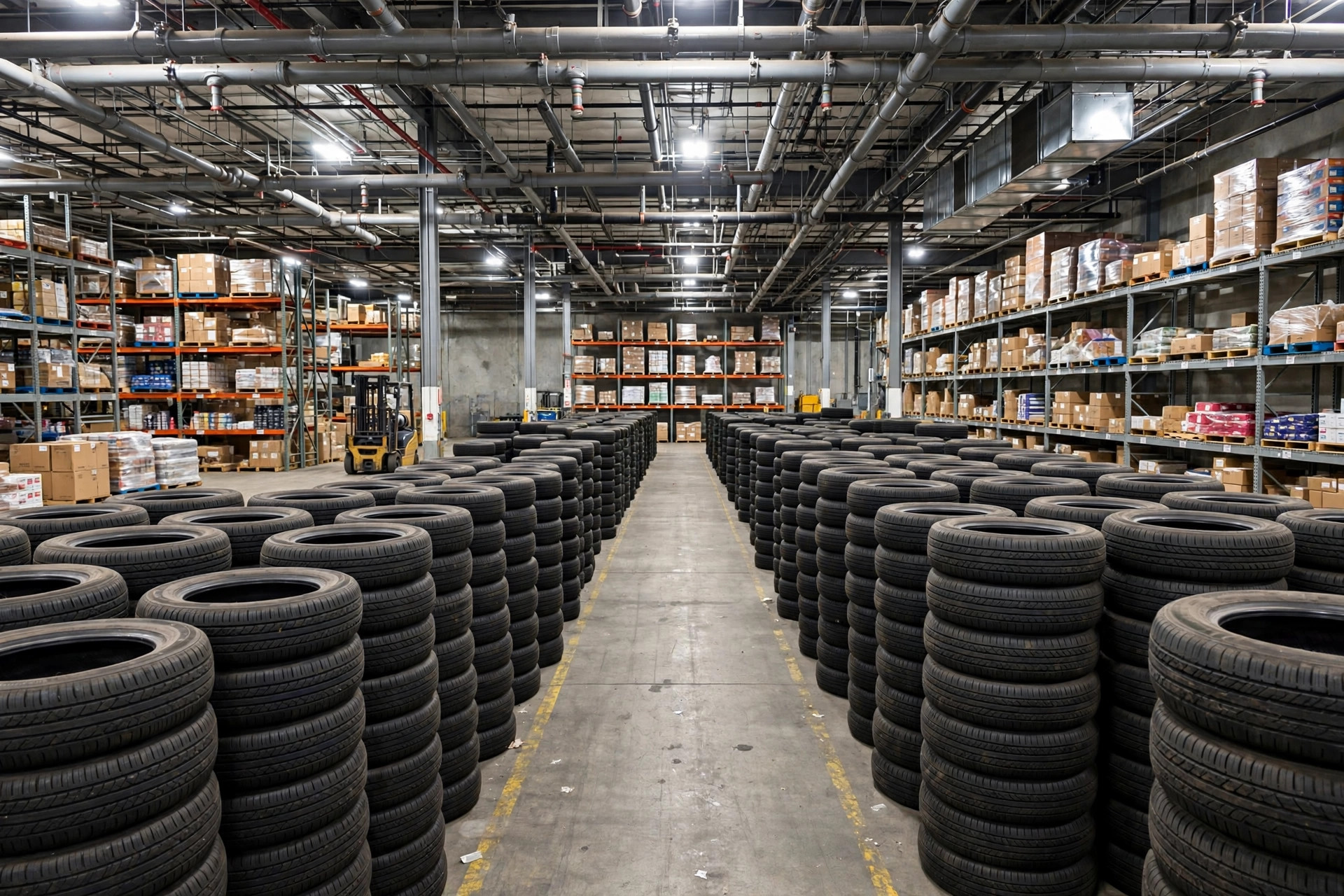
Here's my verdict up front: tires are the most underestimated fire hazard in a warehouse. In spring 2024, a 3PL owner in the Inland Empire called me, frustrated — the fire marshal had walked his tire distribution warehouse, handed him a correction notice, and given him 30 days. His tires were stacked 8 feet high. That made it high-piled storage, and his sprinkler protection wasn't rated for it. His exact words: "They're tires, not gasoline. Eight feet is high?" Yes. It is. Under the fire code, rubber tires sit in the same hazard class as gasoline drums and plastic pellets.
This breaks two ways. First, plenty of tire warehouse operators don't know tires get special treatment. Second, even the ones who know often confuse empty-pallet stacking limits with tire commodity storage — those are two different animals. Empty pallets are packaging; tires are the commodity, and the protection logic is completely different. This article is about the three numbers that matter for tires in a warehouse: stacking height, spacing, and sprinklers.
Why Tire Fires Are So Nasty
Start with the physics. Rubber has an extremely high heat release rate — that's already bad enough. But what makes tires uniquely difficult is their shape: a hollow torus. Once burning, heat convects through the tire hole and accelerates, so fire jumps from one tire to the next fast. At the same time, that same shape shields the seat of the fire from sprinkler water — water runs off the curved surface instead of reaching the flames.
Think of a pile of tires as a stack of "hollow fire bricks": they feed the fire and block the water at the same time.
The worst case is a stacking method called laced: tires interlocked at angles, one wedged into the hole of the one below. The upper tire completely shields the lower one, and sprinkler discharge can't penetrate. NFPA 13's tire storage chapter singles out laced storage as the hardest arrangement to protect. It saves space, no question. It's also a nightmare to extinguish.
So the code's special treatment of tires isn't bureaucratic overreach — it's written in fire history. One background note: the old NFPA 231D, the dedicated standard for rubber tire storage, was folded into NFPA 13 years ago. Tire storage now lives inside NFPA 13. Clause numbers shift between editions, so verify against the current NFPA/IFC editions rather than memorizing old section numbers.
The Three Fire Code Numbers: A Quick Decision Table
| Dimension | The line | What it means |
|---|---|---|
| Stacking height | Over 6 ft for high-hazard commodities = high-piled (general commodities: 12 ft) | IFC Section 202 phrases the 6-ft tier as "where required by the fire code official" — but marshals overseeing tire warehouses enforce it almost universally. Don't gamble on it |
| Spacing | On-tread piles: max 25 ft in the direction of the wheel holes; pile width max 50 ft (25 ft against a wall); main aisles at least 8 ft | The 8-ft aisle is a fire break to keep a fire from jumping pile to pile |
| Sprinklers | 36-inch clearance below sprinklers (general commodities: 18 inches) | 36 inches gives the spray room to develop and spread; tires need double the normal distance |
Height is the counterintuitive one. Most commodities hit the high-piled threshold at 12 feet; tires cross it at 6. Six feet is nothing — a passenger tire is a bit over 2 feet in diameter, so three layers of on-tread storage already puts you over. Warehouse crews routinely stack four high and think "four layers, that's not high" — by the book, it is.
Spacing gets dismissed as the fire department making work. The 8-ft main aisle and the 25-ft pile length limit exist to box a fire inside one pile. Once a tire fire connects across piles, sprinklers can at best contain it — extinguishment is off the table.
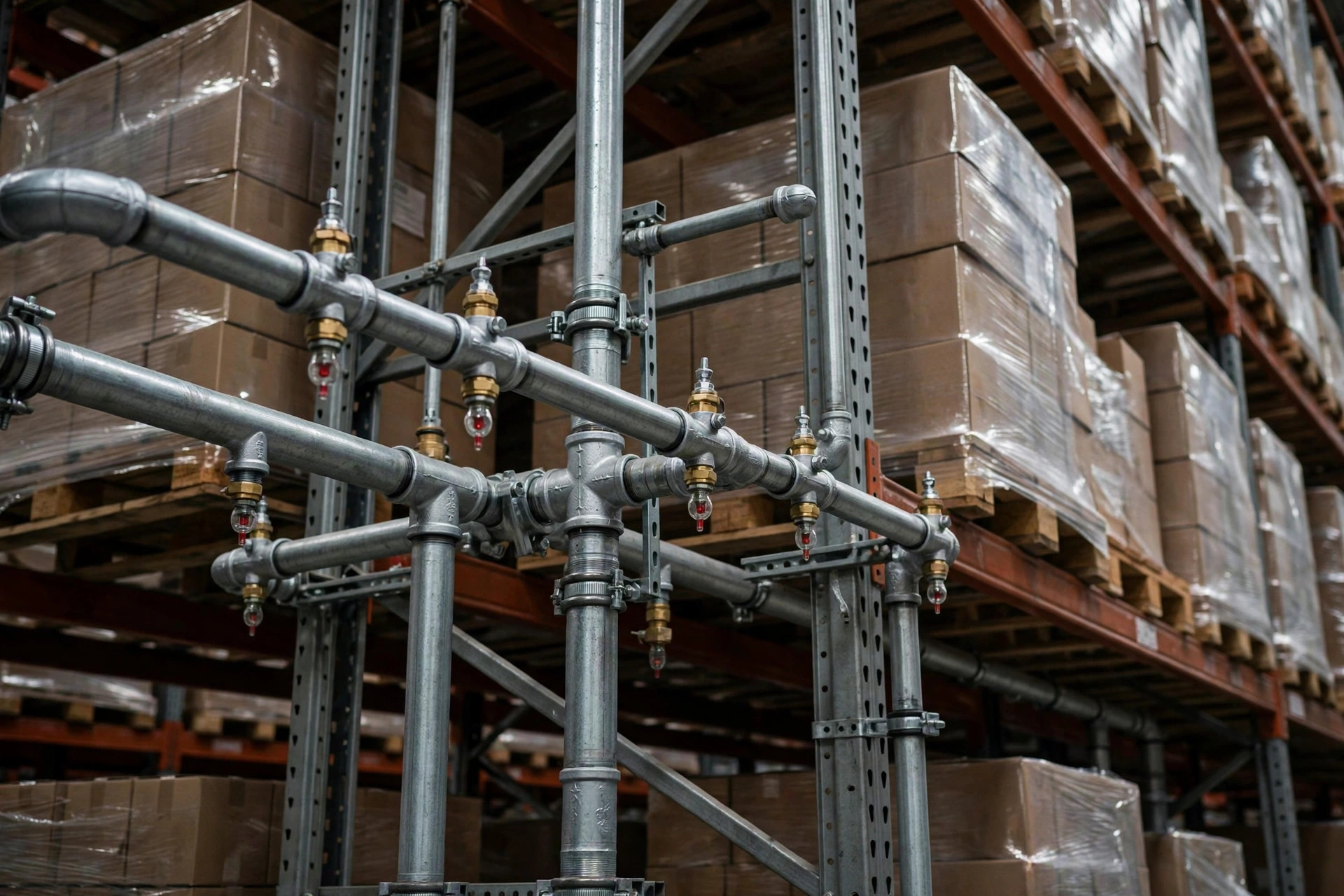
Sprinkler clearance is the expensive trap. Thirty-six inches from the top of storage to the deflector, a full 3 feet of empty air. Standard commodities need 18. Why? Tire fires release heat so violently that the spray needs the extra distance to develop and cover the pile. Plenty of warehouses converted to tire storage without upgrading sprinklers — same heads, same density, wrong commodity. That's exactly what the Inland Empire 3PL got cited for.

Four Traps I See in Real Operations
Trap one: abusing the "miscellaneous" exception. NFPA 13 recognizes miscellaneous tire storage — where tire storage is incidental to the building's main use, the area stays under 2,000 square feet, and stacking is restricted (on-floor on-side up to 12 ft, on-tread up to 5 ft). That gets you downgraded protection. But the keyword is incidental. If tire distribution is your entire business, this exception isn't for you.
Trap two: the high-piled storage permit. Once your high-piled area exceeds 500 square feet, most jurisdictions want a permit. Five hundred square feet is a 20×25-foot corner. Plenty of small tire warehouses assume "it's just a few hundred square feet of tires, no permit needed" — measure it, and you're almost always over.
Trap three: clearance gets eaten by operations. One more layer today, another tomorrow, and suddenly the top tires sit 10 inches below the heads. I visited a warehouse that was fully compliant at design time; six months later, the crew had packed the top layer so tight the 36-inch clearance was gone in half the bays. The marshal swept it with a laser rangefinder and wrote it up on the spot. Sprinkler compliance at design time doesn't mean compliance at operation time.
Trap four: change the stacking method, change the protection class. Switching from on-side to on-tread, or from on-tread to laced, changes the fire growth model, the spread rate, and the water penetration — but nine warehouses out of ten change stacking methods without telling their fire protection engineer. Sprinklers are designed for a stacking-method-plus-height combination. Change the combination, and the design is void.
Second case: in 2023, a tire distributor switched its main SKUs from on-side to on-tread storage. On-tread is denser — about 30% more tires per layer in the same footprint. The height didn't change; the method did. At review, the original sprinkler density no longer matched the new fire model, and they ended up adding in-rack sprinklers to pass. The extra cost would have bought two new forklifts.
The Money Question: Retrofit vs. Shutdown
Run the numbers. By my field estimate, upgrading a 50,000-square-foot tire warehouse from ordinary commodity sprinkler protection to NFPA 13 tire storage protection — tighter head spacing, larger K-factor heads, bigger water supply — typically lands in the $1–3 per square foot range, so $50,000–150,000. Not pocket change.
Now the other side: one fire marshal shutdown at a 3PL like the Inland Empire operation costs well over $10,000 a day in rent, labor, and customer penalties. A 30-day correction window with a height restriction cuts your capacity to 70%. And if there's an actual fire — the insurer sees undeclared high-piled storage, and your claim sits in dispute for half a year, possibly settled at a discount for "failure to disclose risk."
Before the marshal shows up, walk your own floor with a tape measure and a laser rangefinder:
- How high is your tallest tire pile, measured? Over 6 feet?
- Sweep the 36-inch clearance below every sprinkler head — any violations?
- Are your 8-foot main aisles clear, or has product crept into the forklift lanes?
- High-piled area over 500 square feet? Permit in hand?
- Does your current stacking method (on-side / on-tread / laced) match what the sprinklers were designed for?
- Any height increases, added layers, or method changes in the past year — reviewed by your fire protection engineer?
Whether the fire protection money is worth it comes down to one number: the distance from your tallest tire pile to the sprinkler head.
By Da Liu, Automation Engineer