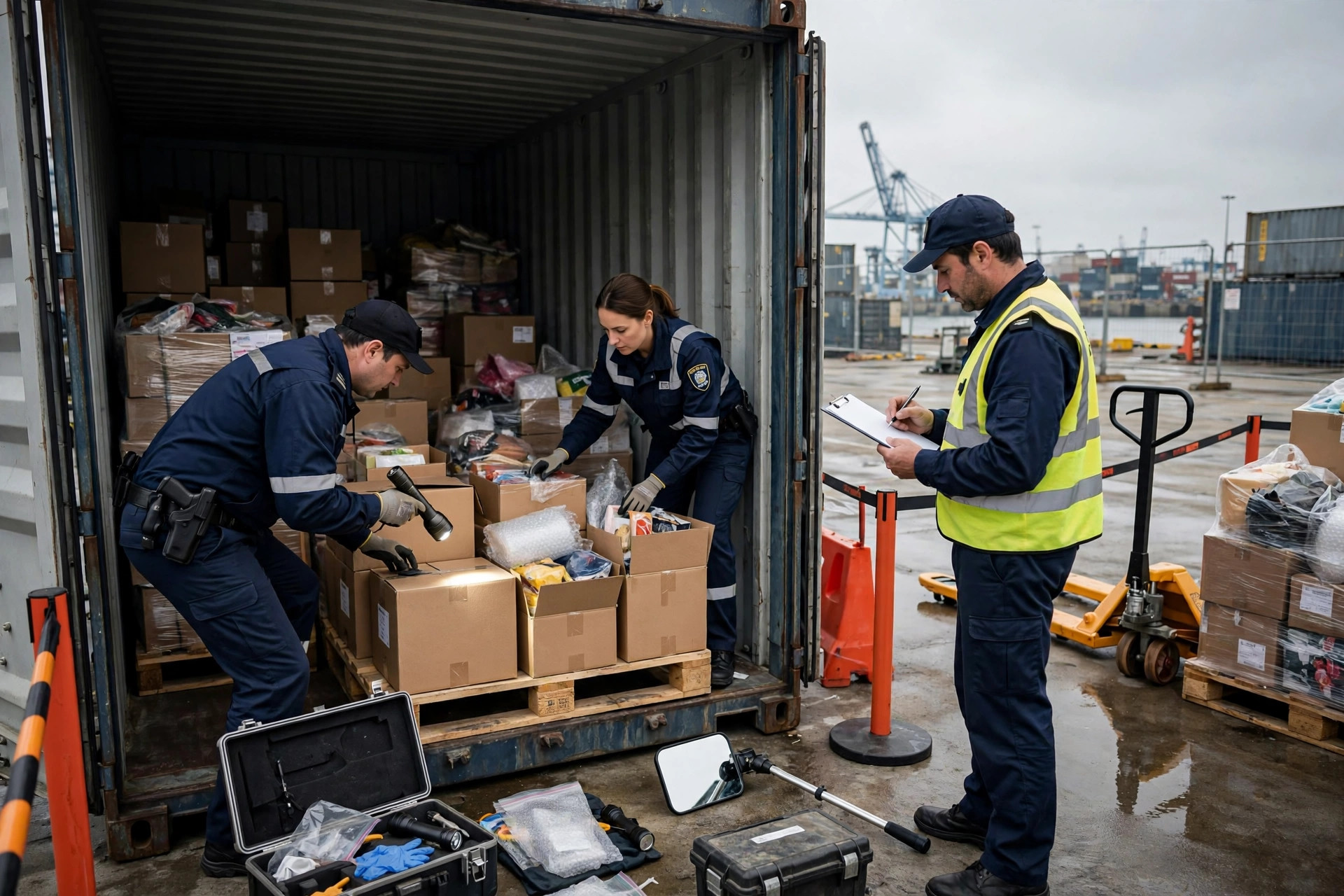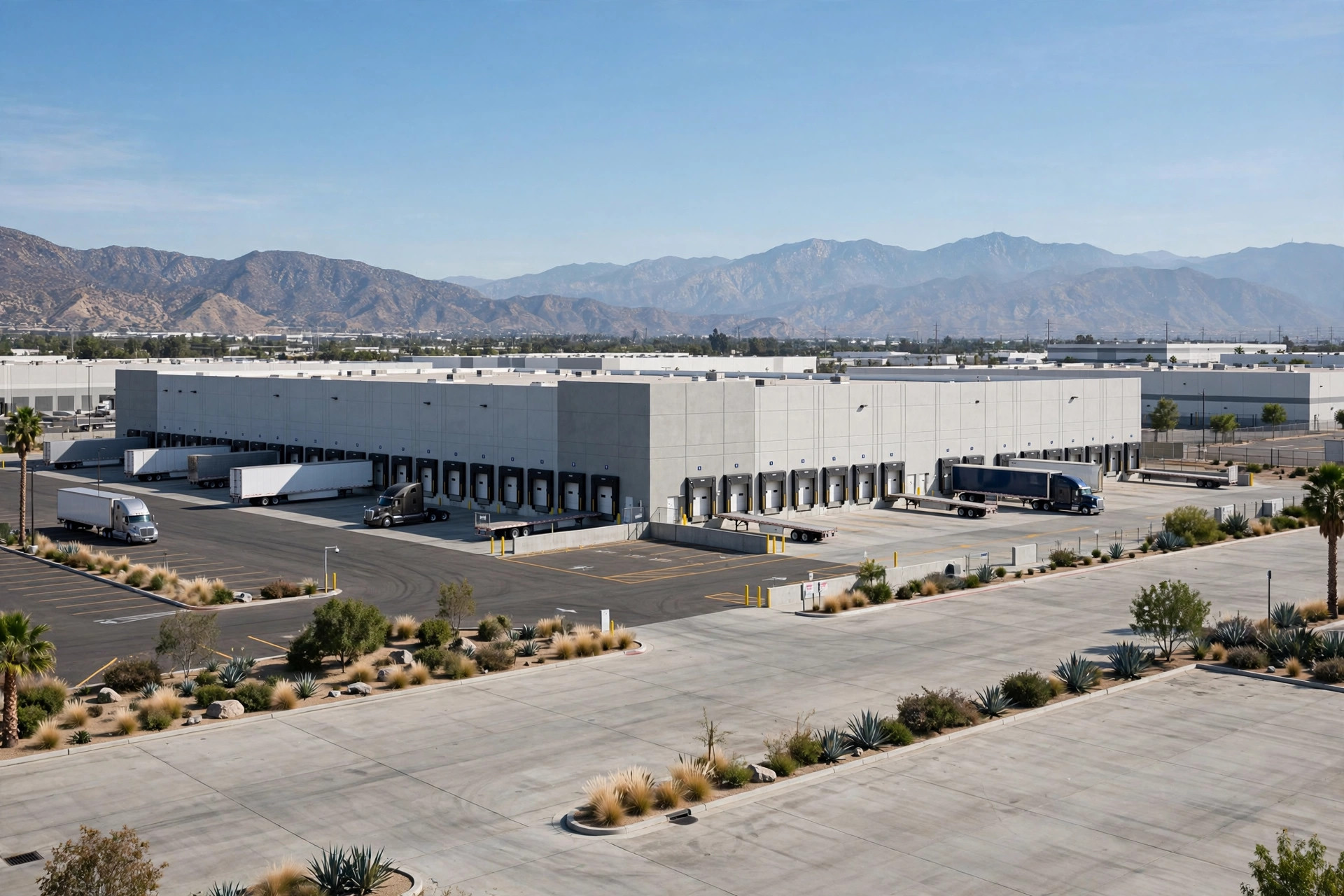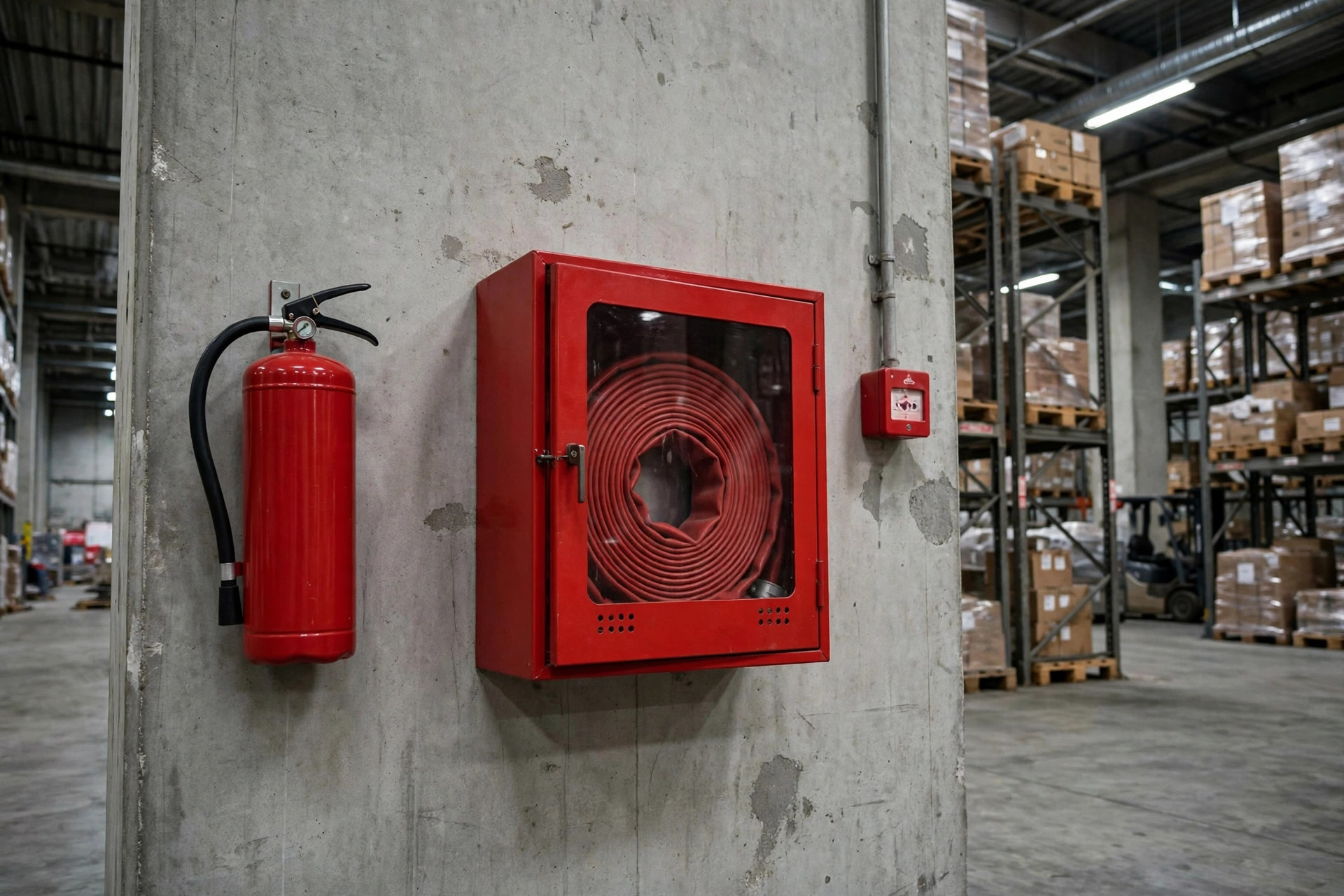
November 2023. I was doing an annual walkthrough at a 3PL warehouse in Ontario, California, when the warehouse manager showed me the invoice his fire protection vendor had just left behind. Fourteen ABC dry chemical extinguishers. Three had overdue hydrostatic tests — the test dates stamped on the cylinders were stuck at 2011. Two had pressure gauges sitting in the red zone. One had a cracked hose. A week before peak season, he had to emergency-order replacements and rush the service work. Several thousand dollars, gone.
I asked him one question: of these fourteen units, do you know which year each was bought, which had its 6-year service, which had its hydrostatic test? He paused. No.
That's the whole story. Buying an extinguisher is the cheap part. Maintaining it is the expensive part. And for US warehouses, there is exactly one authoritative answer on fire extinguisher inspection frequency: NFPA 10. Monthly inspection, annual maintenance, a 6-year internal exam, and a 12-year hydrostatic test. Four tiers, none optional. Let me walk through all four — and run the 12-year math.
Why NFPA 10 splits it into four tiers
Think of an extinguisher as a piece of equipment that sits on standby for years and is expected to work perfectly on the one day it matters. It has four distinct failure modes, and each inspection tier exists to catch one of them:
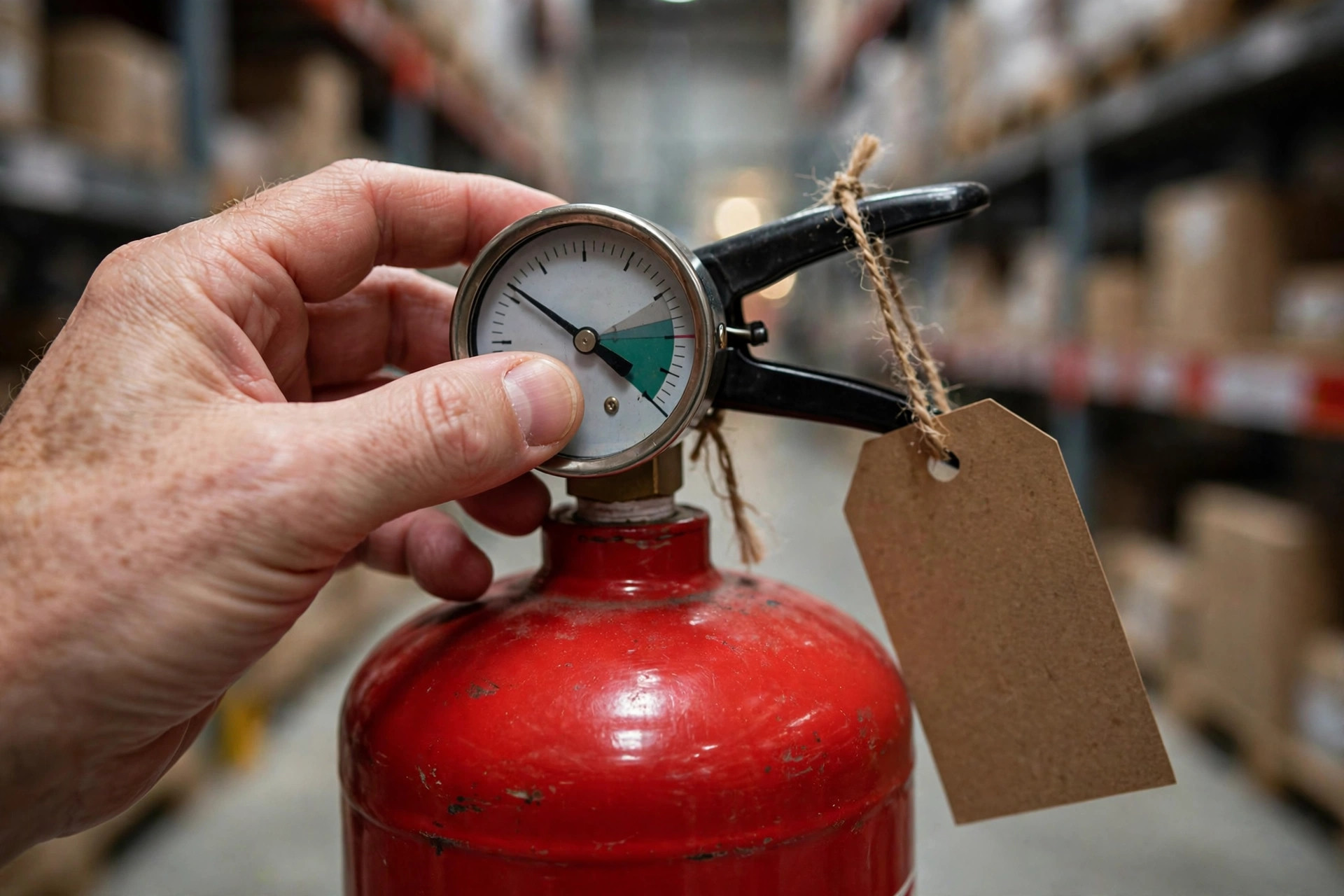
First, it's in the wrong place, blocked, or has lost pressure. Racking got reconfigured and the extinguisher is still bolted to the old column. Peak-season overflow pallets are stacked right in front of it. The cylinder slowly leaked and the gauge needle slid into the red. These things change fast — they can go wrong within a month. That's what the monthly inspection is for.
Second, parts age or get tampered with. The tamper seal on the pull pin is broken (somebody pulled it for fun), the hose is cracked from age, the cylinder is starting to corrode. These need a hands-on look — weighing the unit, replacing seals — once a year is enough. That's annual maintenance.
Third, the powder cakes up. The dry chemical inside an ABC extinguisher absorbs moisture over time and compacts. Six years is plenty of time for a canister of loose powder to turn into a brick. When you need it, you get a puff of nothing. So NFPA 10 requires rechargeable stored-pressure dry chemical units to be emptied, opened, and internally examined every six years, with fresh powder loaded in. That's the 6-year maintenance.
Fourth, the cylinder itself gives out. A steel cylinder in service for over a decade develops internal corrosion and metal fatigue, and its pressure rating drops. At the 12-year mark, it needs a hydrostatic test — pressurize it with water and verify it holds. Think of it as a pressure vessel's major overhaul with non-destructive testing.
It's the same logic as a preventive maintenance program for any machine: the monthly check is the operator's daily walk-around, the annual is scheduled servicing, the 6-year is a mid-life rebuild, the 12-year hydrostatic is the major inspection. The tiers aren't there to generate service revenue. They exist because the four failure modes genuinely operate on different time constants.
The four tiers of fire extinguisher inspection frequency, in one table
| Tier | Frequency | Who does it | What gets checked | Typical cost per unit | What happens if you skip it |
|---|---|---|---|---|---|
| Monthly | At least once every 30 days | Your own staff (no license required) | Correct location, access not blocked, gauge in the green, tamper seal intact, no visible damage | Near zero (internal labor) | On fire day, you grab a dead unit |
| Annual | Once a year | Licensed fire protection technician | Full examination, weighing, new tamper seal, service tag, documented records | $40–$75 | OSHA citations, possible insurance denial |
| 6-year | Every 6 years | Licensed technician | Emptied, opened, internal and external examination, fresh dry chemical | ~$35–$75 | Caked powder — a dud when discharged |
| 12-year hydrostatic | Every 12 years (dry chemical, stored-pressure) | Qualified test facility / service company | Hydrostatic pressure test of cylinder integrity | ~$45–$100 | Corroded cylinder, pressure failure risk |
A few details that matter, straight from the standard:
Monthly inspections can be done in-house. NFPA 10 doesn't require a licensed technician for these — just trained personnel. In practice, you designate someone to walk every extinguisher in the building once a month with a checklist: photograph the gauge, confirm the location, log it. Keep the records until the next inspection. When an OSHA inspector walks in, that log is the first thing they ask for.
Annual maintenance requires a licensed technician. They do what your staff can't: weigh the unit (weight loss means a slow leak), examine internals, replace the tamper seal, hang a dated service tag on the cylinder. That tag date is the foundation of your tracking records.
The 6-year and 12-year tiers apply to rechargeable stored-pressure dry chemical units. Disposable (non-rechargeable) dry chemical extinguishers don't go through this cycle — NFPA 10 says they must be removed from service 12 years from the date of manufacture, no negotiation. CO2 extinguishers run on a different clock: hydrostatic testing every 5 years, not 12. Don't mix them up.
On pricing: the $40–$75 annual, ~$35 six-year, and ~$45 hydrostatic figures reflect commonly published US service-company rates. They vary by region and vendor — treat them as a range and confirm with actual quotes.
Running the 12-year numbers on this inspection frequency
Take the most common unit in a warehouse: a 5 lb rechargeable ABC dry chemical extinguisher. In the US it sells for roughly $60–$80 (prices vary by channel — check current quotes).
Over 12 years under NFPA 10's inspection frequency, one unit costs you:
- Annual maintenance: 12 × $50 ≈ $600
- 6-year maintenance: 2 × $50 ≈ $100
- 12-year hydrostatic test: 1 × $75 ≈ $75
- Monthly inspections: done in-house, labor cost aside
Total: roughly $775 — nearly 10 times the purchase price.
Here's the counterintuitive takeaway: the purchase price of an extinguisher is just the down payment; the maintenance is the mortgage. People do the math backwards. They see a $70 price tag and think "cheap," then flinch at the annual service bill. The maintenance is expensive precisely because the value isn't in the canister — it's in the guarantee that the thing will discharge on any given day across 12 years.
Repair or replace? One decision boundary
Once you know the four tiers, the next question is: at the 6-year and 12-year marks, do you service the unit or buy new? My boundary is simple:
At the 6-year mark on a rechargeable dry chemical unit: service it. The cylinder has plenty of life left. A 6-year internal exam — empty, inspect, fresh powder — runs a few dozen dollars. Keep the cylinder.
At the 12-year mark: run the small calculation first. A hydrostatic test runs roughly $45–$100 plus the vendor's trip charge; a new 5 lb rechargeable ABC unit runs $60–$80. For a single unit, buying new can actually be cheaper than testing. At volume, the math flips: 20 units tested together earns you a bulk rate, and you skip the work of rebuilding your tracking records and re-tagging everything. My rule of thumb: under 10 units, just replace; over 10, negotiate a bulk hydrostatic price.
Disposable dry chemical at 12 years: replace, no discussion. The standard mandates retirement. "It still looks fine" is not an argument.
Replace immediately, don't wait for a tier, when: the gauge sits in the red persistently (recharged and still dropping), the cylinder has through-corrosion or major denting, the hose is cracked, or the tamper seal is broken and nobody knows who touched it. A cylinder is a pressure vessel. Mercy toward the cylinder is cruelty toward yourself.
CO2 units get their own line item: hydrostatic every 5 years, not 12. They're usually in the electrical room or server closet, few in number, and the easiest to forget.
Now let me take a swing at a pet peeve: warehouses that buy "smart" extinguisher cabinets with electronic monitoring and assume the monthly inspection is dead. NFPA 10's actual language: electronic monitoring only extends the visual inspection interval to 90 days. It doesn't eliminate inspections. A sensor can tell you pressure dropped. It cannot see that a pallet is blocking access, or that someone pulled the tamper seal. Anyone selling you a sensor as a replacement for human eyes doing walkarounds is selling snake oil.
The maintenance traps: two failures I've seen with my own eyes
Trap one: no asset register. Back to that Ontario 3PL. Fourteen extinguishers, zero records of which was manufactured when, which had its 6-year service, which had its hydrostatic test. The vendor had to flip every cylinder and squint at stamped dates and tags, and found three units whose hydrostatic tests were 12 years overdue — units that should have been retired long ago. A week before peak season, most of the extra thousands went to rush charges. A register is one spreadsheet: location, model, manufacture date, last annual, last 6-year, last hydrostatic, next due date — updated during the monthly walk. That's the entire workload.
Trap two: gauges lie in extreme temperatures. January 2022, a cold storage facility outside Chicago (around -20°C inside). The warehouse manager's winter monthly check found several extinguishers with needles in the red zone and wanted to replace them all. I happened to be on site for a project, took a look, and stopped him.
The physics is simple: a stored-pressure dry chemical unit uses nitrogen to push the powder out, and the gauge reads nitrogen pressure. Cold drops gas pressure, so the needle falls into the red. It's physics, not a leak — the unit warms back up and reads fine. Replacing them would have been money in the trash.
But the genuinely counterintuitive part: in cold storage, pressure readings aren't the real killer — condensation is. An extinguisher moved between the freezer and ambient areas sweats repeatedly, and the base where the cylinder meets the bracket rusts first. The monthly checklist says "check the gauge" but never says "feel the base for rust." A rusted-through cylinder can have a gauge sitting perfectly in the green — the gauge is fine, the cylinder is scrap. No standard checklist catches that. Understanding the physics does.
My monthly checklist has always had two extra lines beyond the standard: "rust at the cylinder base and bracket contact point," and "has the location moved since last check." Thirty extra seconds. They catch what the standard misses.
Is the money worth it? Watch this one number
A 12-year maintenance bill near 10 times the purchase price — worth it? Watch this one number: right now, how many extinguishers in your warehouse have a manufacture date you can't look up?
If that number is zero, congratulations — your fire safety records are alive, and all four tiers are on track. If it's greater than zero, your extinguisher program is still in the "bought it equals managed it" stage — and NFPA 10's four inspection tiers were designed precisely for everything that happens after the purchase.
Don't rush to buy smart cabinets. Don't rush to switch vendors. Spend one afternoon walking every extinguisher in the building and build the register: location, model, manufacture date, last annual, 6-year, hydrostatic, next due — seven columns. Assign one person to the monthly walk. Once that routine runs, your fire extinguisher inspection frequency is actually implemented. The rest is just following the sheet.
Specific intervals and procedures can carry additional requirements under state fire codes — when in doubt, go by the latest NFPA 10 edition on nfpa.org and your local fire authority's requirements.
By Da Liu, Automation Engineer