Let's start with the numbers.
A 50,000-square-foot warehouse wants automation: conveyors plus sortation, quoted at $1.2 million, promising a 3-year payback. Another warehouse the same size spent nothing on equipment and ran one round of lean improvement instead: re-slotted locations, ABC classification, re-laid the travel paths, standardized the work. A year later, labor productivity is up 22% and the error rate is halved.
The first warehouse's $1.2 million, depreciated over 5 years, costs $240K a year. The second one paid a consultant $80K, and the gains are still compounding in year two.
After running these numbers, I'll say something unpopular: a lot of warehouses' "need for automation" is really just broken process. Automating a bad process accelerates waste. Where people used to waste 10 minutes, now a machine wastes it in one.
Why Lean ROI Often Wins
Automation is addition; lean is subtraction. Addition costs big money. Subtraction recovers money you're already burning.
I've taken apart the cost structures of dozens of warehouses, and the finding is consistent: a warehouse that has never done lean work will feed at least 30% of its new equipment capacity to wasted process. The conveyor flies, but the pack stations can't keep up; the AMR delivers on time, but the picker is still hunting for the location.
Here's the simplified comparison I use with clients:
| Lean improvement | Automation investment | |
|---|---|---|
| Typical spend | Tens of thousands | Hundreds of thousands to millions |
| Time to impact | 2–4 months | 8–18 months including implementation |
| Risk | Low, adjustable anytime | High, hard to reverse a wrong pick |
| Prerequisite | Works best on messy operations | Process already straightened, stable volume |
Read that last row carefully: automation's biggest prerequisite is a process that's already straight. Automating chaos means spending $1.2 million to cement mistakes in place.
The Five Levers: Do These First
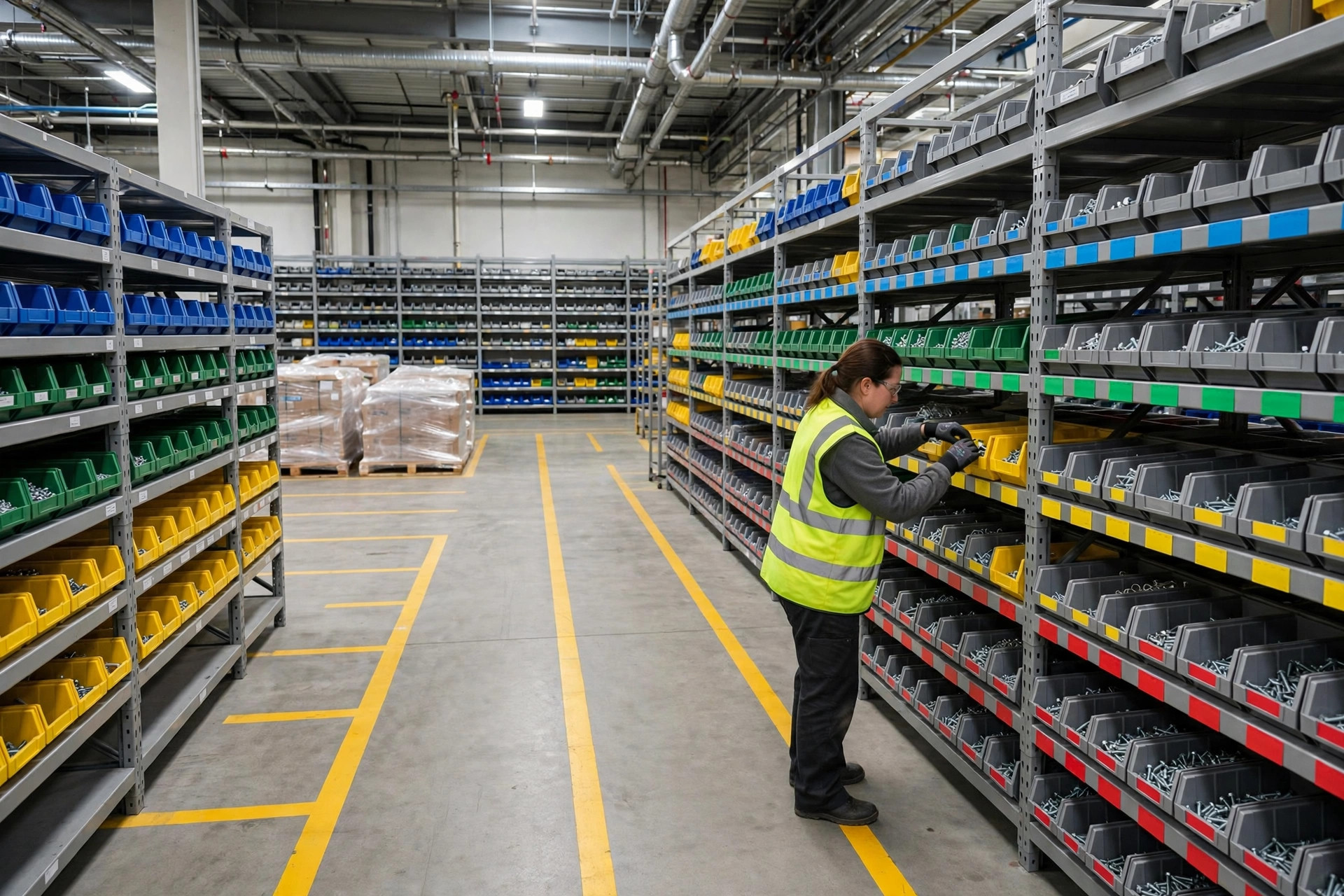
Lever 1: Re-slotting + ABC. The highest-ROI move there is, bar none. I've seen too many warehouses with A-class SKUs (top 20% by velocity) buried on high levels deep inside, pickers walking an extra 3 km a day. Re-slot the A movers into the golden pick zone, and a 200-person warehouse saves enough labor in a year to buy two forklifts.
Lever 2: Re-lay the travel paths. Receiving, putaway, picking, and packing flows constantly fight each other. Draw the travel map, find the crossings, cut 15%+ of travel distance. Costs nothing but half a day.
Lever 3: Standardize the work. Same pick task: the veteran takes 20 minutes, the new hire 40. The gap isn't fitness, it's method. Film the veteran's method, write it as a one-page SOP, and new-hire ramp time gets cut in half.
Lever 4: Visual management. Location labels, floor markings, boards, all readable within 10 seconds of walking in. Search time is the warehouse's biggest invisible waste; visuals are the cheapest cure.
Lever 5: Kill the waiting. Follow one order with a stopwatch and log every wait: waiting for the forklift, for paperwork, for QC. You'll find real work is less than half the order's life; the rest is waiting. Halve the waiting and you've doubled capacity without buying a thing.
When Automation Talk Is Justified
Three signals. Don't rush without all three:
- All five levers are done and productivity has plateaued;
- Volume is growing steadily, with three years of orders to feed the equipment;
- TCO is modeled including maintenance, power, and spares, and payback lands inside 3 years.
I'm allergic to words like "feels like" and "roughly." Each signal above needs a number behind it: three years of history for the volume forecast, power and maintenance inside the TCO, not just the equipment quote.
A Calculable Conclusion
Next time the boss says "let's automate," ask for $80K for one round of lean improvement first. If productivity jumps more than 15%, the waste is still large and automation can wait a year. If all five levers are maxed out and you're still drowning, then talk equipment.
That $80K is the highest-ROI consulting fee you'll ever pay. Trust me on this one.
By Lao Zhou, Logistics Cost Analyst