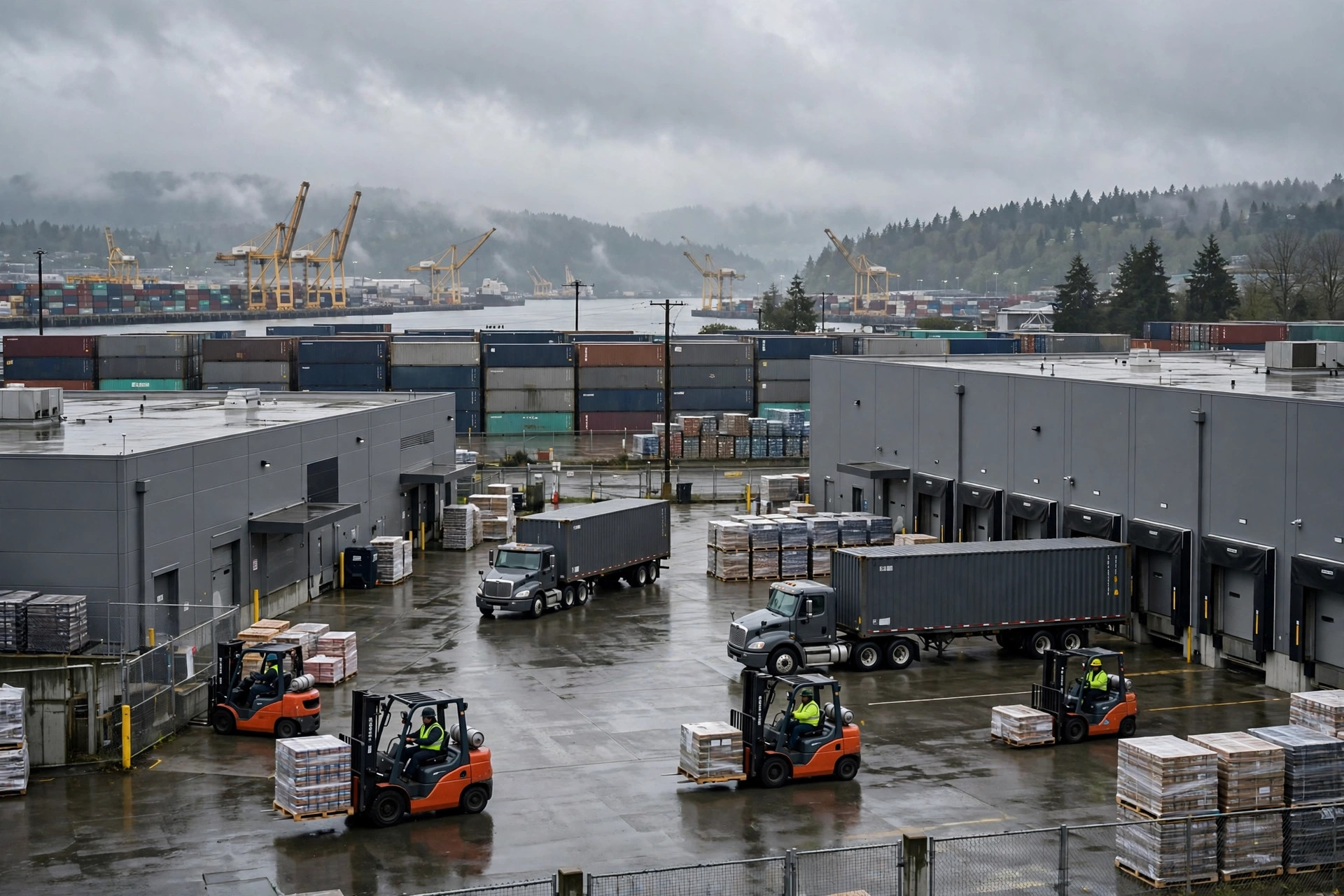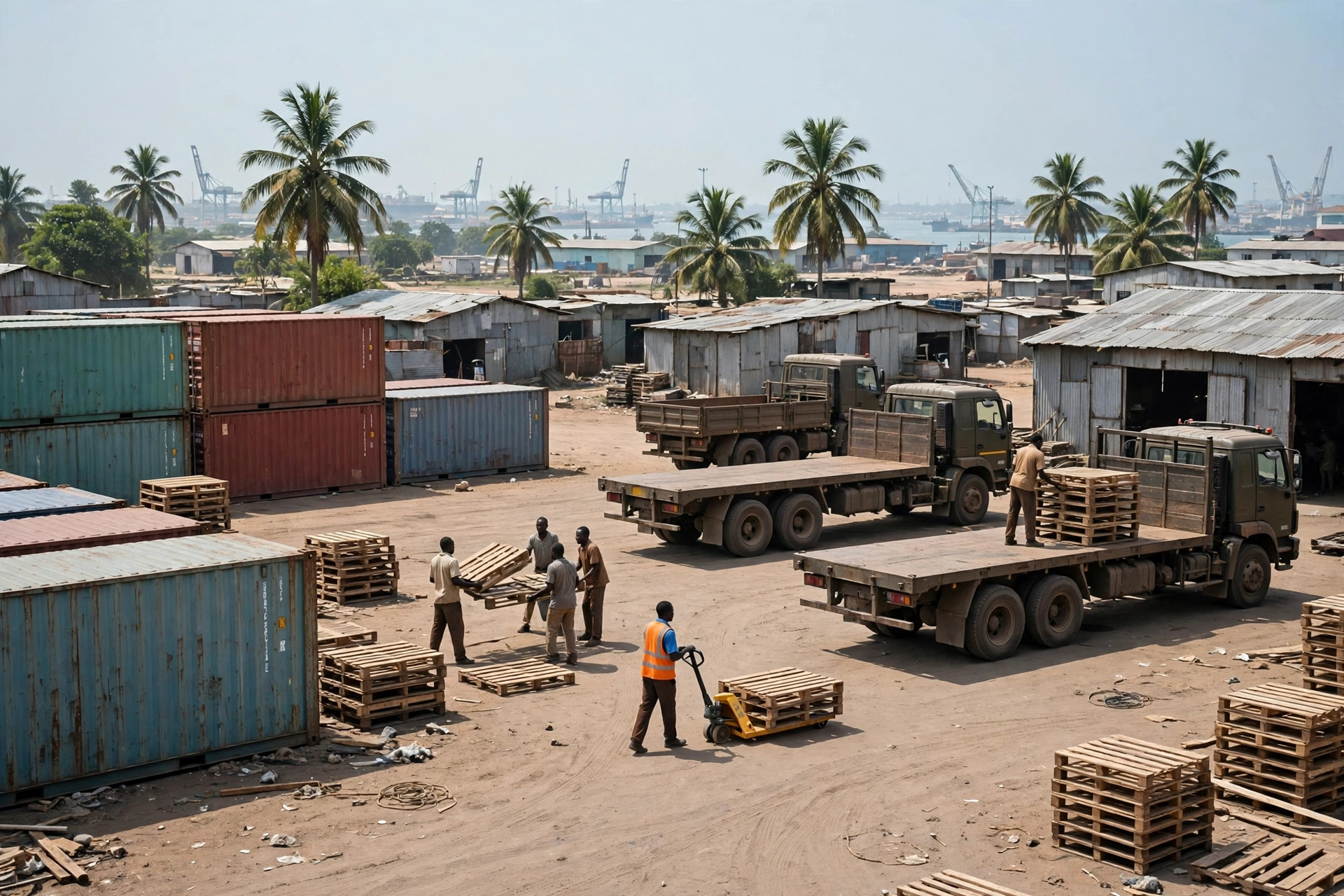
Cotonou is a case worth examining on its own. The port city of Benin is not large in urban scale, yet its position places it at the junction of several West African freight flows: seaward, it is Benin's gateway to foreign trade; landward, its corridor runs toward inland neighbours, while the vast Nigerian market lies nearby across the region. A seemingly local question — whether it pays to rent, build, or run distribution from a warehouse in Cotonou — therefore touches four layers at once: port capacity, cross-border corridors, inland markets, and regional competition. Rent alone cannot settle this account.
According to the pattern described in public regional logistics research and industry reporting, the Port of Cotonou functions first as a corridor port rather than a purely local-consumption port. That is to say, a substantial share of the cargo landed at Cotonou does not stay in the Beninese market at all, but moves onward, northward and eastward. This feature produces the first rule of the Cotonou warehouse market: a warehouse's value depends heavily on how close it sits to the port and to the outbound corridor, and on whether it serves local delivery or cross-border transit. Those are two different businesses, with different cost structures and different risk structures, and talking about "the Cotonou warehouse market" as one thing easily leads to misleading conclusions.
The Structure of the Cotonou Warehouse Market: Port, Suburban Warehouses, and the Inland Corridor
Structurally, warehousing supply in Cotonou falls into three tiers. The first tier is port-area and near-port warehousing, closest to the quays, suited to cargo that needs fast clearance, deconsolidation, and onward dispatch. Rents and service prices here sit at the highest level in the market, but what they buy is time. The second tier is suburban warehouses and yards around Cotonou, with relatively generous space, suited to stockholding, consolidation, and regional distribution centres. Costs sit at a mid level, and performance turns on how efficiently trucks connect toward the city and toward the outbound corridor. The third tier is transit nodes strung along the inland corridor, closer to consuming markets but varying considerably in infrastructure and service maturity, suited to firms that already have stable volumes and are willing to build their own operating capability.
A second phenomenon worth noting is the volatility of warehousing demand in Cotonou. Transit volumes swing more sharply than local consumption volumes, because they respond to neighbouring countries' policies, border-post throughput, and regional market seasonality. In one period when the rhythm of a corridor changed, several distributors dependent on a single corridor found cargo piling up in their warehouses with trucks unable to get out, while firms that had kept buffer warehouses in suburban Cotonou and maintained more than one outbound direction were noticeably less affected. The contrast shows that in Cotonou, warehouse planning is first a risk-management exercise and only second a cost exercise.
Three Distribution Directions From Cotonou, and What Each One Costs You
Splitting Cotonou's distribution directions apart makes the trade-offs much clearer. The table below is a qualitative comparison drawn from the publicly described pattern and common industry practice. Specific rates, transit times, and policy details should always be checked against the latest official sources, and no single source's figures should be applied blindly.
| Distribution direction | Market served | Warehousing layout | Cost level | Key risk |
|---|---|---|---|---|
| Cotonou local and domestic Benin delivery | Benin's local consumer and trading markets | Suburban warehouse covering the city delivery radius | Mid level | Limited local demand scale, seasonal swings |
| Inland distribution via the Cotonou corridor | Transit and consumer markets of inland neighbours | Near-port buffer warehouse plus corridor nodes | Higher, including cross-border and transit costs | Border and policy rhythm changes, volatile volumes |
| Regional markets including Nigeria | Distribution and re-export to large regional markets | Flexible leased space, fast in and fast out | Varies by cargo type and corridor | Intense regional competition, complex compliance |
Here is a counter-intuitive judgment: the warehouse closest to the port is not necessarily the most profitable. A near-port warehouse wins on speed, but it also carries the highest rent level, the most intense operations, and the greatest sensitivity to vessel-schedule swings. If your cargo is not racing a sailing, and what you really need is a stable regional distribution point, a suburban warehouse plus a reliable shuttle route is often the better answer. Conversely, if your business model is "the vessel arrives and the cargo moves," putting the warehouse far away means the rent you saved will be repaid many times over in demurrage, urgent trucking, and customer claims. Warehouse location, in the end, is your answer to the question of what time is worth.
Another variable that is easily underestimated is compliance and documentation. Cross-border distribution involves documents, inspections, and border procedures, and if any link in that chain stalls, warehousing cost stops being rent and becomes the cost of cargo sitting still. Among firms distributing through Cotonou, the real gap is often not who found the cheapest warehouse, but whose documentation and border handover is steadier, and whose cargo remains traceable end to end. That factor belongs in the same comparison table as rent when any warehousing option is assessed.
The Trend: Cotonou Warehousing Is Shifting From "Yard Space" to "Distribution Node"
Taken together, the Cotonou warehouse market is undergoing a slow but clear structural change. Early value came mainly from having somewhere to stack cargo. Increasingly, value comes from being able to dispatch cargo quickly, compliantly, and predictably. Improvements to the port and corridors, shifts in the regional trade pattern, and the growth of inland consumer markets are all pushing in this direction. But this trend does not mean every warehouse benefits. The winners are the nodes positioned between port and corridor, whose operating capability keeps pace with cross-border rhythms, and which do not bet everything on a single corridor.
For firms considering entry into Cotonou, my suggestion proceeds in three steps. First, validate freight flows with a small leased footprint: run one corridor end to end, learn the border rhythm, and measure the real documentation and operating costs before discussing a long lease. Second, let the validated result decide the warehouse tier: cargo racing a sailing stays near the port, stable distribution sits in the suburbs, and an inland footprint extends to corridor nodes only when volumes justify it. Third, put compliance and information systems first, rather than discovering a broken documentation chain only after cargo is already stuck in the warehouse. Specific rates, duties, and transit times must be checked against the latest official sources, and any precise quotation detached from those sources deserves a question mark first.
Finally, an open question remains. If the regional corridor pattern keeps shifting, will Cotonou's warehouses become more like a pure transit channel, or will they develop genuine distribution capability serving West Africa's inland consumer markets? The answer will decide which kind of warehouse is worth holding for the long term in the years ahead — and it is probably too early to call it now.
By Dr. Chen, Supply Chain Researcher