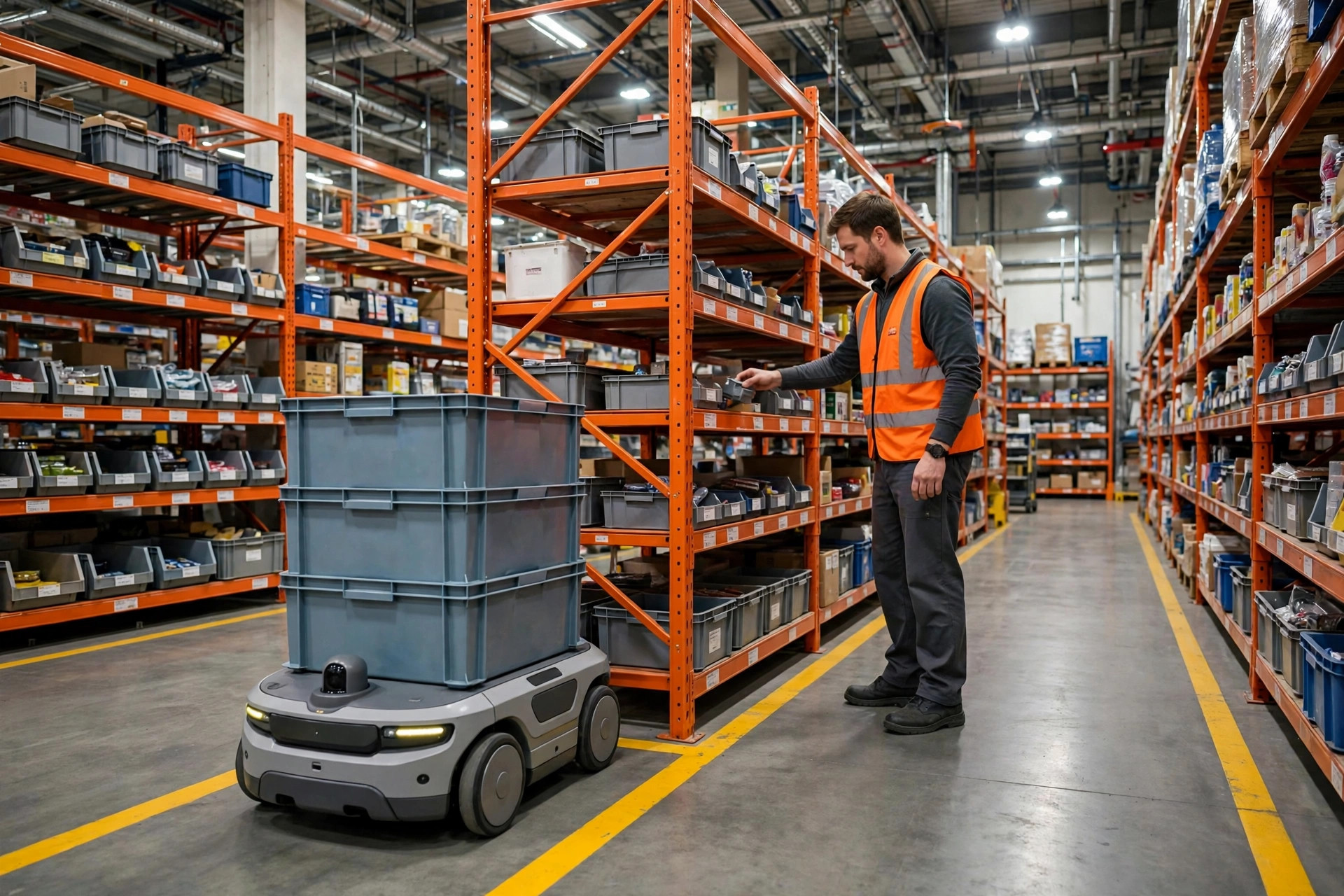
To answer the question of automated case picking warehouse when worth it, start with the numbers: the global robotic warehouse layer picker market reached USD 1.16 billion in 2024, growing at a 14.2% compound annual rate and projected to hit USD 3.23 billion by 2033, according to market research firm Dataintelo. The supply side is buzzing; warehouse operators ask the price at the booth and walk away. Between the buzz and the caution sits an ROI calculation nobody closes cleanly.
The Phenomenon: Trade-Show Crowds vs. Warehouse Caution
At MODEX 2026, FANUC showcased its warehousing-focused CRX-30iA platform, emphasizing flexible box handling and mixed-pallet building. At PACK EXPO in October 2026, Mujin demonstrated a mixed-case palletizing solution claiming up to 1,000 cases per hour, per both vendors' show materials. Earlier, KUKA had introduced its KR FORTEC PA series for heavy-duty palletizing, and Hai Robotics kept pushing multi-layer autonomous case handling through 2025. The supply-side signal is consistent: automated case picking has moved from "can it be done" to "how flexibly can it be done."
The demand side is far more split: the same machine pays back in nine months for one warehouse and is still waiting after five years for another. The machine did not change; the order profile did — which is precisely the part vendor brochures discuss the least.
The Data: What Public Sources Say About Case-Picking Payback
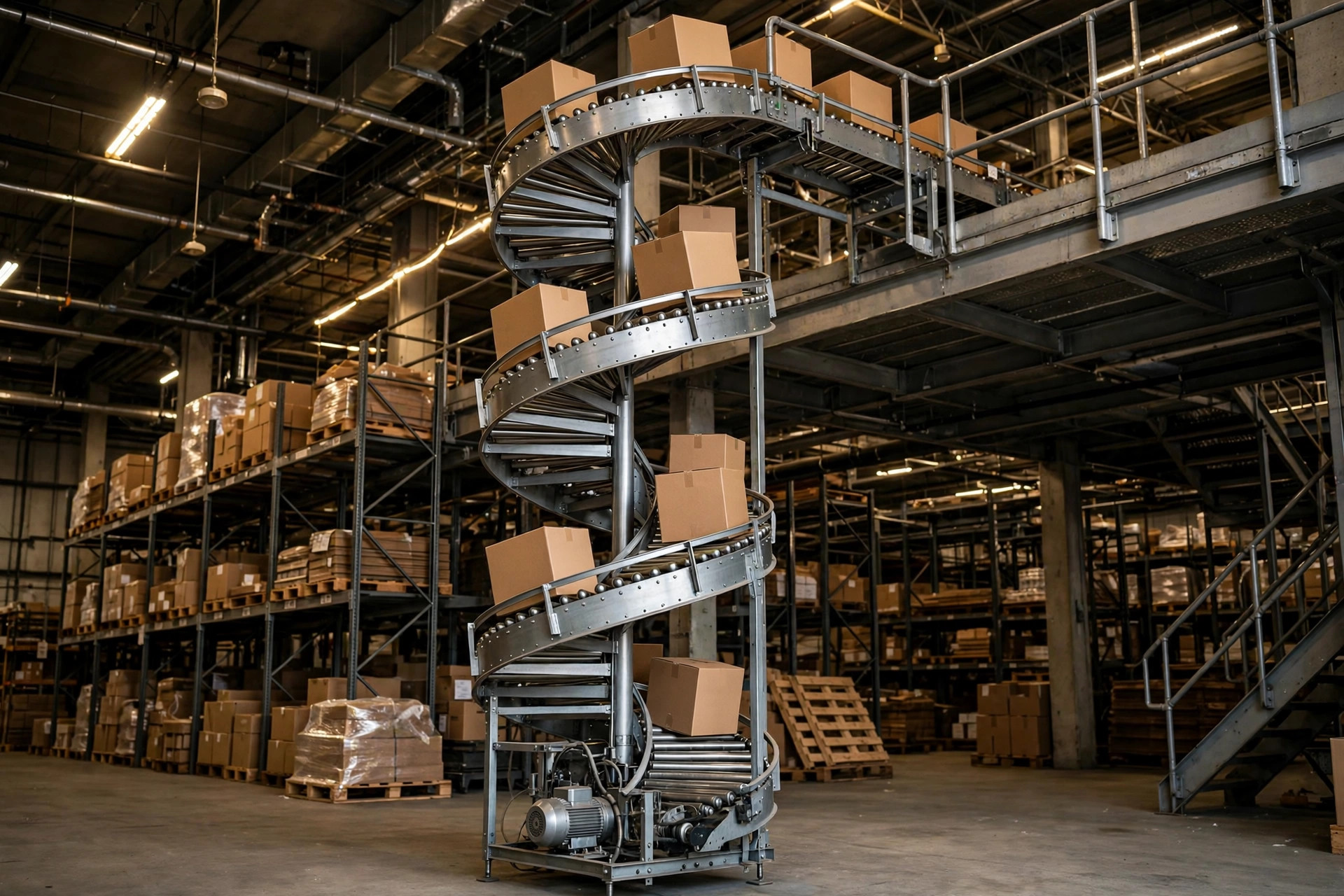
Layer picking first. The Shippers Group, a US third-party logistics provider, installed layer pickers in its Wintergreen and Austell distribution centers because case-picking volume had made manual layer picking the bottleneck. Per the company's own blog, manual picking ran at roughly 240–250 cases per hour; a layer picker operator reaches about 1,200–1,250 — four to five times the manual rate. Notably, they deployed it not as a fixed line but as a "layer pick zone": high-velocity case SKUs sit on both sides of the machine, with the mix adjusted daily to demand. The machine is fixed; the assortment flows.
Robotic layer picking data comes from integrator cases. Midwest Engineered Systems (MWES) deployed a robotic layer picking system for a refrigerated warehouse: a 30-second layer pick cycle (about 120 picks per hour), layer weights around 500 lbs, a single operator for oversight, running 24/7 in a refrigerated environment. Manual productivity decays noticeably in the cold, which amplifies the robot's relative value.
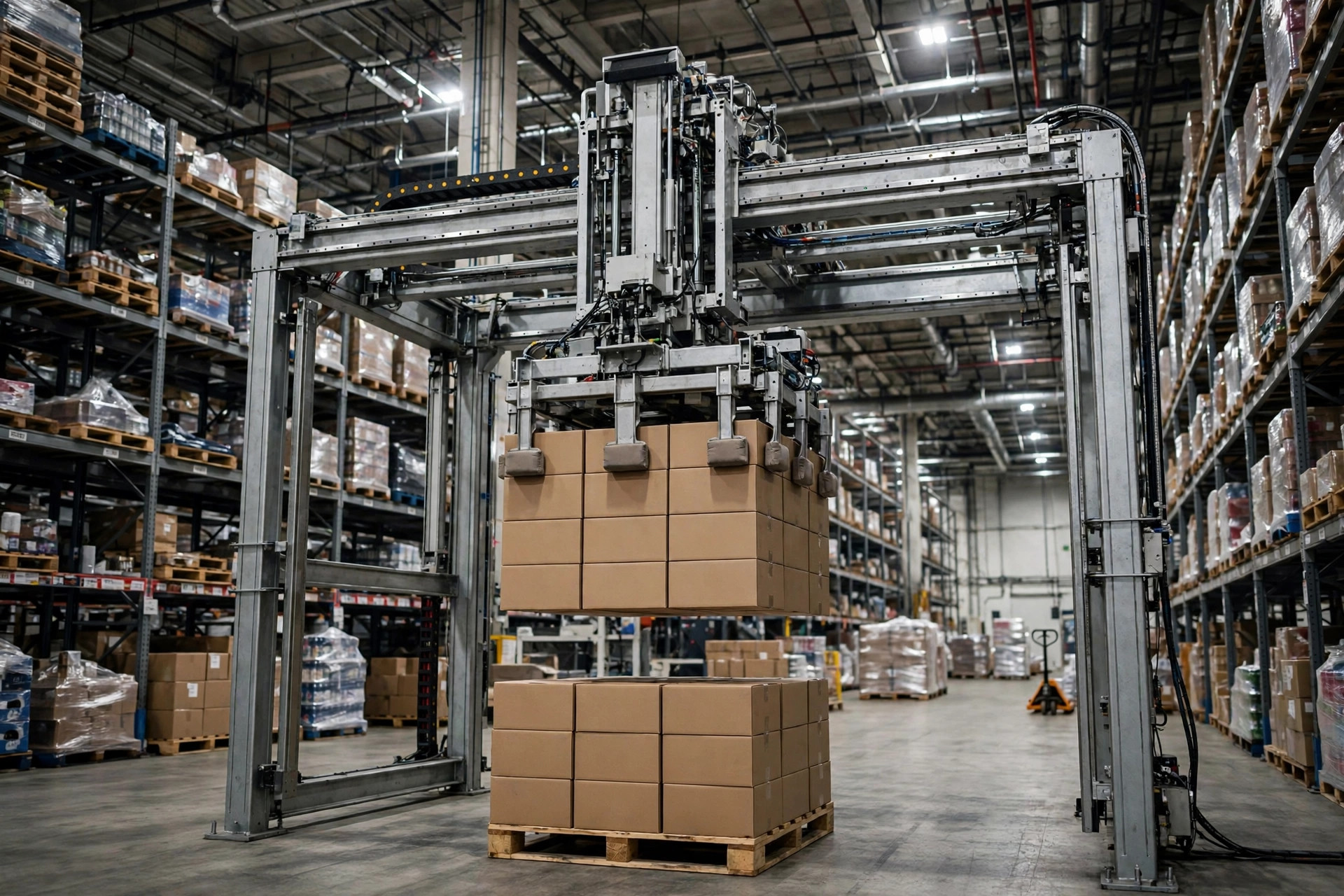
Equipment vendor Cimcorp draws the applicability boundary at warehouses moving more than 1,000 layers per day with 50–500 SKUs picked in layer form, typically food, beverage, and consumer goods. Two disclosed projects: a Canadian alcoholic beverage distributor running four robotic heads on two gantry frames across 100 SKUs at 150 layers per hour, and a US food manufacturer running a two-head system with 250 pallet positions at 400 layers per hour, linked to an AS/RS for automatic replenishment.
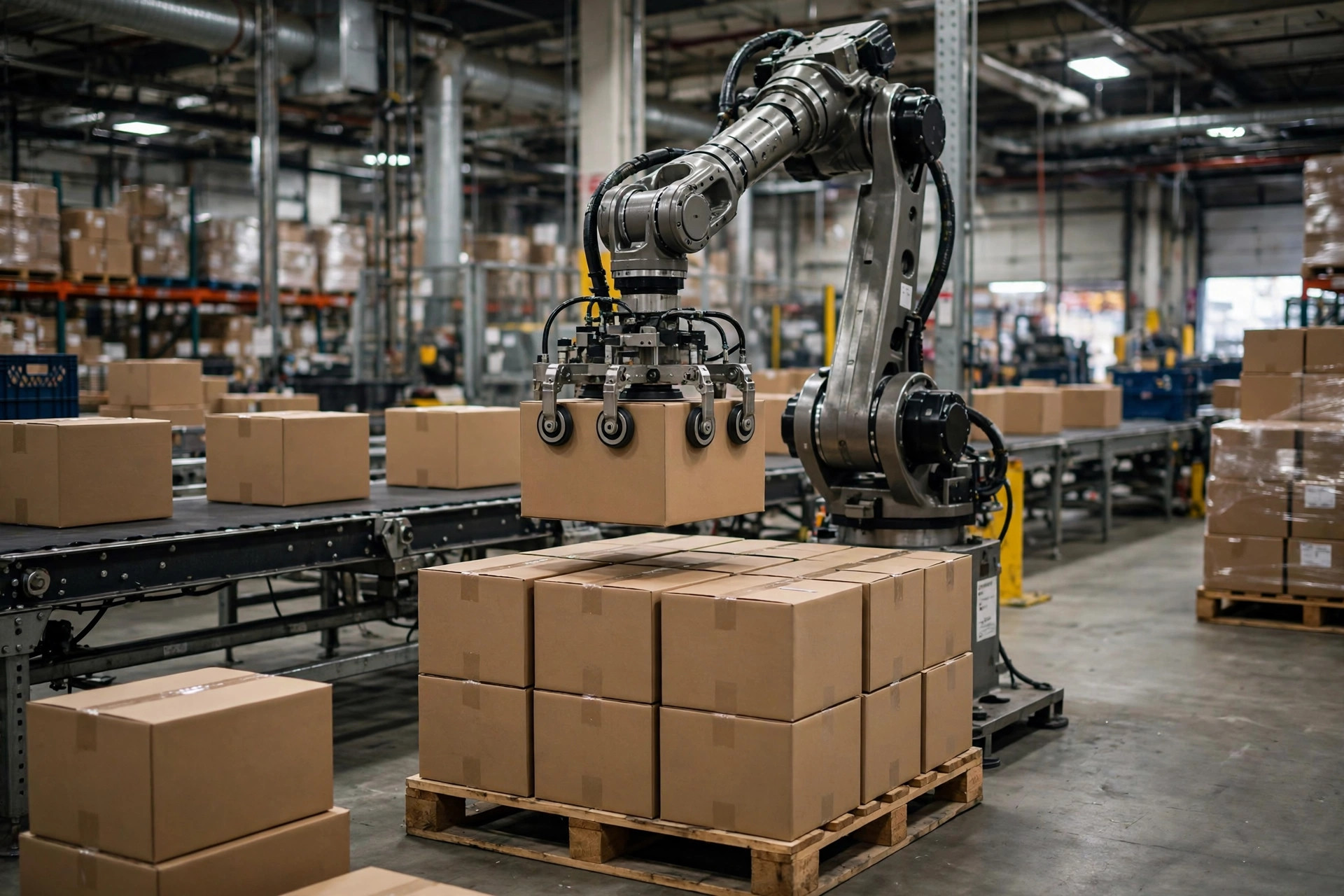
Now robotic palletizing. Transport Works published a worked ROI model — a model, not a measured post-mortem. Scenario: a US distribution center with three operators per shift on palletizing at USD 24 per hour, or USD 144,000 in annual labor. After installing one robotic palletizing cell and redeploying two operators: USD 96,000 in annual labor savings plus about USD 15,000 in injury and overtime reduction — USD 111,000 per year against a USD 170,000 upfront investment plus USD 10,000 annual maintenance. Static payback: roughly 1.7 years; five-year ROI near 197%.
Vendor figures corroborate the magnitude. Paxiom's guidance: USD 200,000–450,000 per system, offsetting one to three workers per line for USD 110,000–330,000+ in annual savings, 12–30 month ROI. ISD's October 2026 press release for its combined palletizing-and-depalletizing cell claims 43% labor reduction versus manual operations and a 9–18 month ROI depending on shift structure and throughput. Three sources, one band: roughly one to two and a half years.
Attribution: Why the Same Machine Pays Back in Nine Months for One Warehouse and Five Years for Another
The attribution of the payback gap is surprisingly clear — and almost none of it is about the machine. First, order profile: the equipment only handles full-layer, full-case orders. The higher the case-order share, the higher the utilization; a warehouse dominated by each-picking is mostly buying a machine that waits for work. Second, SKU concentration: 50–500 layer SKUs is the sweet spot — too few and the machine starves, too many and replenishment cannot keep pace. Third, shift structure: one shift versus two shifts is two different investments; ISD's 9–18 month band comes straight from shift structure, and the MWES refrigerated case looks so good partly because 24/7 operation maxes out utilization. Fourth, contract horizon: per Transport Works' analysis of automation failure modes, when a 3PL's client contract is shorter than the payback period, the investment is unsupported from day one. Fifth, hidden costs: network and WiFi upgrades, WMS/WCS integration, floor-load and safety retrofits — one industry analysis puts the network upgrade alone at tens to over a hundred thousand dollars per facility, per AI Builders Network. Every item missing from the model becomes extra months on the payback.
And the counter-intuitive finding: most warehouses model ROI around "how many heads can we remove" and miss "how much rework and penalty we stop paying." Per the joint technical article from Photoneo and Jacobi Robotics, modern mixed-case systems process 300–1,000 cases per hour versus roughly 180–360 manually — two to five times the throughput — while eliminating the 1–5% inventory shrinkage typical of manual operations and reducing rejected shipments and retailer chargebacks. The biggest return on a palletizing robot is often not in the palletizing motion at all, but in what standardized pallets eliminate downstream: rework, damage claims, and fines — the three line items missing from most ROI spreadsheets.
A Selection Framework: Where the Three Routes Diverge
| Dimension | Manual case picking | Layer picking | Robotic palletizing |
|---|---|---|---|
| Fitting order profile | Fragmented, volatile orders | High full-layer/full-case share | Standardized outbound pallets |
| SKU character | Many, scattered SKUs | 50–500 high-velocity layer SKUs | Stable packaging specs |
| Daily volume | Low or volatile | 1,000+ layers per day | Medium-high throughput, multi-shift |
| Investment | Low | High (equipment + civil + integration) | Medium (USD 200,000–450,000) |
| Payback | — | Long, utilization-dependent | Roughly 1–2.5 years |
| Biggest risk | Labor shortage, injuries | Order-profile drift | Frequent SKU/packaging changes |
Five questions before deciding. One: over the past twelve months, what share of order lines were full-layer or full-case? A structurally low share cannot carry the payback model. Two: how many high-velocity layer SKUs? Inside the 50–500 band, utilization has a fighting chance. Three: will the order profile change materially in the next few years? Category expansion or channel shifts can invalidate today's model. Four: does the contract or depreciation horizon cover payback? For 3PLs, the remaining client contract term should exceed the modeled payback with margin. Five: are hidden costs in the model? Network, integration, civil works, safety — list each, then rerun the numbers.
Trend Outlook: What Will Rewrite the Case-Picking ROI Equation, 2027–2030
The supply-side trajectory is set: AI vision is making mixed-SKU handling viable, collaborative robots are starting to work alongside people, and cloud fleet management reportedly cuts multi-robot idle time by up to 40%, per Accio's trend data. The case and piece picking equipment market is projected to grow at an 8.75% CAGR from 2025 to 2032, per pmarketresearch, with Asia-Pacific growing fastest.
My read: by 2028–2030, progress will extend the "applicable SKU range" but will not move the hard threshold of order density — a machine rated at 1,000 cases per hour that gets two hours of work a day remains an expensive ornament. Falling equipment prices and rising labor costs will keep compressing payback periods, but the selection logic will not change: order profile first, machine second.
As mixed-case palletizing reaches 1,000 cases an hour and layer picking starts handling mixed SKUs, the answer to "automated case picking warehouse when worth it" is sliding from "can the machine do it" to "does your order profile deserve the machine." The genuinely expensive part of this calculation may never have been the machine — it is the robot standing in the warehouse working two hours a day after a wrong purchase, and the decision process behind it that nobody wants to rerun. The question worth tracking next: once AI vision erases the mixed-SKU barrier too, what will be left of automated case picking's last moat?
By Dr. Chen, Supply Chain Researcher