Let me be blunt: when you pick a European distribution center, port rankings are the most useless input in the whole exercise. Yes, the Port of Antwerp is Europe's second-largest port. And "second-largest" has misled more shippers than any two words I know — I've seen too many companies chase the big-port name and then bleed for years on hinterland freight and bonded-warehouse cash flow.
The Antwerp-vs-Rotterdam question was never "which port is bigger." It's "where does your freight actually go, and how does it get there."
Antwerp vs. Rotterdam: the site-selection table, answered honestly
| Factor | Port of Antwerp | Port of Rotterdam |
|---|---|---|
| Positioning | Europe's #2 port; one of the densest clusters of European distribution centers, with deep chemical and cold-chain roots | Europe's #1 port, largest box volumes, densest deep-sea liner calls |
| Hinterland | Rhine-Scheldt delta: road + rail + inland waterway into western Germany and Central Europe | Rhine axis: the most developed barge system, heavy capacity deep into the German hinterland |
| Warehouse supply | Strong supply of bonded and distribution warehouses around the port; mature pharma and cold-chain stock | Large supply, but prime-area rents and labor costs run hot |
| Bonded operations | Mature Belgian bonded-warehouse system with many integrated clearance-plus-distribution providers | Equally mature Dutch system; VAT deferment (Article 23) is the signature advantage |
| Best fit | High-value, temperature-controlled, or value-added freight; cargo bound for Belgium, northern France, western Germany | Pure transshipment, big volumes, cargo headed deep into Germany; shippers sensitive to sailing frequency |
How to use this table: follow your freight. The iron rule of European distribution is to put the DC near your shipment gravity, not near the big ship. The ocean leg is one line on the invoice; the few hundred kilometers of inland transport after it is the money you burn every single year.
Bonded warehousing: the step where I've watched people blow it
In 2019, a smart-home shipper out of Shenzhen came to talk to me about a European DC. They had already picked Rotterdam — "biggest port in Europe, can't go wrong." High-value small appliances, a few thousand orders a month, seventy percent shipping to western Germany, Belgium, and northern France.
Six months in, everything surfaced. First, pulling freight out of Rotterdam, trucking it to the DC, then distributing into western Germany ran well over budget on the inland leg. Second, their freight needed light value-added work — labeling, repacking — and operations warehouses around the port were capacity-tight and priced hard. Third, Dutch VAT deferment is genuinely good, but their EU-wide tax structure wasn't built yet, so the advantage scored exactly zero.
This cuts both ways. Rotterdam wasn't wrong; using a port ranking as a site-selection method was wrong. They later moved the European DC near the Port of Antwerp: closer to their main destinations, with labeling and repacking handled inside an integrated bonded operator at the port, and the per-order all-in operating cost came down. I'm not saying Antwerp beats Rotterdam — I'm saying the math has to run door-to-door, not port-to-port.
Three bonded-warehouse traps, written down for you in advance:
First, "bonded" means deferred tax, not no tax. Freight sits in the bonded warehouse tax-free; the moment it clears into the EU market, every euro of duty and VAT is due. If you picked a bonded warehouse to "save tax," you started from the wrong direction — bonded warehouses save cash flow and operating flexibility.
Second, do the value-added work under bond. Labeling, repacking, re-palletizing — done inside the bonded warehouse before clearance versus done after clearance are two completely different cash-flow and paperwork equations. Before you sign, ask: can this warehouse do the value-added work you need, and does it hold the right authorizations?
Third, keep the re-export and return channel open from day one. European distribution constantly reroutes freight to the Middle East and Africa or sends it back to Asia; how easily your bonded warehouse handles transshipment decides whether that cargo is an asset or a write-off.
DP World's €100 million: who actually benefits from the Antwerp cold chain hub
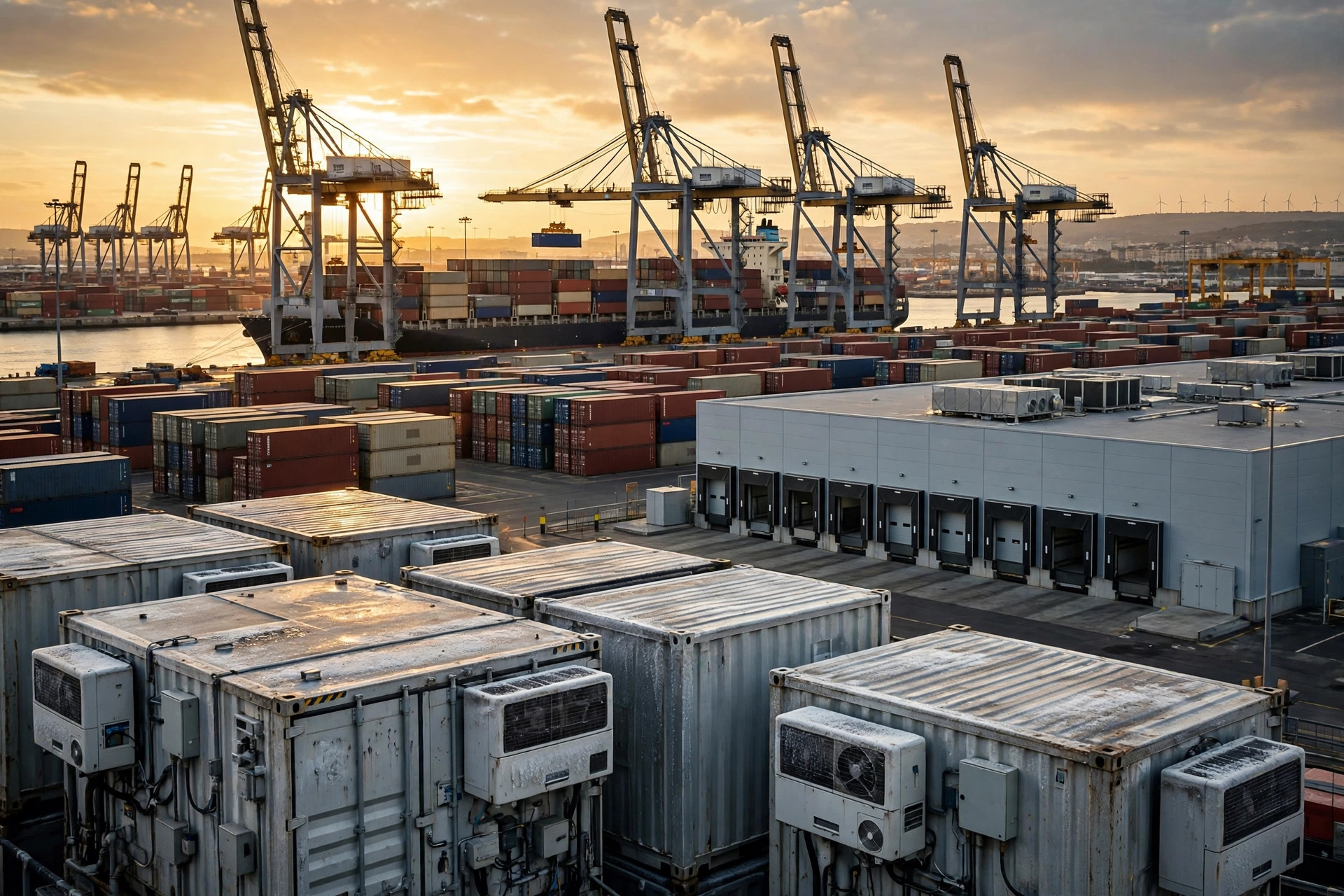
In August 2026, DP World announced a temperature-controlled logistics hub at the Port of Antwerp: €48 million for the first phase, roughly €100 million total across later phases. An 83,000-square-meter site next to DP World's Antwerp Gateway terminal, with more than 55,000 square meters of specialized warehousing once complete. Construction is targeted for the second quarter of 2027, completion for the second quarter of 2028, permitting-dependent. About half the capacity goes to perishables such as bananas; the other half to pharmaceuticals, healthcare products, and chemicals, with multi-temperature zones and consolidation and deconsolidation services.
What does that number tell you? That Antwerp is putting real money behind the cold-chain lane. Europe's bananas and citrus have long entered through Antwerp in large shares, and pharma shippers' demand for compliant temperature-controlled warehouses keeps climbing. A 55,000-square-meter, multi-temperature hub landing next to the terminal means fresh-produce and pharma distributors can find an integrated "terminal-cold store-distribution" operator around the Port of Antwerp — one fewer place for the cold chain to break.
But this cuts both ways: the hub doesn't open until 2028. Talk now and there's no ready warehouse to sign for — only a future cooperation framework. And half the capacity is bulk perishables like bananas; how much multi-temperature space pharma shippers actually get depends on the leasing progress. My read: fresh-produce shippers should start engaging now; pharma shippers should treat it as a site-selection plus, not the deciding factor.
Pharma shippers, take note: a cold store and a pharma-grade warehouse are two different things
In 2023, an in-vitro diagnostics shipper was hunting for temperature-controlled warehousing around the Port of Antwerp — 2–8°C, fully compliant, end to end. They found a cheap "cold store," signed, and discovered the place only ran -18°C frozen and 0–4°C chilled zones. No 2–8°C pharma-compliant zone, and not a single GDP audit document to its name. The freight was already on the water. It sat at the port for two weeks while they scrambled into a compliant pharma warehouse — demurrage plus the emergency move cost them tens of thousands of euros extra.
Bluntly, "cold store" is a big basket that everything gets thrown into; pharma needs temperature precision, temperature records, and audit files. This cuts both ways: for fresh produce, a generic -18°C/0–4°C cold store is fine — cheaper is better. For pharma, read the other party's compliance files and temperature-mapping reports before you sign; without those two, the lowest quote is a trap. DP World's 55,000-square-meter hub explicitly lists multi-temperature zones and pharma allocation in its public materials — when it opens in 2028, pharma shippers in Antwerp get one more credible option.
The four-question framework: answer these before you sign
Here's the decision framework I actually use for European DC site selection. Four questions, in order:
- Where is your shipment gravity? Plot the last twelve months of orders by destination country. What share do the top three markets take? The DC goes as close to those three as it can get.
- Does your freight need temperature control or value-added work? If yes, Antwerp's cold-chain and bonded-operations supply is a plus. If no, Rotterdam's sailing density and scale effects are more honest value.
- Is your tax structure ready? Dutch VAT deferment is genuinely attractive, but only if you hold VAT registrations across multiple EU countries and can file compliantly. Without that, the advantage is zero.
- Do you need re-export or return channels? If yes, the bonded warehouse's transshipment convenience and the second-leg network go on the decision sheet.
One line to close: ports are the vessel's business; the distribution center is the cargo's business — don't pick the cargo's warehouse with the vessel's scorecard.
By Lao Mi, Supply Chain Veteran (20 yrs)