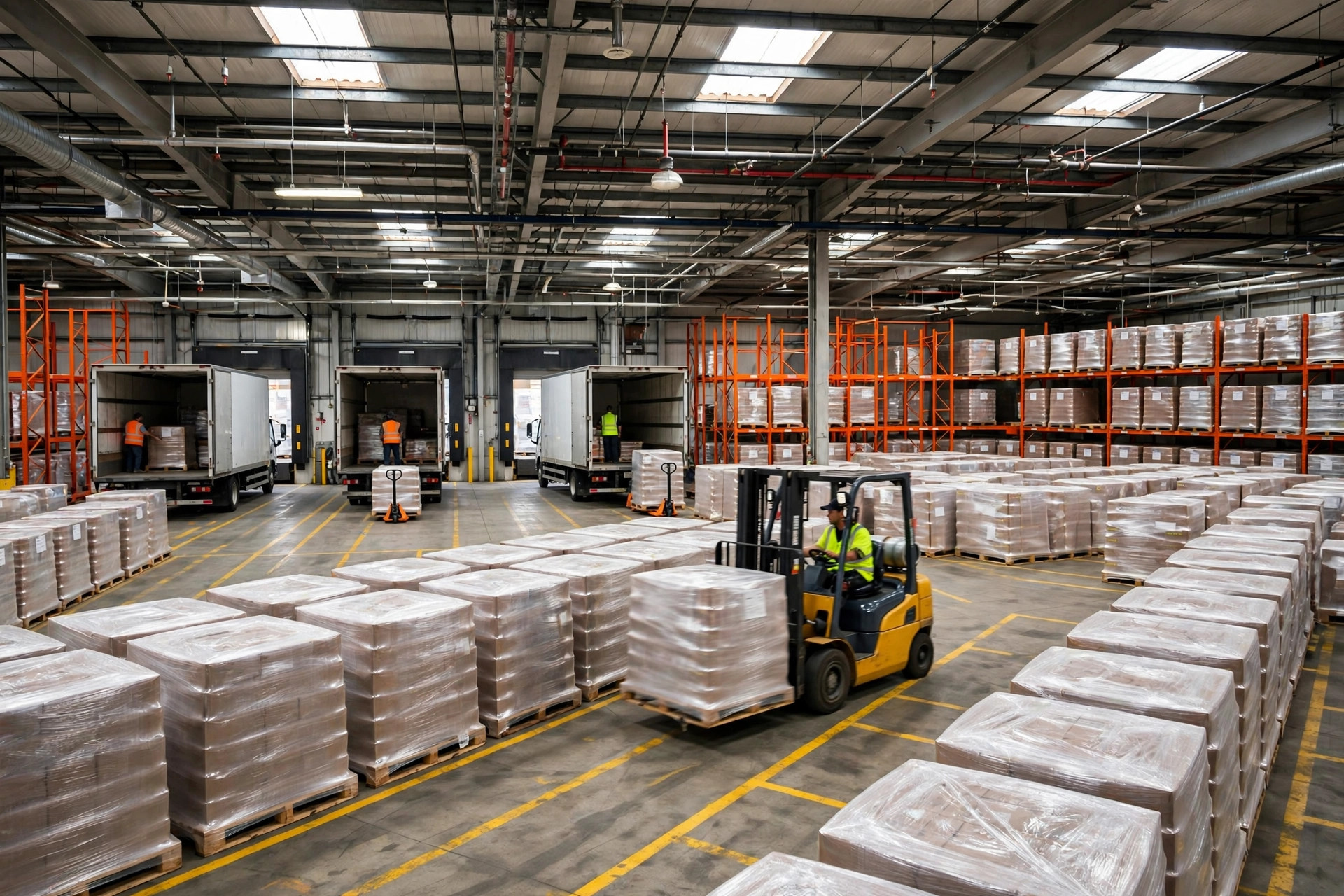
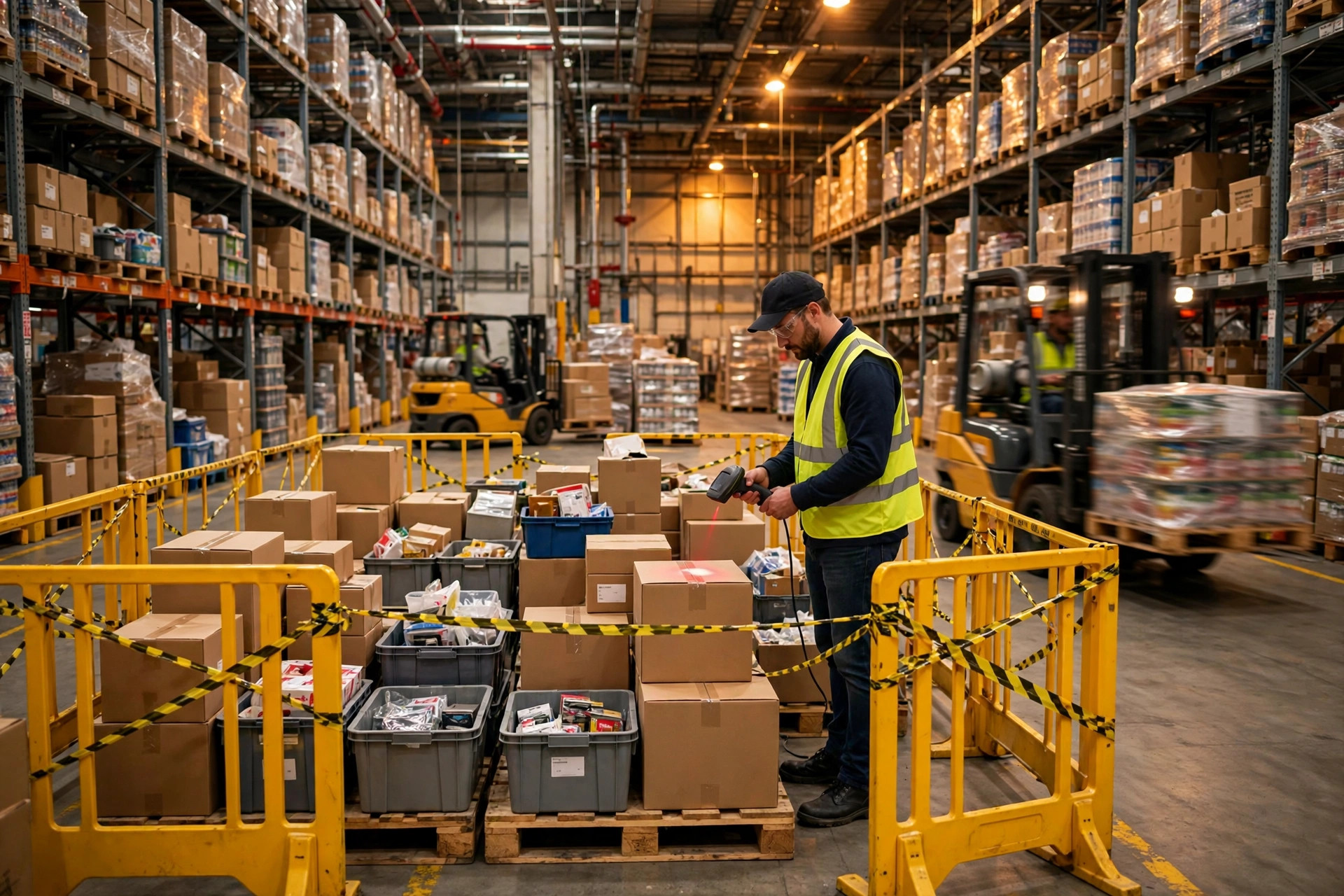
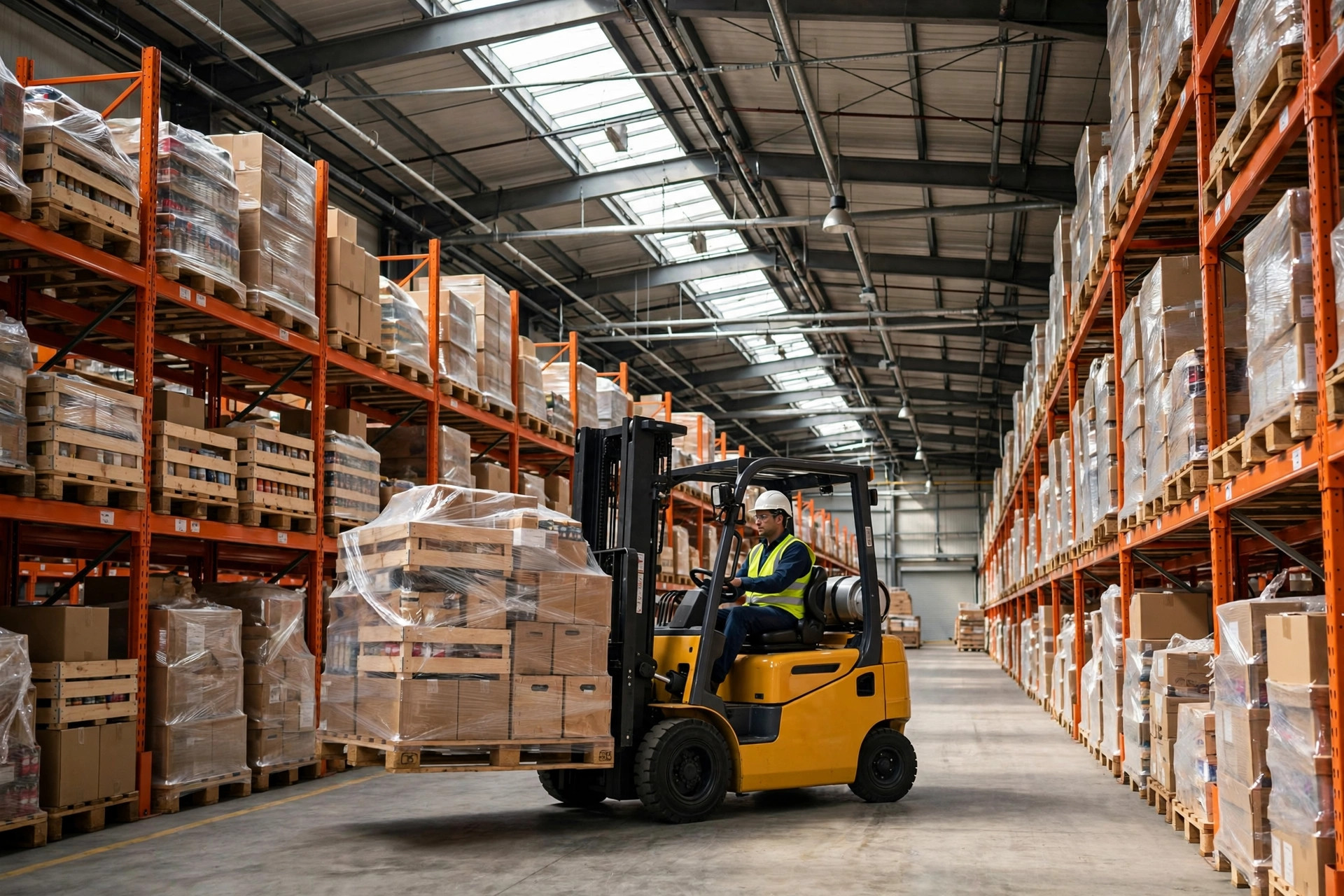
Every weekday before dawn, Royal FloraHolland's Aalsmeer flower auction — royal floraholland aalsmeer flower auction cold chain distribution at its most extreme — clears roughly 10 million stems of cut flowers: auctioned, sorted, and loaded before sunrise. According to the trade journal AJOT, the complex spans 5.5 million square feet with more than 1,100 dock doors, handles some 12 billion stems and plants a year, and sits behind more than USD 5 billion in annual trade; the same reporting estimates that about 40% of the world's flower exports pass through this one site. The numbers are impressive, but what deserves study is not the scale — it is a scheduling logic built around a single KPI: speed.
The nightly ledger: 10 million stems before dawn
Consider two scenes.
Scene one: early February, the Valentine's Day peak. According to Royal FloraHolland's official figures (via aiph.org, 2026-02-20), the 2026 Valentine's Day period saw 464 million stems change hands at Aalsmeer, including 150 million roses — the year's most extreme pulse test. The same reporting documents a complete intercontinental cold chain: roses harvested and pre-cooled in Nairobi, Kenya, board overnight freighters bound for Amsterdam's Schiphol airport, then transfer directly to Aalsmeer in time for the morning auction. There is no conventional "warehousing" step in this chain, only handoffs. A delay at any node eats directly into auction preparation time, and that preparation time is measured in minutes, not hours.
Scene two: an ordinary Tuesday morning. Industry sources record an average of about 60,000 transactions per morning at Aalsmeer. And the trade has a rule of thumb that keeps every scheduler awake: cut flowers lose roughly 15% of their value per day (industry experience). A batch of roses sitting one extra day in the auction hall sheds nearly a seventh of its worth — this is not a question of storage fees, it is the merchandise itself evaporating. Run the math: a lot auctioned at €100,000 loses about €15,000 if it ships a day late, while the cost of one more day in the cold store is negligible by comparison. At Aalsmeer, therefore, the first principle of scheduling is not "save cost" but "buy time" — time is not a cost line, it is the value of the goods.

Cold chain distribution: why 51,800 m² of cold storage is a supporting actor
According to the travel blog wanderlustingk, Aalsmeer's refrigerated space covers about 51,800 square meters. That sounds enormous until you set it against the 5.5 million square feet (roughly 510,000 m²) of the whole complex — about one tenth. The ratio itself is revealing: if the core logic of this cold chain were "storage," the cold store would dominate the footprint. Instead, it functions more like a buffer pool than a reservoir. Flowers arrive, get sorted, and leave, with dwell time counted in hours.
Attribution suggests at least three design layers behind the system. The first is the auction mechanism itself. The Dutch-style descending-price flower clock compresses some 60,000 transactions into a few morning hours — price discovery and sorting instructions are generated simultaneously. The moment a lot is knocked down, its destination dock and outbound truck are already decided. The second layer is load-unit standardization: the Danish trolleys used across the entire hall move flowers from auction floor to sorting zone to refrigerated truck with zero re-handling, squeezing transfer losses to a minimum. The third layer is geography: sitting next to Schiphol airport, inbound air freight and outbound road freight change hands under one roof, eliminating a line-haul leg and the loading waits at both its ends.
Here is the counterintuitive read: most observers assume Aalsmeer's core assets are the 51,800 m² of cold storage and the 1,100-plus dock doors. In reality, what makes it the world's largest flower distribution hub is a scheduling regime designed so that flowers never spend the night — the cold chain here is not used to preserve flowers, it is used to buy time. A preservation mindset asks whether temperatures are compliant; a time-buying mindset asks how many hours each stem has spent inside the building. The hardware serves the timetable, not the other way around. That distinction shapes the entire cold chain distribution logic: every flow is designed to shorten dwell time, not to raise storage density.
Auction clock vs. direct contracts: a grower's decision framework
For growers, consigning to Aalsmeer is only one channel; direct contracts are the other. The trade-off between them becomes clear in a simple framework:
| Dimension | Flower clock auction (Aalsmeer) | Direct contracts |
|---|---|---|
| Price | Market-driven, volatile; peaks can surprise upward, troughs can break cost | Contract-locked, stable but capped |
| Speed to cash | Sorted on knock-down, shipped same day, fast cash conversion | Produced to order; collection depends on payment terms |
| Logistics responsibility | Grower delivers to Aalsmeer; buyers and the system take over from there | Grower or its logistics provider owns the full journey to the buyer |
| Quality risk | The ~15%-per-day depreciation clock starts at harvest; longer chains mean more risk | Controllable chain, but a single failure hits the end customer directly |
| Best fit | Large-scale growers with standard varieties who can absorb price swings | Branded growers with stable key accounts and strong quality control |
There is no universally right answer here; the choice is itself a trade-off. The auction clock buys speed and liquidity at the price of volatility. Direct contracts buy certainty at the price of self-built logistics and account management. For a grower, the real decision variable is not "which channel is better" but "which column my volume structure, variety mix, and cash position resemble more closely."
A trend call: how long can the flower clock keep ticking?
Structurally, Aalsmeer faces two opposing forces. One is disintermediation: e-commerce and direct sales bring growers ever closer to end markets, which in theory erodes the auction's matchmaking value. The other is the concentration dividend: precisely because cut flowers depreciate about 15% a day, no fragmented, small-batch distribution system can easily beat a centralized market clearing 60,000 transactions a morning on time efficiency — liquidity is itself the moat, liquidity requires scale, and scale requires concentration.
My call is that the flower clock will not disappear over the next five to ten years, but its role will split from "the sole pricing center" into "pricing benchmark plus liquidity of last resort": standard, high-volume lots go through the auction for price discovery and fast clearance, while branded and customized demand goes direct. The evidence for this call is the baseline AJOT reported — 12 billion units and over USD 5 billion a year, with roughly 40% of global flower exports concentrated here — which suggests the hub's network effects are still strengthening, not weakening. Disintermediation attacks the information layer; Aalsmeer's real barrier was never just information, but the physical capacity to turn 10 million stems into 60,000 sorted orders before dawn. Information can be replaced by a platform; that kind of dawn-shift distribution capacity cannot, at least not quickly.
One open question to close with: if automated sorting and autonomous refrigerated trucks halve the time of the last hundred meters, will Aalsmeer's window stretch from "the small hours" into "the whole day"? And if it does, what should a flower-clock auction — a mechanism invented to concentrate time — become?
By Dr. Chen, Supply Chain Researcher