Here's the thing about Zimbabwe's tobacco auction season: what decides how much money you make usually isn't the harvest in the field. It's the moisture control inside the auction warehouse. The Tobacco Industry and Marketing Board's quality control unit puts a number on it — 12% of the tobacco delivered to auction floors gets rejected for poor grading and high moisture content. One bale in eight never makes it past the door, and the killer isn't yield. It's water.
The 2025 season moved 350,094,186 kilograms (TIMB's official figure), an all-time record, at an average of $3.32 per kilo. Good numbers. But this cuts both ways: record volume means record rejections too. I've seen too many growers spend four or five months nursing a crop through the curing barn, only to lose it on five words: "conditioning wasn't done right."
Five Links in the Zimbabwe Tobacco Auction Moisture Chain: March Opening to Export Container
Zimbabwe's auction season typically opens in March and runs into August. Moisture runs through five links. Break any one of them and you pay.
Link one: conditioning on the farm. Flue-cured leaf comes out of the barn (roughly 68°C, four to eight days) bone dry — bale it like that and it shatters. Conditioning puts moisture back so the leaf is "in order," the trade term for pliable, folds without cracking. TIMB's own guide says it plainly: cool the barn down first, then condition. Condition a hot barn and moisture distributes unevenly — wasted effort. Overdo it and the leaf feels cold and damp to the touch. That's over-conditioned, and the auction floor will reject it.
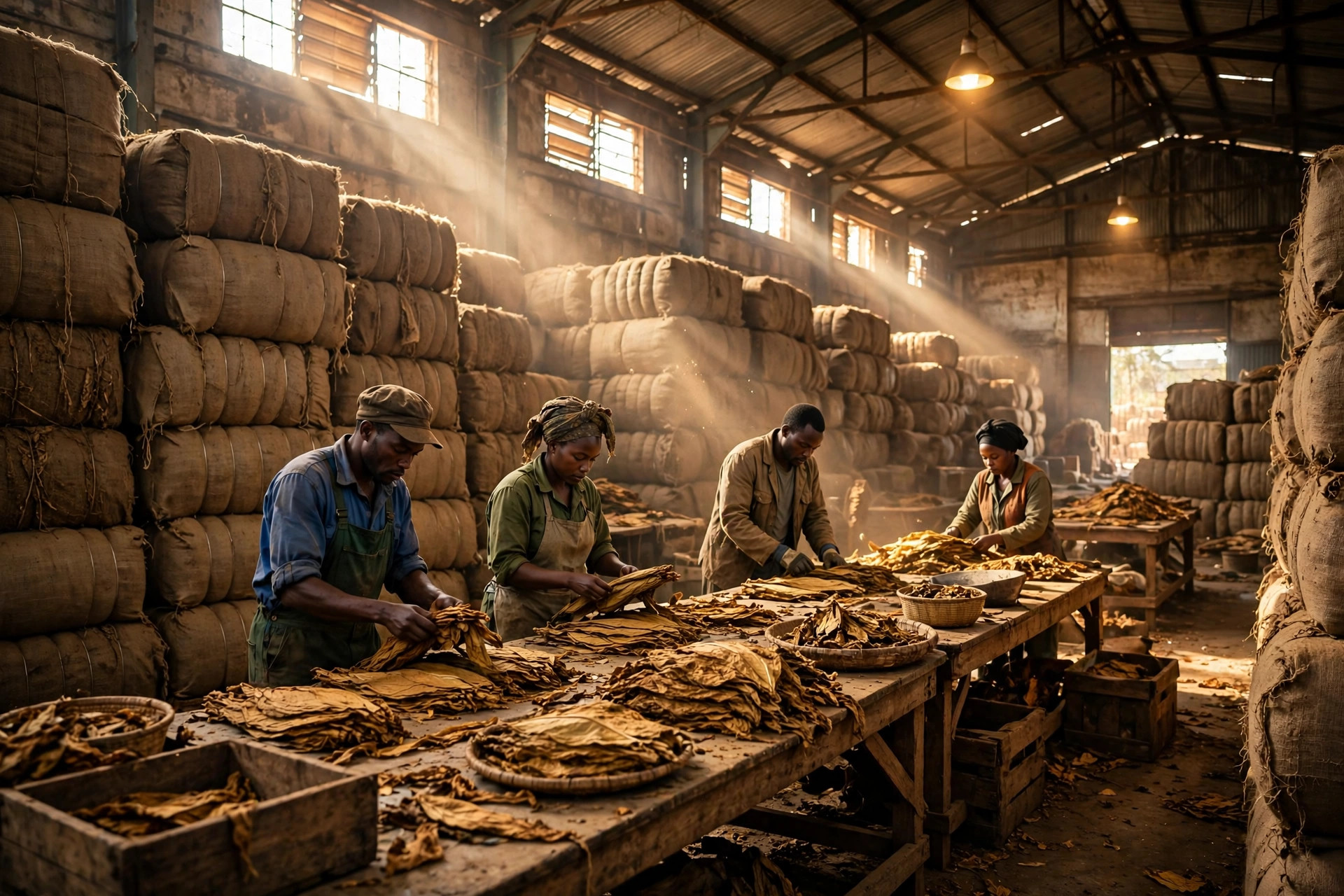
Link two: the grading hall. Bales arrive at the auction floor and get laid out for grading. In January 2026, Ethical Leaf Tobacco got its TIMB license and opened the Ethical Sales Floor (ESF) — Zimbabwe's third auction floor, 9,000 square meters, handling 7,000 bales a day. Bigger floor, longer the bales sit in the hall — and if hall humidity isn't managed, bales pick up moisture while they wait, and the grader knows "this bale is off" the moment they touch it.
Link three: bale specs. TIMB requires a standard baling box: 86cm by 61cm by 61cm, net weight 20 to 120 kilos. Loose, non-standard bales trap moisture in the core. Dry on the outside, heating up inside — that's a mold incubator.
Link four: post-auction bale storage. The buyer wins the bid, bales go into a warehouse awaiting export. This is the link everyone underestimates — the money's spent, so people relax.
Link five: redrying before export. Re-dry to a safe moisture level before loading the container. A shipping container crossing the ocean swings through big day-night temperature differences. Condensation is physics, not opinion — and one wet container puts the whole shipment at risk at the destination port.
The 800 Bales in Harare: Where I've Seen This Go Wrong
The one that sticks with me is from the 2025 season. A buyer rented a warehouse in Harare for his auction winnings — 800-plus bales, stacked neat and tidy. The problem was the neatness. Bales stacked flush against the wall, no ventilation gaps between stacks, nothing under the bottom layer. Then two weeks of rain, and the walls started sweating. By the time anyone noticed, the bottom of the two wall-side rows had mold spots.
Two sides to this. On one side, the loss: moldy bales get rejected if you're lucky; the real pain is the whole lot getting downgraded. On the other side, the lesson was cheap: pallets to lift bales off the floor, 60-centimeter air gaps between stacks, doors opened for ventilation two hours a day. All of it together costs a fraction of a percent of the cargo value.
And here's the side most people miss: the auction floor rejection rate is 12%, while the contract channel sits around 1%. Why the gap? Contract growers have field technicians watching their conditioning and baling. Independent auction growers are on their own. Those eleven percentage points are simply the difference between "someone's watching the moisture" and "nobody is."
The Moisture-Control Math, Laid Out
Take one 100-kilo bale. At the 2025 average of $3.32/kg, that's $332 a bale.
| What you spend on | Cost | What it costs you not to |
|---|---|---|
| Cool the barn + proper conditioning | Near zero — half a day's labor | Uneven moisture, rejected at the floor, wasted freight and time both ways |
| Standard baling box | Required by TIMB anyway | Irregular bales, core heating and mold, whole bale written off |
| Pallets + ventilation gaps in storage | Pallets and labor, under $1 per bale | Remember those 800 bales: two wall-side rows moldy; at 10% loss that's 80 bales × $332 |
| Redrying before export | Fixed re-dry cost | Container condensation, claims at destination |
The math is blunt: every dollar spent on moisture control prevents many dollars of loss. And moisture cuts both ways — too wet gets you rejected, too dry costs you weight (dry leaf shatters, and every handling step sheds grams you're paid by the kilo on). The real skill is hitting "in order." Not more, not less. Exactly right.
Four Things That Actually Work in an Auction Warehouse
First, don't condition by feel alone. TIMB's guide is specific: cool the barn, then condition in small batches. No moisture meter? Use the hand test: folds without cracking and doesn't feel cold — that's in order. Snaps when folded — too dry. Feels cold and damp — too wet, dry it back down.
Second, the "three nevers" for bale storage: never against the wall, never on bare floor, never blocking the door. Bottom layer on pallets, half a meter off the wall, ventilation gaps between stacks. In rainy season, check the walls for damp daily.
Third, somebody has to own humidity in the grading hall and the warehouse. A 9,000-square-meter floor moving 7,000 bales a day turns stock fast — less exposure. Small floors and transit warehouses where bales sit for days? That's where a hygrometer and a ventilation fan earn their keep.
Fourth, always redry before export. Don't trust "it looks dry enough." A container leaving via Durban sees double-digit temperature swings day to night, and condensation inside the box doesn't care about your judgment. Build the re-dry cost into your pricing and stop resenting it.
Here's the counterintuitive part nobody talks about: over-dried leaf quietly steals from you too. Tobacco sells by the kilo. Leaf that's too dry crumbles at every touch — grading, baling, loading — and each step sheds weight. Two percentage points of moisture on a 100-kilo bale is two kilos, about six and a half dollars at $3.32/kg. A thousand bales and you've silently lost over six thousand dollars. High moisture gets you rejected loudly; low moisture robs you quietly. Veterans know conditioning is never about "drier is better" — it's about landing exactly on "in order." No instrument needed to find that line, but somebody has to teach it and somebody has to check it. That 1% contract-channel rejection rate? That's what "somebody's watching" buys you.
One more: the truck ride from farm to floor. An open truck in one rainstorm undoes all your conditioning. On a 350-million-kilo season, transit losses look small until you divide them per bale. A tarpaulin isn't optional.
Zimbabwe's tobacco story is just getting started — 350 million kilos in 2025, with the value-chain transformation plan targeting 500 million by 2030. The bigger the volume, the more carefully the auction warehouse moisture math has to be done. So tell me: of that 12% rejection rate, how much never had to happen?
By Lao Mi, Supply Chain Veteran (20 yrs)