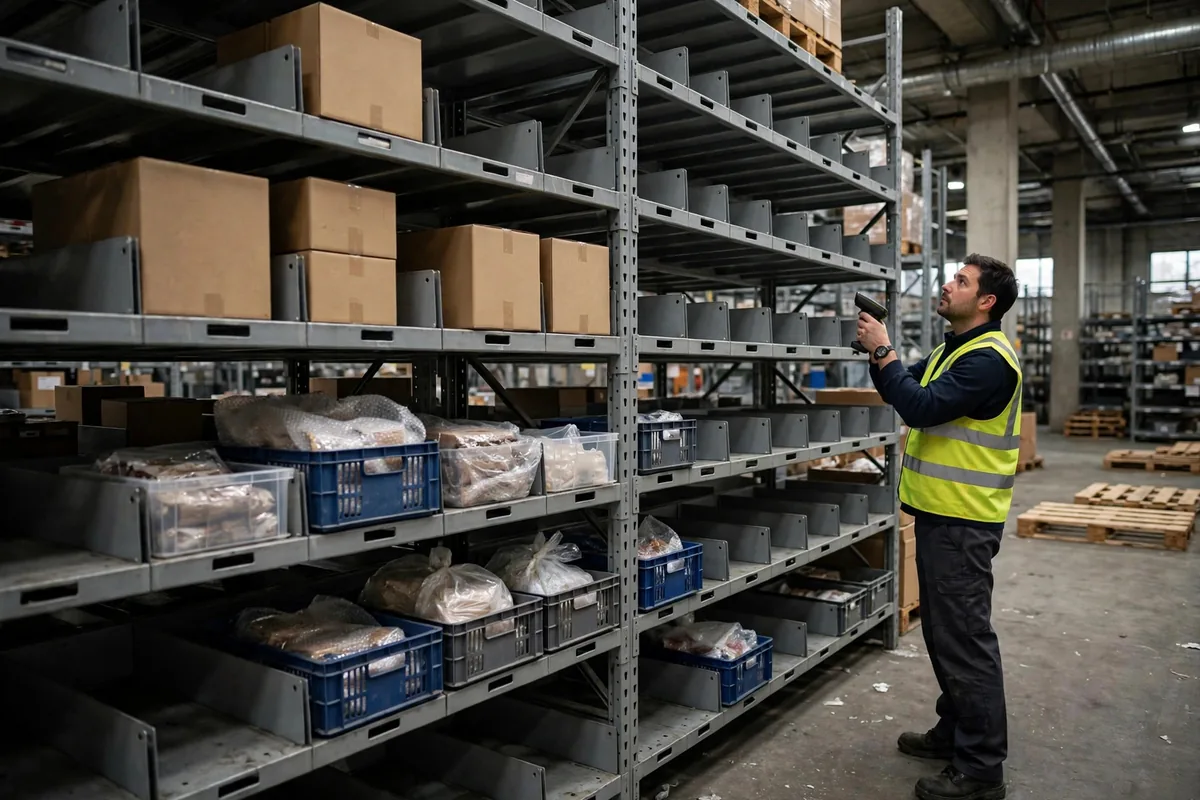
I have been driving trucks for fifteen years, and I can tell you this: I am not afraid of traffic. I am afraid of arriving at a warehouse and finding the stock does not match the paperwork.
One autumn a couple of years ago, I delivered a load of home appliance parts to a warehouse in eastern China. The paperwork said 120 cartons. The warehouse team counted twice and found 117. Where were the other three? The system said they were in aisle A, row three. We walked over. The shelf was empty. The record said they had shipped out last month, but the shipping papers had no trace of them. I waited at the gate for almost two hours. In the end the customer called and said to unload the truck first and chase the missing three cartons later. The truck got unloaded, but I never forgot that day. When warehouse records are wrong, everybody pays for it at the worst possible moment.
That is what warehouse cycle counting frequency is really about. It is not one giant annual count. It is a steady rhythm of small counts, catching small errors before they grow into big ones.
Start with ABC: Count the Valuable Stuff More Often
Warehouses have used the same old method for years, called ABC classification. Class A is roughly 20% of SKUs but roughly 80% of inventory value. Class B is roughly 30% of SKUs and roughly 15% of value. Class C is roughly 50% of SKUs and only roughly 5% of value. The exact split varies from one warehouse to the next, but the logic does not change: count the valuable, fast-moving items more often, and count the cheap, slow-moving items less often.
The common warehouse cycle counting frequency that follows from that split looks like this: count A items weekly or monthly, B items monthly or quarterly, and C items quarterly or every six months. Notice that A items get two different answers, weekly and monthly. Neither guide is wrong. There is no single standard answer. The rhythm has to follow value and movement. An item that ships dozens of times a day needs a different rhythm from an item that ships twice a month, even if both are expensive.
Cycle Counting Frequency: How Many Counts a Year?
Setting a warehouse cycle counting frequency on principle alone is not enough. You have to check whether your people can actually do it.
A published worked example gives a useful reference point: for a catalogue of 2,000 SKUs, following a quarterly ABC rhythm adds up to more than 9,000 counts a year, about 35 counts a day, and one employee can finish them in 45–60 minutes a day. Do not copy that number blindly — use it as a yardstick. It is less than an hour tucked into a normal working day.
My own rough method is simpler. List your A items first and count how many SKUs there are. Then look at how many people you can spare each day. If counting A items weekly means more than 60 counts a day, you do not have enough hands. Either move some A items to a monthly rhythm or assign another person. If you are only doing a dozen counts a day, your rhythm can probably tighten up, and the fastest-moving A items could go to twice a week.
Follow the discrepancies — the adjustment I trust most. One warehouse started with monthly counts for A items and kept finding two or three SKUs off every month. They switched to weekly counts and the errors dropped quickly. Another warehouse counted C items every six months, found them correct twice in a row, and stretched the interval to once a year, moving the saved time to B items. A counting schedule is not a stone tablet. It is a living record that follows the errors.
| Class | Rough share | Common cycle counting frequency | What to watch |
|---|---|---|---|
| A | About 20% of SKUs, about 80% of value | Weekly or monthly | High-value, fast-moving SKUs |
| B | About 30% of SKUs, about 15% of value | Monthly or quarterly | Medium-value, medium-movement SKUs |
| C | About 50% of SKUs, about 5% of value | Quarterly or every six months | High-volume, low-value, slow-moving SKUs |
From One Annual Count to Cycle Counting: What 90 Days Can Show
Last year I was chatting with a warehouse supervisor at a consumer goods warehouse. They used to do one big annual count, shutting down for two days with everyone counting, and the books still did not balance afterwards. After they switched to cycle counting, their inventory accuracy rose from the 85–93% range to above 98% within the first 90 days. That is a commonly reported starting effect for warehouses moving from an annual count to cycle counting: accuracy often climbs from 85–93% to above 98% within 90 days.
The target for a mature operation is inventory accuracy above 98%, and above 99% for A items. Do not dismiss one or two percentage points. When inventory records are inaccurate, supply chain performance drops by 10–15%. The system says the stock is there and the shelf is empty, so customer service takes an order it cannot fulfil. Or the shelf is full and the system says zero, so purchasing buys another pile. I have seen both mistakes on the road, and both end with the customer and the warehouse blaming each other.
There are also useful targets for discrepancy rates: 0.2–0.5% for a dedicated warehouse, and 1.5–3% for cross-dock operations. Cross-docking is different by nature — goods flow straight through without sitting in storage — so a higher discrepancy rate is reasonable there. Judging a dedicated warehouse by cross-dock standards, or the other way round, will only push people into cutting corners.
Cycle Counting Frequency: Counting More Often Can Cost Less
After fifteen years of dealing with warehouses, my conclusion is simple: you cannot tell whether the books are accurate on a normal day. You find out when something goes wrong.
A customer once told me his warehouse counted once a year. After the annual count they found a batch missing, and it took two weeks to trace it to a returns entry recorded against the wrong location three months earlier. With a weekly A-item count, that batch would have surfaced within a week.
Here is the counterintuitive part: counting more often does not necessarily cost more. One annual count shuts the warehouse down for two days, with everyone counting. Thirty-five small counts a day at 45–60 minutes keep the warehouse running and the errors keep shrinking. Many people think cycle counting adds work. In reality it breaks one big annual headache into small daily jobs.
That said, cycle counting is not magic. Counting finds a mismatch between the books and the shelf, but it cannot recover stock that is already gone, and it cannot fix a broken receiving process. When a count finds a difference, someone has to investigate the cause: was the delivery not counted properly, was the wrong location picked, or was the unit of measure wrong in the system? Count without investigating, and you can count forever and still be wrong.
My Advice to Customers and Warehouses: Start with Class A
My advice is practical, in three steps.
Start with Class A. Do not try to count the whole warehouse at the highest frequency on day one. You will not have enough hands, and the routine will not last a month. Set A items to weekly or monthly, B items to monthly or quarterly, and C items to quarterly or every six months. Run it for a month, see how much time it takes each day and how many discrepancies appear, then adjust.
Then write down the cause of every discrepancy: which SKU, how much it was off by, and what might have caused it. After a month, the cause that keeps repeating is the process you need to fix.
Finally, a word to customers. When you visit a warehouse, do not just look at whether the shelves are full. Ask when the last cycle count was, and what the A-item accuracy rate is. If nobody can answer, the books are probably a mess. And if your goods sit in a warehouse whose books are a mess, you should know that going in.
After all these years on the road, I believe one old saying: the books are kept accurate day by day, not settled at the end of the year. Get the rhythm right — A weekly, B monthly, C quarterly — and the warehouse will not end up with a pile of old debts nobody can untangle.
By Shifu Zhao, Trucking Veteran (15 yrs)