
Peak-season orders just doubled. Do you grit your teeth and pay your full-timers overtime, or make one phone call and bring in twenty temp workers? — I get asked this every peak season. And every year, somebody gets the answer wrong.
I've spent 20 years on the floor of American warehouses. I've run facilities staffed entirely with full-timers, and ones where half the floor was temps. Neither model is absolutely right or wrong — but each has its red lines and its price tag. Let's break it down: when to use temps, when you must use full-timers, where compliance draws the line, and what the real cost difference is.
Where Are Temps Actually Cheaper?
Here's my conclusion up front: temps are cheap in "flexibility," not in "hourly rate." Read that three times.
Temps genuinely fit three scenarios: seasonal surges (holiday peak, promotional events), piloting new business (a new product line where volume is uncertain), and covering gaps (leaves, resignation windows). The common thread: demand is uncertain, and carrying full-timers through it is waste.
Flip it around — three roles I never staff with temps: forklift operators (licensed, experienced, and an accident is a catastrophe), leads and inventory staff (they manage people and the books — they need to be your people), and shipping verification (the last checkpoint; there's no room for error). Staffing core roles with temps saves pennies and gambles dollars.
In 2021 I ran an 80,000-square-foot warehouse in Fontana, California. For peak season we put temps across the entire pick line and kept full-timers only on forklifts and lead roles. Our error rate doubled versus normal months. The extra return shipping and rework labor ate the entire hourly-rate savings — and then some. Since then my rule is: temps do only the most standardized picking and packing. Anything touching the system stays with full-timers.
Where Does Compliance Draw the Line?
This is where people flip the truck. Plenty of owners think "the staffing agency sent them, so whatever happens isn't on me." Dead wrong.
Red line one: don't dress up employees as "contractors." In the US, if you call someone an independent contractor but dictate their hours and how they work, legally they're your employee. California's AB5 law, effective 2020, applies the ABC test and it's strict — get caught misclassifying and the back taxes plus penalties will make you question your life choices. "Fake outsourcing, real temping" gets scrutinized on both sides of the Pacific; only the names differ.
Red line two: you can't skip safety training for temps. OSHA has been clear for years: the host employer and the staffing agency share responsibility for temp worker safety. A temp's first day means forklift aisles, fire exits, and emergency procedures — none of it optional. I've seen warehouses let temps "just follow along and pick it up." One had a workplace injury in the first week — the workers' comp and shutdown losses would have paid for a full year of safety trainers.
Red line three: pushing "same work, different pay" too far invites lawsuits. A temp doing the same job can earn a lower hourly rate than a full-timer — that's market reality. But when the gap is absurd and nobody ever converts to full-time, discrimination and labor disputes start brewing. My practice: strong-performing temps get a conversion path within 90 days. It's a retention tool and a compliance firewall in one.
If you operate in both China and the US, note that China's interim rules on labor dispatch cap dispatched workers at 10% of total headcount and require equal pay for equal work. Check current regulations and get counsel's read before you act on ratios — don't go by memory.
How Should You Actually Do the Math?
Most people only compare hourly rates. That's wrong. Here's the formula I use:
A staffing agency quotes you $26–28 an hour for a worker who takes home $18. A 40–50% markup is normal. A full-timer? $20 an hour, plus Social Security, health insurance, paid leave — the loaded cost runs 25–30% higher, landing around $25–26 an hour. Looking at the numbers alone, temps seem slightly more expensive?
But you can't do the math that way. There are three hidden costs:
First, training drag. A temp takes two to three weeks to reach 80% of a full-timer's productivity. Over a three-month peak season, you're perpetually paying for the "rookie phase." Full-timers get more efficient in year two and three. Temps stay at square one forever.
Second, turnover churn. Temp turnover runs two to three times full-timer turnover. Every departure restarts recruiting, training, and ramp-up. I've calculated that getting one picker from day one to working independently costs — direct and indirect — about half a month's wages.
Third, errors and damage. Rookies mispick more, damage more in packing, and lose more packages. At peak-season volumes, a one-point difference in error rate means dozens of customer-service tickets a day.
So my formula: temps win for anything under three months; if you're still temping the same role past six months, you're losing money. That role should have been converted to full-time.
How Do You Staff the Peak-Season Roster?
Here's the method I've used for years. I call it the 70-30 structure:
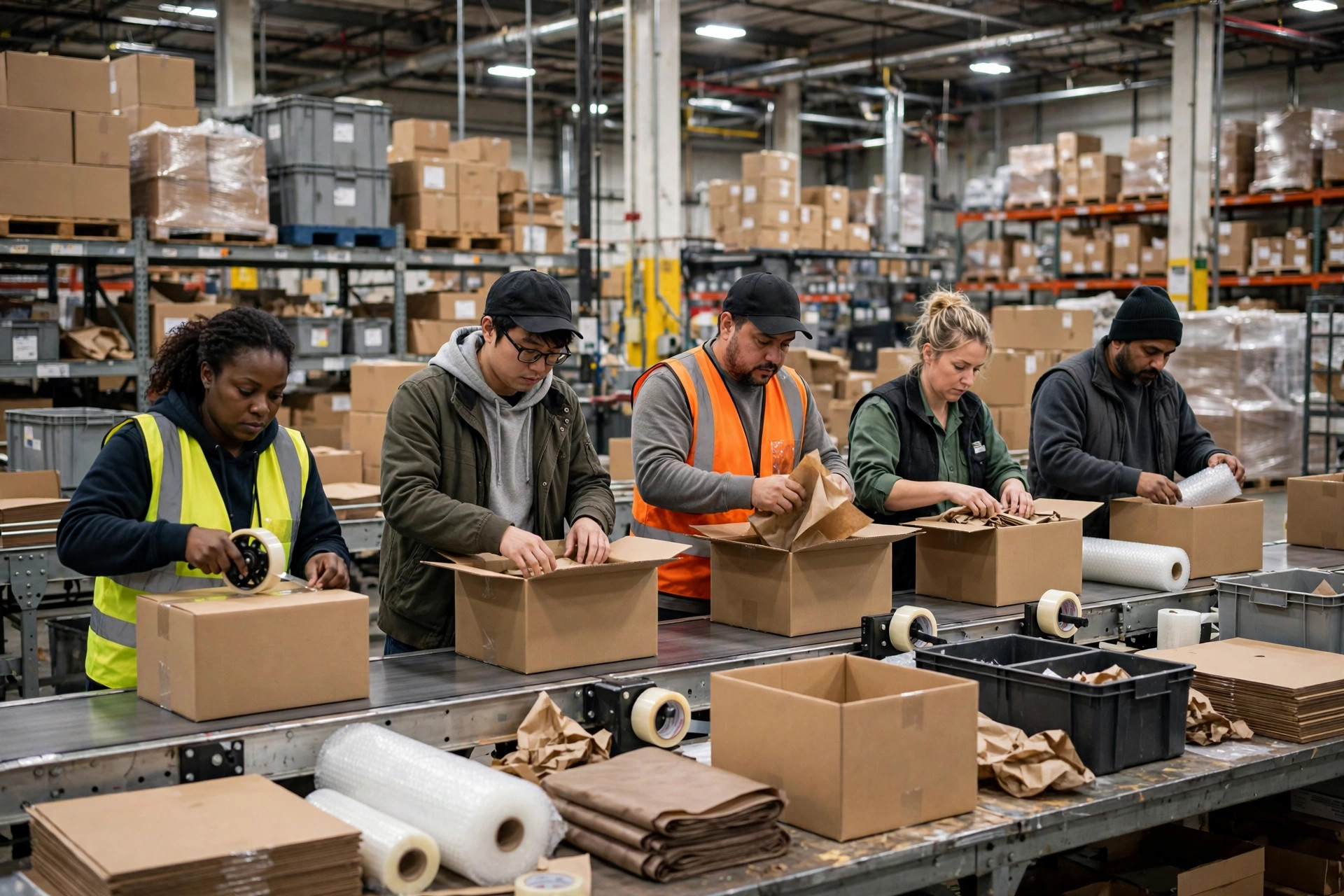
Seventy percent full-timers as the foundation, thirty percent temps for the surge. Full-timers guarantee the floor — systems, equipment, and critical steps don't break. Temps absorb the wave — when volume doubles, there are hands to throw at it. Once temps pass half the floor, management loses control and error rates explode. That's a lesson I paid for in real money.
Start recruiting temps two months early. Don't wait until November — good agencies have nobody left for you by then. Lock in the partnership in September, bring people in during October for training and ramp-up, and they're at full speed when peak hits. Temps are people too; familiar surroundings make a real productivity difference.
Treat temps as a talent pipeline, not disposable labor. Talk conversion with the strong performers before peak season ends. Every peak season is my best recruiting window — someone battle-tested over three months beats any interview hire. Owners who treat temps as disposable always pay it back double in recruiting.
Give temps something to aim for. Write down the conversion criteria: attendance, units per hour, error rate. Hit the bar, get converted. A temp with something to aim for and one without are two completely different workers. This costs nothing and works best.
One line to close: temps buy you flexibility; full-timers are your foundation. Flexibility can be purchased. The foundation has to be built yourself. Peak season never tests how many people you have — it tests whether your people hold together when volume doubles. You can't buy that with temps.