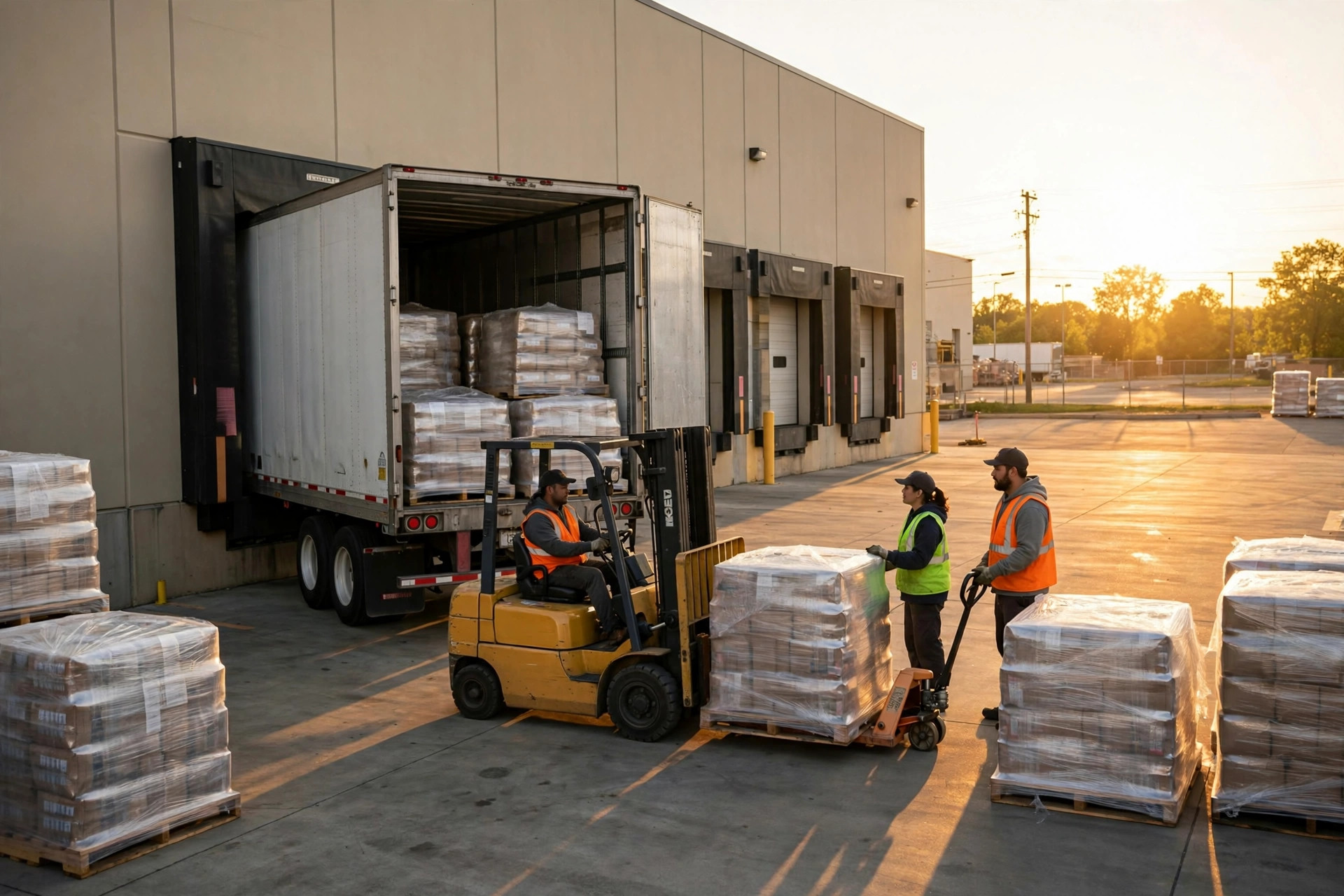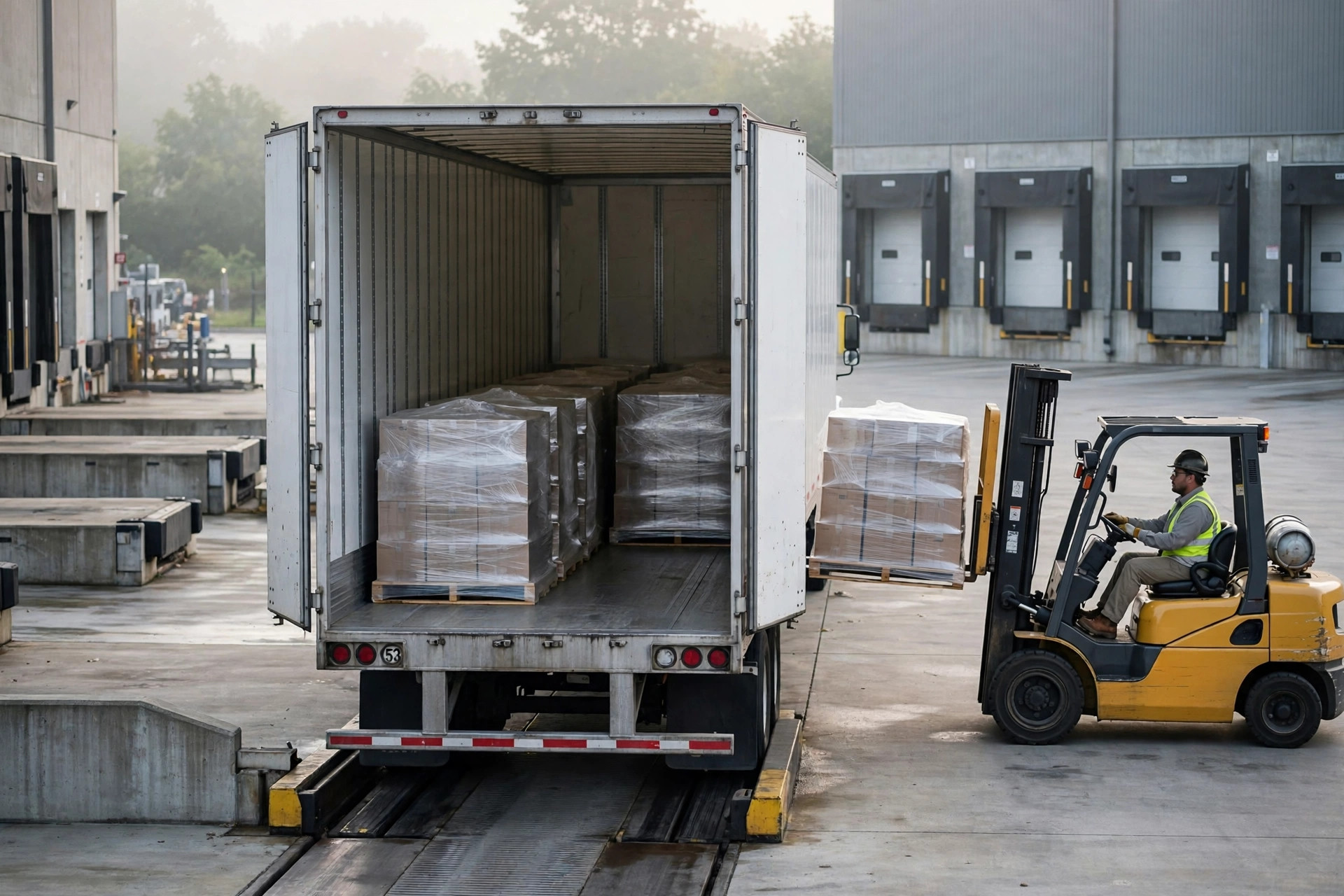
Every shipper moving 6 to 15 pallets faces the same unanswered question: when to use partial truckload vs LTL or FTL. US road freight has long offered two familiar answers — less-than-truckload (LTL) and full truckload (FTL) — and shippers in the middle usually pick one of two wrong ones: cram a dozen pallets into the LTL network and endure repeated terminal handling, or pay for an entire 53-foot dry van and run half of it empty for "peace of mind." Partial truckload (PTL) is the third mode built exactly for this middle ground, and it remains far less understood than the other two.
Boundaries first: the data, then the choice
Start with the numbers, because the thresholds define the decision. According to freightrate.com's 2026 LTL-vs-FTL comparison guide: LTL is designed for roughly 150 to 15,000 pounds; PTL typically covers 5,000 to 15,000 pounds, or 6 to 18 pallets; FTL corresponds to the full capacity of a 53-foot dry van, about 26 pallets. Red Stag's 2025 PTL guide draws the ceiling wider, noting that some carriers accept freight up to 30,000 pounds. That spread itself carries an important message: PTL is not a statutory category but a market-formed service, and each carrier's acceptance band differs slightly. Confirm the actual range with the carrier before quoting — no single source's number should be treated as an industry standard.
Why is six pallets the rule-of-thumb boundary? The reason is not weight; it is LTL pricing logic. LTL is priced on NMFC freight class and weight, and carrier networks are optimized for consolidating many small shipments. A 10-pallet shipment occupies space that could have held seven or eight small ones, so LTL carriers effectively discourage it with punitive pricing — an open secret in the industry. PTL, by contrast, is priced on the trailer space you actually use. No NMFC classification step, which means no reclassification disputes and no minimum-density surcharges showing up as surprise line items. Echo's PTL overview stresses this point: what you save is not only money but the friction in the quoting process itself.
Partial truckload vs LTL vs FTL: three ledgers, kept separately
Cost, transit time, and damage must be accounted for separately. Blend them and the conclusion will be wrong.
The cost ledger. Below 5,000 pounds, LTL is nearly unbeatable — that is its home turf. But once a shipment crosses about 8,000 pounds, industry outlet Total Connection reports PTL frequently running 20 to 30 percent cheaper than LTL. At the other end, Echo's figures suggest PTL can save up to roughly 35 percent versus booking a full truck — but treat that as a carrier blog's marketing figure. Real savings depend on the lane and the season; base the decision on actual quotes for your own lanes, not on anyone's published ceiling.
The transit ledger. LTL freight gets unloaded at the origin terminal, transferred onto a linehaul, unloaded again at the destination terminal, and handed to a local delivery truck — three to five handling events is normal. PTL skips the terminal network entirely: the same trailer runs origin to destination with typically one or two en-route stops for co-loaded freight. Total Connection's figure is one to two days faster than LTL on the same lane.
The damage ledger. Handling events correlate with damage probability — one of the few relationships in freight that hardly needs defending. PTL loads once and unloads once, which makes it a natural fit for high-value, fragile, or packaging-sensitive goods. Every LTL terminal transfer is a fresh exposure. FTL also loads once, but you pay for the whole trailer to get that privilege.
Two cases: punished by LTL, and paying for empty air
The first case is a home-furnishings e-commerce brand running two replenishment loads a week, 10 to 12 pallets each, from a Southern California warehouse to a Texas regional facility — on LTL for three years. The problem was never transit time; it was the invoice. Pallets mixed assembled furniture with accessories, and the LTL carrier issued four reclassification adjustments in a year, with surcharges totaling more than 20 percent of the base freight. After switching to PTL, priced on occupied space, the invoices became predictable and each move arrived about a day sooner. This is the classic "punished by LTL pricing logic" profile: the shipment had outgrown LTL's comfort zone, and the network was expressing its discomfort through pricing.
The second case runs the other direction. An auto-parts distributor moves four to five shipments a month, 8 to 9 pallets each, to Midwest customers — always as full truckloads, on the theory that "urgent freight deserves a dedicated truck." Do the arithmetic: 9 pallets in a 26-pallet dry van is a load factor under 40 percent, meaning roughly 60 percent of the freight bill pays for air. After moving to PTL, transit time slipped by about half a day (one extra en-route stop) while the freight cost fell to roughly 60 percent of the full-truck figure. This is the classic "paying a full-truck premium for peace of mind" profile: the peace of mind is real, the premium is certain, and the only uncertainty is how large the avoided risk actually was.
When to use partial truckload: a four-question framework
The decision compresses into four questions, answered in order.
One: does the shipment fall in the 6-to-18-pallet, 5,000-pound-plus band? Outside it, PTL is probably not the answer — go back to LTL's or FTL's home turf.
Two: has this freight suffered LTL reclassification disputes or accessorials before? If yes, PTL moves up the list — its class-free pricing removes the soil those disputes grow in.
Three: does the shipment need certainty or absolute speed? For the fastest possible transit, FTL remains unmatched. For "faster than LTL and stable," PTL fits. Note that PTL's transit variance comes from co-loading stops, so build a buffer into hour-precise delivery commitments.
Four: does the lane have reliable PTL capacity? PTL's price advantage rests on carriers co-loading your freight with someone else's. On remote lanes or in soft seasons, there may simply be no truck to book — the largest hidden constraint of PTL, and the question most decision frameworks omit. A discount you cannot book is not a discount.
One counterintuitive judgment: the closer the pallet count gets to a full truck, the more wrong "just book the truck for simplicity" becomes — but "PTL always beats LTL" is equally wrong. Light, low-density freight (bulky hollow packaging, for example) can occupy six pallets yet weigh far under 5,000 pounds: it clears PTL's weight threshold while LTL may still price better on space. Weight and cube must be evaluated together; either one alone misleads.
The trend read: LTL carriers have been intensifying their discouragement of large shipments in recent years, optimizing networks ever more toward small, frequent freight — while e-commerce replenishment and regional distribution keep pushing average pallets per shipment upward. Those two trends point at each other, and PTL, the "middle option," has a plausible path to becoming the default for the 6-to-15-pallet band. Whether it actually gets there hinges on an open question: can PTL capacity evolve from opportunistic co-loading into a bookable, committable standard product? Until then, it remains an option to be validated lane by lane, shipment by shipment — genuinely useful, but not an automatically correct answer.
By Dr. Chen, Supply Chain Researcher