Here's the bottom line up front: if your warehouse cycles through more than 100 people a year and you're still running paper I-9s tracked in a spreadsheet, you're not saving money. You're running an input-validation system with the validation turned off — errors sail through, and when it blows up, you're billed per form.
I'm an automation engineer. I see everything as a production line. Form I-9 is, at heart, an employment-eligibility input-validation system, and the architecture is actually clean. Three layers:
Section 1 is the employee-side input: name, identity, work-authorization attestation, filled out by the employee no later than the end of day one. Think of it as a registration form — leave a required field blank and the submission should never pass.
Section 2 is the employer-side verification: the employer (or an authorized representative) inspects original documents — originals, not copies — records the document info, signs, and dates. Deadline: within three business days of the employee's first day of work for pay. This is incoming-goods inspection on a production line: skip it and everything downstream is rework.
Section 3 is reverification: when documents expire or an employee is rehired.
The acceptable documents are an enumerated type: List A is a single document that proves both identity and work authorization (U.S. passport, green card). List B (driver's license — identity only) plus List C (Social Security card, work permit — authorization only) together make a complete input. Miss one and validation fails.
E-Verify is the networked real-time validation layer bolted onto the system: it pings DHS and SSA databases with the I-9 data. Participating employers must open a case no later than the third business day after the employee starts work for pay. Order matters: complete I-9 first, then the E-Verify case — pre-screening applicants is expressly forbidden. One more detail: if you use E-Verify, any List B document the employee presents must have a photo.
The theory is tidy. What the system fears is a specific input pattern: high-volume concurrent input with not enough verification capacity. Which happens to be exactly how warehouses hire during peak season.
Why bulk hiring is this system's nightmare
One paper I-9 takes a practiced HR staffer about 20 minutes: inspect, fill, sign, file. A hundred hires is 33 hours — a full person-week. Peak season? 180 temp pickers walk in the week before Black Friday, and HR is still two people. It's like tripling the feed rate on a line designed for a 60-second takt time — the inspection station collapses first.
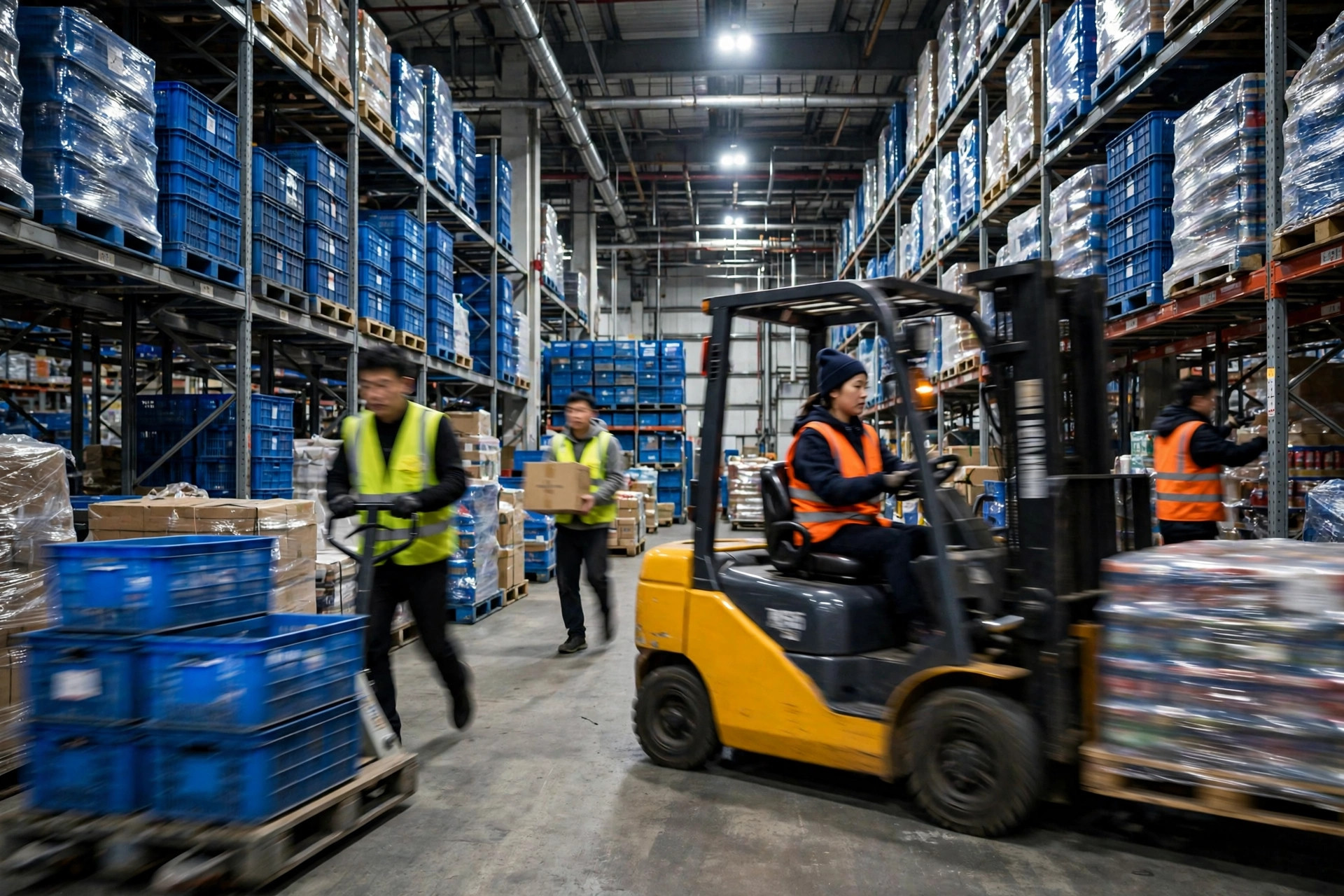
That collapse happened in November 2025 at a 120,000-square-foot 3PL warehouse in Fontana. 180 seasonal pickers in one week. Section 2 legally had to be done within three business days; two HR staff couldn't physically get through 180 forms in three days. Forty-plus forms slipped to day five. Thirty more went out with the employer signature block blank — filled in, but unsigned. Invalid batch.
Then the Notice of Inspection arrived in March 2026. The rule: three business days to hand over every I-9. And here's the 2026 twist that changed the math — on March 16, ICE updated its inspection guidance and reclassified more than ten common error types from "technical" to "substantive." Technical errors used to get a 10-business-day cure period. Substantive violations get none. Wrong is wrong, fined per form on the spot.
The Fontana warehouse ended up with 120 forms flagged as substantive violations. The penalty band is $288 to $2,861 per form (the January 2025 inflation adjustment; no newer adjustment had been published as of September 2026). Take a below-midpoint $1,200 per form: 120 forms is $144,000. One peak-season staffing crunch turned into a six-figure fine.
Here's the counterintuitive part: the biggest I-9 risk was never "hiring someone you shouldn't have." It's "hiring perfectly legal workers and botching the paperwork." Paperwork fines have nothing to do with the worker's status — an all-citizen workforce with sloppy forms gets fined per form just the same. Plenty of operators think "we hire locals, we're fine" — treating the validation layer as decoration and betting the auditor never shows up. After ICE closed the cure window in March 2026, the odds on that bet changed.
The dividing line: when does electronic I-9 pay for itself?
Paper versus electronic, in a table, because numbers talk:
| Paper + manual process | Electronic I-9 + E-Verify integration | |
|---|---|---|
| Time per form | about 20 min | about 8 min (field validation catches errors automatically) |
| Labor for 100 hires | about 33 hours (one person-week) | about 13 hours |
| Error rate | Typically 10–15% (missing signatures, late completion, expired documents never reverified) | Required-field checks + deadline alerts push it under 2% |
| Annual cost | $0 (but HR hours aren't free) | A few thousand dollars/year (check vendor sites for current pricing) |
| Fine per substantive violation | $288–$2,861 per form | Same — but the error base is an order of magnitude smaller |
My dividing line is blunt: more than 100 hires a year, or any single bulk hire over 50 people, and electronic I-9 pays for itself. The arithmetic is simple: 100 hires × 10% error rate = 10 bad forms × about $1,000 each = $10,000 of exposure. An electronic system costs a few thousand a year. Positive ROI. Below that line — 20 hires a year, stable crew, small warehouse — a manual process plus a checklist is fine. Buying a system there is over-engineering, and I won't recommend it.
Time to shoot down a piece of pseudo-wisdom: "E-Verify is voluntary at the federal level, so skipping it saves hassle." Saves what hassle? A few minutes of case setup per person, in exchange for betting the whole paper process's double-digit error rate. Since March 2026 there's no cure window for substantive errors — the "we'll fix it if we're audited" strategy is mathematically dead. It's like pulling the inspection station off the line to save labor: when defects reach the customer, the recall costs dozens of times what the station cost. Stupid with unusual clarity.
Maintenance potholes: three single points of failure
Once the system is live — paper or electronic — three single points of failure will get you. Bulk-hiring warehouses step on every one of them:
Pothole one: the clock. Section 2's three business days run from the first day of work for pay, not from the offer letter. Peak onboarding brings 60 people on a Monday; the supervisor is busy with scheduling, training, and safety briefings, and signatures slide to Thursday or Friday. Being late is itself a substantive violation. The fix is unglamorous but works: sign on day one, never batch it. Electronic systems can fire a 48-hour warning; manual processes need HR to clear the pending pile before leaving each day.
Pothole two: expired reverifications. When a worker's document expires (a work permit, say), Section 3 reverification is due. Retention rule: keep the form three years from the hire date or one year after termination, whichever is later. Warehouses churn; people leave and their forms stay, and the people who stay let documents lapse with nobody watching. My recommendation: manage reverification dates like equipment PM due dates — if your WMS reminds you about cycle counts, it can hold I-9 dates too. MTBF thinking applies perfectly here: skip preventive maintenance and the failure will arrive on your busiest day.

Pothole three: mishandling a Tentative Nonconfirmation. A TNC only means "the data didn't match" — often a name change the SSA never recorded, or a typo at entry. The rule is explicit: notify the employee, give them eight federal working days to contest it, and take no adverse action in the meantime. Only a Final Nonconfirmation followed by continued employment triggers the $998–$1,992-per-person fine.
In 2024, an e-commerce warehouse in Phoenix got three TNCs in a row, and the night-shift supervisor just sent all three people home permanently. One of them had changed her name after marriage without updating SSA records; she came back eight days later with a confirmation letter, and her slot was already filled. The settlement: two months' back pay plus legal fees. Mishandling a TNC costs far more than the TNC itself. And never dictate which document a worker must present — demanding particular documents is a discriminatory practice, fined at $236–$2,364 per person. The employee chooses.
So is the money worth it? It comes down to one number: $144,000. That's the scale of the Fontana fine. An electronic I-9 system costs a few thousand a year. $144,000 ÷ $5,000 = 28.8 — the system breaks even if it stops five bad forms a year, and everything after that is pure profit. Every automation engineer knows: front-loaded validation always costs an order of magnitude less than rework after the fact. The I-9 system is no different.
By Da Liu, Automation Engineer