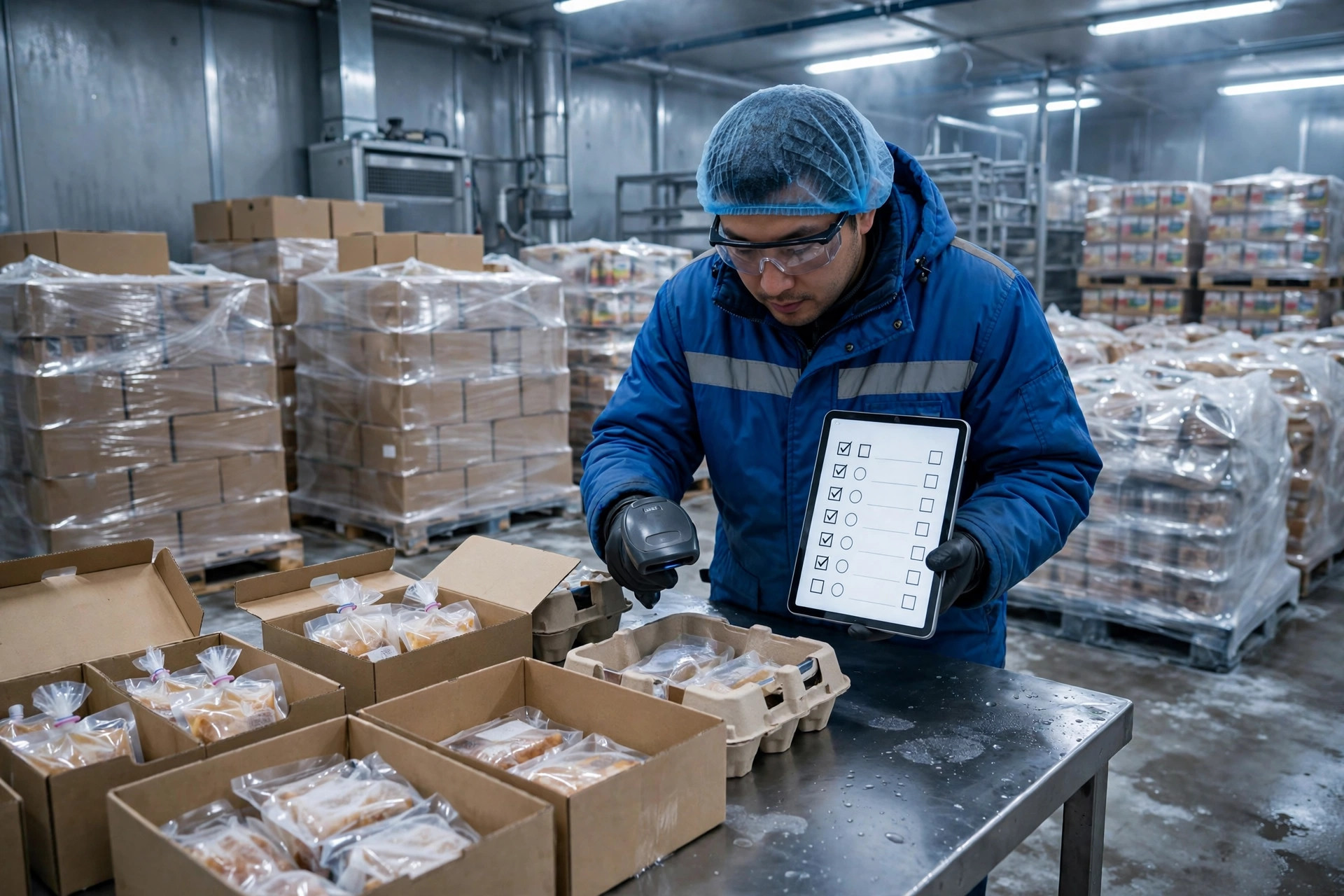
Bottom line first: when a supplier's Certificate of Analysis doesn't line up at incoming inspection in a food warehouse, the sequence is always the same — quarantine first, decide second. Food-safety parameters (micro, heavy metals, allergens) out of spec? Reject outright; there is no deviation path. Paperwork mismatch (lot number, quantity, dates)? Give the supplier 24 hours to correct it, and reject if they can't. Only minor deviations on non-safety parameters qualify for "accept with deviation" — with written customer approval and a three-level sign-off chain on file. I've seen this failure mode three times; every warehouse that got burned had it backwards: receive first, inspect later, signatures never.
Why a COA Mismatch Is the Most Expensive Failure in Food Warehousing
Incoming inspection in a food warehouse is nothing like incoming inspection in a general warehouse. A wrong receipt in a general warehouse costs you freight and labor. Releasing a bad lot in a food warehouse costs you a full-lot recall, downstream customer claims, and in the worst case an FDA warning letter. Under the FDA's Food Safety Modernization Act, the receiving facility must verify its suppliers' food safety controls — and the COA is the most used, and most easily gamed, link in that verification chain.
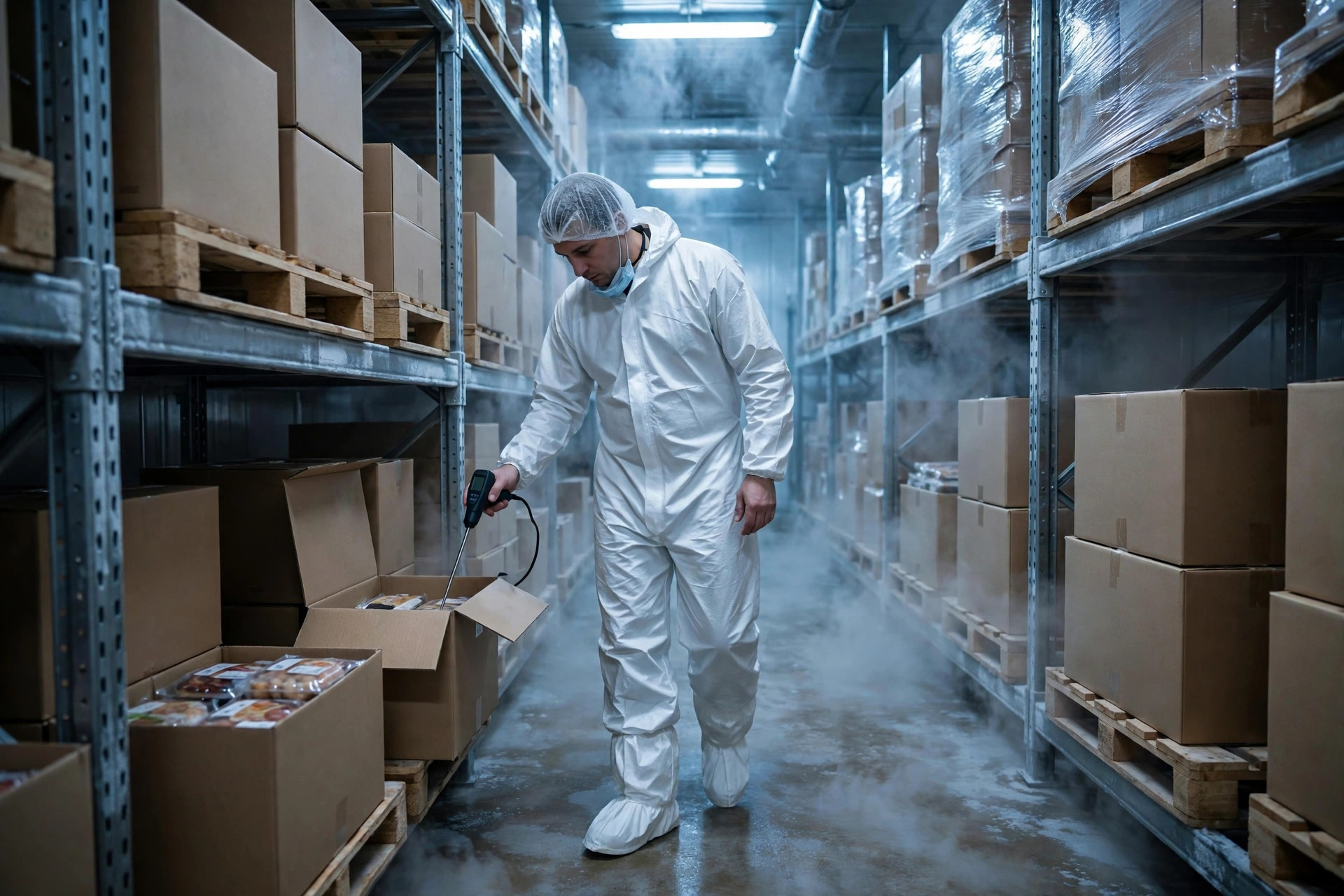
Fall 2024, Fresno, California: I was on site at a 3PL food warehouse when about 4,000 cases of frozen blueberries arrived — the first kind of mismatch. Every parameter on the COA looked beautiful — micro and pesticide residues all within spec. The receiver was ready to release. I stopped him for a lot-number check. The COA said lot 20240318-A; the outer cases were printed 20240318-B. One letter off, and the entire COA is scrap paper: it certifies a lot that isn't this one. The supplier admitted they had sent the wrong file and issued the correct COA before we released. Released against the wrong COA, every downstream traceability record would have pointed at a phantom lot — unfindable on recall day.
The second kind of mismatch is blunter: parameters out of spec. In 2023, a spice importer's warehouse in Dallas, Texas received roughly 12 tons of dehydrated garlic powder. The COA showed total plate count at 80,000 CFU/g against a customer spec limit of 50,000 CFU/g — a key safety parameter, 60% over the line. The supplier's sales rep called on the spot: "We're in a hurry on this one, just take it on deviation, we'll do better next time." The warehouse manager almost said yes. The customer's QA ended the debate in one sentence: micro out of spec means no deviation path — reject the whole truck, send it back, and the supplier shipped a fresh lot two weeks later. That call aged well: three months later, a different lot from the same supplier tested positive for salmonella at another warehouse and FDA issued a recall notice. Do the math: the lot value is one thing; a release-and-recall would have cost multiples of it in freight, destruction, and claims.
The COA Verification Checklist: Six Steps Within 30 Minutes of Arrival
Incoming inspection doesn't fail from being too strict. It fails from being "close enough." In every SOP I've rolled out for clients, COA verification is a checklist that must be completed within 30 minutes of arrival — six steps, none skippable:
- Match identity. Supplier name, product name/SKU, lot number, and production date on the COA must agree with the outer-case labels and the purchase order — all three. Match the lot number character by character, including letter suffixes. The Fresno blueberries died on one letter.
- Match timing. The COA issue date cannot predate the production date. The report number must be unique and traceable to the testing lab. For re-tested COAs, check the re-test date and its linkage to the original report.
- Match parameters. Compare every key parameter against the customer spec sheet. For safety parameters — micro, heavy metals, allergens, pesticide residues — any single failure stops the process cold. Record actual values for non-safety parameters (moisture, color, particle size) for the deviation decision.
- Match completeness. Test method, lab name, authorized signatory — all three must be present. A COA that's stitched from screenshots, missing key pages, or has a blank signature block is an invalid document: quarantine first, wait for the original.
- Match sampling. A passing COA does not exempt you from inspecting. The sampling plan follows ANSI/ASQ Z1.4 (current edition governs) — sample size comes from the tables, never from "I'll just open a case." Sampling points must cover the whole trailer: front and back pallets, top and bottom layers. For frozen product, record arrival temperature too.
- Match the system. Enter the results into the WMS in real time: lot number, COA number, inspection verdict, inspector name. Photograph paper records for archiving; retention follows the customer spec — for food I recommend shelf life plus one year.
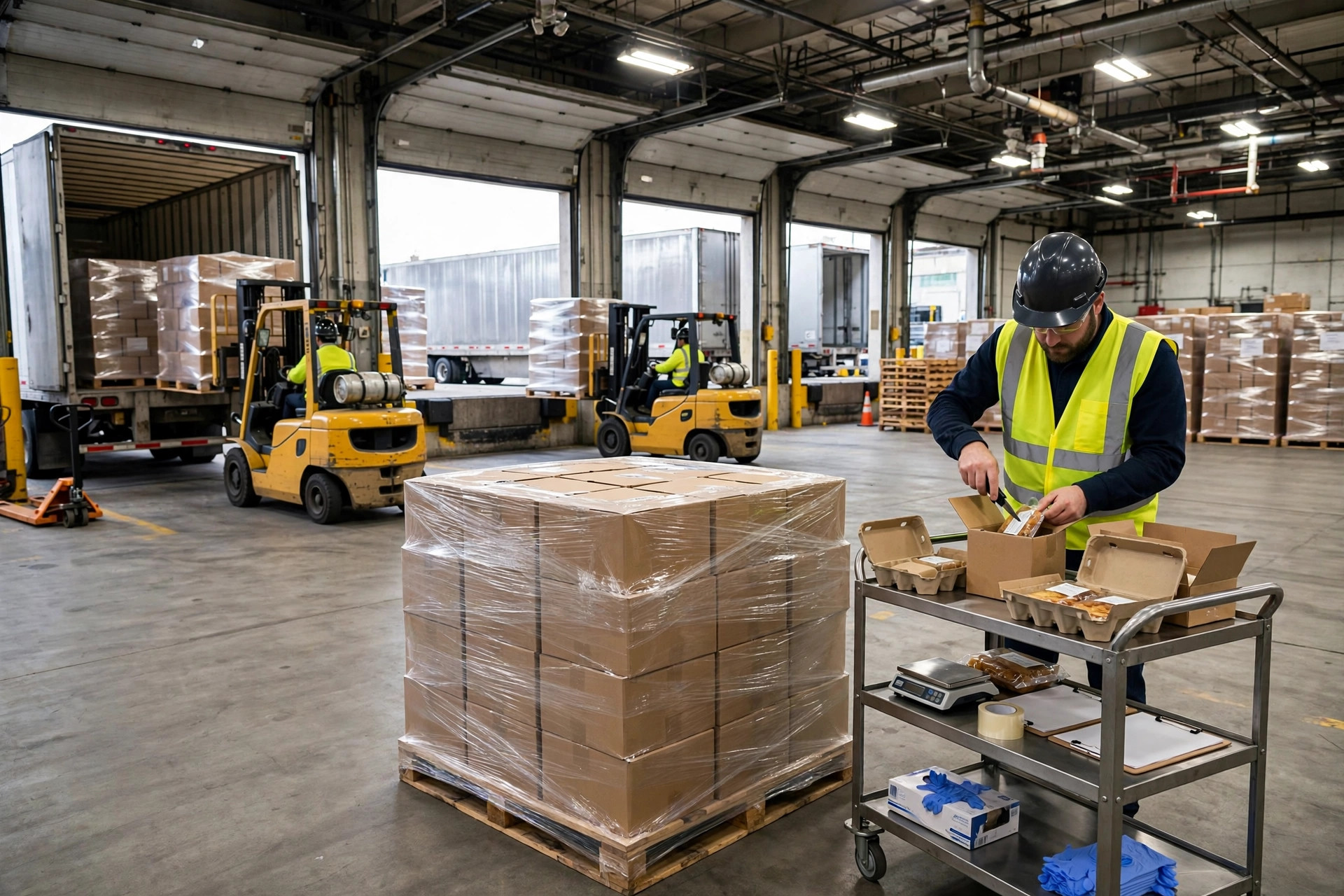
The Deviation Decision Tree: Reject, Hold, or Accept with Deviation
Once the checklist is done, every mismatch lands in one of three buckets. Memorize this tree and the dock never needs to call for permission again:
Reject outright (no deviation path): safety parameters out of spec — micro, heavy metals, allergens, pesticide residues; a falsified COA (stitched pages, alterations, a report borrowed from another lot); spoiled product, foreign material, or damaged packaging creating contamination risk. Rejection actions: tag the entire lot "REJECT," physically segregate it in the reject area, lock the lot in the WMS (no putaway, no allocation), and issue a rejection report to the supplier and customer within 48 hours, kicking off return or destruction.
Quarantine pending verification (decide later, never release): paperwork mismatches — lot number, quantity, or dates disagreeing with the physical goods; incomplete COA pages or missing signatures; non-safety parameters that look out of spec and need re-testing. Quarantine actions: tag and move the goods to the quarantine area (WMS location locked), and give the supplier 24 hours to correct the paperwork or re-test. Corrected within 24 hours, it re-enters the normal inspection flow; if not, it converts to a rejection.
Accept with deviation (the only flexible lane): only for minor deviations on non-safety parameters — moisture a touch high, color slightly off — with re-testing confirming zero food-safety risk. Deviation acceptance requires all four conditions at once: ① written sign-off from the customer's QA (email or system approval — a verbal "sure" doesn't count); ② sign-off from the warehouse QA manager; ③ sign-off from the inspector — the three-level chain is non-negotiable; ④ a deviation number assigned to the lot in the WMS, fully traceable, with the system auto-flagging "deviation lot" at outbound. Miss any one of the four and it stays in quarantine.
The sign-off chain is the weak point of deviation acceptance. The worst case I've seen: the warehouse manager "agreed it on the phone" with the customer's salesperson, the goods were released, and three months later the customer's QA said, "I never signed anything." Without written records, deviation acceptance is just an unauthorized release — and the liability sits entirely with the warehouse.
The Failure Patterns I've Seen Three Times
Failure one: "The COA is clean, so the goods are fine," right? This is the most counterintuitive lesson: a clean COA proves nothing about the goods — if your sampling plan is wrong, you inspected nothing. Early 2025, an Arizona warehouse received a 40-pallet trailer of frozen product. The receiver opened one case from the outermost first pallet, saw a clean COA, and released the whole trailer. Two weeks later the customer complained: pallets in the back were moisture-damaged and moldy — the reefer unit had failed in transit and the pallets near the rear doors lost temperature. A COA tests the supplier's sample at the plant — it can't catch what happened in transit, and neither can sampling that only covers the first pallet. Remember: the COA is the supplier grading its own homework; incoming inspection is your own defense. Sampling must cover the whole trailer — that is exactly why sampling standards exist.
Failure two: deviation by handshake. Covered above. I'll say it once more: written, written, written.
Failure three: checking that a COA exists, not that it's correct. Plenty of warehouses do incoming inspection as: "Did the supplier send a COA? Yes? Release." A document existing is not a document being right. The Fresno blueberries had a COA, every parameter passed — the lot number was just one letter off. That's why step one of the checklist exists: to catch "present but wrong."
One thing you can use tomorrow: print the six-step checklist and this decision tree, and tape them to the wall in the receiving area. Incoming inspection doesn't need inspectors with fancy credentials — it needs a process with no skippable steps, so when the COA doesn't match, the process makes the call, not whoever happens to be on the dock.
By Lin Xiao, WMS Implementation Consultant