
In the fall of 2024, a 3PL operations manager in Southern California told me a story that has stayed with me. His warehouse handled 14 SKUs for a direct-to-consumer skincare brand. One day the brand called with an urgent request: within 24 hours, account for every unit of a single lotion batch shipped back in March — which channels received it, how many units were still in the building. A consumer had reported a serious allergic reaction, and the brand had decided it needed to file a serious adverse event report with the FDA. The 15-business-day reporting clock was already ticking. It took the warehouse three full days to reconstruct the paper trail for all 6,200 units in that batch. Lot codes had been recorded only on paper receiving slips; the WMS tracked inventory at the SKU level, with no lot dimension at all.
That small story sits squarely in the middle of MoCRA's implementation timeline — and it explains why the warehouse, not just the brand, has become part of the compliance equation.
One timeline: what MoCRA actually changed
MoCRA — the Modernization of Cosmetics Regulation Act — was signed on December 29, 2022, the largest expansion of FDA cosmetics authority in more than 80 years. According to the FDA's published implementation schedule: facility registration and product listing became mandatory on July 1, 2024; serious adverse event reporting — due within 15 business days of the responsible person receiving a report — took effect on December 29, 2023; the requirement to print a U.S. address, phone number, or electronic contact for adverse-event reports on the label took effect on December 29, 2024; the GMP (good manufacturing practice) rule, statutorily due in draft form by December 29, 2024, remains delayed and is expected to align broadly with ISO 22716; on December 18, 2025, the FDA released draft guidance on mandatory recalls; and a proposed rule on fragrance allergen labeling is targeted for November 2026. Confirm all dates against the FDA website before acting on them.
Two data points deserve to be pulled out of that timeline. First, enforcement tightened progressively, not overnight: the FDA granted roughly six months of enforcement discretion from late 2023 into mid-2024, but after July 2024, failure to register a facility became a prohibited act under the Federal Food, Drug, and Cosmetic Act — and products from unregistered facilities can be refused at import. Second, the recall tool is now materially stronger than the one that existed before MoCRA. Prior to the law, the FDA had no mandatory recall authority over cosmetics and relied on voluntary action: when Claire's voluntarily recalled talc-based children's cosmetics in 2019 over asbestos contamination concerns, the FDA could only advise consumers to stop using the products. Since December 29, 2023, MoCRA has given the FDA mandatory recall authority, which changes the "brand moves first, regulator follows" pattern into one where the regulator can order the move itself.
Three gaps where warehouses feel the pressure
The first gap is between what the label says and what the warehouse verifies. Under the Fair Packaging and Labeling Act and cosmetics regulations, labels must carry ingredients in descending order of predominance, net quantity, and manufacturer or distributor information — plus, under MoCRA, a contact for adverse-event reports. Yet receiving docks typically verify count and condition, not label content against the FDA filing. For importers, this is the sharpest edge: product listing requires submitting each product's ingredient information to the FDA, and if the ingredient order printed on the label does not match the filing, the product is misbranded — subject to import refusal or recall. The warehouse is the first physical touchpoint; skipping label verification there pushes the risk downstream to customs clearance and shelf placement, where it is far more expensive to fix.
The second gap is batch traceability. MoCRA's statutory actor is the "responsible person" — the manufacturer, packer, or distributor named on the label — and a pure-play 3PL is typically not one. But FDA record requests run along the chain: when the agency examines a responsible person, it asks for upstream and downstream records; and a brand working inside its 15-business-day reporting window must first isolate the implicated lot, quarantine on-hand inventory, and account for everything already shipped. The three-day reconciliation in the California case had a single root cause: the WMS had no lot dimension. SKU-level inventory management cannot answer lot-level questions. This is a data-model problem, not a paperwork problem — whether lot codes are captured by scan at receiving, whether lot attributes inherit through location moves, and whether picks record lot-level flow and enforce first-in-first-out by lot. Miss any one of the three, and the chain breaks.
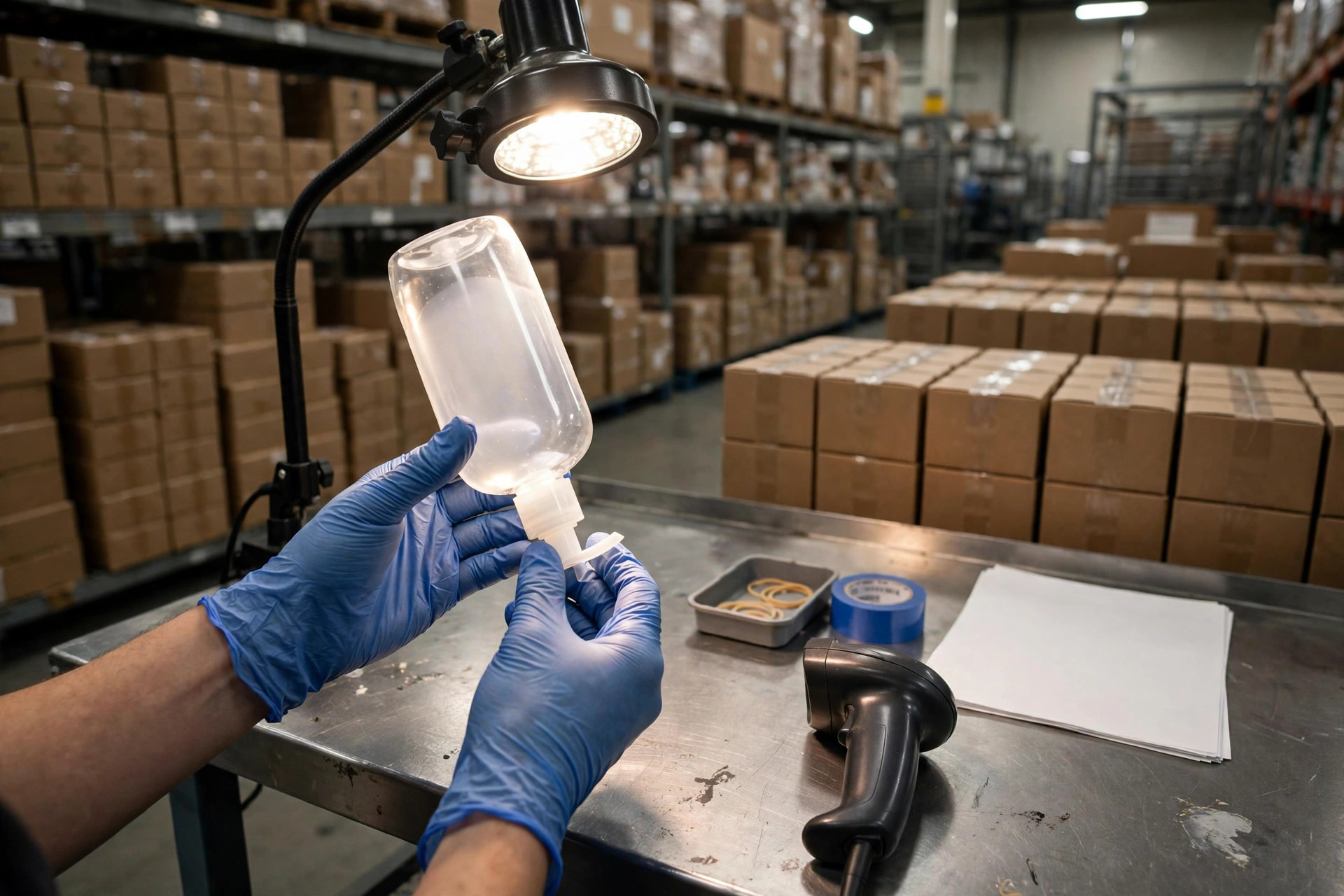
The third gap is the contract boundary. Not being the legal responsible person does not stop commercial risk from flowing downstream to the 3PL. Brand recall plans almost always include a line like "the warehouse will freeze the implicated lot and provide complete receiving and shipping records within X hours" — while the 3PL's storage agreement often reduces "recall cooperation" to a single sentence with no response-time commitment, no data-format specification, and no fee schedule. When an incident actually happens, the warehouse either does free overtime reconciling by hand or gets blamed by the client for records it cannot produce. For warehouse operators, the real negotiation is not whether to cooperate but the SLA and pricing of that cooperation.
The counterintuitive economics of lot granularity
Here is the counterintuitive part: smaller lots cost more to run day-to-day but lose less in a recall; consolidating multiple production lots into one "warehouse lot" for convenience trades efficiency for a multiplied recall blast radius. The instinct that "fewer lots are easier to manage" gets it exactly backwards from a compliance perspective — lots are firewalls, and every consolidation widens the potential recall scope. The right way to account for it is to treat lot granularity as an insurance premium: the extra minutes spent scanning lot codes at receiving are premium payments against a recall that may never happen. And 3PLs should price that work explicitly in the contract rather than treating it as a courtesy.
The math clarifies the decision. Take a mid-size 3PL handling 20 SKUs and shipping about 100,000 units a month: full lot-level traceability — scanning lot codes at receiving, adding a lot dimension to the WMS, training the floor — typically requires a one-time investment of several thousand to roughly ten to twenty thousand dollars, depending on the vendor quote; the ongoing cost is mainly the extra three to five minutes per receiving ticket. Compare that with a small-scale recall: line-downtime costs to isolate and count the implicated lot, relabeling or repackaging rework, write-off losses, and logistics fees the brand may pass through. A recall covering 5,000 units can easily cost several multiples of the traceability investment. The binding constraint is time: inside the 15-business-day reporting window, brands typically demand a lot-movement list from the warehouse within 24 to 48 hours. A warehouse without a lot data model can only page through paper slips — which is precisely how a three-day reconciliation happens. The time window itself is part of the compliance design.
| Traceability granularity | Day-to-day cost | Recall response speed | Potential recall blast radius |
|---|---|---|---|
| SKU-level only, no lots | Lowest | Slow: manual document search | Whole SKU or whole receiving batch |
| Receiving-batch level | Moderate: scan at receiving | Fast: system lookup | One receiving batch |
| Production-lot level, end to end | Higher: capture at receiving, moves, and picks | Fastest: locate in minutes | One production lot |
Three converging trend lines
On trends, I see three lines converging. First, the FDA's enforcement toolkit is essentially complete — registration, listing, adverse-event reporting, and mandatory recall authority are all live; the final GMP rule and allergen labeling are a matter of timing. Cosmetics warehousing is moving from a lightly regulated zone into a normally regulated industry. Second, brands will systematically push compliance requirements downstream: a demonstrable lot-traceability capability and recall-drill records will become qualifying criteria for 3PL selection, not bonus points. Third, federal compliance is only the floor: several states — California, Washington, Colorado, and Maryland — have begun enforcing bans on intentionally added PFAS in cosmetics across 2025 and 2026, and state-level rules will be the next battleground. A 3PL running a national footprint will need state-by-state compliance checklists.
The open question worth watching: when the final GMP rule lands and inspectors start walking into warehouses, how many 3PLs' receiving processes and WMS data models would survive an unannounced lot-traceability drill? Before MoCRA, cosmetics warehouses competed on price and speed. After MoCRA, will compliance capability become the new dividing line? The answer will probably only emerge after the first wave of real warehouse inspections.
By Dr. Chen, Supply Chain Researcher