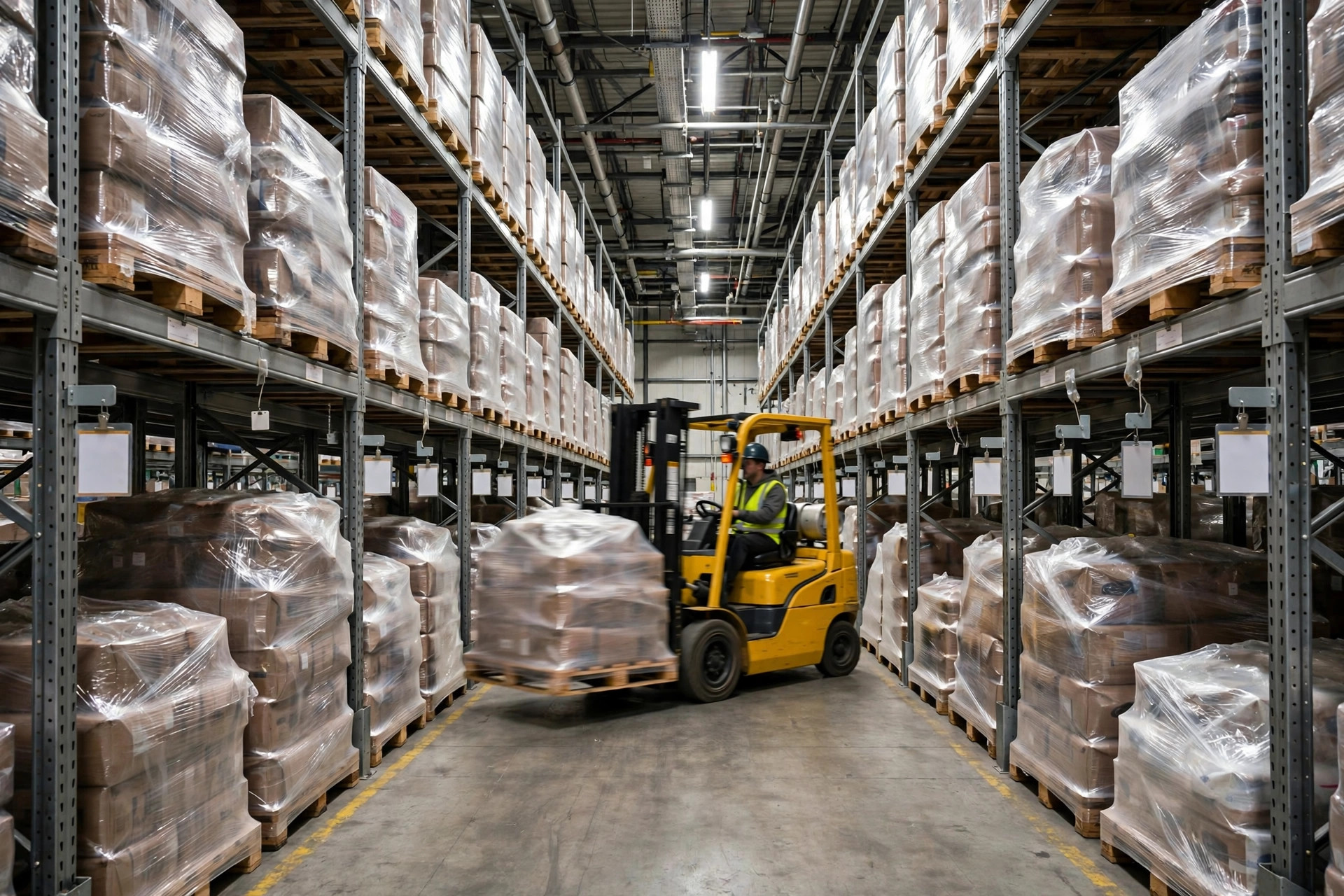
Let's start with the money. Consignment inventory looks like free financing: the goods sit in your warehouse, the supplier still owns them, and you only pay when stock actually sells. Zero working capital tied up. Finance teams love it — a clean balance sheet, healthy cash flow. But run the full math with me, and you'll see that "zero carrying cost" is only true on paper. The real costs hide in three places: the financing premium baked into your purchase price, the opportunity cost of your pallet positions, and the extra operating cost on the warehouse floor.
The Real Ledger on Consignment Inventory: 3.84M Saved, 690K Kept
A real project first. From 2023 to 2025, a 3PL warehouse outside Los Angeles ran a consignment program for an auto parts supplier: 1,200 pallet positions occupied year-round, average goods value around $40,000 per pallet. (All figures below are illustrative, shown to demonstrate the calculation method — use your actual contract numbers.)
If the operator had bought that $48 million of inventory outright, at an 8% annual cost of capital, the carrying cost would be $3.84 million a year. Switching to consignment wiped that line out — but suppliers don't do charity. The supplier added a 5-point financing premium into the unit price. With annual purchases of roughly $60 million through this program, that premium cost $3 million a year.
And we're not done. Consignment stock has to be managed separately: a dedicated monthly cycle count, a separate owner dimension in the WMS, settlement reconciliation. About $150,000 a year in incremental operating cost.
The honest bottom line: 3.84 − 3.00 − 0.15 = $690,000. Consignment was still the right call, but the actual savings were less than a fifth of the headline number. That's why I say: do the math before you sign.
Where Consignment Inventory Costs You on the Warehouse Floor
Consignment stock and owned stock run on two completely different ledgers operationally. Here is where the extra cost shows up:
| Cost item | Who typically pays | What operations needs to watch | | Storage fees | You (the operator) | Charged per pallet or per sq ft, same as owned stock — don't expect the supplier to share it | | Handling, inbound/outbound labor | You | Consignment SKUs often turn in smaller, more frequent moves — labor cost creeps up | | Dedicated cycle counts | You | Consignment requires separate counts, at least monthly — can't be folded into routine counts | | Insurance | Negotiable | Goods lost or damaged in your building — whose policy pays? Write it into the agreement | | Slow-moving / expired stock handling | Negotiable | Dead consignment stock is the hottest potato — who pays return freight? | | System integration | You | Separate owner dimension, settlement trigger development — a one-time investment | | Shrinkage allowance | You | Cap it in the agreement — above the cap the supplier eats it |
One sentence captures the whole table: consignment saves financing cost and adds operating cost. Financing cost is visible. Operating cost is a dull knife.
Owned vs Consignment: One Table
| Dimension | Owned inventory | Consignment inventory | | Working capital | High — full goods value on your books | Zero (on paper) | | Purchase price | You hold bargaining power, volume discounts | Usually carries a 3–8 point financing premium | | Operational complexity | One ledger | Two ledgers, separate counts and reconciliation | | Dead-stock risk | Yours to absorb | Returnable to the supplier — but only if the agreement says so | | Switching suppliers | Relatively free | High switching cost, you get locked in | | Best fit | Fast-moving, low-value, standardized SKUs | High-value, slow-moving, long-tail SKUs |
Here's the counterintuitive part: the biggest cost of consignment isn't the operating fee — it's the transfer of bargaining power. When the supplier owns the goods, you can't casually switch suppliers. A new supplier means rebuilding the settlement flow, the system setup, the count routines. In that locked-in relationship, when the supplier raises prices 2 points a year, you have almost no leverage to push back. Over three years, the premium can eat more than the financing cost you originally saved. That's money wasted — and most operators only see it after the agreement is signed.
Lesson Two: Pallet Positions Are Money
In 2024, an e-commerce warehouse in Shenzhen took on a consignment batch of small home appliances. The inbound went smoothly; then the goods sat for nine months barely moving, 300 pallet positions locked up. When peak season hit in Q4, their own fast-moving goods had nowhere to go, and they had to rent temporary space next door — an extra RMB 80,000 a month (illustrative).
Pallet positions occupied by consignment stock are idle cost in the off-season and hard opportunity cost in peak season. Without a dead-stock clause in the agreement — say, 90 consecutive days with no movement means the supplier must pull the goods within 30 days or mark them down — that inventory becomes a squatter in your building. Remember: pallet positions are a warehouse's most expensive asset. Consignment must never become a supplier's excuse to occupy them for free.
The 8 Clauses Your Consignment Inventory Warehouse Agreement Must Have
When operations people read the agreement, don't let legal language fog you. Lock down these eight:
- Title transfer trigger: at outbound scan, or at customer delivery? One day of difference is one day of payment terms.
- Settlement terms: Net 30 or Net 60? Longer terms mean a higher supplier premium.
- Count frequency and variance liability: monthly counts — who pays when variance exceeds the agreed threshold.
- Dead-stock handling: days-without-movement definition, supplier pull-back deadline, freight responsibility.
- Insurance: who buys the warehouse legal liability and cargo coverage while goods sit in your building.
- Shrinkage cap: e.g., 0.5% — above the cap, the supplier absorbs it.
- System integration: API or spreadsheet reconciliation, and the reconciliation cycle.
- Minimum purchase commitment or service fee floor: stops the supplier from dumping stock and going silent.
Miss one of these eight, and you buy yourself a future dispute. The agreement is the warehouse's moat, not legal's paperwork.
The Decision Formula: Run It Yourself
Should you do consignment? Don't go by feel. Use this:
Net consignment benefit = Goods value × Cost of capital × Average days held ÷ 365 − Annual purchases × Price premium rate − Annual incremental operating cost
Positive result: sign. Negative: the supplier's "free money" is actually more expensive than your own. You can get all three inputs: goods value from your purchase volume, cost of capital from finance, and the premium rate by asking the supplier for two quotes — cash price versus consignment price — and subtracting.
My conclusion is blunt: consignment fits high-value, slow-moving long-tail SKUs, where the carrying-cost savings are real money. For fast-moving low-value goods, don't bother — the working capital involved is small anyway, and consignment's operating cost and price premium will cost you more. Do the math first, then sign. Don't waste that money.

By Lao Zhou, Logistics Cost Analyst