Five years selling beauty and personal care, and the tuition I've paid on warehouse fulfillment could buy me a car.
Not ad spend. Not hijacked listings. The three things that hurt me the most all lived inside the warehouse: expiry management, leak-proofing, and kitting. In July 2024, a batch of lipsticks stored in my California warehouse melted into what I can only describe as a "lipstick mudslide" in 100-plus-degree heat. Over twenty thousand dollars of inventory, straight to the trash. That's the day I learned that in beauty ecommerce warehouse fulfillment, the warehouse isn't a cost center — it's the whole game.
Here's everything I learned the hard way, so you don't have to.
Expiry: Amazon Is Stricter Than Your Mother
Let me start with a rant: too many sellers think expiry management means slapping a date sticker on the box and calling it FIFO. Think that, and your shipment is one inspection away from being rejected.
Amazon FBA is notoriously strict with expirable products: you must label expiry dates at inbound, and units with insufficient remaining shelf life get rejected or flagged for removal. The exact thresholds change, so always check the platform's latest policy — never go by gut feeling. In November 2023, I sent a batch of sunscreen to FBA that mixed in two lots with short remaining shelf life. The whole shipment got flagged for removal. Removal fees, relabeling, re-inbound — over $4,000 gone, right before Black Friday prep season.
Here's what I do now, three rules:
First, every inbound lot gets its expiry recorded. SKU plus lot number plus expiry date, entered into the system at receiving. No expiry info, no receiving. The warehouse argued with me three times about this. They don't argue anymore.
Second, FEFO instead of FIFO. Beauty and personal care must pick by "first expired, first out," not first in. For the same SKU with different lots, the system auto-prioritizes the lot expiring soonest. Don't underestimate this switch — after moving to FEFO, my near-expiry inventory (under six months remaining) dropped from 12% to 3%.
Third, I cut my stock cover from 90 days to 60 days. This is the counterintuitive one: most sellers think deeper inventory is safer, but for beauty it's the opposite. Expiry is a ticking bomb — the longer stock sits, the bigger the write-off risk. Cutting to 60 days of cover raised my stockout rate by less than 2 points, but cut annual expiry write-offs by nearly $30,000.
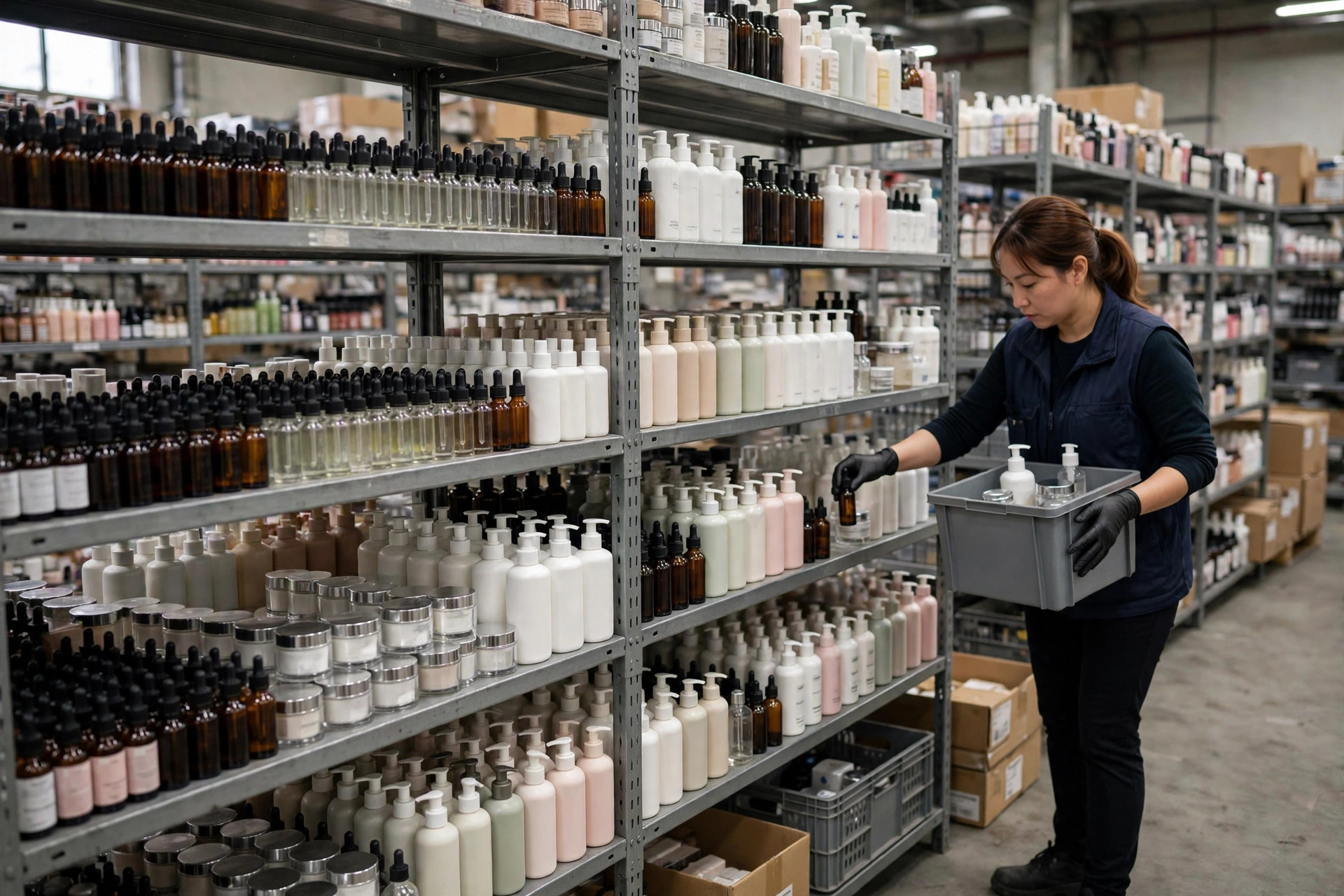
Leak-Proofing: Stop Shipping Liquids in Just a Bubble Mailer
Leaking liquids, creams, and serums are the number-one source of bad reviews for beauty sellers. In March 2025, a serum of mine went viral on TikTok Shop — over 3,000 orders in a week. I shipped them in nothing but bubble mailers. Leak complaints hit 8%. Bad reviews, refunds, platform penalties, all at once. That one SKU lost me $18,000.
I've tested the three mainstream leak-proofing options. The cost and effectiveness gap is absurd:
| Method | Cost per bottle (my actuals) | Protection level | Best for |
|---|---|---|---|
| Heat-shrink seal | ≈$0.08 | Seals the cap, stops seepage | Lotions, serums, shampoos |
| Resealable poly bag | ≈$0.15 | Catches leaks if they happen | Almost all liquids and creams |
| Air column bag | ≈$0.35 | Drop + leak double protection | Glass bottles, high-ticket items |
My standard now: heat-shrink seal plus poly bag, double protection, about $0.23 per bottle. After the switch, that serum's leak complaint rate dropped from 8% to 0.6%.
Here's the counterintuitive take: the most expensive packaging is rarely the best. Air column bags on a small serum bottle are overkill — and they eat up dimensional volume, which pushes up last-mile shipping costs. You're paying twice. Packaging is always a three-way trade-off between "good enough," cost, and volume. Whichever option gets complaints under 1%, pick the cheapest one that does it.
One more thing: TikTok Shop and standalone sites are looser than FBA on packaging requirements, but you eat every return yourself. FBA at least has the platform's customer service machine. On your own site, one leaking order can cost you twenty times the packaging cost in support and refunds. Do the math.
Kitting: Money Printer or Money Pit?
Gift sets, buy-one-get-one bundles, holiday limited editions — the easiest lever a beauty seller has for raising average order value. Last Q4 I ran a holiday set: cleanser plus serum plus moisturizer. AOV went from $28 to $49, and conversion went up 1.3 points. I thought I'd found a money printer.
Then I did the full kitting math.
The kitting flow is: break down singles, pick per bundle recipe, box the set, shrink-wrap, label with the new bundle SKU. My warehouse charges $0.50 to $1.20 per set in labor, depending on complexity. Add $0.80 to $1.50 for the gift box itself, and you're at $2-plus in extra cost per set before anything else. Worse, the damage rate: 1% on single-unit shipments jumped to 3.5% on sets — bigger boxes, more items inside, more things to break.
And FBA is brutally picky about bundles: they must be shrink-wrapped, labeled as a set not to be separated, and barcodes can't be obscured. Check the latest platform policy for the exact specs. My first batch of holiday sets got the whole shipment bounced back for rework because the shrink-wrap didn't meet spec. Another loss.
The counterintuitive conclusion: bundles do raise AOV, but they also raise kitting cost, packaging cost, damage rate, and support complexity. If you can't account for all four, don't do bundles — you'll just be working for the warehouse and the carrier. My rule of thumb: a bundle's margin needs to beat the single SKU's margin by at least 15 points to be worth it.
Two Traps to Dodge in Advance
Trap one: summer heat melts lipstick.
The "lipstick mudslide" from the intro happened in California in July 2024. Cream and stick products — lipsticks, foundations, lip glazes — soften and deform in hot warehouses, and in extreme heat they melt outright. My fix: from June through August, all cream/stick products move to climate-controlled storage. It costs about 30% more in warehousing fees, but it's far cheaper than a write-off. Plus I ship at night to dodge daytime heat. This one I tested myself — zero melt write-offs in summer 2025.
Trap two: perfume is hazmat. Don't ship it like regular freight.
Perfume contains alcohol, which makes it dangerous goods. FBA has specific inbound restrictions for fragrances, and carriers have hazmat requirements — always confirm with the latest platform and carrier policies. I've seen sellers ship perfume to FBA as ordinary beauty products and get the entire listing taken down. The right move: use a hazmat-qualified carrier, or keep the fragrance line on your standalone site with direct fulfillment from your own warehouse, sidestepping the platform restrictions.
The Bottom Line
Beauty and personal care fulfillment isn't won by who has the biggest warehouse or the fastest pick. It's won in the details: is expiry recorded at inbound, is FEFO actually enforced, do liquids get double protection, have you done the four-part math on bundles, did you move to climate control for summer.
Get these three things right, and fulfillment flips from cost center to moat. Tested it myself — it works.
By Ah K, E-commerce Seller (5 yrs)