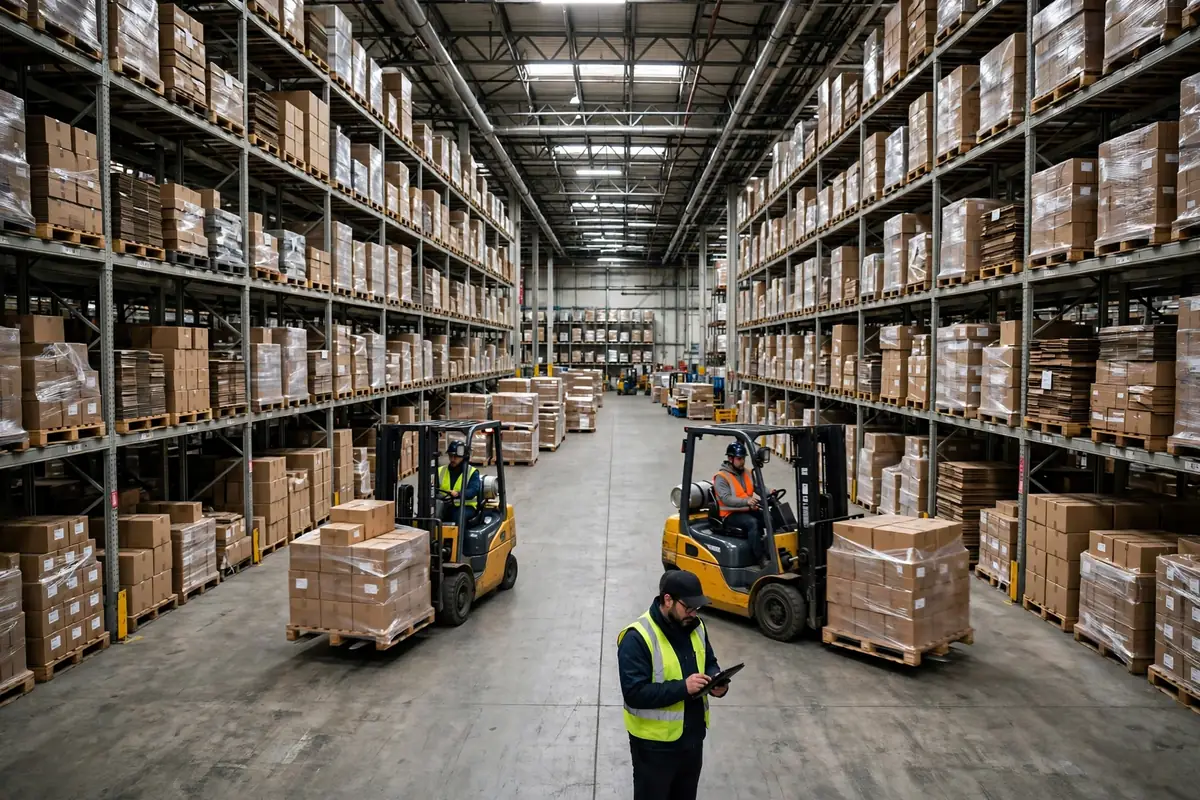
We have a client in Dongguan who sells small home appliances, and his story is a textbook case of 3PL client tiering done badly. Last fall, during peak season, he was shipping two or three thousand orders a day and filling three picking lines in our warehouse. That same week, another client, one we had worked with for five years, shipped only four or five hundred orders a month. He called in a panic because his goods were replenishment stock for a supermarket chain, and one late day meant a deduction from his payment. Both of them called on the same day. One said, I am your biggest client, my orders go first. The other said, my deadline is in the contract, you cannot push me back. The shift supervisor called me that night and asked who to protect. I told him to protect both, by following the rule we had agreed in advance, not by listening to whoever shouted loudest.
That incident became a training example inside our company. Most warehouses do not get into trouble because they lack staff. They get into trouble because tiering was never discussed out in the open. Everyone has a private ranking in their head, yet everyone claims to treat all clients equally. When peak season hits, equal treatment means nobody gets what they need. The big client feels he paid a lot and got no priority. The small client feels his contract deadline was pushed aside by someone jumping the queue. Both feel cheated, and the warehouse ends up pleasing no one.
3PL client tiering is not about who ships most
Volume is only one part of the picture, and often not the most important part. I have seen a client shipping a hundred thousand orders a month whose goods were uniform, whose paperwork was clean, and whose return rate was low. That client was easy money for the warehouse. I have also seen a client shipping three thousand orders a month whose products each carried a different code, whose packing instructions changed three times, and whose delivery addresses kept changing at the last minute. That small client absorbed half a shift all by himself. If you tier clients by volume alone, the easy clients end up subsidizing the difficult ones, and the math stops working.
Inside our operation we look at three things. Volume means both the monthly average and the peak, and the peak matters more, because a client who triples in peak season needs reserved capacity. Volatility means how reliable the forecast is. A forecast given a week ahead and a forecast given on the morning of shipping are two completely different costs. Complexity means how hard the work is: relabeling, repacking, special inspection, high returns, and how often customer service drags the warehouse into problems. Put those three together and you get a fair sense of what priority a client is actually worth.
There is one more factor people hesitate to say out loud: payment behavior. A client who pays on time and a client who drags payment out for two months are never equal in the eyes of a warehouse. That is not snobbery, it is cash flow. When a client stretches payment terms, the warehouse is already funding labor and packaging out of its own pocket, and staff will quietly push that client's orders back. It is better to put that reality into the open and settle it with price and contract terms than to let it work in the shadows.
What 3PL client tiering looks like on the roster
A tier table written into a contract appendix is useless unless it shows up on the daily roster. Our approach is to sort clients into three tiers, each with its own promise and its own queue-jumping rule, written on the scheduling board where everyone can see it. Cut-off times, quality-check staff, and dispatch batches all follow the tier. Supervisors do not have to improvise every morning about who goes first.
| Tier | Delivery promise | Queue-jumping rule | Pricing basis |
|---|---|---|---|
| Tier one: large and stable | Same-day dispatch for orders before cut-off, reserved peak capacity | Rush service available, charged separately | Base rate plus capacity reservation fee |
| Tier two: mid-size or volatile | Next-day dispatch, peak scheduled by forecast | Forecasted orders first, ad hoc orders queue behind | Base rate, ad hoc additions charged separately |
| Tier three: small but deadline-sensitive | Dispatch by contracted deadline, key milestones tracked by a named contact | No jumping ahead of tier one, but delivery deadline is protected | Base rate plus deadline-protection service fee |
The most important row in that table is the queue-jumping rule. Jumping the queue is never free and never based on relationships. Any client can ask for rush service, pay the rush fee, and use reserved capacity rather than stealing someone else's slot. What small clients fear most is not waiting in line. It is watching the rules change overnight. If a big client can push their orders to the next day with one phone call today, and another big client can do the same tomorrow, then the small client's deadline promise is worthless. Fixed rules actually reassure small clients, because they know their cut-off time, their dispatch time, and what the warehouse owes them if it runs late.
Scheduling has one more detail worth getting right. Do not put every client into the same shift. Tier one goods go out in the morning, tier two and tier three goods are staggered into the afternoon and night shifts, and quality checks and dispatch times follow that stagger. The worst peak-season pattern is every client's goods arriving at once in the morning while the afternoon shift stands idle. Staggering is not a punishment for small clients. It is how the whole line keeps moving all day.
Here is the judgment that surprises most warehouse managers: giving the best service to the biggest client is not always the most profitable move. Small clients ship less, but their margin per order is often higher, their requirements are specific, and once you serve them well they tend to renew. Big clients ship a lot, but they negotiate hard, their rates are thin, and losing one of them leaves a hole in the whole operation. A healthy warehouse usually runs on one or two big clients holding the base volume plus a group of small clients contributing real profit. Drive all the small clients away and you are left with big clients only, which leaves the warehouse with even less bargaining power. The big clients may not love hearing that, but the numbers point that way.
Three questions to ask about client tiering before you sign
If you are on the client side and you are negotiating with a warehouse, do not only negotiate price. A low price with vague service terms guarantees a fight in peak season. The next time you sit at the table, ask these three questions.
First, how is my tier decided, and how does it move up or down? A tier cannot be a salesperson's verbal promise. It needs a scoring basis covering volume, volatility, and operational complexity, plus a review cycle, roughly once a quarter. A tiering system that only moves up and never moves down will drift out of shape within a year.
Second, how is rush service charged, and whose capacity does it use? Ask where the rush fee goes, whether it covers overtime cost or quietly subsidizes another client. More importantly, ask what happens when your order gets pushed back by someone else's rush job: what does the warehouse owe you, and how is it paid? A deadline promise with no remedy attached is just a nice sentence.
Third, how is peak-season capacity reserved, and how many days ahead must my forecast arrive to count? Many contracts state normal-season deadlines and say nothing about peak season, which means the deadline quietly stops working when you need it most. Get the warehouse to write down peak cut-off times, dispatch batches, and the time by which you will be told about a delay. A delay you know about early can be managed. A delay you discover from your customer cannot.
What happened with those two clients? The Dongguan seller accepted a tier two slot with a deadline-protection add-on. He gave us forecasts two weeks ahead in peak season and paid rush fees for ad hoc additions. The supermarket supplier got a fixed afternoon dispatch batch for his replenishment orders, with store arrival tracked separately. Neither side has argued since. Nobody gave in to anybody. The rules were set before the pressure arrived, so there was no room left for an argument.
By Susan, 3PL Sales Director