When a China-Europe freight train rolls into Duisburg and the containers come off the wagons, most shippers treat it as the finish line. It isn't. The number that actually decides the landed cost of that cargo is produced in the second half of the journey: Duisburg inland port warehouse logistics distribution — which onward mode the box takes, which warehouse it sleeps in, when customs is cleared, and whether it ends up in Germany, Central Europe, or Western Europe. This article is about that second-half math.
The phenomenon: the terminus is not the end
According to duisport, the port operator, Duisburg is the world's largest inland port. That sounds like tourism copy, but underneath it sits a distribution proposition: China-Europe rail traffic concentrates heavily here. The City of Duisburg's commissioner for China affairs stated publicly in December 2024 that roughly 30 to 40 China-Europe trains move through Duisburg every week, and duisport's CEO has said the port handles about 30 percent of rail trade between Europe and China.
The structural implication is worth spelling out: for a Chinese shipper, Duisburg is not "a destination in Germany." It is the front door of a continental distribution network. The train completes the intercontinental displacement; the European journey — customs clearance, warehousing, deconsolidation, final-mile delivery — only begins at the terminal. And that "last thousand kilometers" routinely costs more than the rail leg itself.
The data: two sets of numbers that reveal the scale of distribution
The first set comes from a single lane. In October 2022, Xi'an launched the first fully timetabled train to Duisburg; by October 2026, the lane was running four westbound departures and three return services per week, covering 9,908 kilometers in 11 to 12 days. Industry reporting puts these scheduled services at more than 30 percent faster than a standard train, with on-time performance above 95 percent — and cargo averaging roughly 41 percent higher value per container. That 41 percent is the telling figure: the buyers of fixed timetables are not the most price-sensitive shippers; they are the most schedule-sensitive ones.
The second set comes from the demand side. Deichmann, the German footwear retailer with more than 4,700 stores worldwide, relies on 25 long-term Chinese suppliers. According to December 2024 reporting, the company's communications manager credited the China-Europe train with stabilizing its China-Germany supply chain and sharpening responsiveness to European consumers. Footwear is seasonal and replenishment-heavy — a mainstream retailer planning around rail says the service has entered procurement's mainstream.
The other side of scale is ground pressure. In 2018, the DIT manager told Xinhua that 600 to 800 trucks moved through the terminal daily, its truck fleet had grown from 10 to 60 vehicles, and it had acquired 200,000 square meters for container storage. A city official added that rail-related activity had created more than 6,000 local jobs. Those figures are dated, but they mark the inflection point when the bottleneck shifted — from "are there trains?" to "what happens after the train arrives?"
The attribution: why Duisburg, of all places
Duisburg's emergence as Europe's distribution hub is not an accident. Four structural factors compound, and each is hard to replicate.
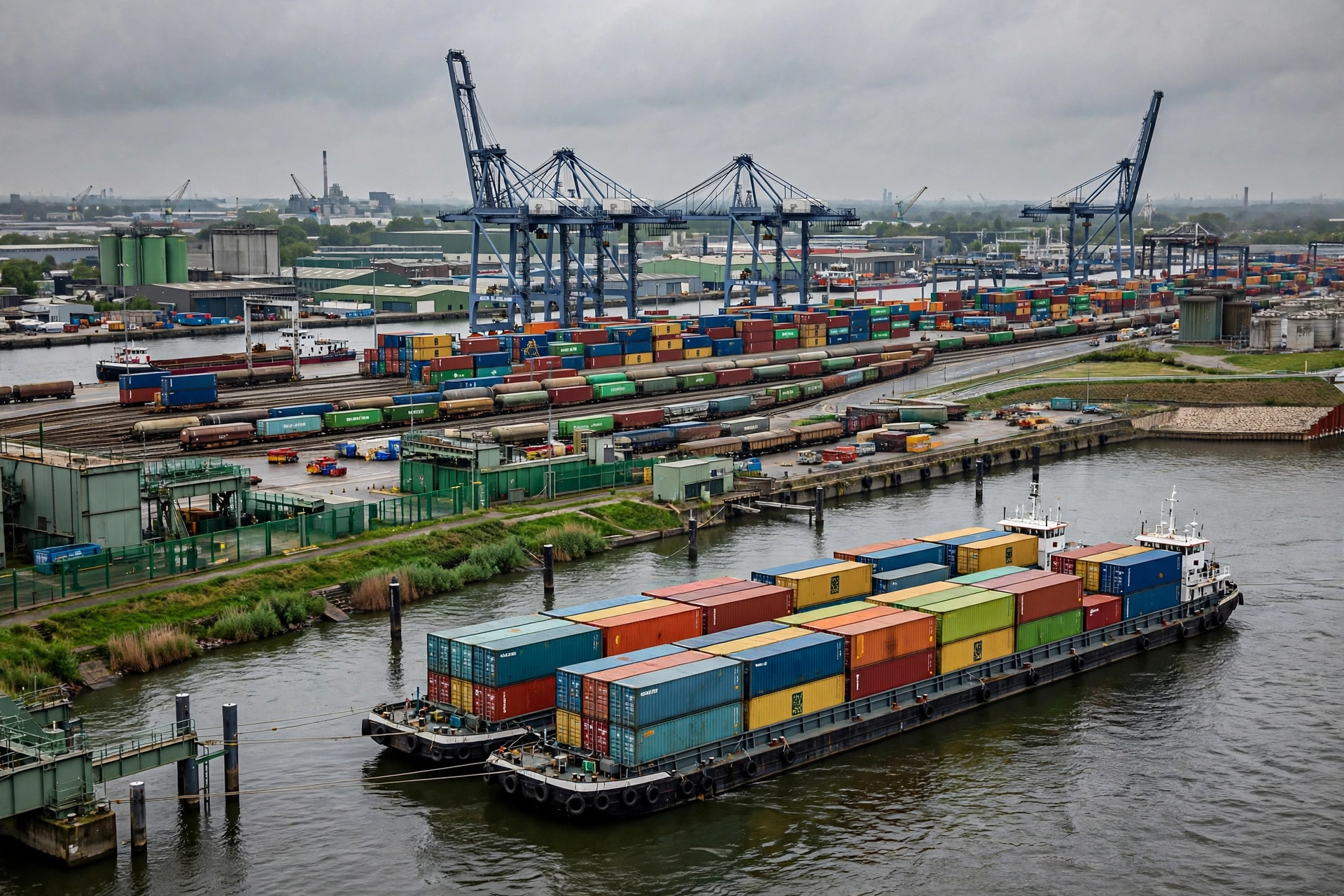
First, geography. Duisburg sits at the confluence of the Rhine and the Ruhr. Rhine barges reach Rotterdam and Antwerp directly — Europe's two largest seaports. Duisburg is simultaneously a rail terminus and a waterway node, which makes genuine trimodal transport possible.
Second, hinterland. The Ruhr is Germany's industrial heartland: cargo is both produced and consumed nearby. The distribution center sits next to demand rather than on the coastline — the core logic that separates Duisburg from a conventional seaport.
Third, the warehouse cluster and its operator. duisport has developed a ring of Logport logistics parks fused with the terminals, and its subsidiary duisport agency designs intermodal distribution solutions as a business line. The port operator doesn't just collect handling fees; it engineers the distribution chain. That "port-plus-warehouse" operating model is what distinguishes an inland port from a plain rail yard.
Fourth, the institutional interface. Customs sits inside the terminal, wired into Germany's ATLAS electronic declaration system, and industry sources describe multiple dedicated tracks for China-bound traffic. Clearance without leaving the yard, transshipment without detours — these details set the friction cost of distribution.
Duisburg Inland Port: Three Ways Out After the Train Arrives
Once the box is off the wagon, the shipper typically faces three onward options. The difference between them is not one-dimensional "speed" but a bundle of trade-offs:
| Mode | Typical destinations | Transit scale | Cost scale | Carbon | Suits |
|---|---|---|---|---|---|
| Rhine barge | Rotterdam, Antwerp and riverside points | Slow (days) | Low | Low | Large volumes, flexible schedules, consolidatable cargo |
| Rail | Southern and Central-Eastern Europe | Medium | Medium | Low | Stable volumes, concentrated destinations |
| Road | Germany, the Ruhr and nearby regions | Fast (hours) | High | High | Time-critical, small-lot, high-value cargo |
The decision framework compresses to three steps. First, destination: barge to the western seaports is the default; rail connects more smoothly to Southern Europe, Poland, and Czechia; within a roughly 300-kilometer circle of Germany, direct trucking wins on simplicity. Second, schedule: catching an ocean sailing means working the barge timetable backward; replenishing retail shelves means paying for trucking's flexibility. Third, value density: the higher the cargo value, the more it pays to buy certainty — trucking, or a fixed-timetable rail product.
Logport Warehouses: The Location Logic of European Distribution Logistics
Warehouse selection around Duisburg shows a clear two-ring structure. The inner ring is bonded warehousing inside the port zone: cargo arrives uncleared, sits in bond, and is released against orders from across Europe. Its value is optionality — cargo with undecided destinations can wait in bonded status until orders firm up. The outer ring is satellite warehousing across the Ruhr: cleared cargo pushed close to consumption points for regional distribution.
The trade-off is concrete. Bonded space saves duty capital and buys distribution flexibility, at higher port-zone rents. Satellite space saves rent and last-mile cost, at the price of an extra handling leg and less flexibility. There is no standard answer — only the shipper's order profile decides. The more fragmented the orders, the more the inner ring is worth.
Customs and Bonded Storage: The Most Underestimated Line in the Distribution Budget
Many distribution cost models give customs a single line reading "2–3 days." Given how the ATLAS system actually works at the duisport terminals, the real variable is not clearance speed but when clearance is triggered. Cargo with a fixed destination should clear as early as possible — warehouse rent burns by the day. Cargo with undecided destinations earns a free option by sitting in bond a few extra days. Get this line wrong and the freight savings evaporate into storage charges.
The counterintuitive read: rail's real value was never speed
Two judgments run against the grain here. First, what the China-Europe train really changed for European distribution is not "faster than ocean" but "the timetable can go into the purchase order." The Xi'an service matters not for the 11-to-12-day figure but for the 95-percent-plus punctuality. When arrival moves from "probably 15 to 20 days" to "the morning of day 11," European buyers dare to plan replenishment around rail. Supply chains never wanted absolute speed. They wanted plannability.
Second, the world's largest inland port does not really compete with Hamburg. Its counterpart is Rotterdam — and the relationship is symbiotic, not rivalrous. Duisburg increasingly functions as Rotterdam's "inland extension terminal": ocean boxes ride barges upriver to Duisburg for distribution, rail boxes ride barges downriver to Rotterdam for export. The end state of the inland port may not be a port at all, but a hub without a shoreline.
The outlook: three lines converging
Connect the data points and three trend lines converge. First, productization: the cargo-value profile of scheduled trains (41 percent higher) shows rail splitting off a premium, high-certainty product from the general-freight channel. Second, the green constraint: rising EU carbon costs will push the relative price of road distribution upward, giving barge and rail a structural tailwind. Third, network effects: Duisburg is ceasing to be a terminus and becoming a two-way hub — return services carry high-value European goods back to China, and the distribution network is starting to serve bidirectional flows.
An open question: as rail timetables read like ocean schedules and inland ports distribute like seaports, will the Duisburg model be replicated at a second European inland port — or is the Rhine-plus-Ruhr geography unreplicable? No standard answer until the next data round; the distribution math, however, has to be done now.
By Dr. Chen, Supply Chain Researcher