The most consequential AI story of 2026 is not another chatbot. It is the moment AI stepped off the server and into the warehouse — the world models warehouse physical AI stack that NVIDIA calls Physical AI. The enabling idea has a deceptively simple name: world models.
The phenomenon is easy to state and hard to overstate. On June 1, 2026, at GTC Taipei, NVIDIA released Cosmos 3 — billed as the world's first fully open omnimodel for physical AI, unifying vision reasoning, world generation, and action prediction in a single mixture-of-transformers architecture. Earlier in 2026, NVIDIA had pushed its Physical AI Data Factory blueprint toward open availability: NVIDIA's reference architecture for the world models warehouse physical AI stack — a system for generating, scoring, and curating synthetic training data for robots. The message was explicit. The industry's biggest bottleneck is no longer algorithms. It is data.
The capital markets agree, emphatically. Physical Intelligence, the San Francisco startup founded in 2024, has raised roughly $70 million in seed funding alongside its first π₀ model, then $400 million at a $2.4 billion valuation with participation from Jeff Bezos and OpenAI, then $600 million at $5.6 billion led by Alphabet's CapitalG — and Bloomberg has reported a new round targeting an $11 billion valuation. Note the remarkable fact buried in that arc: as of public reporting, the company has no commercial product and no disclosed commercialization roadmap. Investors are buying the thesis itself — that a generalist robot foundation model is the next platform.
From Predicting the Next Word to Simulating the Physical World: What World Models Are
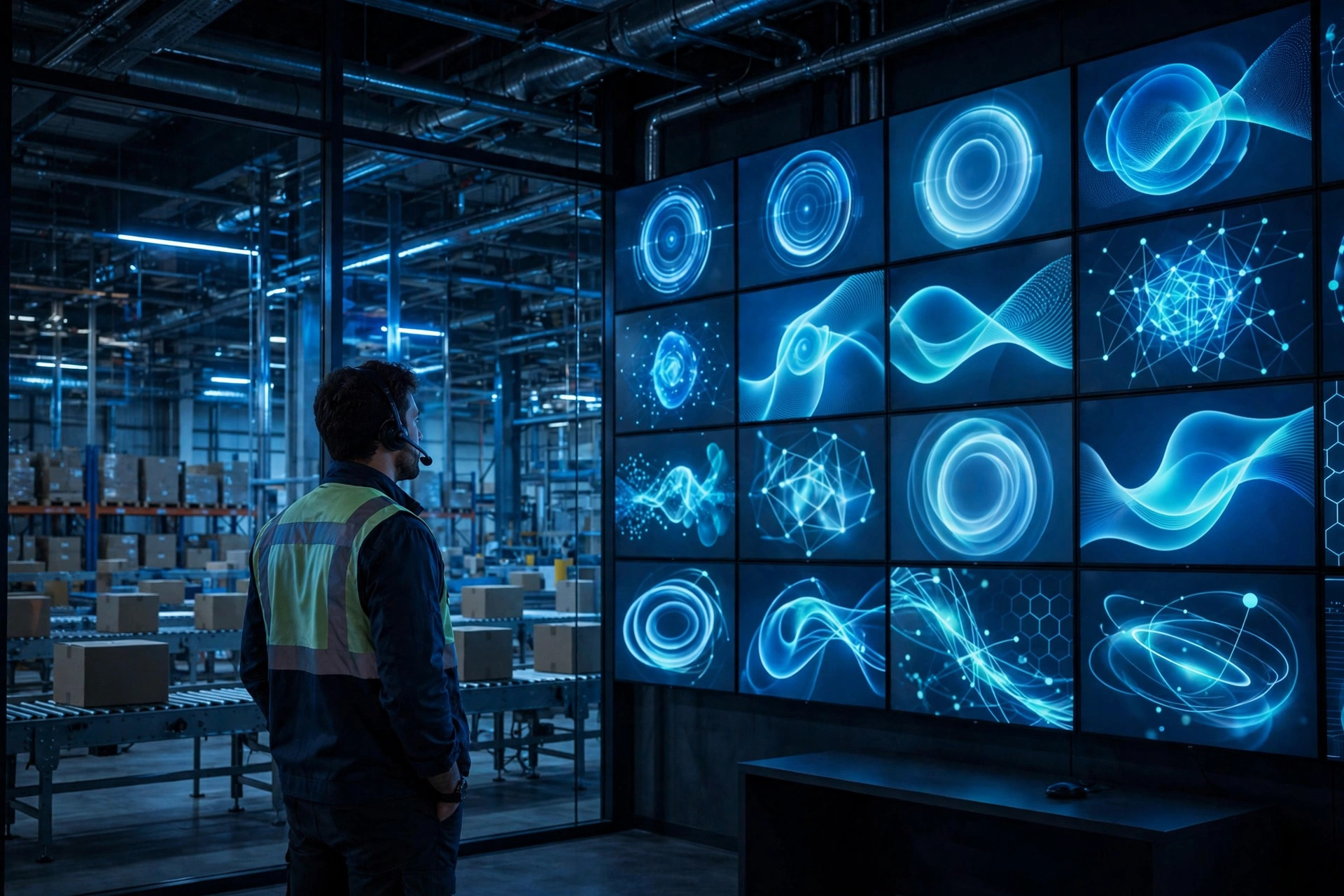
Language models were trained on the internet, and the internet is text. Physical AI has no such luck: there is no web-scale corpus of robot trajectories, and collecting real-robot data is slow, expensive, and occasionally dangerous. A world model attacks this asymmetry directly. Instead of memorizing text, it learns physical intuition — gravity, contact, scale, object permanence — and then generates physically plausible futures: synthetic video in which things fall, collide, and deform the way they actually do. A handful of real demonstrations can thus be multiplied into thousands of training episodes.
Cosmos 3 ships in multiple sizes — Super, Nano, and smaller variants — which is itself a statement about the intended division of labor: train in the cloud, reason at the edge. Inference runs on on-device compute like NVIDIA's Jetson modules, trading raw compute for the one thing a robot cannot wait for: a round trip to a data center. On a factory floor or in a warehouse aisle, latency is a safety constraint, not a convenience metric.
Where the Money and the People Went: A 2026 Timeline
Arranged chronologically, 2026's public milestones sketch the shape of the emerging world models warehouse physical AI stack:
- Mid-2026: NVIDIA pushes its Physical AI Data Factory — a reference architecture for generating, scoring, and curating synthetic data — toward open availability, with cloud vendors like Nebius building deployable frameworks on top. The phrase "data factory" matters — synthetic data is being industrialized, not experimented with.
- June 1: Cosmos 3 launches at GTC Taipei, alongside the Cosmos Coalition — Agile Robots, Black Forest Labs, Runway, and Skild AI as founding members. Open world models are organizing.
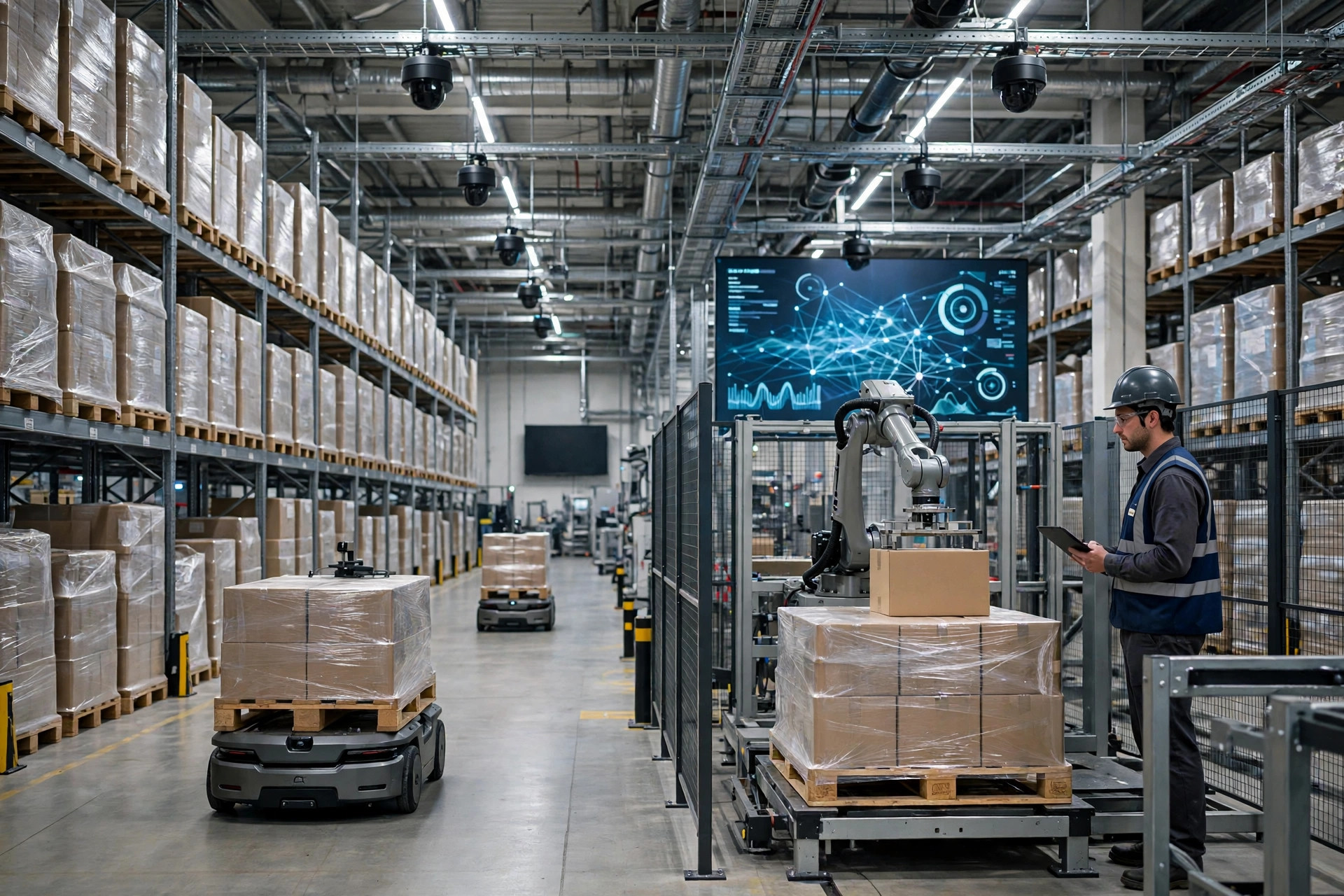
- From Doosan's robot arms to Sereact's dual-arm sorting, the industry is converging on the same pipeline — Isaac for simulation, Cosmos for data, Jetson for inference.
- Doosan Robotics integrates the full NVIDIA pipeline — Isaac Sim and Isaac Lab for simulated training, Cosmos for synthetic data, the Newton physics engine, Jetson Thor for on-device inference — into its Agentic Robot OS. The first two industrial applications: depalletizing and sanding, with commercial deployment of industrial humanoids targeted for 2028.
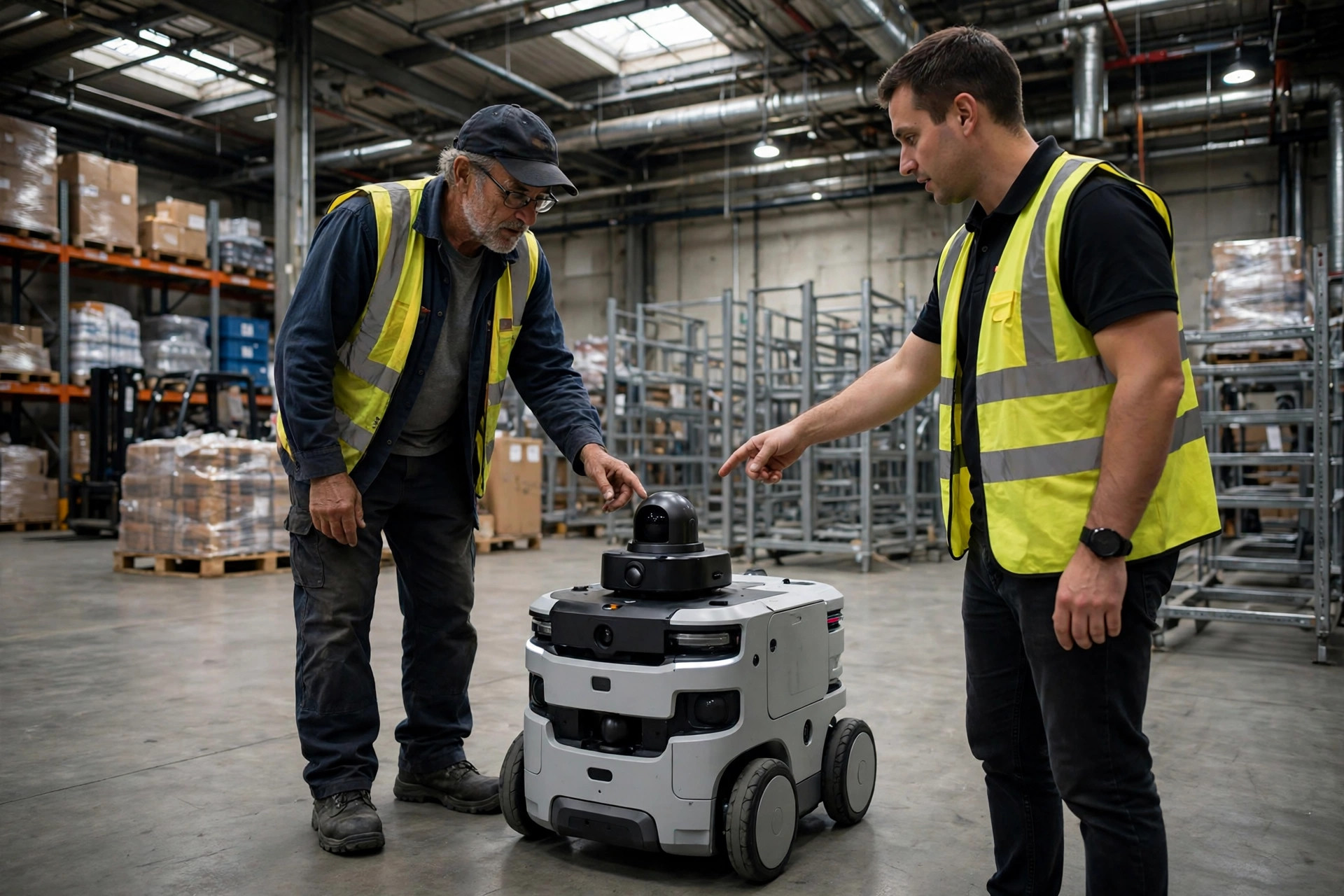
- October 21: Sereact, NVIDIA, Nebius, CEVA Logistics, and Zalando announce a closed training loop inside the warehouse: robotic returns handling at CEVA's fulfillment centers for Zalando. Returns are among the hardest warehouse processes to automate — every item arrives in whatever state the customer left it — and the loop compresses the retrain cycle from weeks to days.
Why the Warehouse: Where World Models Meet Physical AI
The attribution has to start with the central unsolved problem of robot learning for a decade: the sim-to-real gap. Policies that perform beautifully in simulation meet the friction, material variation, and contact dynamics of a real warehouse and fall apart. For ten years the answer was "collect more real data." But real data is punishingly expensive: the cost of ten thousand simulated episodes is a rounding error next to a single day of data collection on a live warehouse floor.
World models change this cost structure. When synthetic data is physically faithful enough, data stops being a scarce resource to be harvested and becomes an industrial product to be manufactured. This is the friendliest possible development for warehouse automation, because the warehouse is where the long tail lives: no two returns look alike, no two damaged cartons fail the same way. Scenarios that were unautomatable for lack of data now have, for the first time, an engineering path.
Here is the contrarian read: the real significance of world models is not that robots get smarter — it is that training data goes from "collected" to "manufactured." The moat moves from "who has the data" to "who has the real-world scenes to validate synthetic data against." The mountains of operational video and exception logs sitting in warehouse servers — historically a cost center — may become assets. On one condition: start saving them now, and save them structured, with timestamps, locations, and SKU context.
2026-2028: Judgments on Three Timescales
Based on public disclosures, three time-bound judgments, left here to be verified:
- 2026-2027 is the validation window. Watch whether closed loops like Sereact/CEVA can sustain week-scale iteration, and whether success rates in unstructured tasks — returns, depalletizing — climb past the breakeven line against human labor cost. If they don't, the story stays in slide decks.
- 2027-2028 is the scaling window. Doosan's stated target of commercial industrial humanoid deployment by 2028 is an observable anchor — behind it, the full pipeline (Isaac, Cosmos, Newton, Jetson) must reach industrial reliability before then.
- Three concrete suggestions for warehouse operators: first, save your operational video — it is future training fuel. Second, pilot in the messy processes — returns, quality inspection, depalletizing — not the pallet moves that already run smoothly. Third, don't train your own world models warehouse physical AI models from scratch; buy the pipeline and use the open weights. Your advantage is the scene, not the algorithm.
An open question to end on: when simulation becomes cheap, what becomes scarce? Perhaps the "surprises" of the physical world itself — and surprises only happen in warehouses with their doors open. A world model can simulate ten thousand ways a carton falls. It cannot simulate the actual chaos of the first day of peak season. The last moat of the physical world may turn out to be the word "physical."
By Dr. Chen, Supply Chain Researcher