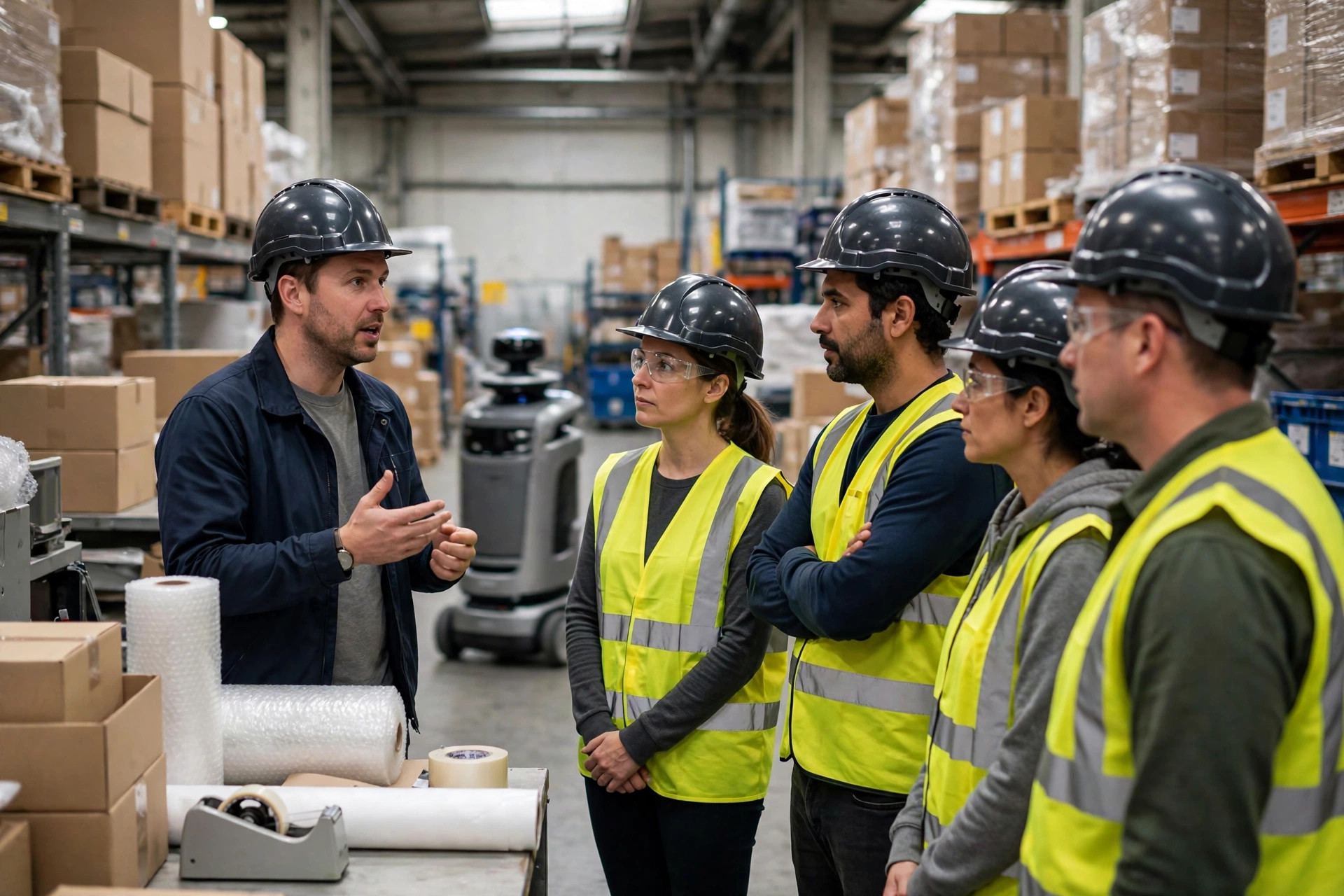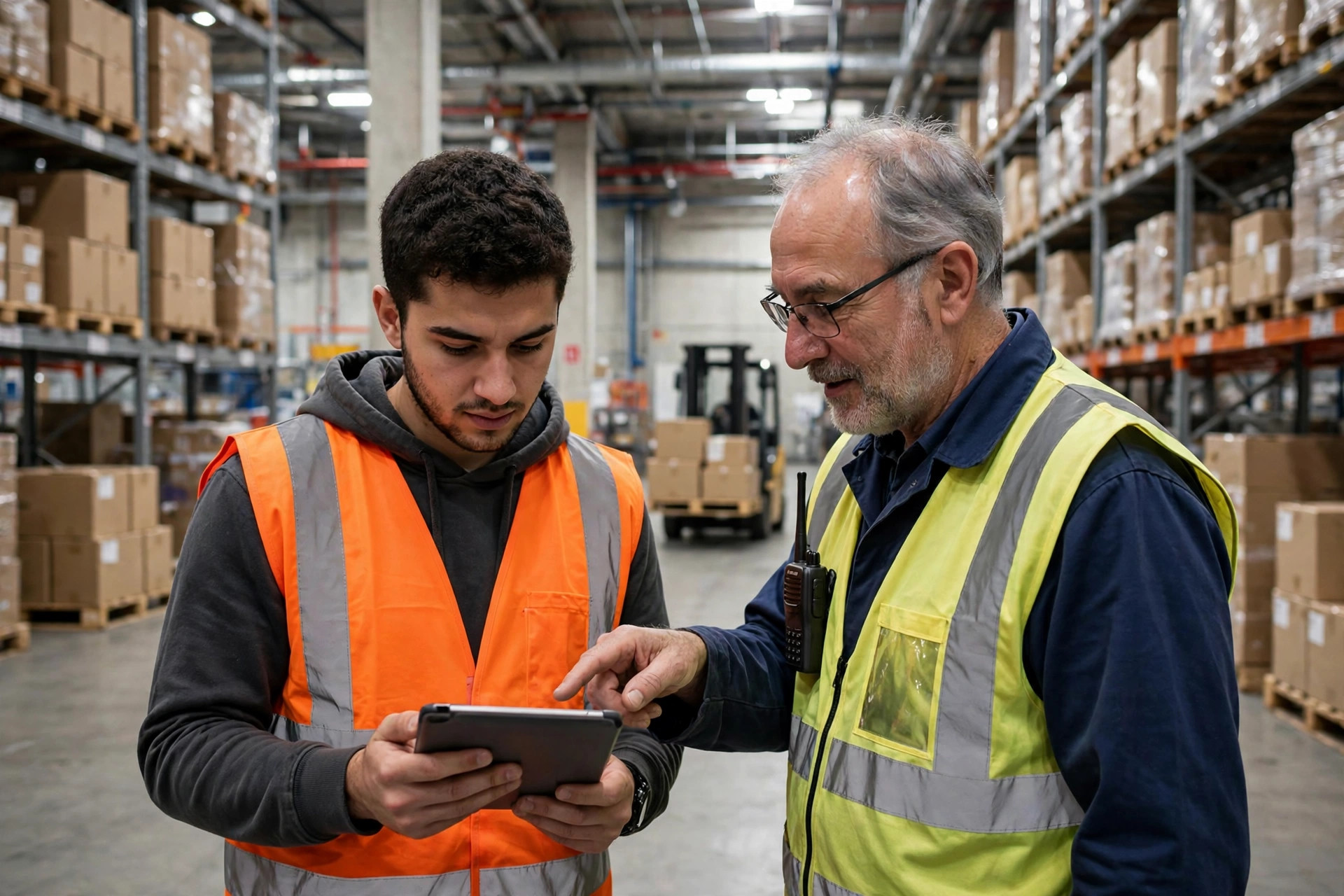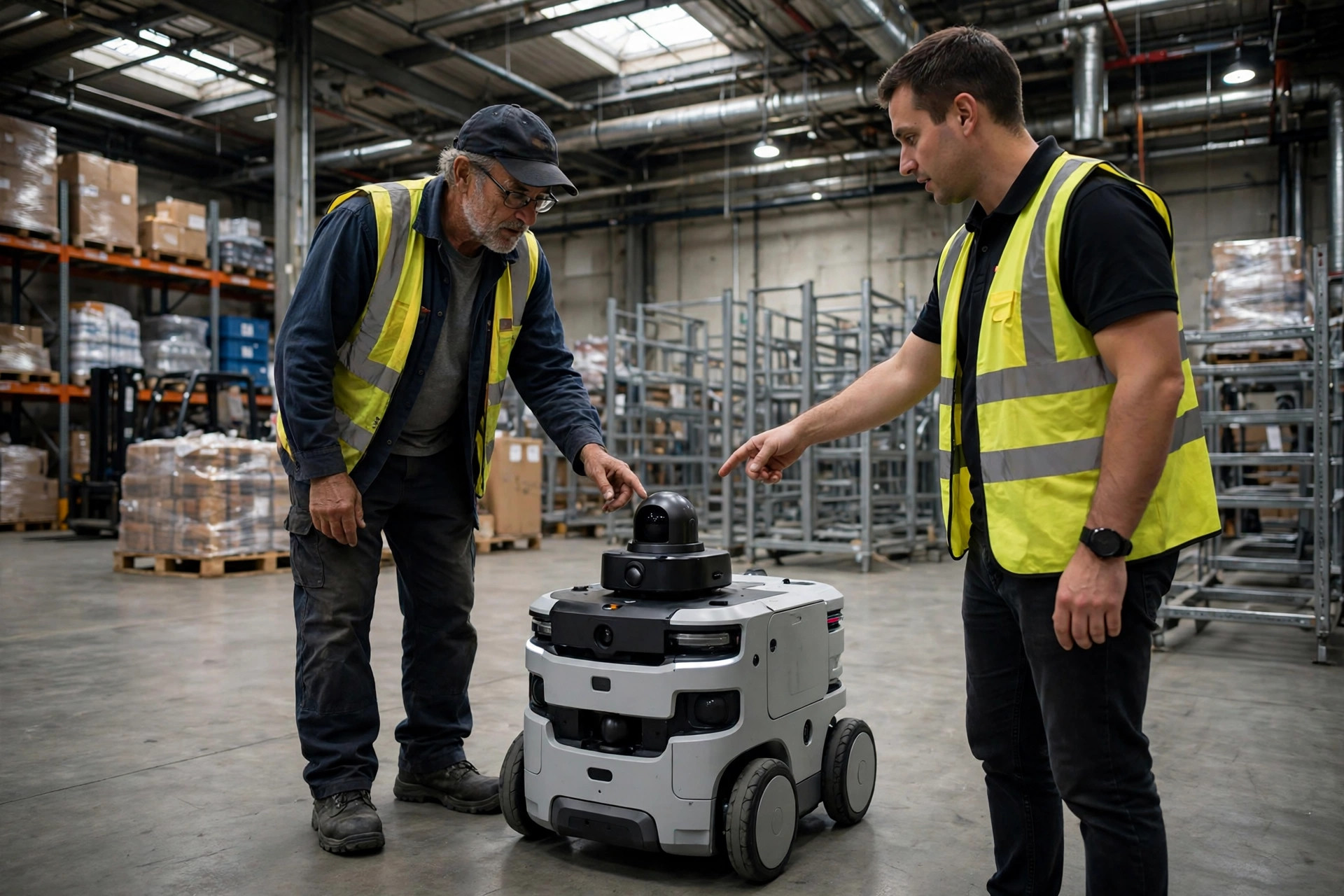
Over the past two years, I have visited more than a dozen warehouses that deployed automation, and the question I heard most often was not "does the equipment work well" but "where do the veteran workers go after the transition." After the AMRs arrived, one site went from 40 pickers to 12. Where did the other 28 go? Equipment vendors' proposals don't answer that. Management's project approvals usually contain a single line: "headcount optimized naturally." But people are not numbers, and behind every "natural optimization" there are individual destinations.
Start with the data: how big is the transition pressure
Let me lay out the public data first. According to a McKinsey report published in October 2026 (via Bloomberg), roughly 11 million American workers — about 7% of the workforce — may need to change occupations by 2035 because of AI. Low-income workers face nearly eight times the likelihood of needing to switch as high earners. The three hardest-hit categories are office and administrative support, retail and sales, and transportation and logistics — warehouse workers are squarely in that third group. The report also estimates that six out of seven workers who switch will need substantial retraining and will likely see their earnings drop.
Now the front line. According to a survey Exotec commissioned in August 2026, conducted by Macromill among 1,031 warehouse workers in Japan, 51% are considering changing jobs. The top reason is physical strain (39.7%), and the task they most want robots to take over is heavy lifting. According to Randstad's Workmonitor 2025, about 60% of logistics roles are facing AI-driven transformation, and nearly a third of workers want to leave because they see no career path.
But there is another side. According to Rockwell's survey of more than 1,500 manufacturers across 17 countries, 41% turned to automation specifically because of skills gaps and hiring difficulties — they couldn't hire enough people to begin with.
Put these together and the picture is clear: displacement is happening, but "nobody wants these jobs" and "workers are being displaced" are happening at the same time. The essence of the transition problem is not "we have too many people" — it is that people's skills and the available roles no longer match.
Why reassignment is so hard: three structural causes
First, skill mismatch. Picking is muscle memory; exception handling is judgment. A picker with eight years on the floor knows every slot location with their eyes closed, but asking them to determine whether an unscannable barcode is a wrinkled label or a missing master-data record requires an entirely different capability. Automation replaces repetitive motion; what remains is judgment and coordination — and the two capability models barely overlap.
Second, wage anchoring. A veteran earns $22 an hour; the transition training period pays $18, with a promise to "revisit after training." From the worker's perspective, that is not a transition — it is a pay-cut notice. McKinsey's estimate that six in seven switchers may earn less plays out on warehouse floors every day.
Third, organizational inertia. Management treats reassignment as HR's job; HR treats it as a training exercise; training ends, and nobody owns assessment, placement, or pay-setting. A transition whose final step has no owner is a transition that never happened.
Three paths: exception handling, equipment tending, data review
Across the sites I visited, reassignment destinations converge on three paths.
Path one: exception handling. Automation handles 90–95% of routine volume; the remaining 5–10% of exceptions — damage, unscannable barcodes, mixed pallets, system dead-ends — can only be handled by people. This is the most natural landing: veteran workers know the floor best, know what "normal" looks like, and therefore spot "abnormal" fastest. Pay can stay flat or even rise, because this is a judgment role, not a physical one.
Path two: equipment tending. Swapping AMR batteries, cleaning lidar sensors, clearing jams, running pre-shift inspections. Not technically demanding, but it requires diligence and floor experience — the people who know when a machine is about to "act up" are the ones who have worked alongside freight every day.
Path three: data review. Reviewing false positives from AI vision inspection, reconciling cycle-count variances, confirming system exception tickets. Suited to patient, detail-oriented people — older veterans often have the advantage here.
Beyond the three paths, one baseline must hold: a wage protection period. My recommendation is 6 to 12 months with no pay cut, then a skill-allowance ladder for the new role. The protection period is not a benefit — it is a necessary cost of making transitions happen. Without it, the three paths above are paper plans.
What failed transitions look like: the lesson of a three-day training
In 2025, I visited a 3PL warehouse in the Midwest. After the AMRs went live, management converted 20 pickers directly into "robot monitors" with three days of training: one day of videos, one day of shadowing, one day of testing. In the first month, their exception-handling pass rate stayed below 50%, and average response time to equipment jams exceeded 20 minutes. Seven people quit within three months.
The post-mortem showed the problem wasn't that workers "couldn't learn." Three things were missing: training didn't carry their normal wage (it paid the minimum, and workers read it as a pay cut); there was no real mentorship (on shadowing day, the mentor was busy handling exceptions themselves); and assessment wasn't tied to anything (pass the test and you're on the floor; struggle on the floor and nobody follows up). The reassignment list was announced, not signed — being "reassigned" and "wanting to move" are entirely different mindsets.
Contrast that with a food warehouse in California in 2024: they published the transition plan six months early, paired each worker with a transition mentor, kept wages unchanged during training, and ran a 30-day dual-role transition (old role in the morning, new role in the afternoon). Ten of twelve workers stayed; two left with severance, on good terms. Those who left, left with dignity; those who stayed, stayed with confidence.
Where this goes: transition plans become standard in automation projects
A few judgments, each with a timeline.
In the next 3 to 5 years, warehouses will see a new role: the human-robot collaboration scheduler — half managing people, half managing robots, with exception judgment and prioritization as the core skill. There is no standard job description for it today; in five years it will be standard headcount.
In 5 to 10 years, pure manual picking roles will largely disappear in developed markets, but "last-mile exception handling" will need people for a long time. Machines handle the routine, people handle the exceptions — that division of labor isn't changing on any foreseeable horizon.
On the organizational side, transition budgets, wage protection periods, and mentorship programs will become standard line items in automation project approvals, not afterthoughts. Today, writing "headcount optimized naturally" in a business case still passes; in three years, investors and management will ask first: what is your transition plan.
One counterintuitive judgment for managers building reassignment lists: the hardest to transition are often not the oldest workers but the best pickers. The strongest muscle memory comes with the strongest resistance to "being replaced by a machine"; meanwhile, the average performers who like to tinker adapt fastest. So don't build the list by seniority — rank by willingness and learning ability. Get that order wrong and no program can save it.
I'll end with an open question. We calculate ROI on equipment to two decimal places; almost nobody calculates the ROI of workforce transition. When people leave, the cost of rehiring and retraining is on the books — it's just filed under "recruiting expenses" and "shrinkage," never connected back to "failed transition." Perhaps the real question isn't "where do the veteran workers go," but this: are we willing to spend on transition the same money we spend on equipment?
By Dr. Chen, Supply Chain Researcher