Here's my verdict up front on the Uruguay free trade zone warehouse question: the zones don't sell you cheap — they sell you certainty. Zonamerica runs on a 1987 law (Law 15.921) that has survived seven governments, left and right, without a single amendment (trade.gov). In Latin America, that is the rarest thing of all.
Let's be blunt about it. The biggest cost of warehousing in Latin America was never rent. It's policy whiplash. Argentina's peso moves daily, Brazil is still rewriting its tax code, and then there's Uruguay — 3.5 million people — which wrote "the government won't mess with you" into statute. I've watched too many companies do beautiful tax math in South America only to have one new regulation wipe it all out.
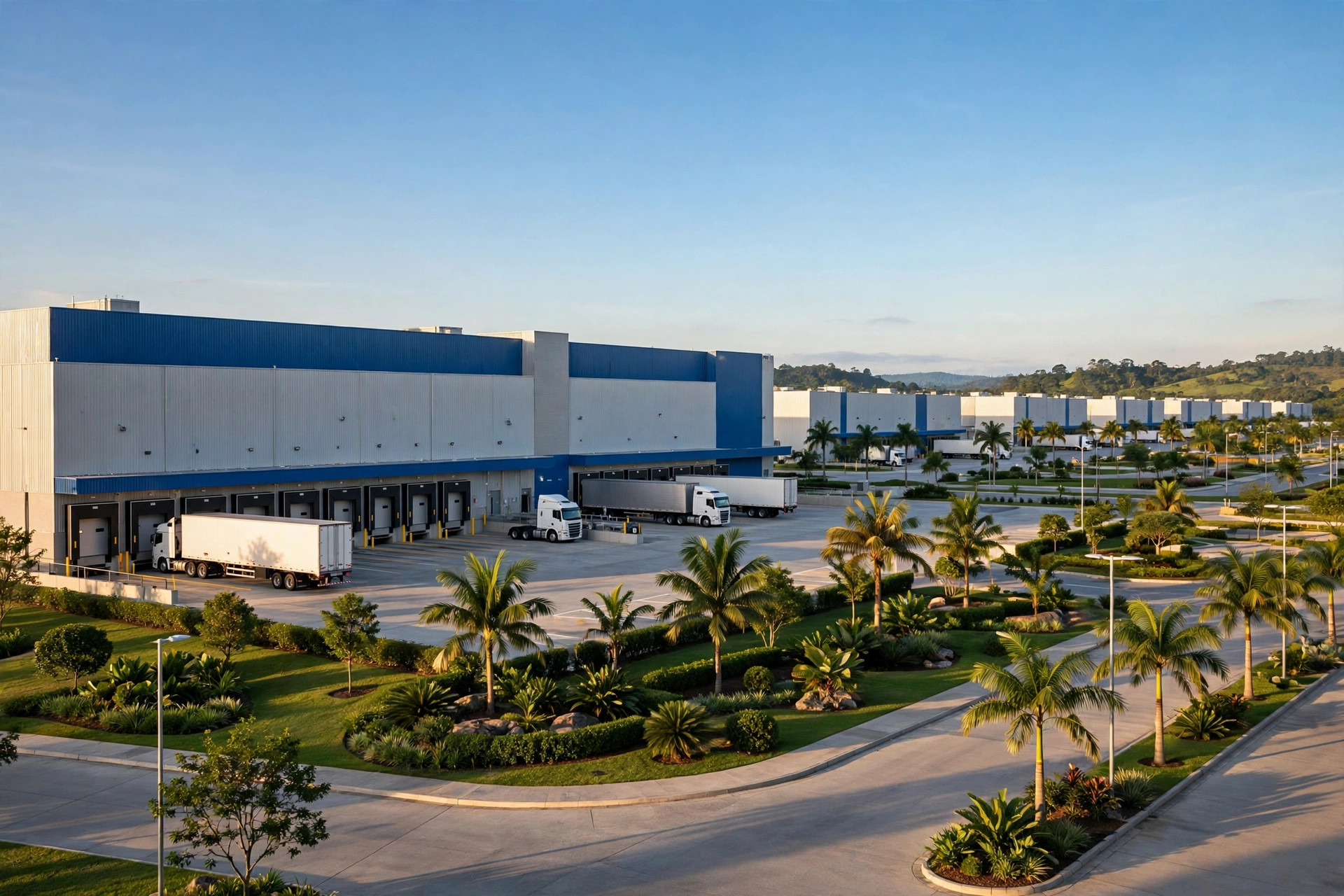
Not long ago, Costa Oriental — a Uruguayan logistics company, not a foreign investor — opened its fifth facility inside Zonamerica, taking its total warehouse footprint to 50,000 square meters. That makes it the largest logistics center in any of Uruguay's free trade zones, with 200-plus people on payroll, and the president showed up for the opening (Uruguay XXI). Read that detail twice: a domestic company betting its core network on the free zone regime. That tells you the zone isn't a tax shell here. It's productive infrastructure.
What Law 15.921 Actually Exempts — The Zonamerica Tax Math
The 1987 law has two teeth, and both bite:
First, a full exemption from all national taxes — the ones that exist now and any that get created in the future. Corporate income tax, VAT, import duties, net wealth tax, all of them (trade.gov). "Taxes to be created" — read those words again. Very few free zone regimes on earth dare to promise that.
Second, a government guarantee: if a legal change during your contract term causes you damage, the Uruguayan state pays for it. That's a statutory indemnity, not a sales pitch.
I've seen too many free zones treat "incentives" as marketing copy — revised every three years, each revision forcing companies to redo their models. Uruguay's regime has run unchanged since 1987 through seven governments (trade.gov). Twelve operating zones contribute roughly 30% of the country's exports and 4.2% of GDP (trade.gov). In 2022 alone, free zone exports hit US$4.268 billion — 32% of national exports (Uruguay XXI). By 2025, Uruguay's own investment agency was citing 40% of goods exports originating in free zones. The numbers are small; the signal is not. A country that stakes its trade lifeline on free zones can't afford to touch them. That's the foundation Zonamerica's 30-year planning horizon rests on.
The Free Port's Five Years: The Distribution Play Behind the Warehouse
Most people confuse the free zone with the free port. They're two different regimes, and they play differently.
The Port of Montevideo was the first free port on South America's Atlantic coast (Ports Law, 1992). Cargo can sit in the port customs area for up to five years, extendable, exempt from all import taxes and surcharges, with no formal import required (trade.gov). Carrasco airport works the same way for air freight. Bonded warehouses, by contrast, give you 24 months with no extensions.
This cuts both ways. The upside: a seller can land goods at Montevideo, keep title without incorporating a Uruguayan company, and drip-feed them into Argentina, Brazil, Paraguay, and Bolivia as orders come in. Paraguay and Bolivia — landlocked — move a lot of cargo exactly this way; Montevideo is their ocean door. The cost: the free port only covers "staying." The moment you want sorting, labeling, or repacking, you need formal free zone user status, with real substance requirements — local staff ratios, a business plan, transfer-pricing compliance.
The trap I've seen: a seller assumes goods entering Uruguay's free zone regime flow "tax-free into Argentina." They don't. Argentina still clears and taxes normally on its side. The zone exempts the Uruguay leg, not the destination country's. What a distribution hub saves you is tied-up capital, inventory flexibility, and certainty — not destination duties. Get that math wrong and the whole model collapses. Cost first, benefit second — that's the only honest way to read any free zone.
Why Argentine Companies Keep Moving to Uruguay
In 2020, MercadoLibre's founder Marcos Galperín moved his home to Uruguay. A former president publicly set a target of attracting 100,000 Argentines (Financial Times, November 2023). But here's the thing people miss: the motive isn't a few points of tax rate. Uruguay's personal taxes aren't low. The motive is three things — free movement of foreign currency, the right to repatriate capital and profits at any time, and a government that doesn't improvise.
For a company running regional distribution, those three are worth more than a five-point tax spread. Argentina's real pain was never the tax rate; it was money going in and never coming out. Uruguay's answer: your money is yours, and it can leave whenever you want. So it's not just wealthy individuals moving — it's regional headquarters and treasury centers landing in Zonamerica. The park now hosts 350-plus companies and 10,000 employees, contributing 1.8% of national GDP (fDi Intelligence, citing Uruguay's National Statistics Institute).
The Math: Uruguay vs. Colombia vs. Brazil
| Uruguay (Zonamerica) | Colombia (free zones) | Brazil (Manaus) | |
|---|---|---|---|
| Corporate income tax | Full exemption, incl. future taxes (Law 15.921) | 20% on export income; 35% on domestic sales — requires an internationalization plan | 75% reduction (reinvestment portion) |
| Cargo dwell time | Free port: 5 years, extendable; free zone: per user contract | Indefinite | International warehouse: 1 year, extendable to 5 |
| Policy stability | 1987 law, seven governments unchanged; state indemnity for legal changes | Dual system since the 2022 tax reform — newer rules | Incentives extended to 2073 (constitutional amendment), but the 2023 tax reform is restructuring the base |
| Best for | Regional distribution hubs, high-value goods, pharma, tech | Export manufacturing plus a 50-million-consumer domestic market | Manufacturing for the Brazilian domestic market |
| The price you pay | Domestic market of only 3.5M people; labor and land cost more than Colombia | Heavy compliance: annual export targets, US$200k–2.2M investment thresholds | Far from consumer markets, deep in the Amazon, high logistics cost |
Sources: trade.gov; ProColombia / ANDI; International Tax Review.
How to read this table? Three sentences: if you want stability, go Uruguay. If you want a big market plus export manufacturing, go Colombia. If you want Brazilian domestic sales, go Manaus. There is no all-rounder — only trade-offs.
Pharma Cold Chain: Zonamerica's Real Moat
Zonamerica hosts more than 20 pharma and life sciences companies, plus six logistics operators registered with the national health authorities (Zonamerica). A Merck executive said it plainly at the Ibero-American free zones conference: "If it weren't for the free-zone regime, we wouldn't be here." Pharma is the industry that consumes certainty — approvals, cold chain, compliance — none of it can be gambled on policy.

The lesson for sellers: if your goods are high-value and tightly regulated — medical devices, supplements, precision electronics — Zonamerica's cold chain and compliance ecosystem is already built, and 20-plus drug companies have paved the road. If you're moving low-value fast-moving goods, Colombia's math may beat it. The first principle of site selection never changes: what does your cargo fear most? If it fears policy, go Uruguay. If it fears cost, go elsewhere.
The Uruguay Option for Sellers Stocking South America
Here's a worked scenario. A Shenzhen 3C seller doing 20,000 orders a month across South America, mainly Argentina and Chile. Option A: ship direct to Argentina — slow clearance, long cash cycles under currency controls, stockouts every peak season. Option B: hold two months of safety stock at Montevideo's free port and distribute against orders — you keep title, no Uruguayan entity needed, and five years of dwell time is more than enough rotation (trade.gov). Pre-position before peak season and you've bought yourself a South American insurance policy. The price: one extra ocean leg plus port warehousing. Run the numbers carefully — the higher the unit value and the costlier the stockout, the more Option B wins.
Now the counterintuitive part: Uruguay's free zone regime's biggest risk is its biggest virtue — it's tiny. With 3.5 million people, you will almost never pay back the investment on domestic sales. Coming here is a bet on the regional distribution thesis, full stop. Get the thesis right and it's Latin America's steadiest warehouse; get it wrong and it's an expensive parking lot. Zonamerica's 92 hectares, 30 buildings, and 350 companies (fDi Intelligence) — not one of them came for the Uruguayan consumer. They all came for the 200-million-person region behind it.
So my advice is one sentence: figure out first whether your goods are meant to be sold to Uruguay, or to pass through Uruguay. If the answer is the latter, Zonamerica deserves a flight to Montevideo to see it with your own eyes. After all — a 1987 law still standing today is itself an answer.
By Lao Mi, Supply Chain Veteran (20 yrs)
Figures in this article: trade.gov "Uruguay Free Trade Zones"; Uruguay XXI (2023 free zone export data, Costa Oriental's 50,000 m² project); Zonamerica (20+ pharma companies, six health-registered logistics operators); fDi Intelligence (park scale and GDP share); Financial Times, November 2023 (Argentine migration to Uruguay); ProColombia / ANDI (Colombia free zone rates); International Tax Review (Manaus incentives to 2073). Details not cross-verified should be checked against each authority's latest published policy.