Here's an uncomfortable truth I've learned in five years of selling online: we obsess over shaving our ad costs from $1.80 down to $1.60, then hand every penny we saved straight to the shipping carriers. Shipping doesn't show up in a dashboard you can optimize. It just quietly sits on every order, eating your margin.
I ran the numbers once. During Black Friday 2024, my little operation shipped 640+ small parcels out of a garage in Ontario, California, at an average of seven bucks and change per order. Then I switched how I bought postage — same products, same weights — and the average dropped to barely over five dollars. That's roughly $1,300 saved in a single month. I didn't change carriers. I changed where I clicked "buy label." That's what this is about: the cheapest way to ship small packages as a small business, tested for real.
Short version up front: the cheapest way to ship small packages comes down to three platforms — Pirate Ship, Shippo, and Stamps.com — and none of them wins in every situation. The free one has the most honest postage. The most full-featured one has the steepest monthly fee. The right pick depends on how many labels you print a month and which carriers you actually use. Here's the breakdown, paid for with my own tuition money.
Pirate Ship: the free one, and why it's the most honest
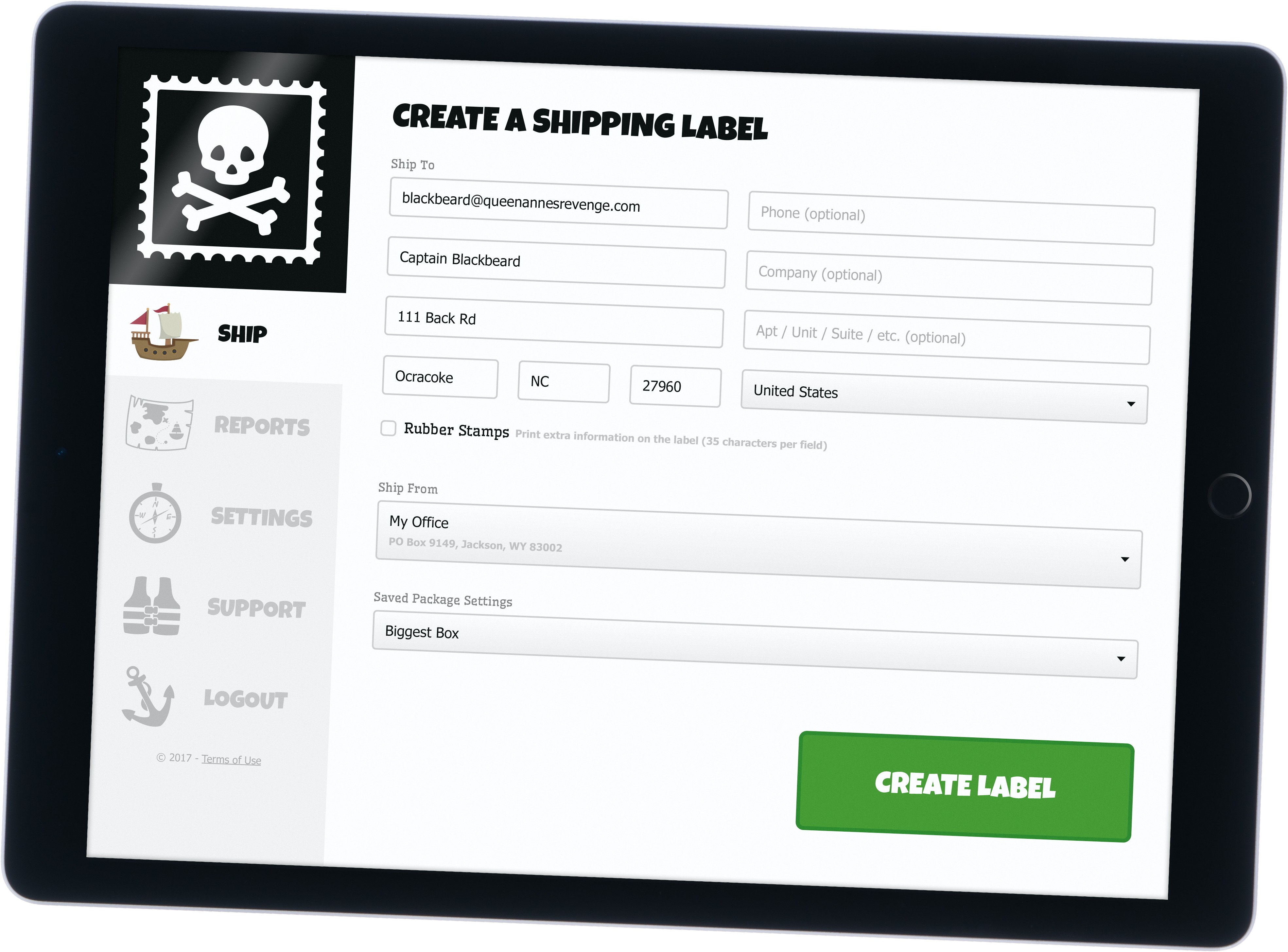
Pirate Ship is a weird company in the best way. Their site says it plainly: the software is free forever, no monthly fee, no per-label service fee. How do they make money? The carriers pay them a cut. Every cent you pay is pure postage — the platform doesn't skim your label.
You get USPS Commercial Pricing, including the famous Cubic rate that prices by package size instead of weight (a lifesaver for small, heavy stuff), plus a Simple Export Rate for lightweight international parcels. UPS discounts are in there too. The catch: it's USPS and UPS only. No FedEx, no DHL. If FedEx is your main carrier, skip this one entirely.
Signup takes five minutes: register with an email, connect Shopify, Etsy, eBay, Amazon, or WooCommerce, and orders flow in automatically. I switched from buying retail postage on the USPS site in October 2024, and the first label I printed made me wince — the same Priority Mail small box cost dramatically less at the commercial rate than what I'd been paying at retail. It felt like discovering the coffee shop had a secret staff price all along.
The downside: order management is bare-bones. No automation rules, no serious batch tooling, no real API. A seller doing thousands of labels a month will outgrow it fast. But for a few hundred labels a month? Bare-bones is a feature — you're not paying for things you'll never use.
Shippo: the universal adapter, but the free tier has a ceiling
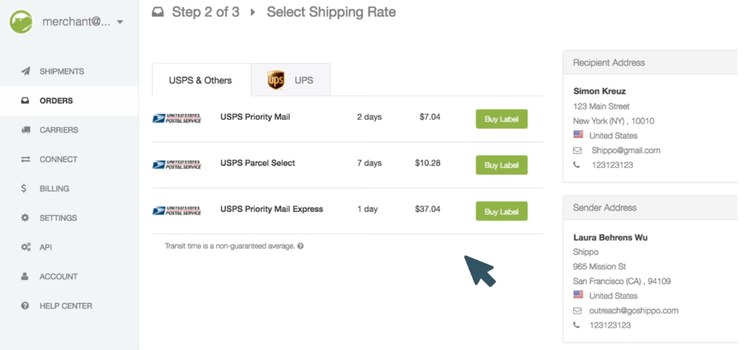
Shippo is the most full-featured of the three: USPS, UPS, FedEx, and DHL side by side on one rate-comparison screen. The Starter plan is free for up to 30 labels a month, with discounted rates and unlimited store connections. Past 30 labels, you're on Pro: $19 a month (or $17 a month billed annually) for up to 200 labels, with higher tiers at $29 and $54 as volume grows.
Watch the fine print: if you connect your own negotiated carrier account on the free plan, Shippo charges 5 cents per label as a pass-through fee — waived on Pro. Branded tracking pages and packing slips are Pro-only too.
I use Shippo's free tier for the odd FedEx Home Delivery label (Pirate Ship doesn't do FedEx). The comparison screen is genuinely satisfying — four carriers' prices lined up, one click, done. But it bit me once: a "weight correction" charge from two months earlier showed up on my bill. Turns out carriers re-weigh and re-measure parcels in transit, and if your numbers don't match, they bill the difference later. Shippo passes those adjustments straight to you, usually 30 to 60 days after shipment. Lesson learned: weigh the packed box, measure the outside at its widest points, and always round up.
Stamps.com: the old-school player — $14.99 a month, but don't fall for the cheap tier
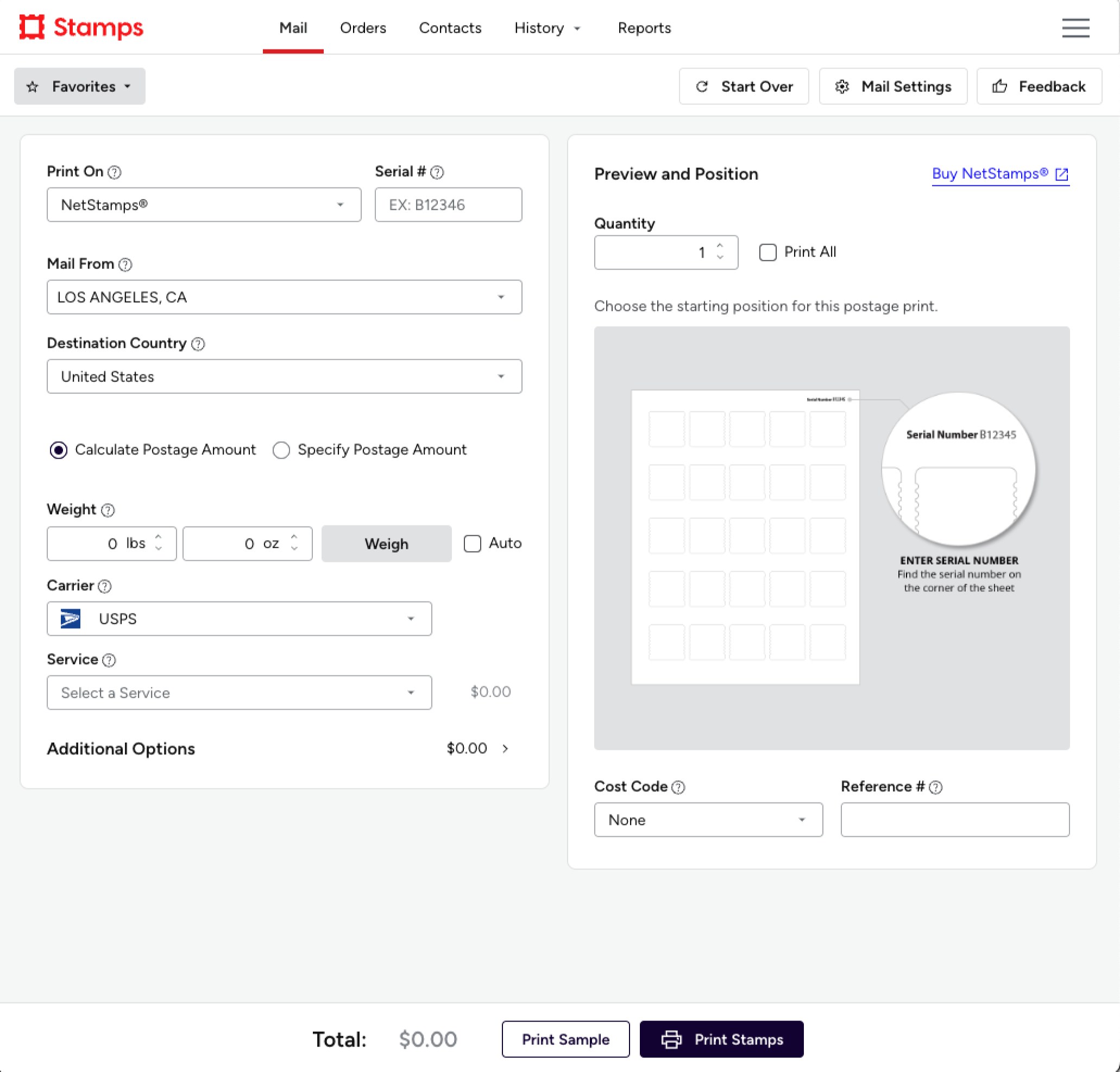
Stamps.com is the veteran here. The interface looks like it's from 2010, but the feature set is real: USPS, UPS, and FedEx labels, printable postage stamps, Certified Mail, batch printing, QuickBooks integration. There is no free plan — only a 30-day trial.
Pricing runs three tiers: Basic at $14.99 a month, Professional at $29.99, Multi-Location at $49.99. Here's the trap: Basic caps you at 10 shipping labels a month. Ten. You're over the limit by your 11th order. So Basic is decorative — the real plan is Professional at $29.99, unlimited labels, three user accounts.
A friend in Houston selling home decor fell for the Basic tier in early 2025 and spent two months working around the cap before upgrading. He swears by the batch printing now — 200 orders in half an hour during peak season with saved presets. But he also complains, fairly, that the interface is ugly, the learning curve is real, and the monthly fee is a fixed cost: in a slow month with 40 orders, that $29.99 charge stings.
Do the math: the cheapest way to ship 80 small packages, compared
Features are cheap talk. Let's talk money. Below is software cost only — postage discounts differ across the three (their rate structures aren't the same), so you'll need to run one real shipment in each dashboard to compare postage. But the software fees are fixed, straight from each site's pricing page as of October 2026 (always confirm against the latest published pricing):
| Monthly volume | Pirate Ship | Shippo | Stamps.com |
|---|---|---|---|
| 30 labels | $0 | $0 (free tier fits) | $29.99 min (Basic's 10-label cap won't cut it) |
| 80 labels | $0 | $19/mo (Pro) | $29.99/mo (Professional) |
| 300 labels | $0 | $29/mo (Pro tier) | $29.99/mo (Professional) |
See the pattern? On software fees alone, Pirate Ship is always $0 — that's its killer move. Shippo's free tier only covers side-hustle volume under 30 labels. Stamps.com's $14.99 tier is basically a trap; everyone who actually ships lands on $29.99.
But here's the counterintuitive part: cheapest software doesn't mean cheapest total cost. If 80% of your freight goes FedEx, Pirate Ship can't help you, and the $19/month you spend on Shippo Pro can be wiped out by FedEx discounts in a day. Flip it around: if you're all USPS small parcels, Pirate Ship's $0 fee plus commercial rates plus Cubic is close to unbeatable. Stop overthinking it.
My actual setup: Pirate Ship for USPS and UPS (the bulk of my volume), Shippo's free tier for the occasional FedEx label. Both cost me $0 a month in software fees. Cheapest rate wins, every single order. This is the setup I've run since October 2024, and my shipping cost as a share of revenue dropped from 11% to under 8%. Tested, not theorized.
Four pitfalls that eat your cheap-shipping savings
First, post-delivery adjustments. I mentioned Shippo's version above, but this is a carrier rule, not a platform quirk — it applies everywhere. Get a scale, measure the packed box at its widest, round every side up to the next inch. Hope is not a strategy.
Second, address correction fees. UPS and FedEx charge extra when a residential address was rated as commercial. Shippo validates US addresses before you pay, which catches missing suite numbers; Pirate Ship's checks are thinner, so double-check recipient addresses yourself.
Third, insurance: don't skip it blindly, don't buy it blindly either. Pirate Ship's insurance is an optional third-party add-on priced by declared value. For anything worth over $100, buy it — one lost package pays for years of premiums. For a $9.99 pair of socks, skip it; the claims paperwork costs more than the product. Read the claims terms: lost vs. damaged have different proof requirements, and photos of your packing process are free evidence.
Fourth, account bans. Don't resell labels, don't game trial accounts, don't lie about weights to get cheaper rates. If you trial Stamps.com, remember to cancel auto-renewal if you walk away — $29.99 a month in silence is an expensive nap. Pirate Ship and Shippo have no monthly fees, so there's no penalty for leaving and coming back.
One last honest take: the cheapest way to ship small packages isn't finding one magic platform. It's making comparison a habit. Run the same shipment through all three dashboards. Recheck every quarter. Carrier discount programs change constantly, and today's winner isn't always tomorrow's. Saving on shipping is like optimizing ads — it's an ongoing practice, not a one-time trick.
This is the setup I actually run. Go try it.
By Ah K, E-commerce Seller (5 yrs)