Every layout drawing I have ever reviewed gives shipping whatever is left. Storage gets its careful math, picking gets its zones, packing gets its benches — and then somebody points at the strip of floor by the doors and says "shipping goes there." Then the first real peak day arrives. Trucks queue in the yard, staged pallets spill into the aisles, a driver is hunting for his load while another load gets put on the wrong trailer, and the dock supervisor is doing traffic control instead of shipping freight.
In a distribution center layout, the shipping department is not a corner. It is a system with four parts — dock doors, staging lanes, the check-and-label station, and the trailer yard — and if any one of the four is undersized, the other three jam. Here is how I lay it out and size it.
The Shipping Department Has Four Parts, Not One
Most drawings show one box labeled "shipping." Open that box up and you will find four different jobs that need four different kinds of space:
| Part | What decides its size | What goes wrong if it is short |
|---|---|---|
| Dock doors | Peak-hour truck turns, not trucks per day | Trucks wait in the yard, doors become the bottleneck |
| Staging lanes | Pallets per wave, waves staged at once | Loads mix, wrong freight on wrong trailer |
| Check and label station | Orders per hour at peak, carton flow | Errors ship, carriers reject freight at the door |
| Trailer yard | Trailers waiting, dropped trailers, yard flow | Doors stand idle because trailers cannot reach them |
The four parts fail as a chain. Plenty of staging is useless if the doors cannot turn trucks. Plenty of doors are useless if the yard cannot feed them. Size them together or do not bother.
Size the Doors by Peak-Hour Trucks, Not Trucks per Day
The classic mistake is dividing trucks per day by working hours and calling the result your door count. Outbound freight does not leave evenly. In most distribution operations I have run, the majority of the day's trucks leave in one evening window, after the last pick waves land.
My experience range for a door cycle — back in, load, paperwork, pull out — is roughly 45 to 90 minutes depending on load type: palletized freight that rolls straight on sits at the fast end, hand-loaded floor freight at the slow end. So a working door turns about one trailer an hour at peak pace. Run the math on a real example: 24 outbound trucks a day, 60% of them leaving in a 4-hour evening window. That is about 14 trucks in 4 hours, or 3.5 trucks an hour. At one turn per door per hour you need 4 working doors — plus one spare for the trailer that arrives late, breaks down at the door, or needs a reload. Five doors. The manager who sized by the daily average got three, and his yard was a parking lot by six every evening.
These are experience numbers, not a standard — measure your own door cycle for a week before you trust them. But size to the peak hour, whichever numbers you use.
Stage by Route and Wave, Never by "Wherever It Fits"
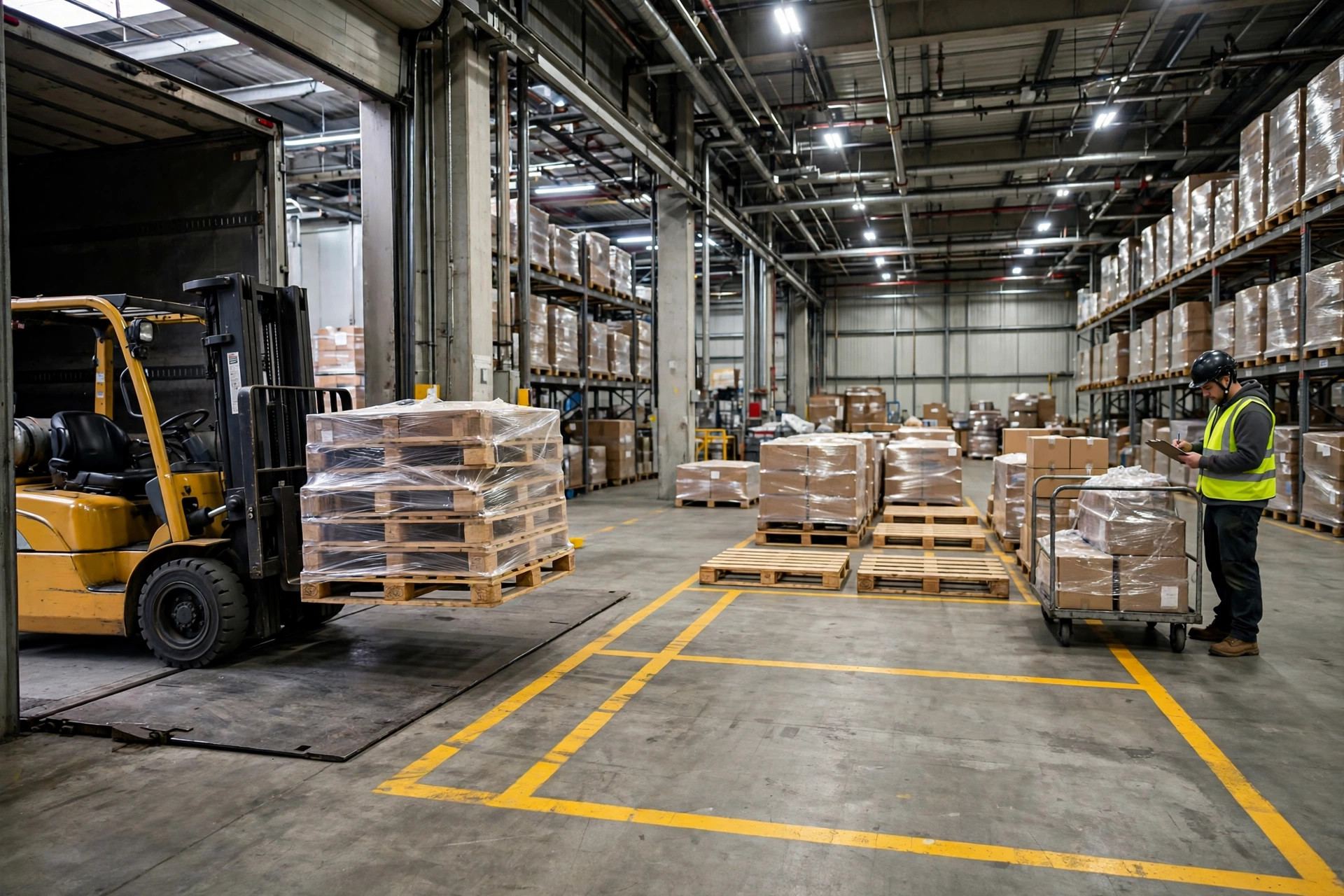
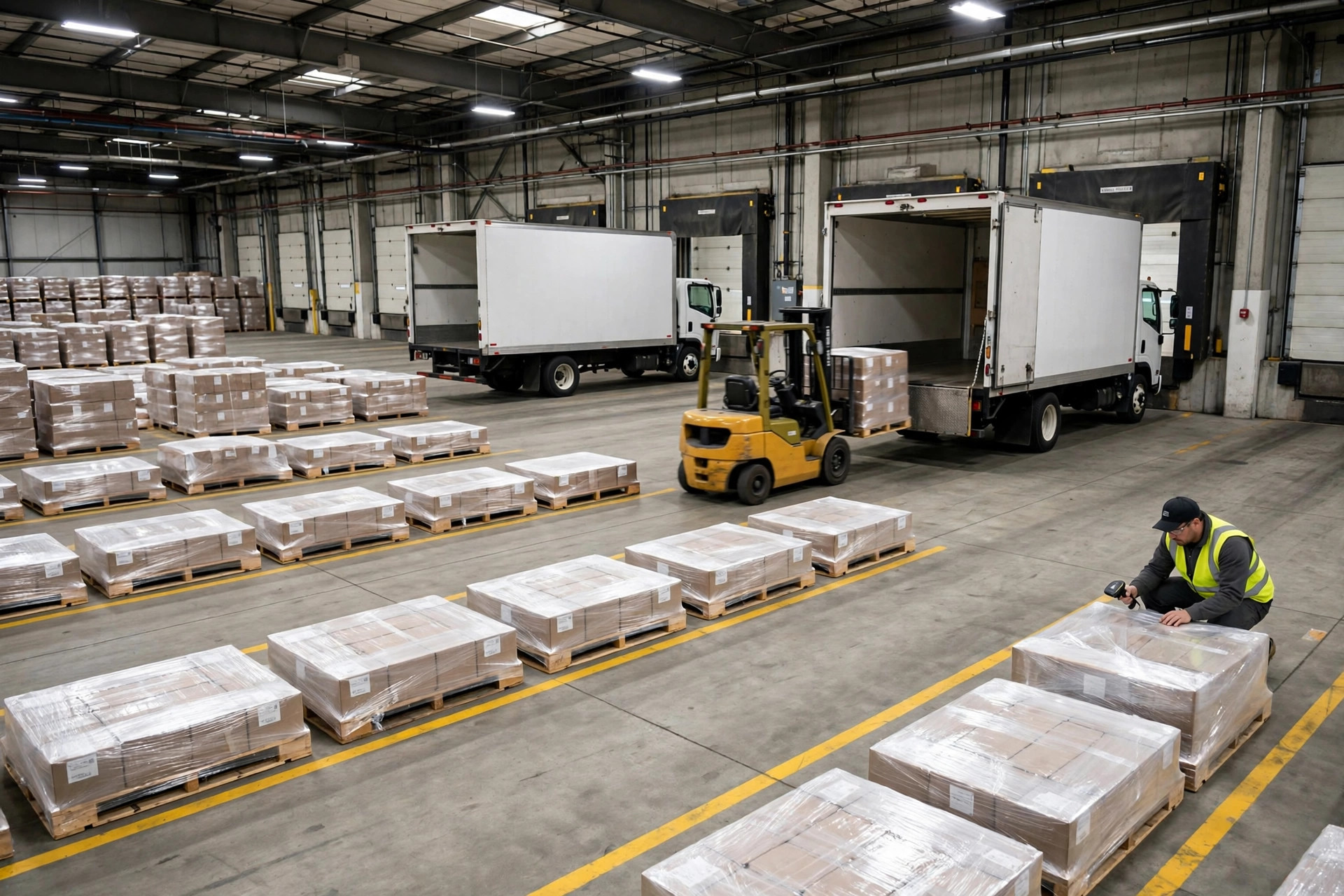
Staging is where distribution center layouts quietly fall apart. Staging has to be divided into marked lanes, one lane per route, carrier, or departure wave — and a lane is sized to hold one full truckload, no more. The moment a second load starts sharing a lane "temporarily," the mixing starts, and mixed staging is how freight gets loaded onto the wrong trailer.
Size the staging floor by your biggest wave, not your average hour. Example: your biggest evening wave is 6 trucks, a truckload is about 24 pallets, floor-staged pallets with working room around them take roughly 15 sq ft each. 6 × 24 × 15 ≈ 2,160 sq ft of marked staging lanes for that wave. If two waves overlap, the overlap is what you size for. Every lane gets a sign, a boundary on the floor, and one rule: when the lane is full, the wave is closed — freight for the next wave does not creep in early.
In the overall warehouse layout design from scratch sequence, shipping is the last zone you place but should be one of the first you size — exactly like its mirror image at the other end of the building, the warehouse receiving area layout, where the same lane discipline applies to inbound freight.
Put Checking and Labeling Between Packing and the Doors
The flow inside the shipping department should read in one line: pack, check, label, stage, load. The check-weigh-label station belongs after packing and before the staging lanes, with its own small buffer on both sides. Put it after staging — or worse, at the dock door — and every error found means a pallet dragged backward through outbound freight.
Two details matter here. First, the label printer and the carrier paperwork live at this station, not in an office down the hall; a missing label should cost thirty seconds, not a walk. Second, this is the last point where a wrong carton can be caught cheaply. Once it is on a trailer, the same mistake costs a redelivery, a chargeback, or a customer.
The Yard Is Part of the Layout
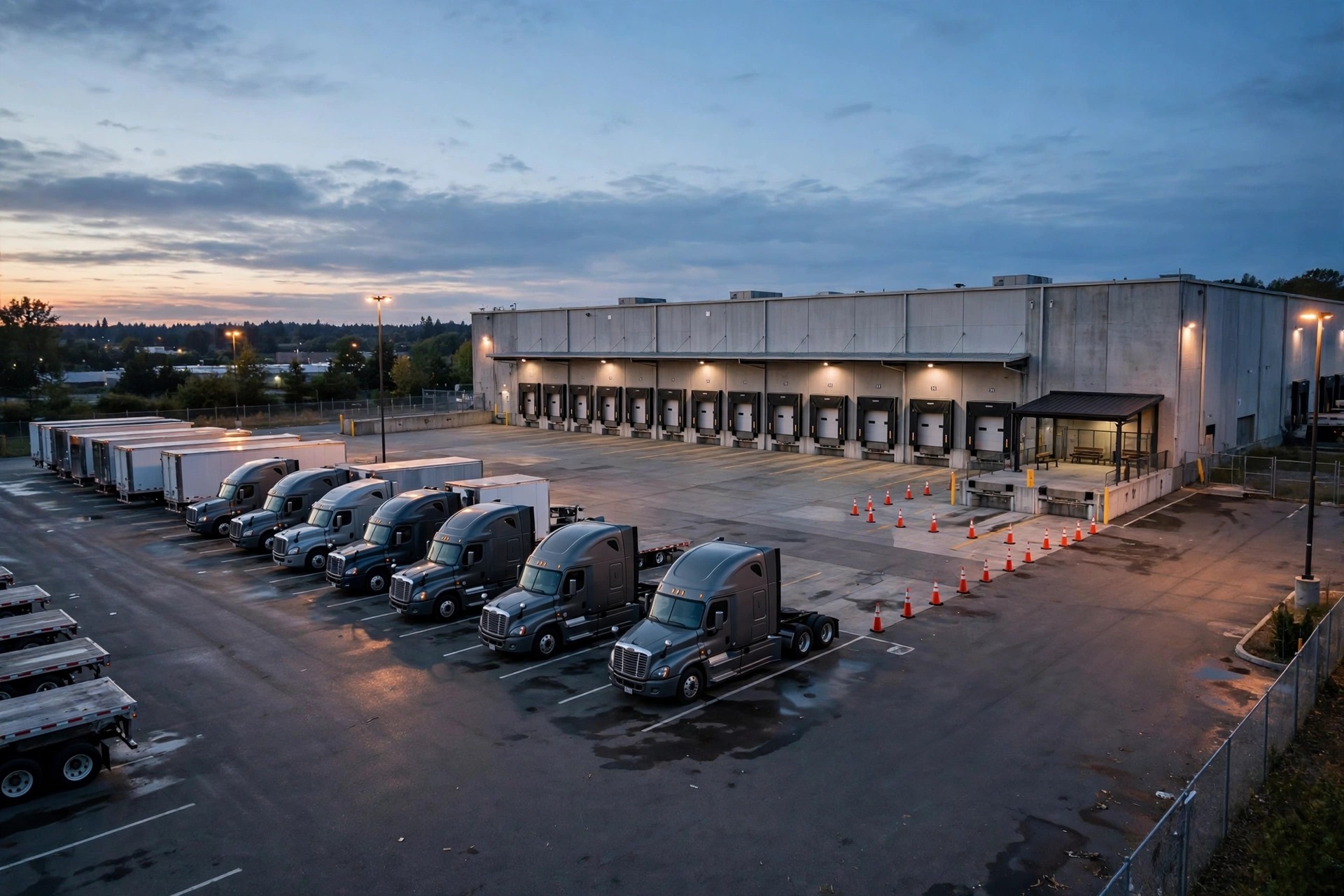
A dock door is only as good as the trailer that can reach it. If your yard forces trucks to reverse across each other's paths, or dropped trailers block the doors you need at peak, the building's door count is fiction. Give the yard one-way flow where you can, mark drop-trailer spots away from the working doors, and keep a clear lane from the gate to every door. When I review a shipping department layout, I walk the yard first — half the "dock problems" I get called about turn out to be yard problems wearing a dock costume.
Shipping Area Checklist
Before you call the shipping department done, walk this list:
- Door count sized by peak-hour turns, plus one spare door
- Staging lanes marked per route or wave, each lane sized to one truckload
- Staging floor sized for the biggest wave (or the biggest overlap of two waves)
- Check-weigh-label station sits between packing and staging, with buffer space on both sides
- One-way flow inside: pack, check, label, stage, load — no backward dragging
- Yard flow one-way where possible; drop trailers parked clear of working doors
- Fire lanes and door swing space never used as overflow staging
Draw the shipping department with the same respect you give storage. Storage holds your inventory, but shipping is where your promises leave the building — and it is the last place that should be living on leftovers.
By Chen Feng, Warehouse Operations Manager