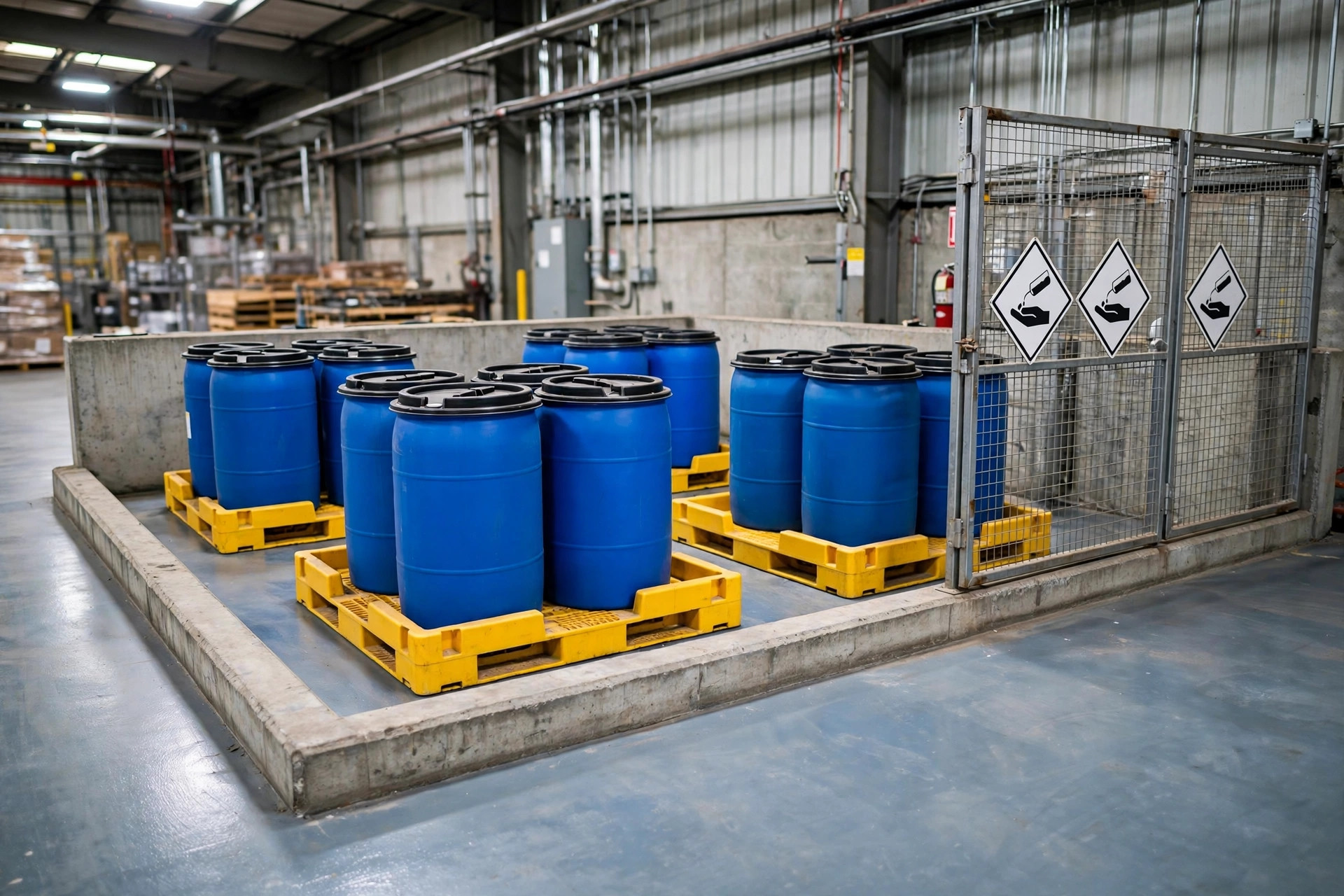
Start with the numbers. Last year the owner of an auto-parts 3PL asked me: a battery maker wanted to store electrolyte in his warehouse, an extra $80,000 a year in gross margin. Take it or leave it? Electrolyte is a DOT Class 8 corrosive material (49 CFR 173.136). Taking it in means a segregated zone, secondary containment, spill pallets, SDS binders on the floor, and HazCom training for everyone. I priced the retrofit for him: $110,000 minimum. His exact words: "That's money down the drain."
Not so fast. This piece runs the three sets of numbers that actually decide the question: what Class 8 compliance costs, what one non-compliant incident costs, and whether the business itself is worth it.
What the regulations actually require for corrosive storage
Class 8 corrosives (49 CFR 173.136) are acids and bases: sulfuric, hydrochloric, nitric acid, sodium and potassium hydroxide, battery electrolyte, sodium hypochlorite (bleach). OSHA's HazCom standard (29 CFR 1910.1200) requires a 16-section SDS for every chemical, and it has to be within reach on the warehouse floor — locked in an office drawer counts as not having one.
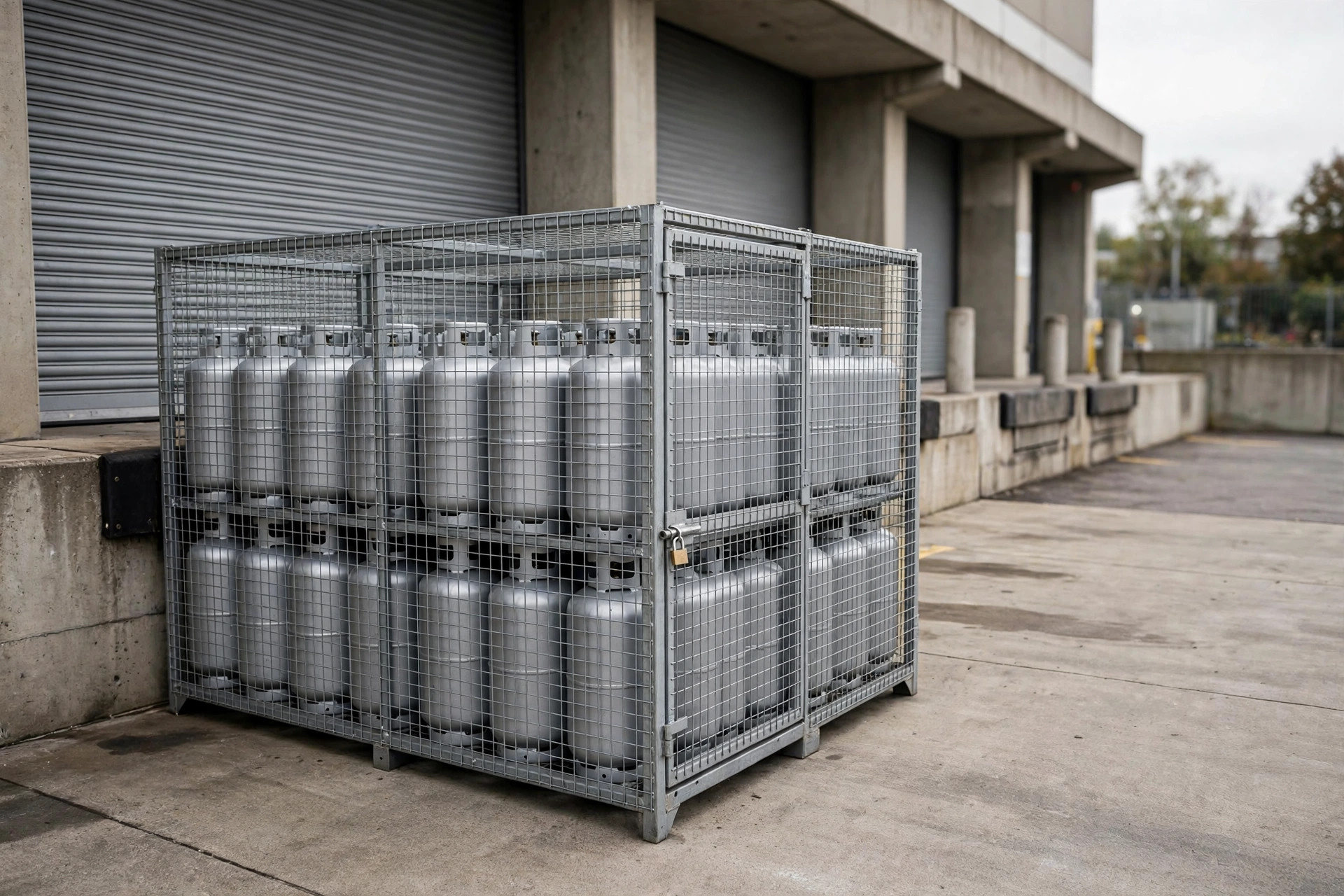
The rules cover three things: don't mix them with incompatible goods (segregated storage), don't let a leak travel (secondary containment), and make sure someone on site knows what to do (emergency response plus training). The containment number is not negotiable: EPA 40 CFR 264.175(b)(3) requires secondary containment sized to hold 10% of the total volume of all containers, or 100% of the largest single container, whichever is greater. Ten 55-gallon drums: 10% is 55 gallons, exactly one drum. Twenty drums: 10% is 110 gallons, so you build for 110. That is the federal floor; several states demand more. Check your state environmental agency's current rules before you build.
One more citation warehouses routinely miss: OSHA 1910.151(c) requires eyewash and emergency shower facilities wherever workers' eyes or bodies may be exposed to injurious corrosive materials. Inspectors love this one.
Set of numbers one: what does the retrofit cost
For a 200-pallet Class 8 zone, here is the typical build-out range (illustrative planning figures — get real quotes from your suppliers):
| Item | Scope | One-time cost |
|---|---|---|
| Acid-resistant floor plus berm | Epoxy floor, seamless containment berm | $30k–$50k |
| Spill containment pallets | About 40 sixty-six-gallon spill pallets | $12k–$18k |
| Acid/base partition | Physical partition walls | $10k–$20k |
| Ventilation plus eyewash | Explosion-proof ventilation, eyewash stations | $15k–$25k |
| Labeling plus SDS station | GHS labels, zone signage, one-page emergency cards | $3k–$5k |
| Worker training | HazCom training plus spill drills | $5k–$10k/year |
| Total | Roughly $80k–$120k |
Before you call that money down the drain, run the second set of numbers.
Set of numbers two: what does one incident cost
In 2023, a New Jersey 3PL stored a customer's sulfuric acid drums in a general racking area with no secondary containment. A night-shift forklift backed into one 55-gallon drum. Acid ran across the floor and into a storm drain. EPA showed up the next morning.
I reconstructed the bill afterward (post-incident estimate): an emergency cleanup contractor worked through the night, hazardous waste billed by the drum — roughly $90,000 for cleanup and disposal. OSHA wrote up multiple serious violations. For reference, the 2025 inflation-adjusted OSHA maximums are $16,550 per serious violation and $165,514 per willful or repeated violation (U.S. Department of Labor, January 2025); the numbers in force at the time were only slightly lower. The warehouse shut down for two weeks of remediation, plus customer claims and lost orders on top. Total damage: comfortably over $300,000 from one drum.
$300,000 versus an $110,000 retrofit. Which one is money down the drain? Here is my first counterintuitive call: compliance money has a price tag; non-compliance money is a lottery ticket.
Set of numbers three: is the business worth it
In 2024, a battery-recycling 3PL in Pennsylvania asked me to run the math before signing. The retrofit quote was $120,000. A three-year contract. $90,000 a year in gross margin. Payback: 120 divided by 90, about 16 months. They signed.
The second layer of the math matters more: within 200 miles, fewer than five 3PL warehouses could legally take Class 8. That is pricing power. Corrosive storage rates commonly run 40%–80% above general cargo (market range, negotiated case by case), and customer stickiness is extreme — switching warehouses means a fresh compliance audit, and nobody volunteers for that.
So the decision rule is one line: annual margin × contract years > retrofit cost × 1.5 → take it; otherwise walk away. The 1.5 is a risk factor covering training, drills, and higher insurance premiums. Pennsylvania: 90k × 3 = 270k > 120k × 1.5 = 180k. Take it. No drama.
The bill everyone forgets: you didn't know the corrosives were there
Here is the part that stings. Most 3PL corrosive incidents are not "we skipped the containment." They are "we never knew it was a corrosive." Customers ship in industrial cleaners containing sulfuric acid, or lead-acid batteries, as general cargo. Nobody checks the SDS at receiving. It sits mixed in general storage for three months. Class 8 next to oxidizers (Class 5.1) is a chain reaction waiting for a leak.
The fix costs an order of magnitude less: an SDS pre-screen at receiving. New SKU comes in, you demand the SDS first, flag it as hazmat in the system, and let the WMS lock down putaway rules. Software configuration money is pocket change next to a berm. The saddest "savings" I have seen: a beautiful containment zone, and the incident walked in through the receiving door.
Leak response, first steps — one page is enough
Nobody reads 16 SDS sections during a spill. Put one emergency card on the wall:
- Get people out, then go back in with PPE;
- Isolate the spill zone — do not hose it down (acid plus water generates heat);
- Ring it with absorbent socks, neutralize small spills;
- Call the emergency number — it is in SDS Section 1, printed on the card.
Drill quarterly. The drill is the best-spent part of the training budget: in a real incident, the crew's first reaction is the difference between a $30,000 problem and a $300,000 one.
The close: three sets of numbers, one table
| Account | Number |
|---|---|
| Compliance retrofit (200-pallet zone) | Roughly $80k–$120k, one time |
| One leak incident, total damage | $300k and up, no ceiling |
| Take-the-business rule | Annual margin × contract years > retrofit cost × 1.5 |
Corrosive warehousing is not a "can we do it" question. It is a "can we do the math" question. The retrofit cost is fixed, the incident cost is unbounded, and the business decision fits in one formula. Run all three before you sign, and the money stops feeling wasted.
By Lao Zhou, Logistics Cost Analyst