Bottom line first: doing family grouping right means exactly one thing — export 90 days of order line data, compute which SKUs consistently appear on the same order (that is the heart of warehouse slotting family grouping affinity), and slot high-affinity items into adjacent locations. Most warehouses that do this see a clear drop in travel distance per order. I have watched this fail three times, and every failure had the same cause: someone slotted by gut feel, grouping products that "looked like family," and the order data said they were strangers.
Why is order data more trustworthy than your intuition? Because human intuition thinks in categories, while orders think in scenarios. You believe shampoo belongs next to conditioner — fair enough. But the data might tell you shampoo's real soulmate is a travel-size bottle set, because that buyer is packing for a trip. Category thinking organizes shelves. Scenario thinking organizes orders. And pickers walk the order's path, not the category's path.
How to Compute Affinity: Three Numbers, All Required
Family grouping borrows its math from market basket analysis. Three metrics:
First, support: the share of all orders in which SKU A and B appear together. This tells you how common the pairing is.
Second, confidence: of the orders containing A, what share also contain B. This tells you how reliably B follows A.
Third, lift: actual co-occurrence rate divided by the expected rate if the two were independent. Lift above 1 means the pairing is real chemistry, not two best-sellers colliding by chance.
Why all three? Support alone will crown two blockbuster SKUs as "family" when they co-occur with everything. Confidence alone will surface nonsense like "yacht buyers also buy yacht wax" — pairs with trivial support. Together, the three filter down to genuine affinity. What thresholds? There is no universal answer. My starting advice: pick values that feel "not too loose" for both support and confidence, run two weeks, then tune. Thresholds are tuned, not computed.
Five Steps to Slot Your Family Groups
Step 1: Export 90 days of order lines and scrub three kinds of dirt. Pull order line detail from your WMS or OMS — you need at minimum order number, SKU, and order date. Scrub three things: returns (they reflect return logic, not buying logic), single-line orders (one SKU contributes zero affinity signal), and test orders plus internal issues. Ninety days is the empirical sweet spot: shorter windows get distorted by promotions, longer ones drag in dead seasonal pairings. For strongly seasonal categories, compute a separate peak-season version.
Step 2: Compute the three metrics for every SKU pair and rank them. In a warehouse with tens of thousands of SKUs, the pair space is astronomical, so subtract first: only compute for SKUs with movement in the last 90 days. Long-tail SKUs in the bottom half of velocity get slotted by category and skip the math entirely — re-slotting for items that ship a few times a year is wasted motion. Output one table: SKU A, SKU B, support, confidence, lift, sorted by lift.
Step 3: Human review against six hard constraints. The data finds chemistry; humans decide cohabitation. Six constraints, no exceptions: weight (heavy low, light high — a heavy item must never be hoisted overhead just to join its affinity partner), cube (don't force big and small into one slot), temperature zone (ambient and chill never share, no matter how deep the affinity), shelf life (short-dated items can't be slowed by a pairing), hazmat (chemicals and food stay separated — that's regulation, not preference), and fragility (fragile next to heavy is fine; fragile under heavy is not). Data proposes, constraints dispose.
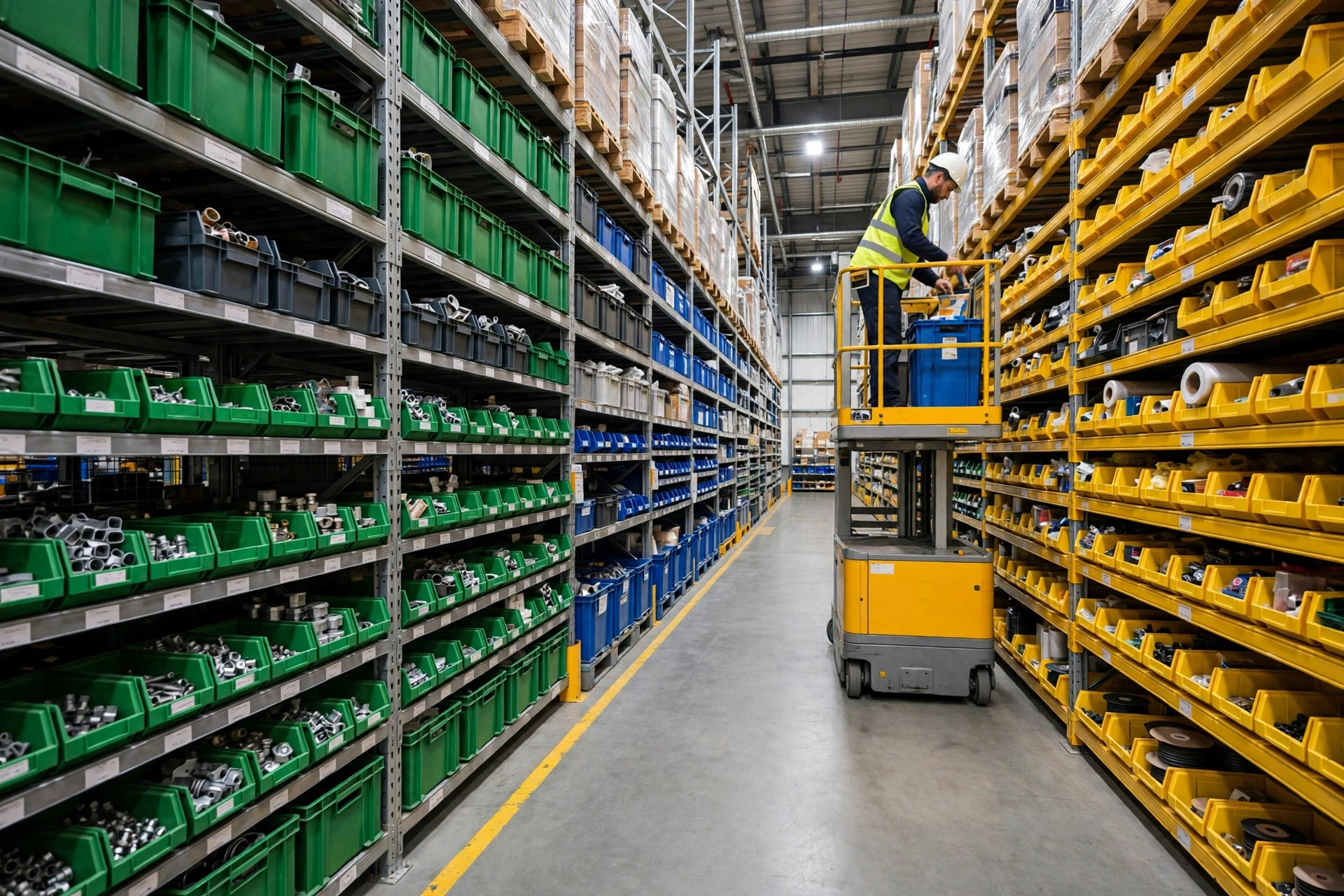
Step 4: The slot rule — high affinity goes adjacent, never in the same slot. This is the most important sentence in this article, and it is counterintuitive: no matter how strong the affinity, do not put two SKUs in the same location. Put them in adjacent locations — same aisle, same side, two or three steps apart. Why? Mixed SKUs in one slot force pickers to dig and sort, and mispicks spike. Adjacent slots mean one step and two reaches: both SKUs in hand, error rate unchanged. Then layer ABC on top: rank each family by weighted velocity for distance from the shipping dock, and give the family's fastest mover the slot closest to the aisle opening.
Step 5: Pilot for two weeks and watch exactly two numbers. Don't re-slot the whole building on day one. Pilot one aisle or one family for two weeks and compare two numbers before and after: aisles entered per order, and travel distance per order. Both down? Roll out. Not down? Go back and tune thresholds. Add one line to your go-live checklist: pull 20 random pilot orders, walk them in the new layout, and log every case where a picker entered an extra aisle for a single SKU. Each one is a family drawn wrong.
Two Project Stories: Affinity Wins and Warnings
November 2023, an auto parts warehouse in Rialto, California. Brake pads lived at the east end of Zone A; brake fluid at the west end of Zone C. Every order crossed the building. The data showed extreme confidence — over half of brake-pad orders also needed brake fluid. Five steps later, brake fluid moved to the aisle next to brake pads, and average aisles-per-order dropped by one. The warehouse manager's words: "We slotted by gut feel for three years. We should have run the numbers first."
March 2024, a pet supplies warehouse in Columbus — the cautionary tale. Cat litter and cat food had the highest affinity in the building, so the previous consultant slotted them into the same bay. The catch: 20-kilo bags of litter went on the upper level, and pickers lifted them overhead all day. Two back injuries in three months. The data was right; step 3 was skipped. The fix: litter moved to lower slots, food to the adjacent upper slots — neighbors, not roommates. Affinity answers "how far to walk." Ergonomics answers "how safely." Both must pass.
Common Failure Modes: I Have Seen This Three Times
Failure one: writing seasonal pairings into permanent slots. Gingerbread and gift boxes show explosive affinity in December, so someone locked them together forever. By January the gingerbread was delisted and a golden slot sat empty for three months. Fix: keep seasonal families in a separate seasonal slot group — move in two weeks before the season, move out one week after, never into permanent slots.
Failure two: setting thresholds once and never revisiting. Pairings change: new launches, delistings, promo strategy shifts — the affinity ranking reshuffles. Fix: recompute quarterly, and trigger a partial re-slot when family membership changes by more than roughly a third. Put the recompute in the SOP instead of relying on memory.
Failure three: dragging a hero SKU away from the golden zone for "family completeness." One warehouse's number-one SKU shipped mostly as single-item orders — it needed no family at all. Someone moved it from its golden slot by the dock to "reunite" it with its relatives, and single-item pick travel got longer. Fix: check order shape first. High-frequency single-item SKUs always get golden-zone priority and skip family logic entirely. Only SKUs with meaningful multi-item order share enter family grouping.
One last counterintuitive truth: the goal of family grouping is not "stored together" — it is "walked less." Any grouping that adds a single step to a picker's route is wrong, no matter how beautiful the numbers look. The data tells you who belongs with whom. The slots decide whether that belonging is worth walking for.
By Lin Xiao, WMS Implementation Consultant