Bluntly put, the February 2021 freeze taught me one thing: in Texas, winter is more dangerous than summer — and every warehouse needs a winter emergency checklist.
People think of Texas as a "hot" place — warehouses worry about summer heat and hurricanes. But in February 2021, a polar vortex dropped south and all 254 Texas counties went under winter storm warning at the same time. Not one county was spared. The grid couldn't take it: 4.5 million homes and businesses lost power, some for three or four days. A later University of Houston survey found 69% of Texans lost power for an average of 42 hours, and nearly half went without running water for more than two days. The Texas health department's final count: 246 dead. The Dallas Fed estimated the economic damage at $80 to $130 billion.
And the warehouses? I have seen too many of them go dark during those days. This is a winter emergency checklist for warehouses, written by someone who lived through it. Power, pipes, inbound — three things, one at a time.
The Pit I Watched: Three Days Without Power, How a Warehouse Dies
Let me tell you about one I saw up close. An auto-parts 3PL warehouse outside Dallas, 120,000 square feet, lost power in the early hours of February 15, 2021, and didn't get it back until the 18th. Once the power went, everything cascaded.
First the forklifts. The electrics couldn't charge; batteries lasted a day and a half, then everything sat dead by noon on day two. The diesels? It was in the teens outside, the fuel gelled, and they wouldn't start. Then the systems. The WMS servers rode the UPS for four hours, then went black — no pick tickets, no receiving, everything on paper. The worst came on day three: a sprinkler main froze and split in the corner by the dock doors, where the temperature had been below freezing for days with the doors cycling open and shut. When power came back and pressure returned, half the receiving area flooded.
Look at it from both sides. On one side, an act of God — nobody planned for Texas getting that cold. On the other, human failure: that warehouse owned a generator that had never been load-tested in five years. When the ice storm hit, it started up fine, ran 20 minutes under load, and tripped on overheat protection. The owner told me later it was the most expensive piece of scrap metal he'd ever bought.
Bluntly: the outage itself isn't what kills you. What kills you is discovering your "plan" was never a plan.
Winter Emergency Checklist, Item One: Power
Power is the first item because in extreme cold, an outage isn't "the lights went out" — it's the whole operation stopping.
Question one: has your generator ever been load-tested? Plenty of warehouses test their generators on no-load all year and never once under real load. No-load and loaded are different animals — cooling, fuel delivery, voltage stability, all of it. Every fall before winter, run a full-load test for 30 minutes and log it. A generator that has never carried full load is the same as no generator.
Question two: how many days of fuel? A generator's day tank usually holds 8 to 12 hours. During an ice storm, gas stations lose power too and fuel trucks may not get through. Put it on the checklist: minimum 72 hours of fuel on hand, the supplier's number taped to the wall, and the moment an extreme-cold warning drops, call and lock in a fuel delivery.
Question three: is the transfer switch automatic? A manual switch means someone has to walk out there and throw it — at 3 a.m., in the teens. An automatic transfer switch isn't expensive, but in the moment it decides whether you "flicker" or "go black for three days."
One more that's easy to miss: a UPS protects servers and network gear, not the whole building. Rank your loads on one page — WMS servers, access control, cameras — and decide in advance who gets the UPS power first.
Winter Emergency Checklist, Item Two: Pipes — Hold the 40°F Line
The second-biggest warehouse killer in a freeze is burst pipes. NFPA 25 is explicit: areas containing water-filled sprinkler piping must be maintained at a minimum of 40°F (about 4.4°C). Below that, water freezes, expands, and the pipe splits.
The spots that freeze are never the middle of the storage area. They're the corners: beside the dock doors (every cycle pumps cold air straight in), the shipping and receiving aprons, unused rooms, where the roof meets the exterior walls. The Dallas warehouse that flooded burst exactly there — beside a dock door nobody had ever worried about.
Three defenses against frozen pipes. First, insulation plus heat trace: wrap exposed piping, put electric heat trace on critical runs, energize it before the extreme-cold warning hits. Second, patrols: during the freeze, walk the weak spots at least twice a day with an infrared thermometer; anything under 45°F gets handled. Third, don't trust dry systems either: dry sprinkler pipes hold compressed air, but condensate pools in the low points, freezes, and splits pipe just the same — drain every low-point valve before winter.
I have seen too many people treat "frozen pipes" as a small thing. Here's a number: water expands about 9% when it freezes, and that 9% is enough to split steel pipe. One burst main can flood an entire rack area. Whether insurance pays is one question; your customers' trust is another, and that one you can't buy back.
Winter Emergency Checklist, Item Three: Inbound — Build the Plan 72 Hours Out
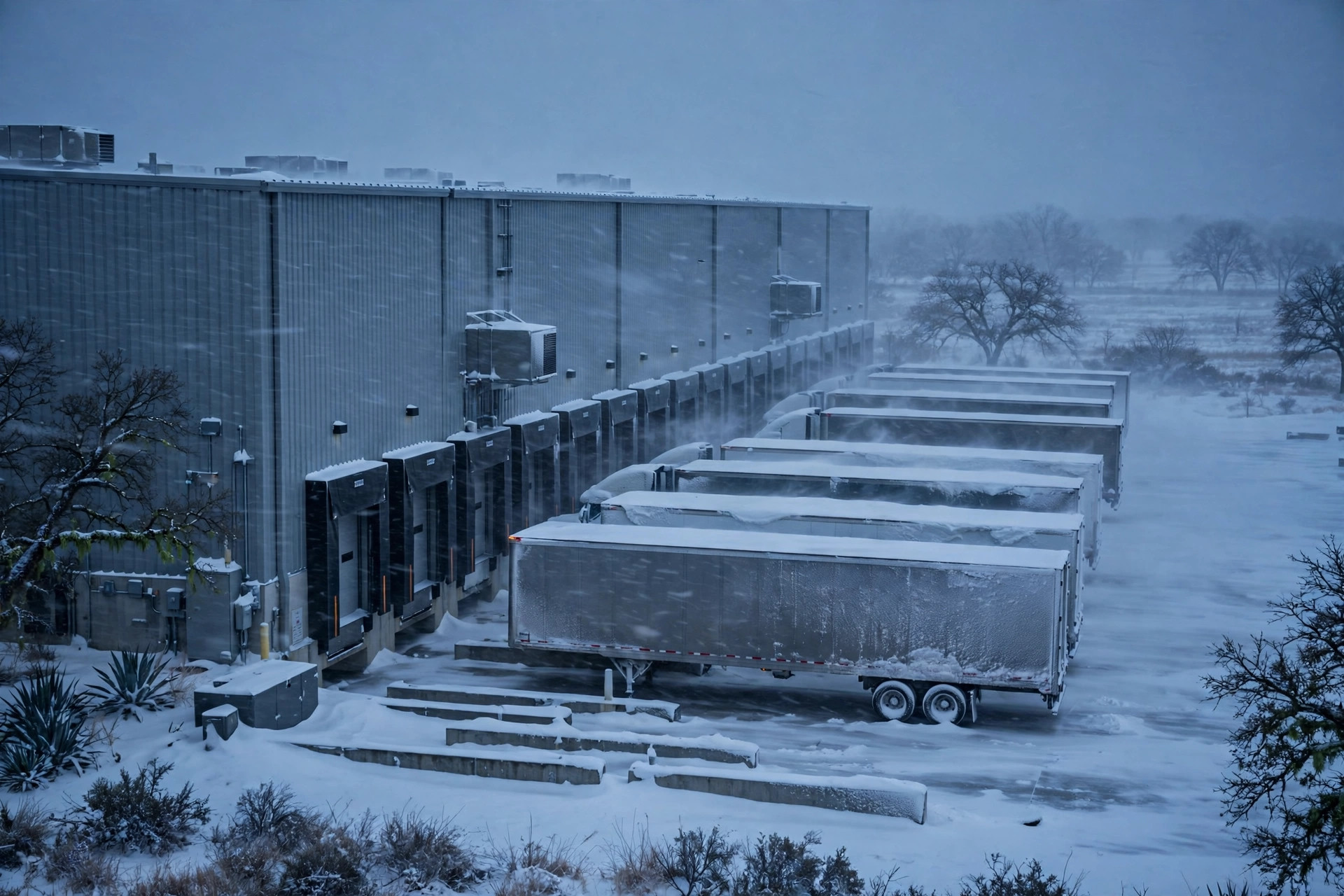
In 2021, Texas highways shut down across the state. Drivers couldn't move, fleets parked. You can do something about your own power, but the freight on the road is out of your hands.
The inbound plan boils down to "72 hours ahead." The moment the weather warning drops, do four things. First, call every supplier and carrier with freight en route, confirm where the trucks are, pull forward what can come early, reroute what can reroute. Second, list temperature-controlled freight separately — every extra day a reefer sits on a closed highway, the loss compounds; reroute it on a pricier expedited lane if you have to, because that money you cannot save. Third, safety stock: ahead of freeze season, push critical SKUs one to two weeks higher — you're buying time with inventory. Fourth, keep a backup carrier list alive year-round; if you start looking for trucks the day of the storm, you won't find one at triple the rate.
Look at it from both sides: the closed roads are an act of God, but "we didn't know where the freight was, couldn't reach the driver, nobody owned the reefer" is a management failure. Since 2021, several Texas 3PLs I know added one rule: every November, refresh the winter emergency contact list — suppliers, carriers, generator service, plumbers, every one of them. The list is paper; the people are real; when it counts, you need to reach a human.
One Line to Close
It's been five years since the freeze, and Texas has hardened its grid since. But the next extreme cold won't RSVP. A plan's value isn't in how thick the binder is — it's whether, in the moment the power dies, someone knows what step one is.
So don't wait. Can your warehouse run 72 hours without grid power? Go crank up the generator right now, run it under load for half an hour, and you'll have your answer.
By Lao Mi, Supply Chain Veteran (20 yrs)