Let me do the math first.
Say you ship 1,000 pallets a month, and each pallet sits in your account for 20 days on average. Go with pallet pooling: at the middle of the industry's published ranges, that's a $4 issue fee, plus 20 days × $0.10 daily hire, plus a $2 transfer fee — $8 per pallet per trip, $8,000 a month. Buy your own: a used grade A 48×40 pallet lists at $7.90 (pallet price index, October 1, 2026), so 1,000 pallets cost $7,900, once.
$8 to rent once, $7.90 to own outright. Buying looks like the winner — but the math has barely started. The hidden traps of renting and the invisible costs of owning are all still ahead.
What pallet pooling actually charges you
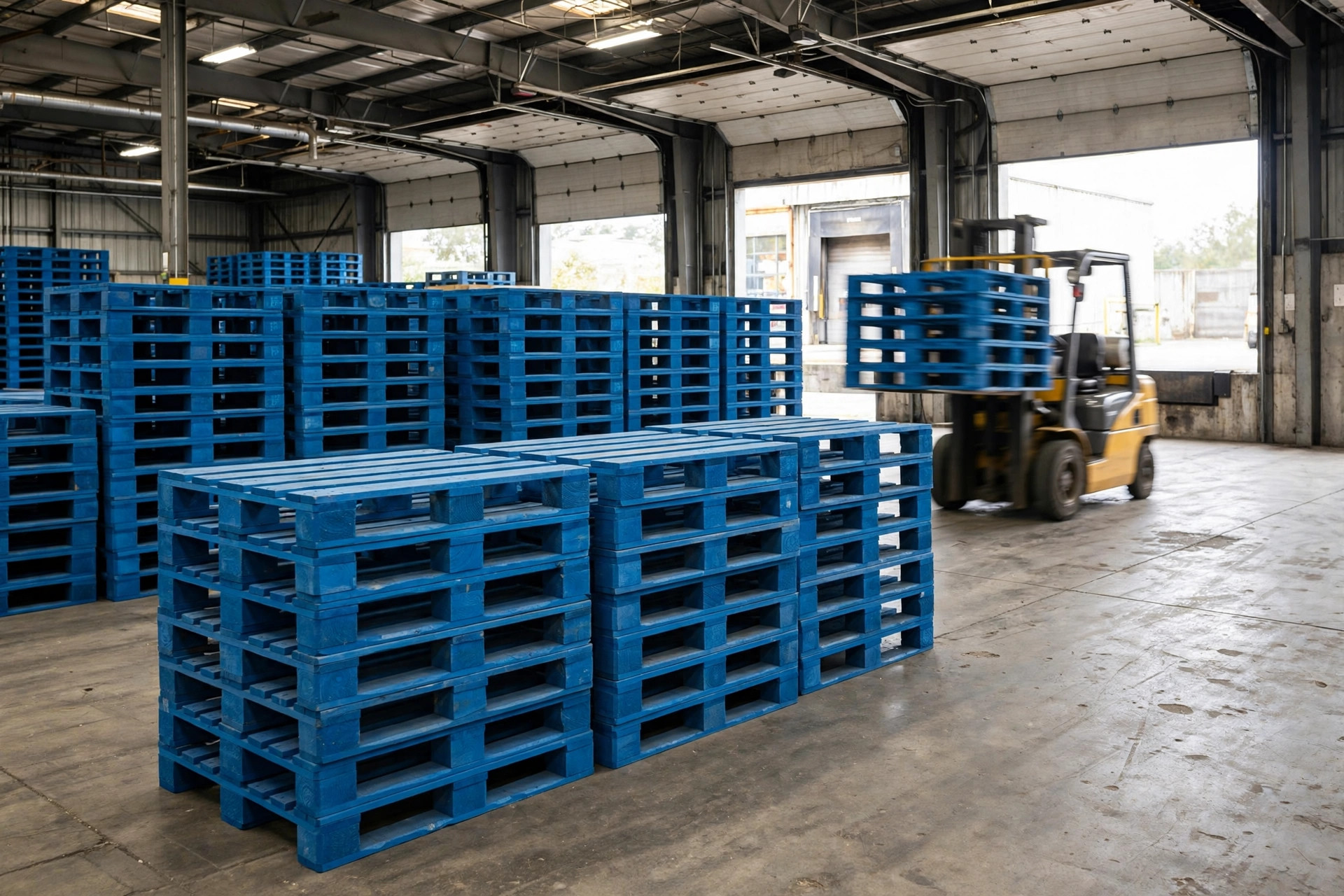
Pooled pallets (CHEP's blue, PECO's red) are never sold, only rented. CHEP's fee structure is three charges plus one sledgehammer. Rates are negotiated contract by contract — neither pooler publishes a price list — but the industry ranges look roughly like this:
- Issue fee: each pallet delivered to you, about $3–5
- Daily hire: each day a pallet sits in your account, about $0.035–0.20
- Transfer fee: moving pallets out of your account when you ship them on, about $1–3.50
- Lost-pallet charge: pallets you can't account for, about $50–55 each
One detail most people miss: the daily-hire clock doesn't stop when the pallet reaches your customer. It stops when you declare the transfer and the pallet leaves your account in the pooler's system. Goods arriving three days early saves you nothing; declaring three days early does. Plenty of companies pay daily hire on pallets that left their dock weeks ago because nobody filed the transfer.
PECO plays it differently: no issue-plus-hire combo, just one flat all-in rate per pallet, so you know the trip cost when you order. PECO doesn't publish the number — check their current policy before you budget.
Buying pallets: the real TCO
Three tiers. Per the October 1, 2026 price index: used grade B 48×40 at $6.00, grade A at $7.90, new at $18.81. Plain white-wood pallets run $5–12 apiece, per PECO's court filings.
But "what does one cost" is not TCO. The full cost of an owned pallet is:
purchase price ÷ average reuses + repair cost per trip + loss rate + management overhead
A $6 grade B looks cheap until it survives only a few turns — broken boards and missing blocks mean repair or scrap. A new $18.81 pallet is sturdy, but ship it one-way to a customer outside any pool and that $18.81 becomes a single-use cost. The biggest line item in owned-pallet TCO is never the purchase price. It's the pallets that don't come back.
The TCO table, then the verdict
Same basis for both options (1,000 pallets/month, 20 days in account, rental at mid-range):
| Cost item | Rent (CHEP mid-range) | Buy used grade A | Buy new |
|---|---|---|---|
| Cost to acquire | approx. $4 issue fee | $7.90 (one-time) | $18.81 (one-time) |
| Holding cost | approx. $0.10/day daily hire | $0 | $0 |
| Cost per trip (20 days) | approx. $8.00 | $7.90 ÷ reuses | $18.81 ÷ reuses |
| Lost/damaged | $50–55 penalty each | $7.90 lost each | $18.81 lost each |
| Repair | Pooler handles it | On you | On you |
| Quality | Uniform 4-way block pallet, 2,800 lb rack rating | Depends on grade, and luck | Built to spec, consistent |
| Admin | Transfer declarations, account reconciliation | Cycle counts, repair, replenishment — all yours | Same |
The row that should stop you cold is "lost/damaged." Lose one blue pallet and the $52 penalty equals six to seven normal rentals ($52 ÷ $8 ≈ 6.5). Whoever manages your pallets isn't managing pallets. They're managing penalties.
Case one: the customer mandates blue pallets — there is no decision
In 2024, a food distributor in Ontario, California — a 3PL serving grocery chains — had a major customer write CHEP blue pallets into the contract: no blue pallets, rejected at the dock. About 2,000 pallets a month, 25 days in account on average.
The math: $4 issue + 25 × $0.10 + $2 transfer = $8.50 per pallet, roughly $17,000 a month in rental. That's $204,000 a year — enough to buy more than ten thousand new pallets outright. None of it is avoidable.
When a customer mandates pooled pallets, the rent-vs-buy question cancels itself. You're left with one arithmetic problem: how to rent as cheaply as possible. Only three levers exist: cut days in account, declare transfers the day you ship, and drive losses to zero. This distributor moved transfer declarations from weekly to daily — that single change cut their daily-hire bill by roughly twenty percent a year.
Case two: renting pallet pooling for one-way lanes means buying pallets at 8x the price
In 2025, an auto-parts exporter in Dallas, Texas shipped to Mexico and a long tail of small distributors — all outside any pallet pool. Pallets went out and never came back.
Rent from CHEP: every pallet out the door counts as lost, $50–55 each. Buy used grade B: $6.00 each, gone for good, cost is $6.
Six dollars versus fifty-two. Renting pooled pallets for one-way lanes is the most expensive row in the entire table — you're effectively buying pallets you don't own at more than eight times the price. That's money spent for nothing.
Stray blue pallets on your dock: not an asset, a liability
Pallets show up mixed into an inbound delivery — a few dozen blue ones that aren't yours. First the verdict: you can't sell them, and you can't throw them away.
Blue pallets are CHEP's property no matter whose warehouse they're sitting in. California law (Bus. & Prof. Code § 21609.7) bars recyclers from buying marked pallets from anyone but the owner, and in September 2026 CHEP won a federal case in the Eastern District of California (CHEP USA v. SCC Pallets), with the court dismissing the pallet company's counterclaims outright. Poolers do sue.
The right handling, in four steps: sort them out and stack by pooler — blue, red, black plastic — separate from your own stock; count them; contact the pooler to arrange collection (CHEP through its site or customer service, PECO via an online pickup request once you have a full load); keep them dry and forklift-accessible until pickup. Never mix them into a load you're selling to a recycler — one blue pallet can get your whole trailer held.
That stack of blue pallets isn't an asset. It's a liability occupying your floor space. Return it fast and stop the bleeding.
The contrarian take: pooling doesn't sell pallets, it sells certainty
Most people frame this as "which is cheaper, rent or buy." Wrong question. These are two different products:
- Renting sells certainty: guaranteed quality (uniform 4-way block pallets), guaranteed recovery (the pooler collects and repairs), guaranteed compliance (when a big customer demands blue pallets, you have them).
- Buying sells optionality: the pallets are yours — ship anywhere, one-way, export, closed loop, no declarations to anyone.
The most expensive operator is the one who rents and still loses pallets: no certainty (the operation is a mess), no optionality (the pallets aren't theirs), and in the end "buying" other people's pallets at $52 apiece. Rent or buy — first ask whether you can control your pallets at all. If you can't, both options burn money.
The ending: a conclusion you can calculate
Memorize this formula and plug in your own numbers:
Cost per rental trip = issue fee + (days in account × daily hire) + transfer fee Cost per owned trip = purchase price ÷ average reuses
Rent wins ⟺ issue fee + (days × daily hire) + transfer fee < purchase price ÷ reuses
Two ready-made answers:
- One-way shipments (never coming back): owned cost per trip is just the purchase price. At mid-range values, renting wins ⟺ days in account < 19. Past 19 days in account on a rental, you're better off buying used.
- Closed-loop reuse: a used grade A reused 4 times costs $1.98 per trip — far below the approx. $6 floor of a rental trip. Reuse twice or more and buying used crushes renting.
And three numbers to stop guessing about: the lost-pallet penalty is $50–55 each (about 6.5 rentals); the hire clock stops when you declare the transfer, not when the truck leaves; PECO's flat rate isn't published — get a quote and check their current policy before you commit.
Once this math is done, the answer isn't in the words "rent" or "buy." It's in your three numbers: days in account, reuses, and loss rate. Find those three numbers and the formula decides for you.
By Lao Zhou, Logistics Cost Analyst