There is a pattern in Greece olive oil export warehouse storage worth pausing over. Oil from large bulk plants and oil from small mills and cooperatives follow almost entirely different storage logics. The first competes on scale and turnover. The second competes on identity and flavor. Oil from the small mills of Crete and Kalamata belongs firmly in the second group: its value does not lie in volume, but in whether it can prove where it comes from, which grade it belongs to, and whether light and heat have damaged it between pressing and bottling. Storage, in this context, is not merely holding stock. It is a value-preserving operation.
This article examines that second logic: how small-mill oil is graded, how it is stored away from light and heat, which containers and pack formats suit it, and how small lots are consolidated for export.
The Phenomenon: Two Greece Olive Oil Storage Logics in One Product
The starting observation is straightforward. Bulk oil is stored to move: large tanks, standardized handling, fast turnover. Small-mill oil is stored to be identified: separate tanks by grade and batch, records tying each tank to a pressing date and a place of origin, and packaging that carries that identity to the buyer. The warehouse work looks similar from the outside, but the thing being protected is different. In one case it is throughput. In the other it is provenance.
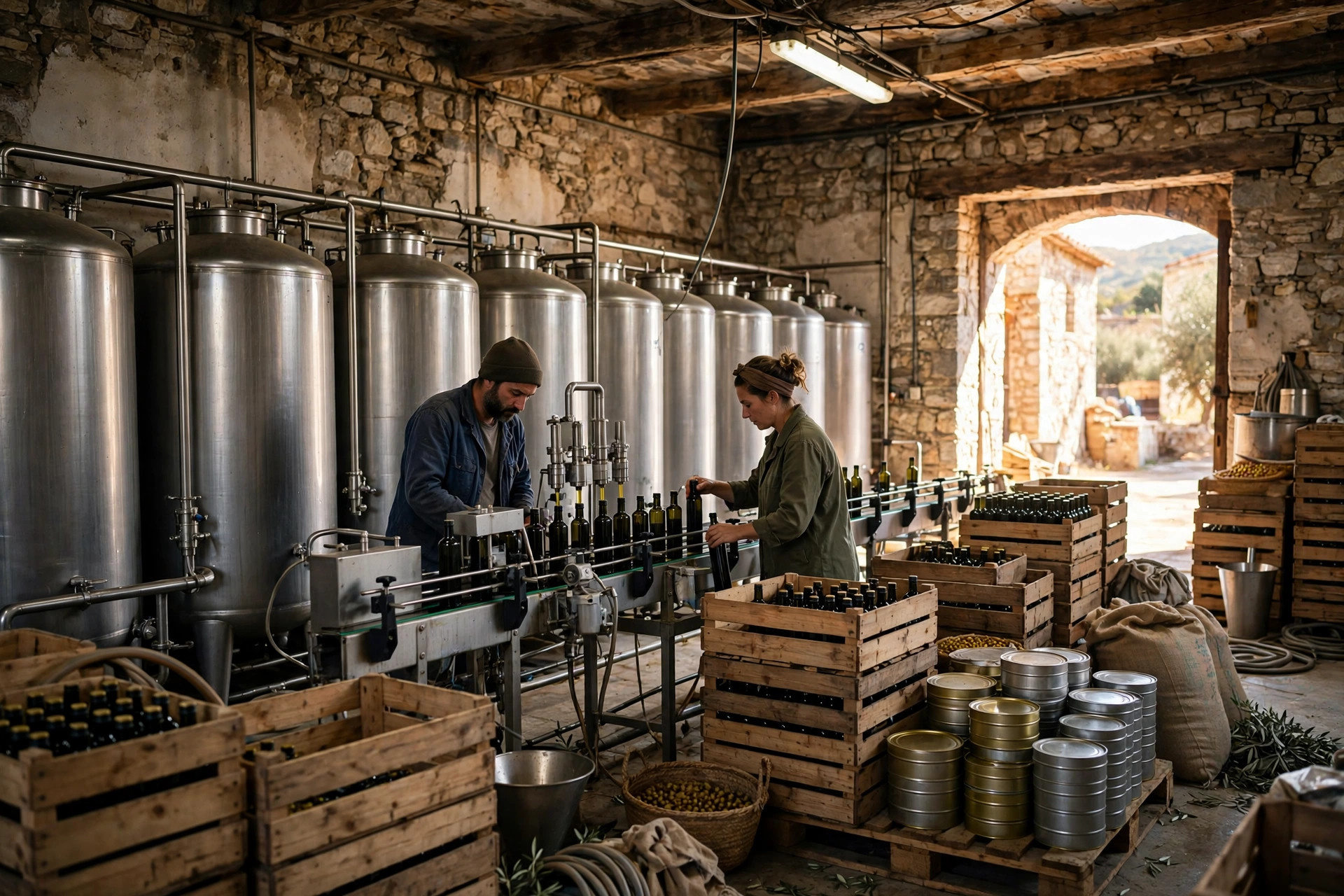
A typical cooperative in Crete illustrates the small-mill approach. Oil pressed during the harvest season is sampled and graded first, then stored in separate tanks by grade, each tank carrying a batch record of its pressing date and source groves. When a buyer orders a particular grade, the warehouse manager locates it from the records without opening tanks to check. A small mill near Kalamata follows the same logic at a smaller scale, sometimes with only a handful of tanks for a whole harvest season and a handwritten ledger as its record system. The tools differ. The principle does not: a warehouse that cannot say which grade sits in which tank will eventually pay for that ambiguity, either by shipping the wrong oil or by having a buyer send it back for re-grading.
This leads to an attribution that is easy to miss. A large share of small-mill storage cost is not spent on tanks and buildings at all. It is spent on proving identity: batch records, grading checks, and origin documentation. If any of those links is missing, the oil's identity in the export market is incomplete. A warehouse that manages storage but not certification has left its most valuable asset outside the warehouse door.
Greece Olive Oil Export Warehouse Storage and the Two Enemies: Light and Heat
The core constraints of olive oil storage reduce to two factors: light and heat. Light accelerates oxidation and degrades flavor. Heat damages quality in ways that are generally irreversible. Warehouse layout and daily routines should be designed around both: no direct sunlight on storage areas, tanks kept away from heat sources, and particular attention to ventilation and shading during hot summer periods.
Stainless steel tanks are the most common storage choice for small mills and cooperatives, for reasons that are easy to explain. The material is stable, does not readily react with oil, seals well, and makes it practical to keep grades and batches apart. Some tanks are blanketed with inert gas to limit contact with air and slow oxidation further. Pack formats then depend on the export route. Dark glass bottles suit retail markets: they block light and present the origin identity well. Tinplate cans are light, protect against light, and suit channels sensitive to weight and breakage. Large bulk formats suit buyers who will repackage or process the oil, but they place higher demands on the buyer's own repackaging capacity and on traceability.
A useful contrast, stated qualitatively, is between the Greek small-mill model and the Spanish bulk-tank model. The Spanish model's strength lies in scale and turnover: large tanks, batch handling, and standardized flows that spread unit logistics costs thinly. The Greek small-mill model's strength lies in identity and flavor: small lots, graded and tanked separately, with a clear geographic origin that can support a premium for high-grade oil. Neither model is superior in the abstract. The question is fit. Buyers chasing scale suit the first; buyers chasing origin identity and a specific flavor profile suit the second. Forcing small-mill oil into a bulk-tank logic may save freight while surrendering exactly what made that oil valuable in the first place.
| Oil grade | Storage requirement | Suitable export format |
|---|---|---|
| Extra virgin | Separate tank, light- and heat-proof, complete batch record | Dark glass bottles, tinplate retail packs |
| Virgin and other grades | Tanked by grade, never mixed with higher grades | Retail packs or bulk for repackers |
| Refined and lower grades | Managed separately by use, clearly labelled | Processing and repacking channels |
Greece Olive Oil Export Consolidation and PDO Protection: Making Small Lots Shippable
The most practical export route for small lots is consolidation: several small shipments combined into one container to share ocean freight. The logic is simple, but it raises the bar for warehouse discipline. Before dispatch, every shipment's batch, grade, pack format, and shipping marks must be checked, because separating mixed cargo after consolidation is far more expensive than checking it beforehand. The consolidation warehouse's cutoff time, its stacking method, and its light and temperature conditions should all be confirmed before booking, not discovered at the port.
PDO protection deserves separate treatment. PDO is the European Union's protected designation of origin system: only oil meeting the official rules on origin, variety, and production method may carry a protected origin name. For warehousing, the practical consequence is that records must match the claim. Where the oil came from, where it was pressed, and how each batch was stored must correspond, lot by lot, to the declared origin name. Where the records do not line up, the origin name does not stand, and buyer confidence falls with it. The specific rules should be checked against the latest official EU provisions before export.
Two trends are worth tracking. First, traceability requirements are tightening: batch records and credible grading are shifting from a selling point to a condition of entry. Second, consolidation and flexible shipping arrangements are maturing, so small lots are no longer dependent on full-container shipment alone. Together, they point toward a single judgment: the small-mill warehouses that will matter most are not those with the largest tanks, but those with the clearest records and the most credible grading.
How far this divergence goes remains an open question. It will depend on two variables: whether major import markets continue to deepen their recognition of origin identity, and whether small mills and cooperatives can keep batch management affordable at their scale. Neither variable is settled yet, and both are worth watching through the next harvest season.
By Dr. Chen, Supply Chain Researcher