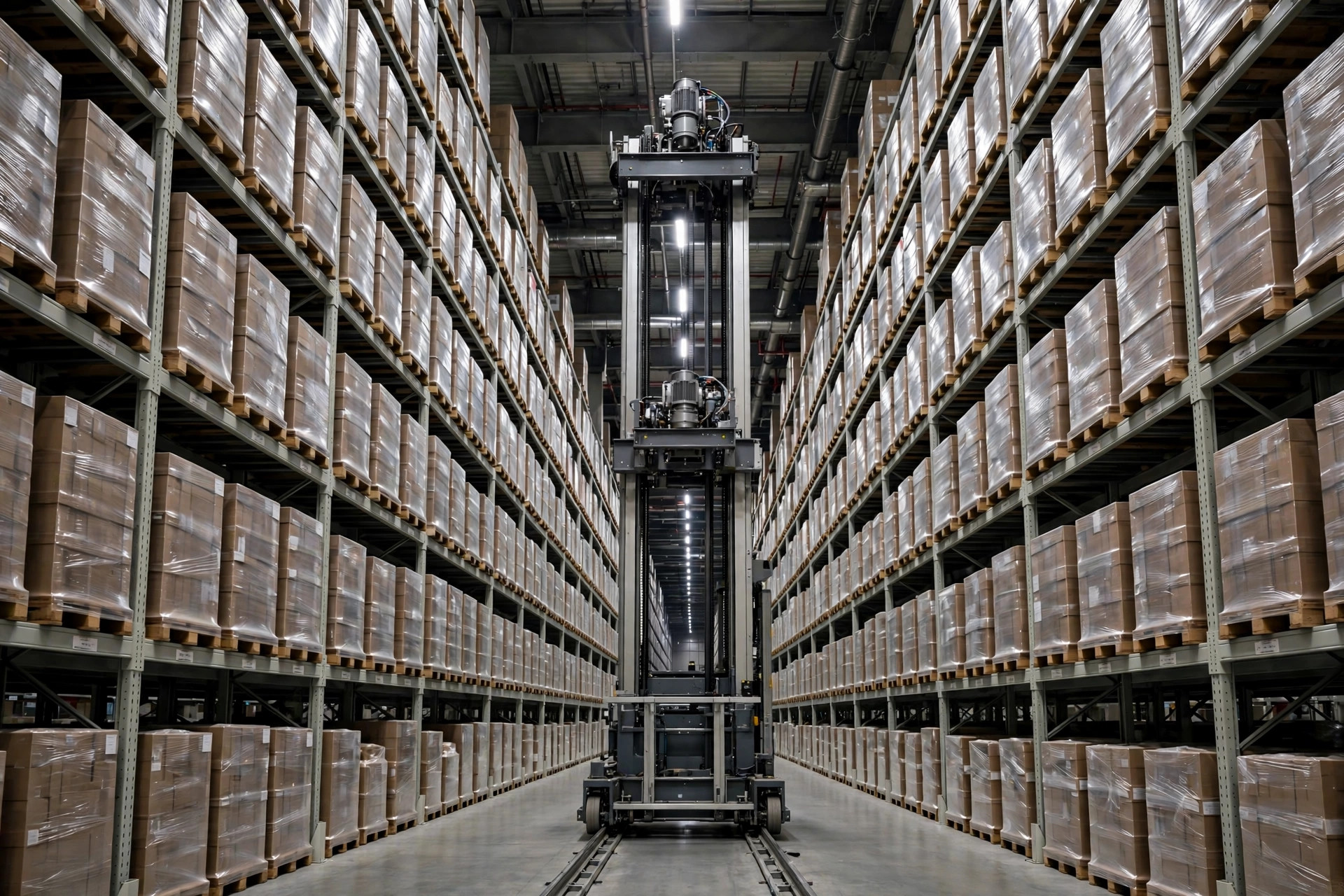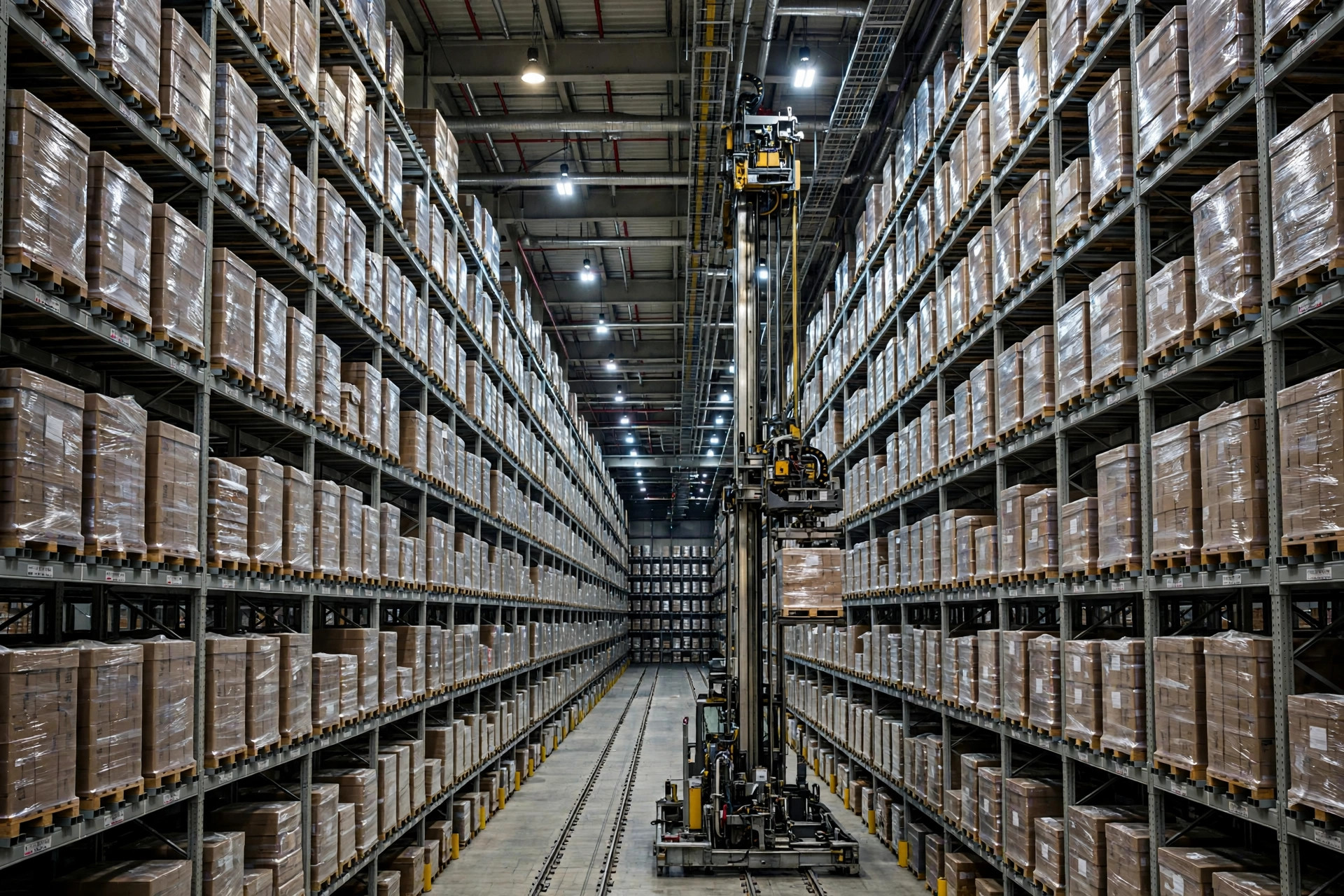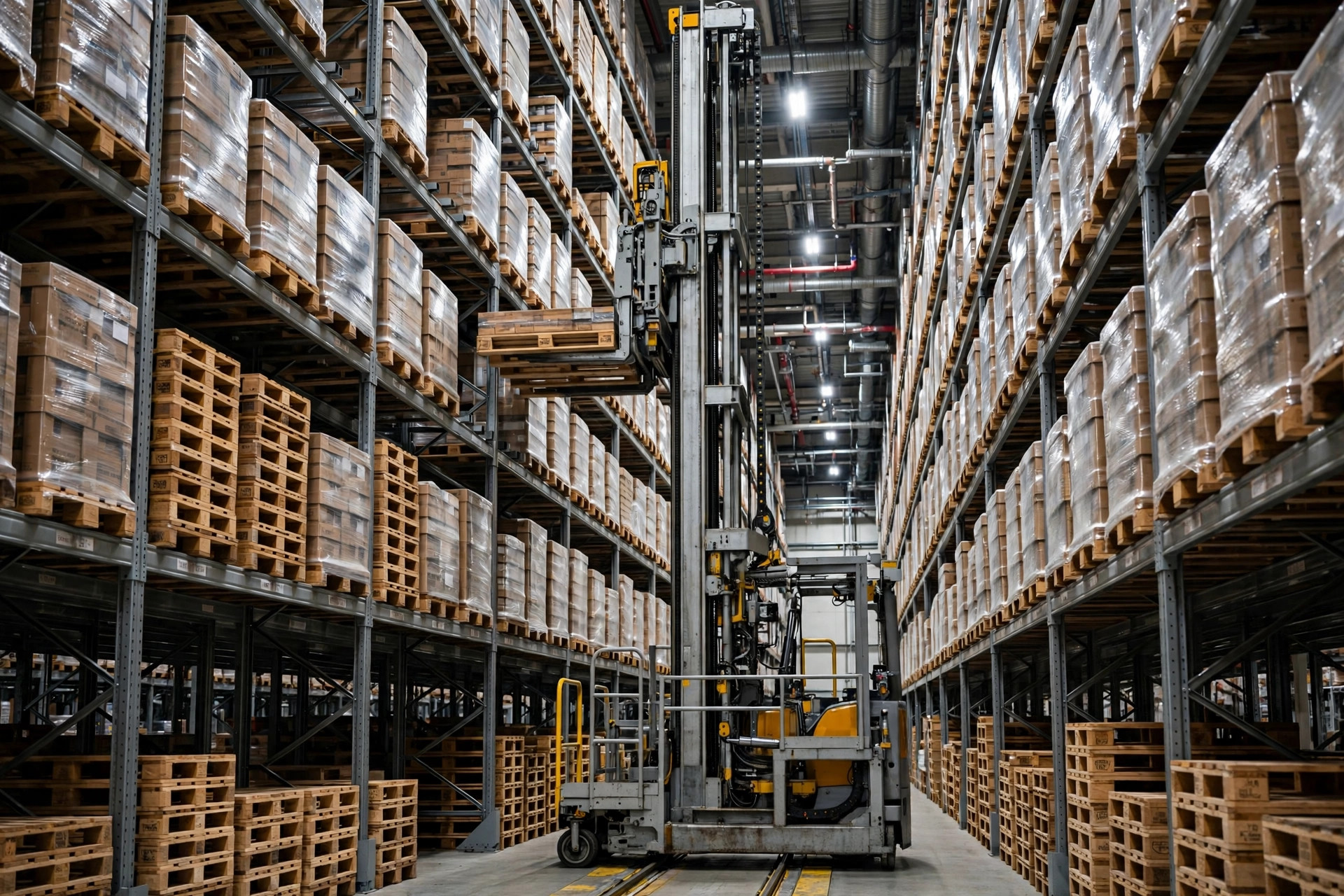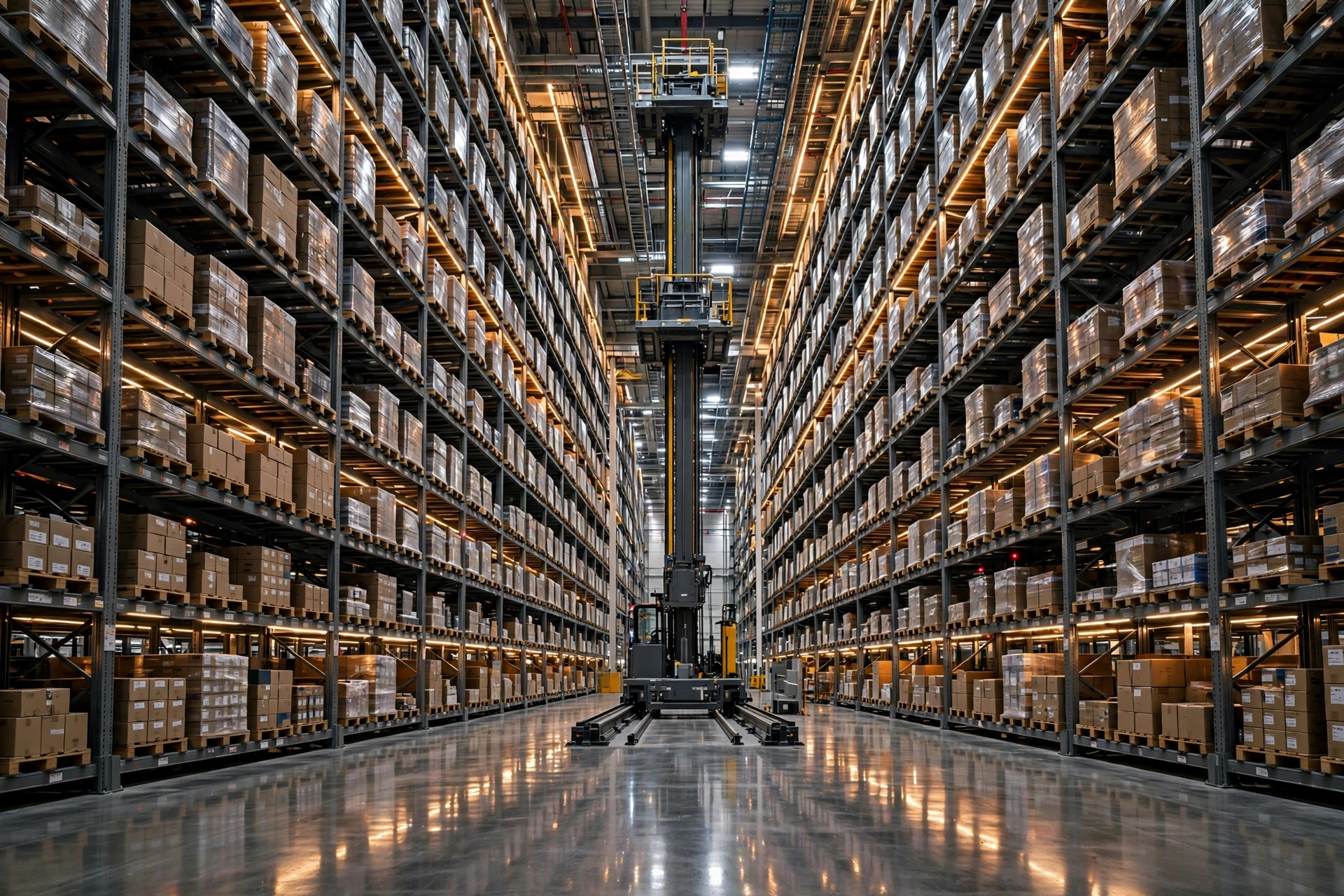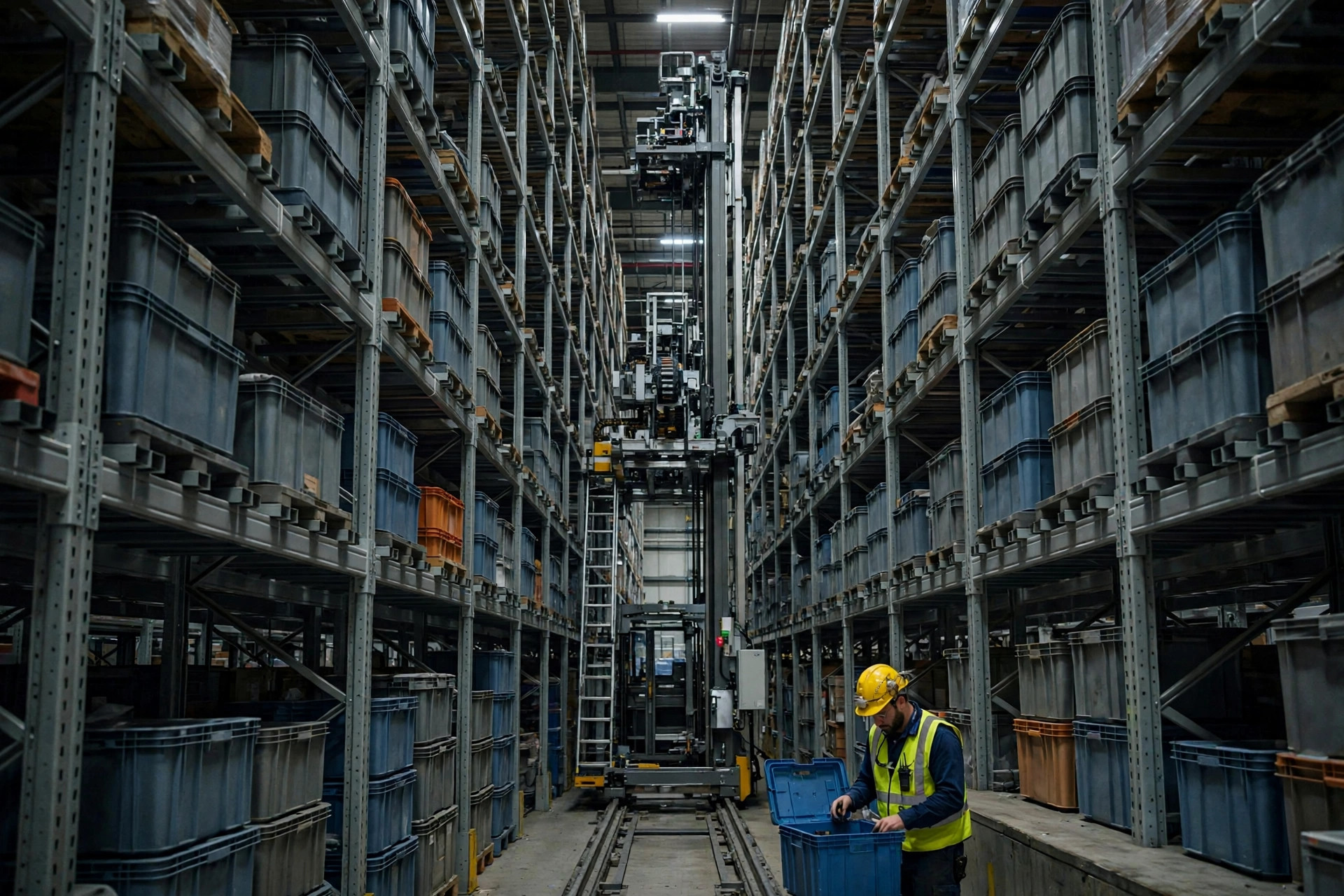
An 18-yuan plastic tote bowed out 12 millimeters on one sidewall. The stacker crane's load-handling device drove into the rack cell, wedged solid, and locked down the entire aisle for five and a half hours. That night the line was supposed to ship 11,000 units. Everything went manual. Post-mortem: the equipment was fine, the racking was fine, the controls were fine. The problem was one overloaded tote.
Back in my systems-integrator days, I'd estimate a third of the miniload emergency stops I dealt with traced back to the tote itself. Not a dead motor, not a lost encoder — a deformed box. Here's the full breakdown: why totes deform, how much deformation it takes to jam an aisle, and a 10-minute daily routine that keeps bad totes out of the racking.
The principle: tote dimensional tolerance is your survival margin
A miniload rack cell leaves almost no clearance for the tote. Drop a standard 600×400 tote into its cell and you've got maybe 20–30 millimeters of total play per side. Think of a high-speed train entering a tunnel — the clearance envelope is fixed, and if the carbody sways a little too much, it scrapes the wall. Same deal in the aisle: the crane runs at 4–6 m/s, the load-handling device telescopes into the cell, and a tote bowed out 8–15 mm will either graze a rack upright and throw alarms all day or wedge itself in hard.
Here's the math that matters: a tote leaves the mold with tolerances around ±2 mm, while the cell gives you 20–30 mm of total margin. Deformation eats half of that margin and you get nuisance alarms daily. It eats two-thirds and an aisle jam is a matter of time.
Plastic deforms from three sources, in order of how often I see them:
First, creep under overload. PP and PE have a nasty habit called creep — slow, permanent deformation under sustained load. You can think of plastic as having a memory: press it long enough and it forgets its original shape. A tote rated for 30 kg, loaded with 35 kg day after day, will have bulging sidewalls within months. That's not a quality defect, it's material physics. No tote, however expensive, is immune.
Second, temperature. Totes staged by the dock doors get baked in summer and frozen in winter. Thermal cycling warps the rim over time. Heat softens the plastic; cold makes it brittle. Both ends are bad news.
Third, rough handling. The most infuriating one. A forklift driver in a hurry spears a stack of totes with the forks — no pallet, just steel on plastic — and every tote comes away with a dent. Workers toss totes, drop them from height, crack the corners. Nobody stops the bent tote at induction, so it rides all the way into the aisle and jams.
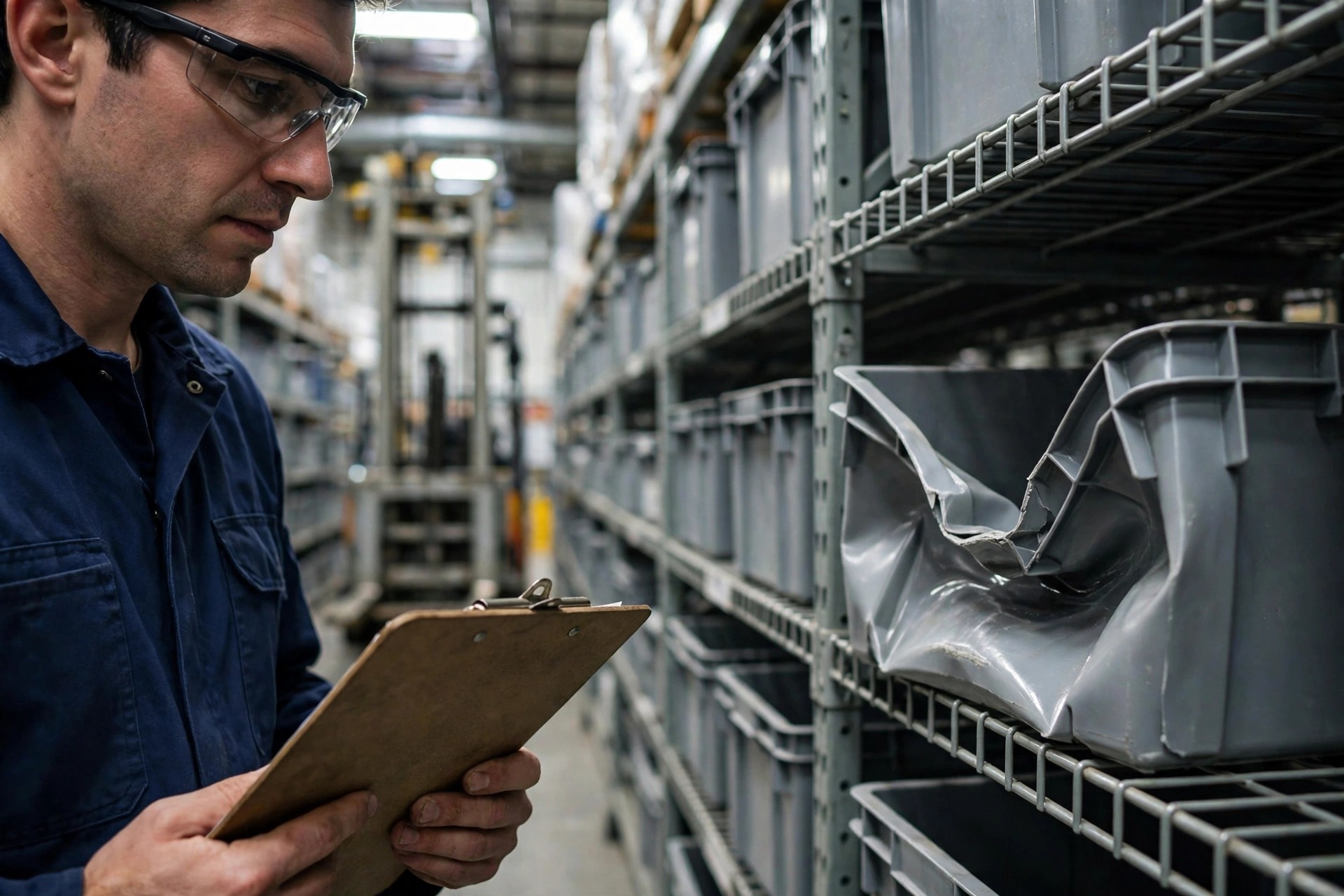
Two real cases from my files. In 2023, a 3C accessories warehouse in eastern China: totes rated 30 kg were routinely loaded with 38 kg of cable reels, because it saved a trip. Within half a year a batch of totes had visibly bowed sidewalls. The worst one went into the miniload aisle, jammed in a cell on level 7, estopped the crane, and shut the aisle for four hours — two outbound lines went manual for the shift. We measured the culprit afterward: 11 mm of sidewall bulge against 25 mm of per-side clearance. Half the safety margin, gone. The other case, Shanghai 2022: a forklift driver speared a stack of totes to save time and caved in the bottom of one. Nobody caught it. The tote entered the conveyor, jammed at a curve section, and the photoeyes threw a cascade of false signals — the line sat dead for 40 minutes. In both incidents, the equipment was innocent. The guilty party was "nobody owns the totes."
The selection threshold: does your warehouse even need to worry?
Not every ASRS cares about this. Here's my rule of thumb — if two or more of these four apply, tote deformation is a risk you should actively manage:
| Risk signal | Why it matters |
|---|---|
| Actual load per tote exceeds 80% of rated capacity | Creep's number-one fuel; chronic overload guarantees bowing |
| Totes get forklifted or thrown by hand | Impact damage is unpredictable — you need interception at induction |
| Ambient temperature routinely above 40°C or below −10°C | Dock-door sunbaking and freezer-adjacent zones accelerate aging |
| You're running a miniload crane aisle | Tight cells, zero forgiveness; goods-to-person workstations with manual handling are far more tolerant |
Flip it around: totes never see a forklift, loads run at half the rating, the building is climate-controlled — then deformation is basically a non-issue for you. Don't spend money here. The point of a threshold is knowing where the money actually matters.
While I'm at it, let me take a shot at a pseudo-solution doing the rounds: "AI vision systems for tote deformation detection" — a six-figure installation on the conveyor that photographs every tote and measures it. I'll say it plainly: that's a fake need. The tote costs 15–25 yuan. You're going to spend hundreds of thousands detecting a 20-yuan consumable — and when the system flags one, what do you do? Throw it away. So why not weld a go/no-go gate frame at induction for a few hundred yuan and physically block out-of-spec totes from ever entering? A few hundred yuan of angle steel beats a six-figure vision system. I'm an engineer, but I still do the math — if the math doesn't work, it's theater.
The maintenance reality: a 10-minute daily inspection routine
Theory is cheap; the floor is where it counts. Three moves, printable, tape it to the induction station:
Move one: look. Put a light over the induction point and have the operator eyeball each tote's rim as it comes in — a straight rim means healthy, a visible arc means bowing. Don't underestimate the naked eye: anything bowed more than 8 mm is visible, and 8 mm is exactly the alarm line. Zero cost; the trick is writing "take a look" into the SOP.
Move two: measure. Build a go/no-go gauge to the tote's diagonal spec — anything out by more than 5 mm won't fit through, and what doesn't fit gets scrapped. Once a week, pull the 20 oldest totes in the building and check them. Ten minutes. And remember: there is no "repair" for a deformed tote. Creep is irreversible — bend it back and it'll bow again. Scrapping it is the cheapest option.
Move three: block. Weld a height-and-width gate at the ASRS induction point, sized to tote dimensions plus 5 mm. An out-of-spec tote physically cannot enter, which means you don't even need the alarm. Highest-ROI spend in this whole program: a few hundred yuan, once, done.
Running the numbers: what one aisle jam actually costs
The table below uses a common baseline (one aisle doing roughly 120 tote cycles per hour; manual-fallback labor at local rates) — plug in your own numbers:
| Item | Scale |
|---|---|
| 4-hour stoppage, ~480 cycles go manual | Several thousand in extra labor; the whole shift plan collapses |
| Crane reset and cell inspection after an estop | 1–2 hours minimum, plus the engineer's site visit |
| Goods inside the jammed tote may be damaged | One tote of electronics can be worth five figures |
| The expensive one: downstream production or outbound SLA breach | Penalties, emergency air freight — uncapped |
Now the prevention side: a gate frame for a few hundred yuan, ten minutes of inspection labor a week, and scrapping a few dozen deformed totes a year at 15–25 yuan each. These aren't even in the same order of magnitude. One jam pays for a decade of tote replacements.
Whether it's worth it comes down to one number
Don't buy a deformation detection system, and don't expect pricier totes to fix this — overload and rough handling will bow any tote you buy. The only spending that pays is the few-hundred-yuan gate at induction and ten minutes of weekly spot checks.
Something you can do tomorrow morning: grab a tape measure, pull the 20 longest-stored totes at induction, check their diagonals, and scrap anything out by more than 5 mm. Ten minutes, zero cost — and whether your aisles sleep soundly tonight depends on those ten minutes.
By Da Liu, Automation Engineer