Start with a ledger. Last fall, a 3PL in Ontario, California — 80,000 square feet — asked me to look at a quote. Their high-bay racks went up in 2011. An assessment found nearly 30% of the anchor bolts missing and many loose beam safety pins. The retrofit quote: $48,000. The owner shelved it as too steep. At renewal, the earthquake deductible landed where it always lands — 10% to 25% of the insured value, meaning one moderate quake costs this owner a couple hundred thousand out of pocket before the carrier pays a dime. $48,000 versus $200,000-plus. Which is the expensive number? That is the subject of this piece: the cost math of pallet rack seismic retrofit.
Know What You're Standing On
Before spending anything, do a self-check. Five items, a flashlight, half a day.
First, anchor bolts. Every upright base plate needs at least one anchor into the slab — that is the floor set by ANSI/RMI MH16.1. Missing, sheared, or rusted-out anchors all count. In old warehouses I have walked, 30% missing is not even the worst I have seen.
Second, beam connections. Beam safety pins must be in place; MH16.1 requires them to resist 1,000 pounds of vertical uplift. Note every beam that has taken a forklift hit — in a quake, beams pop out first and pallets follow.
Third, upright condition. Bent or corroded uprights cannot be saved by a retrofit; replace them. Bolting reinforcement onto a deformed column is paint on a condemned building.
Fourth, back-to-back ties. Back-to-back rows need row spacers locking the rows into one unit against lateral drift. Plenty of legacy warehouses have zero of these, with each row standing on its own.
Fifth, load placards. Are the rated-capacity signs still there and matching actual storage? No placards, no seismic calculation — the engineer cannot start.
The Ontario warehouse failed this check on almost every line: about 30% of base plates missing anchors, no row spacers to speak of, and overweight pallets on the top level. The worse the baseline, the longer the retrofit list, the higher the quote.
The Retrofit Kit, and What the Code Actually Demands
A retrofit comes down to three hardware groups, matching the three ways racks die in an earthquake.
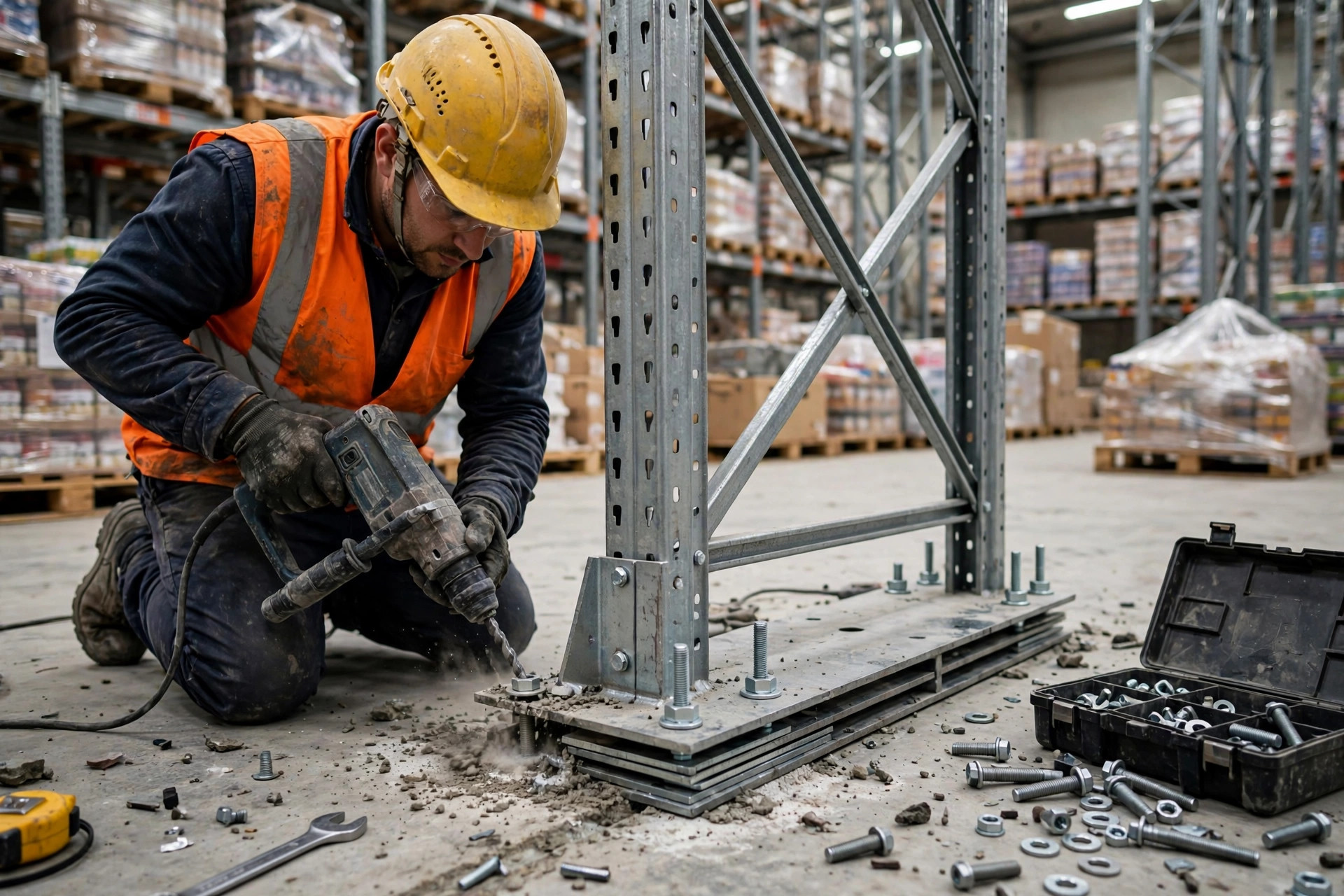
One, anchor bolts. The first thing a rack wants to do in a quake is walk — base shear slides the whole frame. Retrofit means anchoring every column to the slab, with bolt size and embedment set by the engineer's seismic calculation. One detail people miss: shims. Total shim thickness under a base plate cannot exceed six times the diameter of the largest anchor bolt, and anything over two times the diameter must be welded or locked with a second anchor — otherwise the shims spin out and the rack loses its footing.
Two, bracing and row spacers. Longitudinal bracing handles the back-and-forth; row spacers tie back-to-back rows into a single structure. The 1994 Northridge earthquake is the case study that made this concrete: in Santa Clarita, California, several bays of a big-box building-materials store collapsed in the cross-aisle direction. FEMA's report (FEMA 460) is blunt — the failed bays were loaded more than 50% over rated capacity, while properly loaded and anchored racks next to them were undamaged. The chain retrofitted 160-plus stores afterward at about $15 million in 1993 dollars, under $100,000 per store. The racks did not fail for lack of steel. They failed at the connections and the anchors.
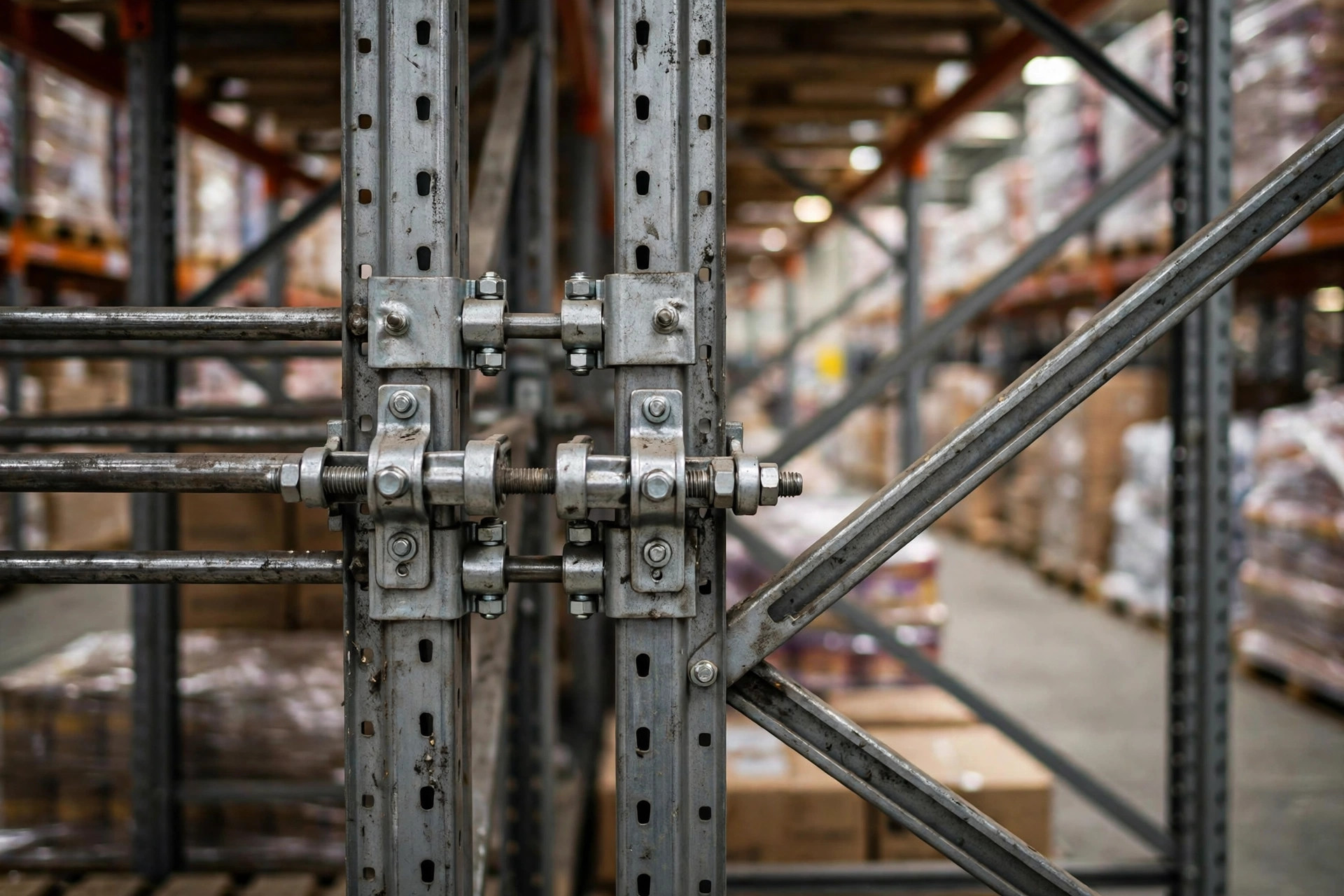
Three, base plates and upright reinforcement. Seismic zones call for larger, thicker base plates; rusted or impact-damaged uprights get replaced with new components, not patched.
On the code side, four things are enough to know. First, the IBC — the current IBC 2024 references ASCE 7-22 — treats storage racks as nonbuilding structures designed to ASCE 7, with the design standard being ANSI/RMI MH16.1. Second, most of California sits in Seismic Design Category D or higher; the seismic forces are real, not paperwork. Third, the capacity on the manufacturer's plate is static capacity. The seismic capacity the engineer stamps is usually lower — a beam rated 5,000 pounds static might only get 4,000 pounds seismic. Waving a static placard at the permit office does not work. Fourth, do not tie a single row of rack to the building wall to save money. Tying the rack to the building shuttles earthquake forces back and forth between the two, and the analysis gets extremely complex — RMI's own guidance says avoid it. Use bigger base plates, denser anchor patterns, or cross-aisle ties instead.
Do the Math: Retrofit vs. Loss vs. Insurance
Here is the core table. Numbers marked ★ are verifiable from public sources; the rest are industry-experience magnitudes — get your own quotes and check them.
| Retrofit side | Amount / magnitude | Note |
|---|---|---|
| Seismic assessment + PE-stamped drawings + permit | $2,500–$7,000 ★ | Typical California rack-permitting range, seismic calcs included |
| Retrofit hardware (anchors, row spacers, bracing, base plates) | Tens to low hundreds of dollars per bay | The hardware itself is the cheapest part of the three |
| Installation labor + partial shutdown to move product | Usually the biggest line item | Drilling and relocating freight; don't do it in peak season |
| Whole-warehouse retrofit (80k sq ft scale) | $30,000–$80,000 magnitude | The better the baseline, the cheaper |
| If you don't retrofit | Amount / magnitude | Note |
|---|---|---|
| New rack replacement cost | $50–$200 per pallet position ★ | A bay holds 40–60 pallets; one collapsed bay is thousands to tens of thousands |
| Product loss | Per your inventory value | One bay of high-value goods can exceed the whole retrofit budget |
| Downtime | Per day | For a 3PL, one dark day means penalties and lost customers on top |
| OSHA citations | Up to $16,550 per serious violation ★; up to $165,514 per willful/repeated ★; $16,550 per day for failure to abate ★ | 2025–2026 penalty levels |
| Earthquake insurance deductible | 10%–25% of insured value ★ | Moderate losses fall entirely inside the deductible — the carrier pays nothing |
Two ledgers inside that table, calculated line by line.
The insurance ledger. Earthquake deductibles in California run 10% to 25% of the insured value, and commercial properties buy this coverage on the private market — the standard policy excludes earthquakes outright. Translation: racks fall, product is damaged, and if the loss sits below the deductible, the insurer pays zero. The $48,000 retrofit buys down exactly that below-deductible slice of risk — and no financial instrument can transfer it. Insurance covers the catastrophe; the retrofit covers the far more likely "small" disaster. Anyone counting on earthquake insurance to cover their racks should read their deductible clause first.
The OSHA ledger. OSHA has no dedicated rack standard; citations run through the General Duty Clause, Section 5(a)(1), and 29 CFR 1910.176. In 2022, OSHA published a citation against a warehouse whose rack rows B04, B05, D04, and I04 were never anchored to the floor, plus damaged racks left unrepaired: serious violation, $14,502 initially, settled at $8,701.20. Another national retailer has been cited repeatedly for unanchored rack columns, and a prior citation makes the next one more expensive. Here is the counter-intuitive part: the OSHA fine is the cheapest line on this entire table — replacing one collapsed bay costs several times the maximum serious-violation penalty. What is actually expensive is what follows: OSHA's National Emphasis Program for warehousing puts you on the radar, and then come abatement orders, shutdowns, and legal bills. And if somebody gets hurt, that is an entirely different ledger.
Which Racks Are Not Worth Retrofitting
This is the trade-off, and it cuts against the "always retrofit" pitch: a retrofit only pencils out for racks with a sound base. Three cases where you replace instead. One, height-to-depth ratio over 8 to 1 — past RMI's line, no amount of hardware makes the structure right. Two, uprights with widespread impact damage or corrosion. Three, racks from an unknown manufacturer with no load documentation — the engineer cannot run the seismic calculation without costly component testing, and at that point new racks are cheaper.
Conversely, racks installed after about 2010, with placards intact, sound uprights, and a problem limited to missing anchors and missing row spacers are the best retrofit candidates there are. The Ontario warehouse was exactly this: in the $48,000 quote, hardware was well under half. Engineering, stamped drawings, and labor to drill and relocate product were the real money. That is the second counter-intuitive finding — the most expensive part of a seismic retrofit was never the bolts. It is the engineer's stamp and the labor. Procurement teams that compare hardware quotes are comparing the wrong price.
So the conclusion writes itself as arithmetic: spend $2,500–$7,000 first on a licensed PE seismic assessment and get the retrofit list with a real quote. Then compare three numbers: retrofit cost, your earthquake deductible, and one bay's replacement cost. If the retrofit is under one-third of the deductible, spend it without hesitation. The Ontario owner did: $48,000 against a $200,000-plus deductible. His words after the math: the money was not spent, it was recovered.
By Lao Zhou, Logistics Cost Analyst