Here's the math that ends the debate. A license plate label costs under two cents in bulk. A single mispick costs $50 to $300 by industry reckoning. Five thousand labels cost less than one shipping error. Once you've done that arithmetic, "should we do LPN tracking" stops being a question. The only question left is how to implement it without wasting money.
I'm a cost analyst, not a WMS implementer — which is why I look at this from one angle only: how much money does this little "ID card" save you, and how much does it charge you.
Where the Money Leaks Without License Plate Tracking
A warehouse without LPNs tracks inventory by SKU: so many units of product A at location B. Sounds fine. The problem is the pallet — freight moves by the pallet and sits by the pallet, but the system has no concept of "the pallet." Money leaks in three places.
Finding freight. Receivers put stock away from memory and paper slips; three days later someone needs a specific lot and it's flip through paperwork, call around, "does anyone remember where it went." Intermec once surveyed 250 supply chain managers: the average mispick cost $22, and a typical operation bled $390,000 a year on them. With e-commerce volumes since, industry estimates for one wrong shipment now run $50 to $300.
Mispicks. With no pallet-level identity, pickers work off SKU and location. Grab the wrong case or the wrong lot and the system never notices. One wrong shipment triggers the full combo: return, reship, customer service tickets.
Cycle count variances. Book versus physical never ties out, and nobody can say why — lost, misplaced, or misrecorded? With no identity per pallet, variances just get written off, and year-end counts bury them in shrinkage.
Fall 2024, an 85,000-square-foot 3PL outside Ontario, California doing e-commerce fulfillment: losing a pallet in peak season was routine. Two receivers, paper slips, walking the aisles — half an afternoon gone. After they went to print-on-receipt LPNs, you typed the plate number and the system told you the location and when it went in. Finding freight went from hours to minutes. The owner told me a month of saved search time pays for a year of labels. I believe him — labels are absurdly cheap, as I'll show below.
What an LPN Actually Is: an ID Card for the Pallet, Not the SKU
LPN stands for License Plate Number, and "license plate" is the right metaphor. It doesn't name the goods; it gives this pallet an identity. The WMS stops asking only "where is this SKU" and starts asking "where is this LPN, what's inside it, where did it come from."
The distinction outsiders miss — and it matters on the books: a SKU answers "what is this product," while an LPN answers "where is this pallet." In theory, warehouse inventory should be the sum of every LPN. The SKU quantity is just a derived number. Tracking SKUs without LPNs is like keeping only totals with no line items — when book and physical disagree, you don't even know which entry to investigate.
A word on SSCC. GS1 defines an 18-digit Serial Shipping Container Code — extension digit, company prefix, serial reference, check digit — globally unique, built to identify pallets and cases as logistics units. Here's the part that saves money: you only need a GS1 company prefix (which carries membership fees) if your pallets leave the building and trade data with partners like retail distribution centers. For internal LPNs, a self-assigned serial works fine and costs nothing. Small warehouses hear "18-digit international standard" and assume it's expensive. The standard is free; the expensive part is the piece you don't need.
The Real Cost of LPN Tracking: Labels Are a Rounding Error
Five cost components:
| Cost item | Magnitude | Notes |
|---|---|---|
| Labels | ~$0.02 each | 4x6 thermal, bulk pricing; 300 pallets/day runs under $200/month |
| Printer | A few hundred dollars, one-time | Desktop thermal printer; most WMS shops already own one |
| Scanning hardware | $0 incremental | Handhelds are standard kit, nothing new to buy |
| Label-and-scan labor | ~1 minute per pallet | Stick it, scan it; budget a dozen or two labor hours a month |
| Go-live one-time effort | The big one | First-time labeling of all existing stock plus a wall-to-wall count — maybe half a day of downtime or two days of overtime |
See it? Labels are a rounding error. The real costs are the minute per pallet and the go-live fortnight. Any vendor who dwells on "label costs" is dodging the two items that actually matter — whether this money is wasted depends entirely on whether those two got estimated honestly.
Now the benefit side. At a conservative $100 per shipping error (industry range $50–$300):
| Without LPN (monthly) | With LPN (monthly) | |
|---|---|---|
| Labels | $0 | ~$180 (300 pallets/day) |
| Added labor | $0 | A dozen-odd hours |
| Mispick losses | 2 x $100 = $200 | Near zero |
| Search time | Hours of hunting through paperwork | Minutes with a scan |
| Count variances | Written off | Traced to the exact LPN |
Blunt conclusion: two fewer mispicks a month pays for the labels, and the search time you save usually covers the labeling time with change to spare. That's the breakeven point for LPN tracking — embarrassingly low.
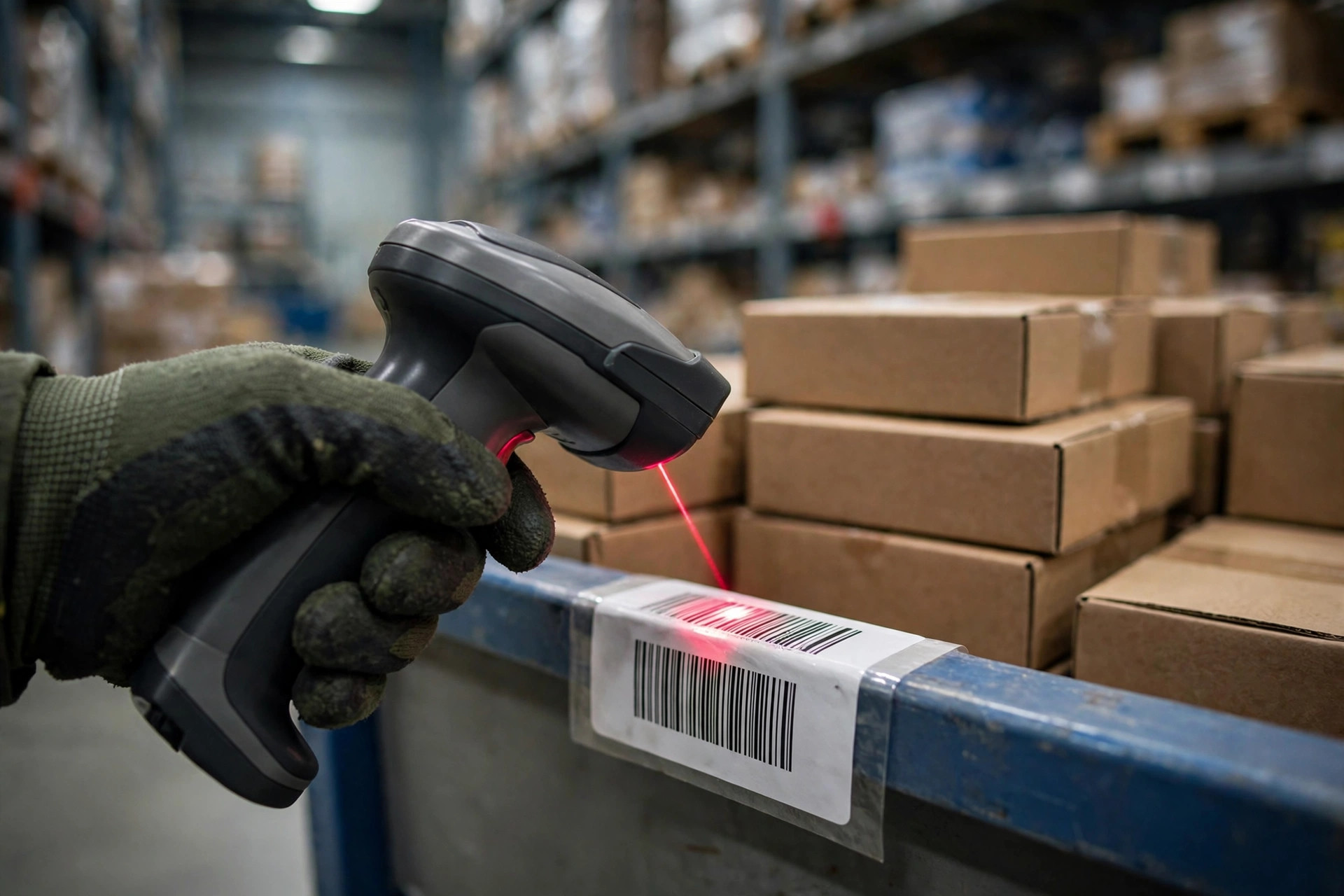
Three Implementation Decisions: Pre-labeled vs. Print-on-Receipt, Splits and Merges, Numbering Discipline
Concept and math settled. Implementation is three decisions, each with a cost angle.
Pre-labeled or print-on-receipt. If suppliers apply SSCC labels before shipping, receiving is just scanning — match against the ASN and you're done. That fits operations with stable suppliers feeding retail DCs, and it pushes the labeling cost upstream. 3PLs with mixed shippers have to print at the dock and eat the cost themselves. A food distributor serving supermarkets told me that once suppliers pre-labeled to the GS1 standard, receiving went from "open and count" to "scan the pallet and spot-check" — the whole paper-verification step disappeared. The saving was an entire process step, not a few labels.
Splits and merges. One rule: when the physical form changes, the number changes. Split one pallet into two — retire the old number, issue two new ones. Combine two into one — retire both, issue one. Warehouses that skip this end up with phantom pallets in the system long after the physical goods were broken apart — and that's where most book-to-physical gaps come from. This one costs nothing but discipline.
Numbering discipline. Internal LPNs just need a scheme — date plus sequence is the lazy standard. The requirements are "one number, one pallet, never reused." Reusing number ranges is the most dangerous thing you can do on the books: historical documents stop matching current reality and traceability collapses. Set the rule once, avoid endless arguments later.
Exception handling, in one line: label torn or unscannable — print a fresh number, void the old one, link the two. Never hand-write a number on a replacement label. Someone will misread it tomorrow.
The Counterintuitive Part: LPNs Aren't Really About Finding Freight Faster
Two contrarian judgments.
First: everyone says LPNs exist to "find freight faster." Wrong — that's a side effect. The real value is traceability of responsibility. Ship the wrong pallet and one scan tells you whether the picker grabbed the wrong LPN, the stower mislabeled it, or the supplier shipped it mixed. Without LPNs, disputes are "you can't prove it, I can't prove it, we eat it." With LPNs, it's "pallet 37, put away October 3rd at 2pm, scanned by the stower" — three sentences, done. For a 3PL, this decides whether "whose fault is the lost pallet" can actually be settled with the shipper. Warehouses that can't settle it end up paying out of pocket.
Second: small-warehouse owners ask me, "we only receive 50 pallets a day — is LPN worth it?" My answer: the smaller you are, the more it's worth. Big warehouses have inventory control teams to hunt lost pallets. In a small shop, the owner hunts them personally — and the owner's time is the most expensive labor in the building. Fifty pallets a day is $30 a month in labels. One avoided mispick pays for the whole thing. Small warehouses don't skip LPNs because the math fails; they skip it because nobody told them how cheap labels are.
The Close: One Formula, Plug In Your Numbers
You don't need a consultant for this. Five minutes:
Monthly label cost = pallets per day x 30 x $0.02 Breakeven: monthly mispicks x cost per mispick > monthly label cost + added labor cost
Plug in your three numbers: pallets per day, mispicks per month, cost per mispick. If the left side wins, do it. If it doesn't, recheck your numbers — you've probably understated the true cost of a mispick.
A two-cent label buys a full identity for one pallet, from receiving to shipping. On the books, it may be the highest-ROI piece of paper in the warehouse.
By Lao Zhou, Logistics Cost Analyst