The verdict first: nine out of ten warehouse floor cracks are nothing to panic about. But there's one kind of crack where you don't hesitate — you act. Mix up the two, and you either burn money on repairs you never needed, or you walk past a rack upright standing on air and never know it.
This cuts two ways. Concrete shrinks as it cures. Shrinkage makes cracks. That's concrete being concrete, and it has little to do with quality. I've seen too many warehouse managers on their knees with a flashlight, staring at a hairline crack, ready to hire a contractor to tear up the whole slab. Honestly? That's scaring yourself. The other side is settlement: the ground underneath is moving, the slab is going down with it — sometimes unevenly. That's not a "crack" problem anymore. It's structure moving. Leave it alone and it will eventually reach your racking, your forklifts, and your dock doors.
Two Scars of Mine, One of Each Kind
First, the one that should have been fixed and wasn't. Years ago at a 3PL warehouse in LA County, a crack ran across the main travel aisle. Forklifts hit it with a thud, and the pallets rattled. The warehouse manager figured "it's been cracked for years, we've always lived with it." Then one day a carton slid off the top of a pallet and nearly hit a picker. Only then did they bring someone in. The finding: one side of the crack had settled, and the baseplate of a nearby rack upright was hanging in the air — the whole row was being held up by its neighbors. That row was one bad day away from a disaster. The fix took slab jacking, epoxy injection, and reinforcement, plus two days of shutdown. The bill would have sealed a hundred hairline cracks.
Now the opposite: the one that almost got "fixed" for no reason. Another warehouse had a few fine cracks in the floor. A contractor came out, took one look, and declared the slab shot — full removal and replacement, with a quote long enough to scare anyone. The owner panicked and asked me to take a look. I brought a ruler. You couldn't fit a business card into the cracks. No height difference across them. Forklifts crossed without a bump. No fresh spalling along the edges. Classic shrinkage cracks — they formed in the first couple of years after the pour and they'll look exactly like that for the rest of their lives. Epoxy seal, photos on file, done. The contractor's full-replacement quote went straight into the shredder.
Two scars, two lessons: settlement can't wait, and shrinkage cracks shouldn't be upsold. Confuse them and you lose both ways.
When to Live With It: Seal It, File It, Check It Quarterly
If you see the following, living with it is perfectly fine. Seal, document, check back regularly:
Hairline cracks. Too thin for a business card, no height difference across the crack, your fingernail doesn't catch when you run it over. These are almost always from curing shrinkage. Once they've stabilized, they stop developing.
Old cracks. They've been there for years, the width hasn't changed, no fresh debris along the edges. A stable crack is a good crack. What you fear is a "live" one.
No impact on operations. Forklifts cross without bouncing, pallets sit level, pickers don't trip. A floor is a working surface, not an exhibit. If it doesn't affect the work, leave it alone.
Dry. No water seeping through, no dampness wicking up, no ponding in the rainy season. Once moisture gets involved, rebar corrosion and edge deterioration accelerate. A dry crack ages very slowly.
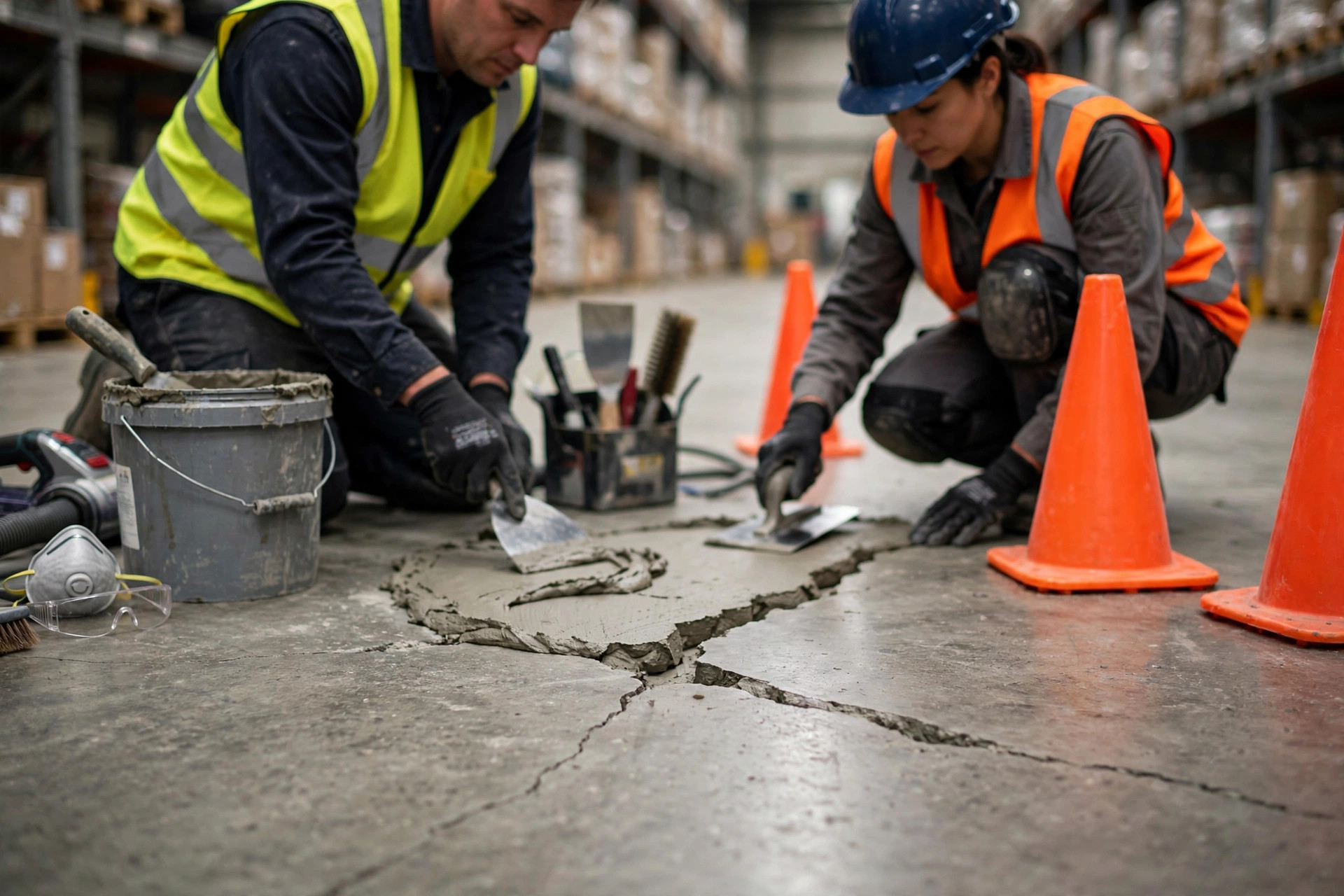
Living with it is a three-step routine: seal with epoxy so water and debris stay out; photograph and file it, width measured and recorded; re-measure every quarter. If the width doesn't move, keep using it. The whole routine costs next to nothing, but it tells you what matters — whether the crack is dead or alive. Data decides.
When You Must Fix It: Don't Gamble With Safety
These situations get no "living with it." Act now:
The crack is growing. This measurement is wider than the last, or fresh debris keeps crumbling off the edges. The slab is still moving. A live crack doesn't stop on its own — it only gets worse.
There's a height difference across it. Forklifts bounce noticeably, pallets sit tilted. A height difference means this isn't surface shrinkage — the two sides are settling at different rates. That's settlement, confirmed.
Rack uprights are affected. Baseplates hanging in the air, shims loose, an upright looking slightly out of plumb. Racking is the one thing in a warehouse you never gamble with. When floor settlement reaches the racking, load capacity is compromised. There is no "living with it" here.
Docks and doors are affected. Dock levelers sticking, door tracks misaligned so doors won't close, canopy leaks pouring into the building. The dock is the warehouse's throat. When it has problems, receiving and shipping feel it directly.
Water is pooling or wicking. Settlement created a low spot that ponds in the rain, or moisture is wicking up through the crack. Water is the enemy of concrete and rebar both — with water in the picture, deterioration runs at double speed.
One rule to remember: if it touches the safety of people, forklifts, or racking — fix it. If it's just ugly — seal and watch. Between safety and cosmetics, there is no trade-off to debate.
Four Repair Methods, Four Different Price Tags
When repair is genuinely needed, the industry basically offers four options. Pick by matching the method to the diagnosis:
| Method | Fits | Cost and trade-off |
|---|---|---|
| Epoxy injection / sealing | Hairline cracks, minor seepage | Cheapest and fastest, back in service same day — but only treats the surface, does nothing for settlement |
| Crack stitching (dowel bars across the crack) | Cracks with slight movement, risk of widening | Mid-range cost, ties the two sides together — treats the symptom; if settlement continues, it cracks again |
| Polyurethane slab jacking | Localized settlement with height differences | No demolition, lifts fast, minimal shutdown — expensive, and you must find the settlement cause first |
| Partial removal and replacement | Widespread settlement, voids under the slab | The most thorough — but also the priciest and longest shutdown, basically a small civil works project |
Bluntly: there's no "best" method, only the right one for the diagnosis. Using the big fix on a small crack is overkill; sealing a settling slab is self-deception. Diagnose before you treat.
Two more traps worth flagging. First, if you lease the building, read the lease before you lift a finger: who pays for floor repairs, and above what amount does the landlord have to approve? Get it in writing before the work starts, not after, or you'll be arguing with the landlord over the bill. Second, find the cause of the settlement before you repair: poorly compacted fill, a shifting water table, overloaded storage. Leave the cause in place and the crack comes back. A jacked-up slab with the cause still active will be sinking again in six months.
A warehouse floor is the thing nobody looks down at — until something goes wrong, and then it's the only thing anyone talks about. When was the last time you bent down and looked at yours?
By Lao Mi, Supply Chain Veteran (20 yrs)