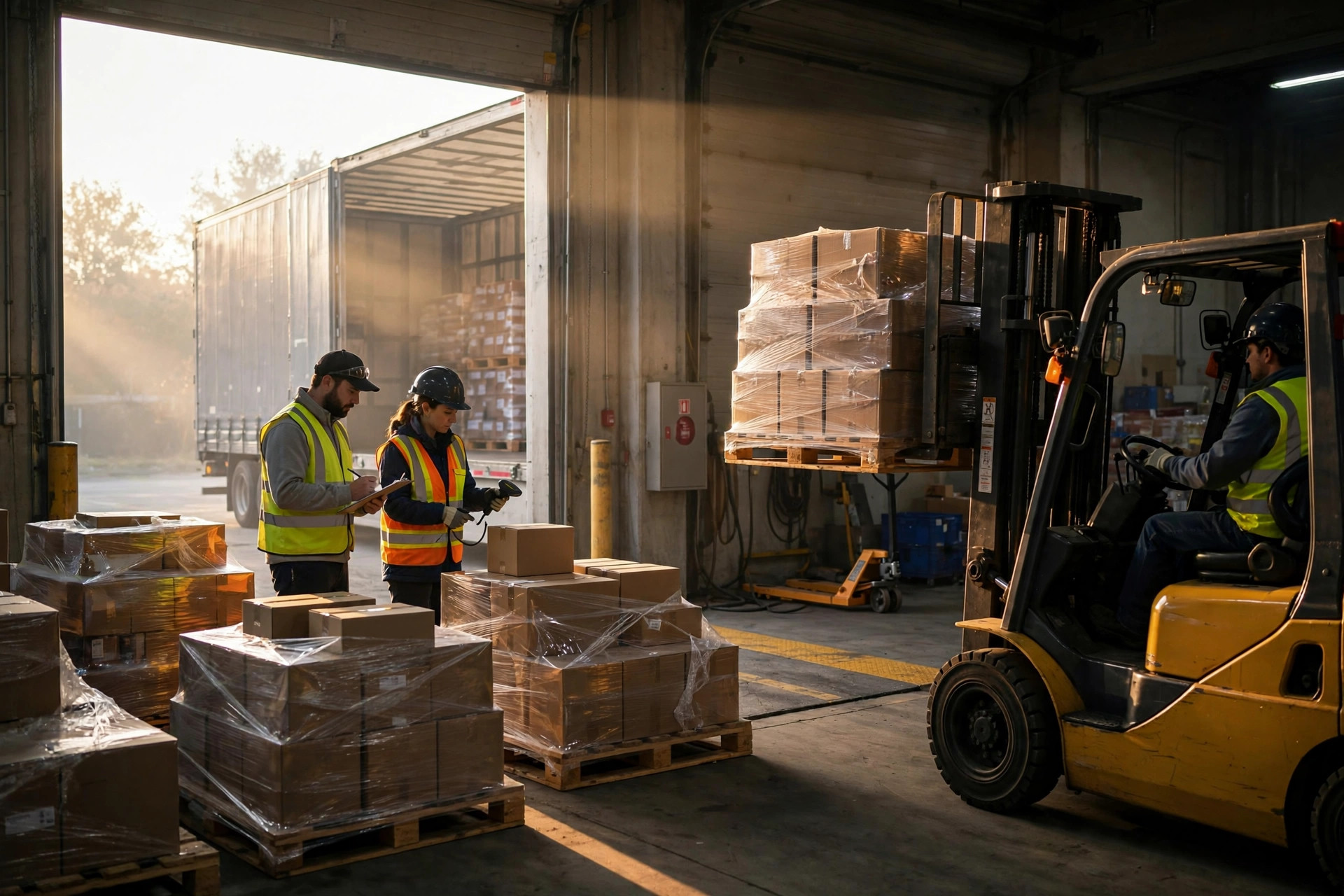
Here is the conclusion up front: when the truck arrives and you find a warehouse ASN mismatch handling problem on the dock, do not sign, do not release the truck, and do not rush the goods onto the shelves. Freeze the shipment where it stands, assign an exception code within fifteen minutes, and only then sort out whose fault it is and how the paperwork gets fixed. Reverse that order and you pay for it later: once you sign, responsibility gets blurry, and once wrong goods reach a location, the error hides inside your inventory.
I have spent years implementing warehouse systems. The expensive part is a dock with no agreed moves. Everyone improvises: the receiver wants to unload first, the driver wants to leave, the supplier promises a corrected ASN by phone, and the old version is still live. By the time everyone finishes talking, half the shipment is put away and the paperwork matches nothing.
Warehouse ASN Mismatch Handling Starts With a Freeze, Not a Debate
Freezing is a pause button that keeps the error on the dock instead of letting it walk into stock. This is the four-step move I write on the whiteboard at every receiving door:
Step one, put the whole shipment on "pending verification" status. The goods stay in the dock staging area: nothing goes to a location, no pallet gets broken down. Anything already unloaded gets pushed back to staging, and you photograph the pallets and case markings before anything moves again.
Step two, print three documents and lay them side by side: the EDI 856 advance ship notice, the purchase order, and the packing list that came with the truck. Then pull the SSCC scan record. Where the four do not line up, circle the exact line that disagrees. Never write a vague "does not match" for the whole shipment.
Step three, assign an exception code. I use only four. Code A is a quantity difference, B is an SSCC code that does not check out, C is wrong information on the purchase order or packing list, and D is a version problem — a re-sent ASN or an old version never voided. Once the code is set, every message about this shipment uses the same language.
Step four, notify purchasing, the supplier, and the carrier in the same email, with the photos and the circled difference attached. The truck can wait, but evidence cannot: once it leaves, the original pallet appearance and case markings are gone for good.
I have seen this exact trap three times. In November 2024, at a third-party warehouse outside Ningbo, a night delivery of home appliances arrived with an 856 listing 14 pallets. The floor count came to 12, and two pallets carried SSCC codes absent from the 856. The receiving lead wanted to sign for the 12 and "deal with the other two tomorrow." I stopped him: signing for 12 would have meant accepting that only 12 arrived, leaving the two unidentified pallets as nobody's problem. The supplier had split the delivery into two dispatches and the second 856 went out half a day late: the goods had arrived before their paperwork. After a three-hour freeze, the second 856 arrived, all four documents lined up, and the shipment went into stock with no dispute left behind.
When the ASN Data Disagrees, Check the Four Documents in This Order
An ASN data mismatch usually means one of the four documents is wrong in one place, dragging the other three into confusion with it. A fixed checking order locates the fault within about half an hour in most cases.
Check the version first. Did the supplier re-send the 856? Was the old version voided? Is the system still matching against the old one? Version problems account for the largest share of the mismatches I have seen: the goods are right and the paperwork is right, but two versions are fighting each other inside the system.
Check the SSCC codes next. Scan the physical pallet's code and look it up in the 856: is it there at all, and do the case count and item match? If it does not check out, every quantity calculation after it is guesswork.
Then check the purchase order. Do the item, quantity, and delivery window on the PO agree with the 856? If the PO itself is wrong, the supplier shipped against a wrong PO, and no dock check will reconcile it.
Finally, check the packing list, the paper record that travels with the truck: case count, gross weight, and markings against the physical goods. When it contradicts the 856, trust the physical scan, freeze first, and get the supplier to confirm in writing which document governs. A verbal assurance does not count.
In March 2025, an electronics warehouse in Dongguan fell into the version trap. The supplier sent an 856 in the morning, spotted a wrong case count, and re-sent it that afternoon without voiding the first version. The system matched the earlier version, every scanned case count came out wrong, and the receiver nearly rejected the shipment as short. The version log told the real story: not one case was missing. Void the old version, lock the new one, re-match, release.
Splitting Responsibility Three Ways, With an Evidence Trail
When the data does not match, responsibility falls to one of three parties: the supplier, the carrier, or the system. Dividing it is not a shouting contest. Fill in the table and the answer is usually obvious:
| Mismatch type | What to freeze | First thing to check | Most likely owner |
|---|---|---|---|
| Quantity difference | The whole shipment | The version log, then the packing list | Supplier shipped wrong, or split without saying so |
| SSCC code not found | Only the pallets that fail | The supplier's dispatch record | Supplier mislabeled or never sent the 856 |
| Wrong PO information | The whole shipment | The original PO | Purchasing or the supplier's order desk |
| Packing list vs. 856 conflict | Only the cases that differ | The physical scan result | Physical goods govern, then written confirmation |
Here is the counterintuitive judgment at the heart of this topic: the fastest move on the dock is usually the most expensive move in the warehouse. Sign now and fix the paperwork later, and you have turned a data problem into an inventory problem. Wrong goods get put away, picked, and shipped, and the stock count throws up a variance. By the time a customer complains, the cost is many multiples of the two hours a freeze would have taken. The freeze looks slow, but it is the cheapest step in the chain: while the error is still on the dock, you can still amend it or send it back.
Once responsibility is clear, the reissue process has its own discipline. A re-sent 856 must carry a new version number, with the old version voided in the same action, so the system holds exactly one valid version. Supplements go by email, never by phone call. When the corrected ASN arrives, do not just release the shipment: run the four-document check again, confirm the disputed lines are closed, and only then lift the freeze, ideally by the same person who set the exception code.
The Mistakes I Keep Seeing at the Dock
Mistake one: signing for part of the shipment and leaving a tail. Signing 12 pallets and leaving two unidentified ones looks flexible, but it splits one shipment into two sets of books, and the ownership of those two pallets becomes an argument nobody can settle. Freeze the whole shipment. Solve the whole shipment.
Mistake two: treating a phone call as evidence. "The supplier said on the phone to go with the new version" is worth nothing when the supplier later denies it. Every confirmation goes by email, with photos of the disputed lines attached.
Mistake three: never voiding the old 856. The new version goes out, the old one stays live, and the next match collides with it again. Voiding and issuing are two steps of the same action.
Mistake four: releasing the goods without setting an exception code. The stock goes in cleanly, but the system holds no record of the exception. Next month the same supplier makes the same error the same way, and nobody remembers how it was handled. Exception codes are the warehouse's memory.
One last line: a warehouse ASN mismatch handling failure is not scary. What is scary is a dock with no action list. Post six steps at the receiving door — freeze, code, reconcile, assign, supplement, re-verify — and anyone on shift can run them from the sheet. Then a data mismatch stays what it should be: a delayed delivery, not an inventory incident.
By Lin Xiao, WMS Implementation Consultant