Here is the bottom line on ups negotiated rates small business how to get: it works in two layers. Layer one requires zero negotiation — register a UPS business account and you automatically get Daily commercial rates, substantially cheaper than retail. Layer two is the actual negotiation — sitting down with a sales rep to lock in negotiated rates. Small businesses shipping a few dozen packages a day should not expect to negotiate enterprise-level base discounts. Your real leverage is in accessorial fee reductions and annual review terms.
First, let me correct a widespread misconception: negotiated rates are not a big-company privilege. A negotiated rate is fundamentally "predictable volume in exchange for a discount." The sales rep wants your volume to be stable and theirs. Small volume is not the problem. "No data, no commitment, no growth story" is the problem.
The Money I Found During a WMS Go-Live
Early 2025, I was implementing a WMS for an outdoor-gear e-commerce company in California. During a lull waiting on an API integration, I asked their ops lead to export their UPS invoices — and I had to laugh. The company shipped over 20,000 parcels a year, all at retail rates. They had never even registered a business account.
That same day I had them do three things: register a UPS business account, switch their shipping software to commercial rates, and book a call with a sales rep to negotiate. Three months later we reconciled: moving from retail to commercial rates alone cut per-parcel cost substantially; the negotiated agreement then carved out another chunk through accessorial reductions. The annual savings covered half my implementation fee. The owner's exact words: "I should have had you look at the invoices on day one."
I have seen this mistake three times. Small companies pour 100% of their energy into product and traffic, and nobody ever looks at the freight bill. In implementation terms: a go-live saves labor; a rate negotiation saves hard cash — often with higher ROI.
Ups Negotiated Rates Small Business How to Get: The Six-Step Playbook
This is a checklist. Every step is actionable. Do them in order; do not skip.
Step 1: Register a business account — grab the first cut with zero negotiation (do it today)
Register a business account on ups.com and get your shipper number. The moment the account is active, Daily commercial rates kick in — UPS's baseline pricing for all business accounts, far below the retail rates you pay at a UPS store or as a guest on the website. One detail that matters: the dimensional-weight divisor is 139 for commercial rates versus 166 for retail. Same box, commercial account, smaller billable weight.
Action item: before you leave work today, register the account and switch your shipping software's default rate to the commercial rate. No negotiation with anyone required.
Step 2: Pull your data and build a one-pager (two weeks before negotiating)
Sales reps only respect data. Export 3–6 months of shipping history and compute eight numbers: total parcels, daily average, weight distribution (1–5 lbs, 5–10 lbs, 10+ lbs), zone distribution, service mix (Ground vs. Air share), residential share, returns share, and monthly seasonality (how many times busier peak is than normal). Put it on one page. Print it.
Our WMS go-live checklists run 200+ items; negotiation prep is this one page. Without it, you are "just asking around" in the rep's eyes. With it, you are "a serious prospect about to sign."
Step 3: Talk to the right person
Find "contact sales" on ups.com or call customer service and ask for small business sales. Do not negotiate with the counter clerk at a UPS store — they have no discount authority. Open with data: "We ship X parcels a day, expect Y% growth over the next six months, and want an annual agreement." The rep needs pipeline; you give them certainty, they give you discounts.
Step 4: Three levers, negotiated one by one
At the table, discuss three things and do not get sidetracked:
First, base discounts, negotiated per service type. Ground and Air are separate conversations — if 90% of your volume is Ground, concentrate your firepower there. Do not waste leverage on niche services.
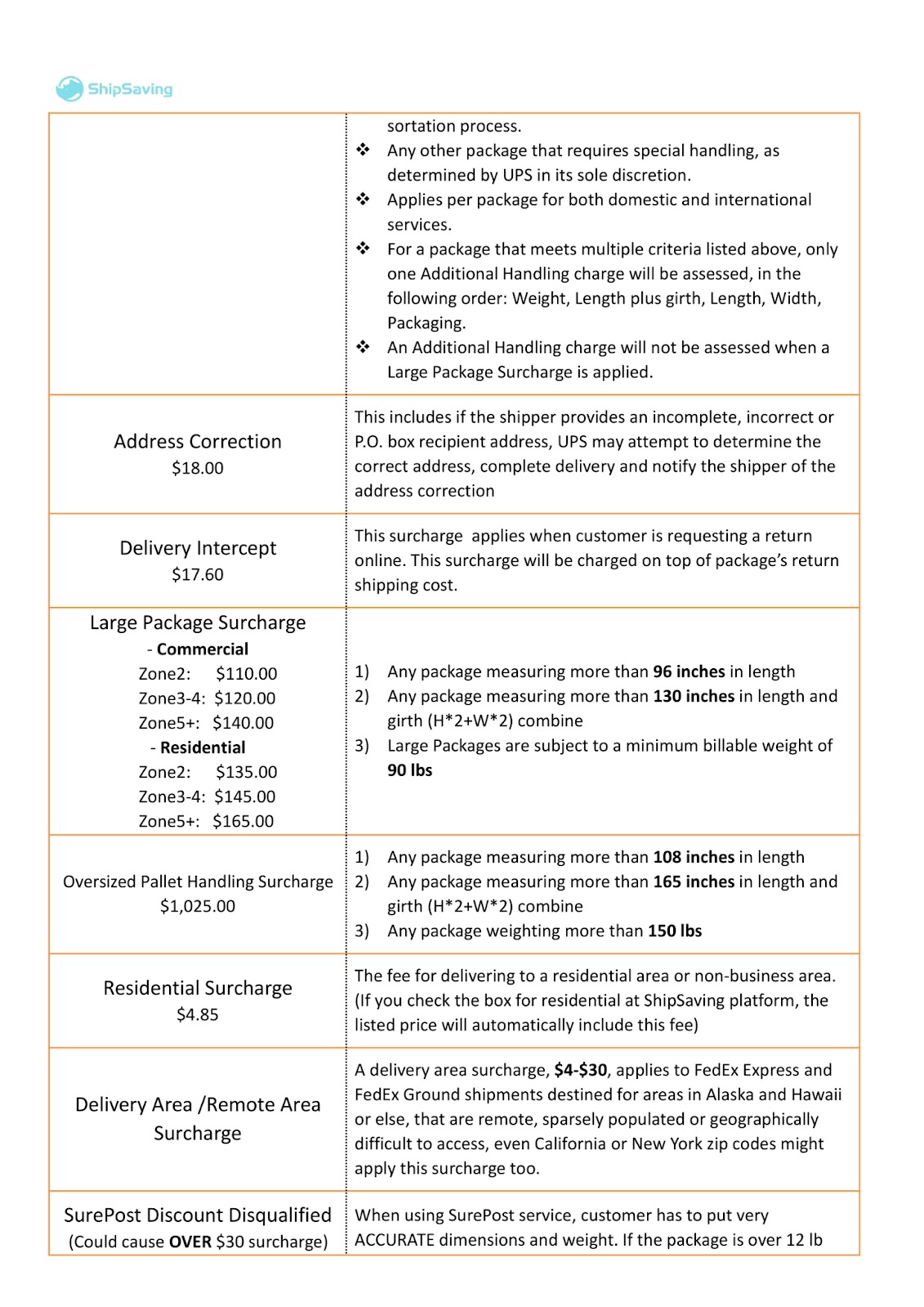
Second, accessorial reductions or caps — the golden lever for small businesses. Fuel surcharge (updated weekly, charged as a percentage of the base rate), residential surcharge, delivery-area surcharge, address-correction fees — these routinely eat more than half of a base discount. Negotiating an accessorial reduction or cap is worth far more than squeezing two extra points off the base.
Third, terms: annual review (renegotiate at expiry instead of auto-renewing at a higher rate), volume commitments with headroom (commit to your off-peak volume, not your peak), and a cap on auto-renewal increases.
Step 5: Integrate and verify (within one week of signing)
Connect the negotiated rates to your shipping software — ShipStation, Shippo, or your own system all support it. Then run three test labels and check that the billed rate matches what you negotiated. If it does not, call the rep immediately. A verbal promise that never lands in the system is worth zero.
Step 6: Annual review plus quarterly audits
Agreements typically run one year. Start the renewal conversation 60 days before expiry — with a full year of actual data, your leverage is stronger than it was last year. Audit your invoices every quarter and claw back overcharges. One client routinely recovers thousands a quarter, all from "small money" like address corrections and duplicate charges.
Ups Negotiated Rates Small Business How to Get: The Four Ways to Pay Compared
| Method | Negotiation needed | Volume threshold | Depth of discount | Best for |
|---|---|---|---|---|
| Retail (store / guest checkout) | No | None | Baseline, most expensive | Individuals shipping occasionally |
| Daily commercial rates (automatic with account) | No | None | Substantially below retail | Every small business — register today |
| Third-party platforms (aggregated discounts like Pirate Ship, Shippo) | No | None | Near-negotiated levels | Low-volume shippers who do not want to be locked in |
| Negotiated rates | Yes | Stable volume + data | Deepest, plus accessorial leverage | 30+ parcels/day with a growth story |
And here is a math exercise to decide whether a smaller box is worth it. Dimensional weight = length × width × height (inches) ÷ 139; you are billed on the greater of actual and dimensional weight. An 18×14×12-inch box weighing 8 lbs: DIM weight = 18×14×12÷139 ≈ 21.8 lbs, billed as 22. Switch to a 16×12×10 box: DIM = 16×12×10÷139 ≈ 13.8 lbs, billed as 14. That is 8 billable pounds saved per parcel — 400 pounds a day at 50 parcels. That math beats grinding for one more discount point at the table.
The Mistake I Have Seen Three Times
Mistake one: negotiating only the base discount, ignoring accessorials. Reps love giving you an attractive base number while conceding nothing on surcharges. Before signing, pull three months of invoices and compute what share of total spend is accessorials. If it is over 30%, your firepower belongs on the surcharges.
Mistake two: committing to peak-season volume. You ship 200 a day in peak and 40 a day off-peak; commit to 150 and three slow months get you downgraded. Commit to off-peak volume and keep 30% headroom. Missing a commitment costs more than the two points you left on the table.
Mistake three: a dirty address database burning address-correction fees. This is the crossover perspective from a WMS implementer: address validation is standard in every go-live I run. Many small businesses hand-key addresses — missing apartment numbers, one wrong digit in the ZIP — and every correction costs a fee. Over a year, that often exceeds the extra discount you negotiated. Fix address validation in your order system first, then negotiate. Stop the bleeding before asking for a discount.
One contrarian take to close: the lowest negotiated rate is not always the best deal. The cheapest agreement usually comes with the harshest volume commitments and exclusivity — put 90% of your volume with one carrier and you lose the ability to comparison-shop. When service fails or peak season blows up, you have no backup.
The optimal small-business setup is usually a mix: the bulk on your negotiated UPS rates, light parcels on USPS (Ground Advantage is often cheapest under a pound), urgent shipments with whichever of UPS and FedEx quotes lower. Never put all your eggs in one basket — and at the negotiating table, let the rep know you have alternatives. That is what makes your discount move.
To summarize in one sentence: register the business account today, build the one-page data sheet this week, and walk into the negotiation next month. Do not wait until you are "big enough" — volume is negotiated, not waited for.
By Lin Xiao, WMS Implementation Consultant