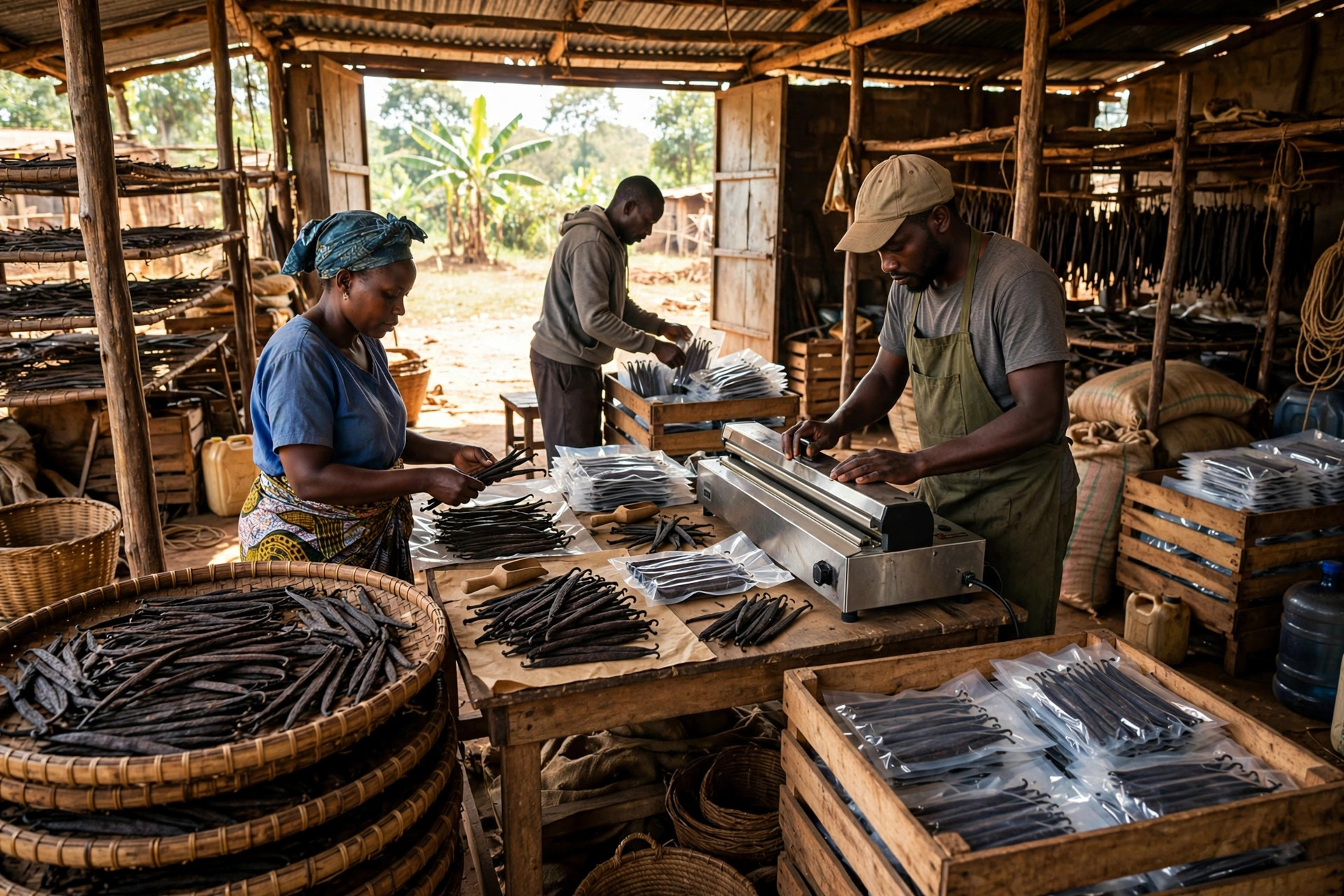
Let me be blunt: in Uganda vanilla export warehouse storage, most deals don't die on price. They die in the warehouse. The pods leave the field looking perfect, they sit in storage, they get boxed and shipped, and then the buyer opens the bag overseas — mold, flat aroma, and the whole shipment gets marked down. I've watched it happen more than once, and it hurts every time, even when it's not my cargo.
I sell stuff for a living, and I've been following the Uganda vanilla line for a few years now. When I first touched the storage side, I thought it was just "find a dry place and stack it." I was wrong. The ledger for this business starts the moment the pods come through the door. If you can't account for every step, whatever margin you negotiated up front will bleed out the back.
Receiving Is Where Uganda Vanilla Export Warehouse Storage Gets Decided
Uganda vanilla is the Bourbon-type pod. After harvest it goes through killing, sweating, sun-drying, and conditioning, with the moisture coming down step by step. What the warehouse usually receives is already-cured pods — but "already cured" does not mean "ready to box." Out of every ten batches I take in, one or two always have under-cured pods mixed in, or a single batch where some pods are drier than others.
My rule now is rigid: no sampling, no intake. I check three things — whether the pod bends naturally with a bit of sheen, whether the smell is deep and rich rather than grassy, and whether it feels flexible instead of brittle or limp. Anything off gets pulled aside.
I learned this the hard way. A supplier point up in Bunyoro once sent a batch that looked great on the surface, and I got lazy and only checked the top two crates. A few crates in the middle had under-cured pods mixed in. Two weeks after intake, a spot check found those crates already going sticky. Lesson learned: sampling has to be layered — top, middle, and bottom. Skipping that half hour of work can cost you the whole batch.
Grading has to be finished before intake, too. Length, plumpness, and aroma each get their own grade. Mixing grades is the dumbest shortcut there is — good pods stored next to bad ones pick up moisture and mold together, and then the entire crate sells at a discount. The labor grading costs you pays for itself in the outbound price the same day.
The Daily Mold Ledger of Uganda Vanilla Export Warehouse Storage
Most people fighting mold only watch one thing: "is the warehouse dry?" I watch the handoffs. Killing, sweating, sun-drying, conditioning — every time the pods move from one stage to the next, that's when mold finds its opening. The day pods come in from the drying yard, I log their condition, temperature, and ventilation state, and the next stage follows the log, not anyone's gut feeling.
Here's the math that keeps me honest. Take a 40-kilo batch. If it goes moldy and has to be sold at a discount, the money lost covers roughly half a year of what I spend on moisture control. And what does moisture control cost? Desiccants, sealed crates, and the labor for regular inspections. It genuinely isn't much. People who skip the small spend end up paying the big loss. I walk suppliers through this math every time: the money you spend fighting mold is visible; the money mold takes from you is unavoidable.
Here's the counterintuitive part: drier is not better. Over-dried pods turn brittle, snap easily, and lose aroma fast — a buyer can tell the moment they smell them that the batch was rushed. I'd rather dry slow and turn the pods often than rush it with high heat. Fast drying looks like it saves a few days, but it actually ships the aroma and the appearance out the door with it. Slow work here isn't sentiment. It's money.
During storage, I run a fixed weekly inspection: smell, color, and feel, crate by crate. One sticky pod means the whole crate gets isolated and rechecked. Every inspection goes into a log by crate number, so a problem can be traced back to a batch and a supplier point. It sounds fussy. It has saved me twice — once, an inspection caught a faint moldy smell early, and we dealt with one crate in advance and lost only a few kilos. If we'd found it right before shipping, that whole crate would have been written off.
| What I do | What it costs | What it risks |
|---|---|---|
| Layered sampling + grading before intake | Half a day of labor | Almost nothing |
| Weekly inspection + crate-by-crate log | One inspection a week | A few kilos at most |
| Mixed intake, no inspections | Labor saved up front | The whole batch discounted or scrapped |
That table is taped to my warehouse wall. A new helper reads it once and gets it: in this line of work, being diligent is how you save money.
One more rookie mistake: never stack crates against the wall or straight on the floor. My rule is a fist's width from the wall, crates on pallets, with air gaps left open. A helper once stacked a pile flush against the wall to save space, and when the rainy season damp came through the wall, the bottom two crates started going sticky at the bag seals. We caught it early and only dealt with those two crates. A few more days and the whole stack would have gone with them. Since then, stacking against the wall is a red line in my warehouse — whoever does it redoes it, no arguing.
Before the rainy season, I also check the roof, doors, and windows. The worst enemy of a vanilla store isn't one big storm. It's days of damp in a row — a little seep through a wall crack, a little leak at a window seam. The bags look fine on the outside, but open one up and the aroma is already flat. That slow damp is harder to fight than visible mold, and the only defense is checking often and turning stock often.
Vacuum Bags and Paperwork: Don't Blow It at the Finish Line
Outbound, two things go wrong most: vacuum packing and documents. Vanilla for export needs vacuum sealing and cool, dark, dry storage — and no refrigeration. Refrigeration sounds like the safe option, but it actually makes pods pick up moisture and lose aroma. I've seen someone stash a shipment in a cold room "to be safe" and the buyer opened bags full of condensation. Don't touch that. A cool, dry room-temperature store is the right answer.
Don't over-vacuum the bags, either. Pull too hard and the pods deform and snap, and the moment the appearance drops, the buyer has a reason to push the price down. My standard is simple: pull until the bag hugs the pods with no big air pockets left, then check every seal for leaks after closing — one leaky bag gets replaced, no exceptions. Before boxing, I recheck crate numbers against the inspection log. A crate whose number doesn't match the log doesn't ship.
On documents, exporter registration, a phytosanitary certificate, a certificate of origin, and a certificate of analysis are the usual requirements — check the latest official policy before you ship, since specifics change. I once had a certificate of analysis arrive two days late, and the cargo sat at the port for two extra days, with storage charges and delay risk piling up. Since then, my rule is documents first: the cargo can enter the warehouse a day late, but the paperwork cannot be a day late. And only cured pods may be exported — that's a local management requirement, a hard line. Under-cured pods stay at origin for more conditioning; they never get forced into an export crate.
So that's the whole game. Uganda vanilla export warehouse storage isn't about how big your warehouse is. It's about how carefully you keep the ledger — intake, grading, inspection, vacuum sealing, documents. Every small saving at one step can come back doubled as mold or a price cut at the next. My setup isn't fancy, but this trick actually works — I tested it myself.
By Ah K, E-commerce Seller (5 yrs)