Let me open with the number that usually sells ring scanners.
A 30-picker team, each scanning roughly 800 times a day. If a ring scanner saves 3 seconds per scan, the team banks 20 labor hours a day. At a picker loaded cost of $3.50 an hour, that's $70 a day — about $21,000 a year over 300 working days.
The hardware premium? Ring scanners run roughly $250–$500 a unit on the open market; handhelds $200–$800 depending on the model (check your distributor for current quotes). For 30 units the delta might be $4,000–$8,000.
On paper, payback in three months. Case closed? Not even close. That back-of-the-envelope math makes three mistakes: the "3 seconds saved" was never measured; it prices the hardware but ignores loss, batteries, and training; and it never computes a break-even point — below a certain scan volume, the saved seconds can't cover the premium.
Let's do it the finance way. All the way down.
What the Ring Scanner Actually Saves: the Pick-Up and the Put-Down
The efficiency gap is not about scan speed. Both devices decode in milliseconds. The gap is motion.
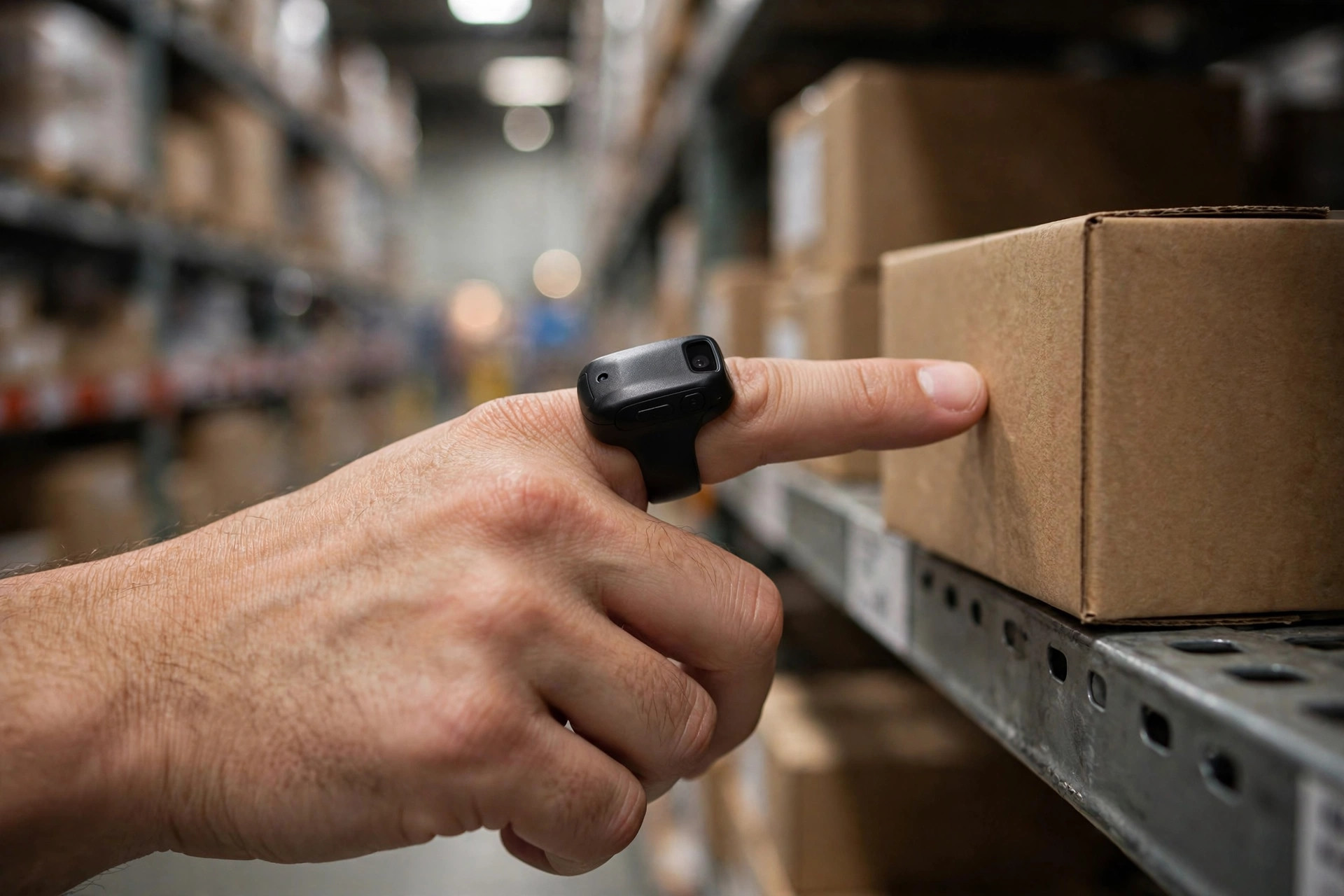
A handheld scanner's scan cycle is: reach for the gun → lift and scan → re-holster (or belt it) → work with both hands. A ring scanner lives on your finger: raise the hand → scan → keep working. Two motions — the grab and the stow — disappear entirely.
In May 2023, a 3PL in Dongguan running cross-border small-parcel fulfillment ran a head-to-head: same picker, same aisle, same 200 orders. Handheld averaged about 7 seconds per scan including the grab-and-stow; the ring scanner about 4. That delta is pure motion, not hardware.
Do not treat that number as a standard. How much of your pick cycle is scanning depends on your pick mode:
- Discrete order picking (one order at a time, constant scanning): scanning dominates the cycle, savings are maximal
- Full-pallet or full-case outbound: few scans per unit of work, savings are rounding error
- Heavy or bulky items: the ring scanner's "free hands" is a safety and ergonomics play, not just a seconds play
Step one, always: take a stopwatch to your own floor, time 100 scans, take the median. Use your number, nobody else's.
The Five-Line TCO: Ring Scanner vs Handheld Scanner
Pricing the hardware and stopping there is how finance teams die. The three-year TCO needs five lines:
| Cost line | Handheld scanner | Ring scanner | Notes |
|---|---|---|---|
| Unit purchase | $200–$800 | $250–$500 | Open-market bands; confirm with your distributor |
| Annual loss / replacement rate | ~8–12% | ~10–15% | Ring units are small, easy to lose and drop; handhelds break more but get lost less |
| Batteries & charging | Shared cradles, cheap | Wrist straps / charge bases, 1 spare battery per user | Small batteries, short runtime — spares are mandatory |
| Training | ~half a day to productive | ~a full day to productive | "Raise hand to scan" muscle memory takes longer; veteran pickers resist it |
| Efficiency gain (as labor) | Baseline | 2–4 seconds saved per scan (measured) | Convert measured seconds × hourly cost × annual scans |
In September 2024, an apparel e-commerce warehouse in California (6,000 orders/day) shared its internal math with me: 45 pickers moved to ring scanners at a $42,000 hardware premium — then lost 11 units in year one, triple the loss rate of the handheld era. Replacement cost: $18,000. That single line ate nearly half the projected gain.
The lesson: the ring scanner's TCO is dominated by loss and replacement, not purchase price. Budget without a 15% replacement reserve and the model falls apart.
There is one more hidden cost teams consistently miss: charging logistics. Ring scanner batteries are small — most need a mid-shift swap across an 8-hour shift. That means two batteries per picker plus gang-charging cradles for the team. The Dongguan 3PL forgot this line item in its first purchase order; by week two the afternoon shift was collectively dead-battery, and an emergency order of 60 spare batteries and 4 cradles cost an unbudgeted $1,700. Money you don't put in the spreadsheet gets spent on the floor anyway.
The Break-Even Point: How Many Scans Justify the Switch
The formula is simple. Filling in your own variables is the hard part:
Annual net benefit = (seconds saved ÷ 3600) × picker hourly cost × annual scans − annual incremental cost
"Annual incremental cost" is the ring scanner's annualized three-year TCO minus the handheld's annualized three-year TCO (including replacements, batteries, training).
A worked example — sample parameters, substitute your own:
- 3 seconds saved per scan, picker cost $3.50/hour
- 800 scans/person/day, 30 pickers, 300 days/year
- Annual labor saved = 3/3600 × 3.50 × 800 × 30 × 300 ≈ $21,000
- Annual incremental cost (with replacements) ≈ $5,500
- Annual net benefit ≈ $15,500 → payback in roughly 4–5 months
Run it backward for the break-even: with $5,500 in annual incremental cost, 3 seconds saved, and $3.50/hour, you need about 19 million scans a year — roughly 2,100 scans per picker per day for a 30-person team. Sounds high, but peak-season e-commerce pickers routinely clear 2,000+ scans a day.
Bottom line first: warehouses averaging under 500 scans per picker per day will likely lose money on ring scanners. The saved seconds can't cover the premium. Don't buy the "free your hands" story without the math.
Three Warehouse Profiles That Should Not Switch to Ring Scanners
Beyond the spreadsheet, three profiles should stay put:
- Low scan frequency. Full-pallet receiving, cross-dock, fewer than 100 scans a day. The ring scanner's entire advantage is built on high-frequency scanning. No frequency, no return.
- Brutal turnover. The ring scanner costs an extra half-day of training per head. If people quit in two months, that training never amortizes. Fix retention first, upgrade hardware later.
- Already running voice picking. Voice is itself a hands-free solution — adding a ring scanner on top is double investment. Pick one, not both.
The counterintuitive verdict: most warehouses that lose money on ring scanners don't lose it because the device is bad. They lose it because their scan volume can't support the TCO. Every vendor ROI case study comes from a 10,000-orders-a-day monster. If you're under 2,000 a day, stopwatch first, purchase order later.
The Calculable Conclusion
Switching to ring scanners needs no meeting. It needs three steps:
- Measure: 100 timed scans, median, get your own "seconds saved"
- Account: fill in the five TCO lines with your purchase price, loss rate, and labor cost
- Plug into the formula: net benefit > 0 → switch; < 0 → don't; ≈ 0 → wait for the next price drop
One sentence to take away: scan frequency is the only independent variable. Over 1,500 scans per picker per day — switch without hesitation. 500–1,500 — run the math first. Under 500 — that money is wasted.
By Lao Zhou, Logistics Cost Analyst