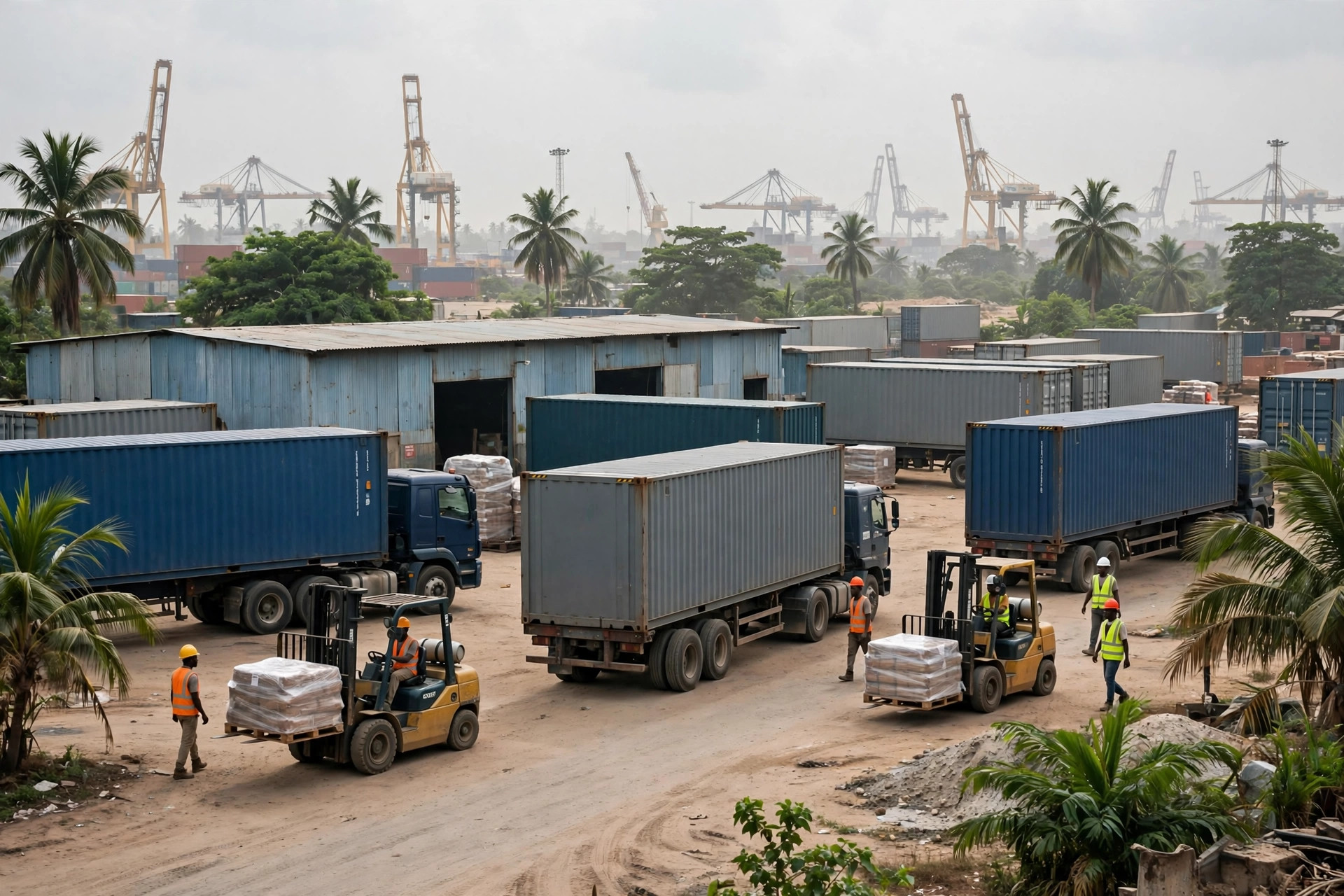
Setting up a warehouse in the Lisbon area is rarely a question of finding the cheapest available building, and it is better understood as a judgement about position within a network formed by the port, the airport and the highway corridors that run north and east, which is why the lisbon warehouse market logistics picture only makes sense once three prior questions are answered: where the goods come from, where they have to go, and how fast replenishment really needs to happen. Public industry reports and information published by port and airport authorities describe a fairly clear division of labour here, with sea freight entering through the port area, time-sensitive goods clustering near the airport and the northern highway corridor, and national distribution stock settling at inland nodes, and this pattern emerged from years of interaction between freight flows, labour supply and land availability, so understanding it matters more than comparing two rental quotations in isolation.
The Lisbon Warehouse Market: How Port, Airport and Highway Divide the Work
A warehouse near the port derives its most direct value from removing one transfer, since a container discharged at the quay can be stripped, sorted and forwarded without an additional trunk leg when the destination is the Lisbon metropolitan area or when customs and inspection steps must be completed nearby, although land around the port is comparatively constrained, dock capacity and yard depth are not equally suited to every product type, and peak-hour congestion on port roads can quietly consume part of the time saving the location was supposed to deliver. The airport area works on a different logic, serving goods for which time matters more than storage cost, including samples, spare parts, high-value small items and e-commerce orders requiring rapid handling, although volumes there swing more sharply between seasons, which shows up directly in staffing plans and space utilisation. Nodes along the northern and eastern highway corridors deserve closer attention from smaller operators, because although they sit at a distance from both port and airport, they lie on main routes toward central and northern Portugal and into the Iberian interior, making them suitable for regional distribution and safety stock, and allowing wider hinterland coverage from one location rather than holding all inventory in a higher-cost core area.
One case I have followed involved a modest distributor serving southern Europe, which had originally placed its regional stock near Madrid, where the market was larger and suppliers concentrated, and which later routed part of its volume through Lisbon because the port is a natural gateway into the south-west of the peninsula, so goods arriving there and moving north or east could reach customers by a more direct path. Its first mistake in Lisbon was instructive: it rented the closest available warehouse to the port, found dock capacity insufficient, and during peak weeks trucks waited longer than the trunk leg it had saved, so replenishment broke down and complaints rose. After revising its structure, it kept only a small stripping and transfer point near the port and moved bulk stock to a highway-corridor distribution warehouse, and although this two-stage structure looked like an extra step on paper, waiting time fell and inventory visibility improved, suggesting that choosing a location is seldom a one-off decision but a process of correcting the division of functions between nodes as operations reveal their constraints.
A second case came from a company handling light assembly and returns processing, whose volumes were modest but whose range was broad, and for which returns speed mattered more than storage unit cost, so it chose a mid-sized building near the airport rather than the port area or a large outlying warehouse, reasoning that time from receipt to restocking was its decisive metric rather than floor-space utilisation. Labour near the airport proved more flexible for temporary shifts, visits to inspect goods were easier, and the arrangement, which would look expensive on a rent comparison, made complete sense within the company's own business logic, and that gap between rent comparison and business logic is where small operators most often go wrong, because they compare buildings before comparing what each building is actually asked to do.
The Lisbon Warehouse Market Framework: Three Location Choices
Taken together, those experiences point toward a practical decision framework, which is not a price list but a way of asking, before negotiation begins, what category of goods the warehouse will serve. Port nodes suit import stripping, transfer and freight connecting with port procedures, with fewer transfers as the advantage and dock capacity, height and peak congestion to verify. Airport nodes suit time-sensitive, volatile volumes, with fast response as the advantage and headroom in space and staffing as the cost. Inland nodes suit national coverage, safety stock and steady replenishment, with wider coverage as the advantage and a longer leg for urgent replenishment as the cost. An illustrative calculation clarifies the structure, without pretending to be a quotation: holding everything in the core area saves trunk mileage but pays in occupancy and waiting time, whereas splitting stock between a port transfer point and an inland warehouse adds one internal transfer and gains a steadier outbound rhythm with lower peak pressure, and the example numbers show structure only, not any actual warehouse's charges, since current rents, labour terms and fees should be checked against the latest official sources and confirmed by site visits and quotations.
| Location | Best suited to | Main advantage | Cost to verify first |
|---|---|---|---|
| Near the port | Import stripping, transfer, sea-freight connection | One fewer transfer, smoother procedure link | Dock doors, height, peak congestion |
| Near the airport | Samples, spares, high-value small items, returns | Fast response, flexible labour and access | Volume swings, headroom in space and staffing |
| Inland distribution node | National coverage, safety stock, steady replenishment | Wide hinterland, stable outbound rhythm | Longer leg for urgent replenishment |
A Counter-intuitive Judgement: Closer to the Hub Is Not Always Better
Many operators setting up in Lisbon instinctively assume that the closer a warehouse sits to the port or airport, the better it must be, and that instinct holds when volumes are large and frequencies dense enough to absorb hub fixed costs, but for small and mid-sized operators the relationship often reverses, because hub building constraints, queuing time and competition for labour gradually erode the positional advantage, while a slightly more distant warehouse with smooth dock operations, uncongested access and stable staffing can deliver more reliable performance. A related trade-off deserves equal attention, since a lower-rent outlying warehouse can prove expensive in total cost when replenishment is frequent and orders fragmented, because repeated short transfers and overtime labour slowly consume the rent saving, so the real calculation is never unit price alone but unit price, frequency, waiting time and delivery reliability together, and it is here that the lisbon warehouse market logistics decision becomes genuinely interesting for smaller firms, whose disadvantage is lacking volume to spread hub fixed costs, while their advantage is flexibility, since a transfer point plus a distribution warehouse can simulate, at smaller scale, what a large operator achieves with one large building.
Looking ahead, change in this market is unlikely to come from any single project alone, and more plausibly from several forces acting together, including redistribution of freight flows within the Iberian Peninsula, continued demand from e-commerce and returns processing for smaller, faster-turning space, and constraints on land and labour shaping what kind of warehouse the core area can offer, and those forces together make one large warehouse solving every problem progressively harder to sustain, while a transfer point, a distribution warehouse and flexible labour become progressively more common. For a small or mid-sized operator considering Lisbon, the question worth spending time on may therefore not be whether Lisbon is worth entering at all, but how its goods should be divided in function between port, airport and inland nodes, and whether, after that division, replenishment rhythm, returns routes and peak-season flexibility still hold together, and that question has no standard answer, since the answer sits inside each operator's order pattern, and inside details visible only after walking a warehouse floor and following a delivery route in person, which is why the lisbon warehouse market logistics story, read as a structural trend rather than a list of addresses, remains an open one to watch.
By Dr. Chen, Supply Chain Researcher